

What ni tsurete and ni shitagatte mean
Ni tsurete comes from tsureru, to take someone along. The image is one change taking another change along with it. Ni shitagatte comes from shitagau, to follow or obey: the second change follows the first.
In their shared meaning, both describe proportional change. The first half names a change that progresses (time passing, prices rising, a child growing up) and the second half names a change that happens alongside it. Hi ga tatsu ni tsurete, kizu ga naotte kita, as the days passed, the wound healed.
The key condition is that both halves are gradual. Words like naru, become, fueru, increase, heru, decrease, and verb te-form plus kuru or iku, which show change over time, are extremely common in these sentences.
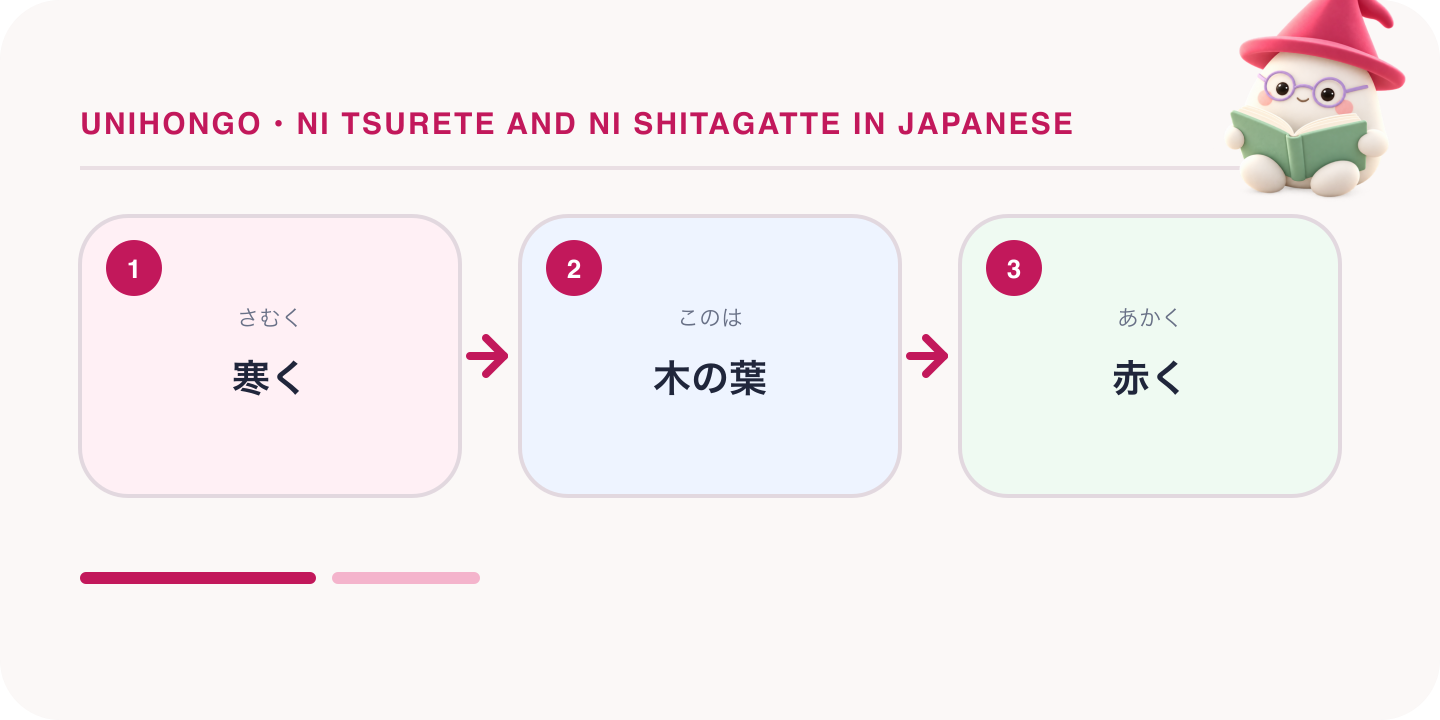
| Japanese | Romaji | Meaning |
|---|---|---|
| 寒くなるにつれて、木の葉が赤くなってきた。 | Samuku naru ni tsurete, ki no ha ga akaku natte kita. | As it got colder, the leaves turned red. |
| 年を取るにつれて、記憶力が落ちてくる。 | Toshi o toru ni tsurete, kioku-ryoku ga ochite kuru. | As you get older, your memory gets worse. |
| 日が経つにつれて、傷が治ってきた。 | Hi ga tatsu ni tsurete, kizu ga naotte kita. | As the days went by, the wound healed. |
| 山を登るにしたがって、気温が下がっていく。 | Yama o noboru ni shitagatte, kion ga sagatte iku. | As you climb the mountain, the temperature drops. |
| 人口が増えるにしたがって、住宅が不足してきた。 | Jinkō ga fueru ni shitagatte, jūtaku ga fusoku shite kita. | As the population grew, housing became scarce. |
How to form them
Both patterns follow a verb in the dictionary form or a noun that itself expresses change, such as seichō, growth, jidai no henka, the changes of the times, or kōreika, the ageing of the population. They do not follow ordinary nouns or adjectives directly; turn an adjective into a change first with naru.
The written form ni tsure is common in formal texts, and ni shitagai appears in the same way. Both can also modify a noun with no, although this is less common.
| Form | Pattern | Example | Meaning |
|---|---|---|---|
| Verb | Dictionary form + につれて | 慣れるにつれて | As I get used to it |
| Change noun | Noun + につれて | 時代の変化につれて | As the times change |
| Adjective | Adjective + なる + につれて | 暗くなるにつれて | As it gets darker |
| Verb | Dictionary form + にしたがって | 高くなるにしたがって | As it gets higher |
| Written | につれ / にしたがい | 経済の発展につれ | As the economy developed |
| Formal | に従いまして | ご案内に従いまして | Following the guidance (announcements) |
The extra meaning of ni shitagatte: in accordance with
Ni shitagatte has a second, very common meaning that ni tsurete does not share: following, in accordance with, as instructed by. Here it follows a noun for a rule, a sign, an instruction or a person's guidance. Kakariin no shiji ni shitagatte kudasai, please follow the staff's instructions, is a standard line in announcements.
In this meaning the second half can be a request or an action by the speaker, because it is not about proportional change at all. You will see it constantly on signs, in manuals and in station and hotel announcements.
| Japanese | Romaji | Meaning |
|---|---|---|
| 係員の指示に従ってください。 | Kakariin no shiji ni shitagatte kudasai. | Please follow the staff's instructions. |
| 矢印に従って進んでください。 | Yajirushi ni shitagatte susunde kudasai. | Please go in the direction of the arrows. |
| 医者のアドバイスに従って、お酒をやめた。 | Isha no adobaisu ni shitagatte, osake o yameta. | I stopped drinking on my doctor's advice. |
| 規則に従って処理します。 | Kisoku ni shitagatte shori shimasu. | We will handle it in accordance with the rules. |
| 説明書に従って組み立てました。 | Setsumeisho ni shitagatte kumitatemashita. | I assembled it following the instructions. |
Ni tsurete cannot replace ni shitagatte in these sentences. Shiji ni tsurete sounds as if the instructions were changing and the action changed along with them.
Ni tsurete vs ni shitagatte for change
For proportional change the two are close enough that textbooks often teach them together. The differences are small but real. Ni tsurete is the more conversational choice, and it suggests that the second change comes along naturally, almost as a side effect. Ni shitagatte is a little stiffer and slightly more logical in tone, as if the second change follows as a consequence.
Ni shitagatte is also a bit more comfortable with a first half that is a deliberate progression, such as moving further along a route or a process: saki e susumu ni shitagatte, michi ga semaku naru, the further you go, the narrower the road becomes. Ni tsurete works here too, but many speakers prefer ni shitagatte in this kind of description.
| Japanese | Romaji | Meaning |
|---|---|---|
| 日本語が上手になるにつれて、友達が増えた。 | Nihongo ga jōzu ni naru ni tsurete, tomodachi ga fueta. | As my Japanese improved, I made more friends. |
| 先へ進むにしたがって、道が狭くなる。 | Saki e susumu ni shitagatte, michi ga semaku naru. | The further you go, the narrower the road gets. |
| 子供が成長するにつれて、生活が変わった。 | Kodomo ga seichō suru ni tsurete, seikatsu ga kawatta. | As the children grew up, our life changed. |
| 技術の進歩にしたがって、仕事の仕方も変わってきた。 | Gijutsu no shinpo ni shitagatte, shigoto no shikata mo kawatte kita. | As technology advanced, the way we work changed too. |
Ni tsurete vs to tomo ni
To tomo ni means together with, and in the context of change it works like ni tsurete: kōreika to tomo ni, iryōhi ga fuete iru, medical costs are rising along with the ageing of society. It is more formal and common in news, reports and speeches.
To tomo ni has other meanings that ni tsurete lacks. After a noun for a person it means together with them: kazoku to tomo ni sugosu, spend time with family. After a verb or event it can mean at the same time as a single event: yoake to tomo ni shuppatsu shita, we set off at dawn. Ni tsurete never describes a single simultaneous moment.
| Japanese | Romaji | Meaning |
|---|---|---|
| 高齢化とともに、医療費が増えている。 | Kōreika to tomo ni, iryōhi ga fuete iru. | Medical costs are rising with the ageing of society. |
| 夜明けとともに出発した。 | Yoake to tomo ni shuppatsu shita. | We set off at dawn. |
| 家族とともに新年を迎えた。 | Kazoku to tomo ni shinnen o mukaeta. | I welcomed the new year with my family. |
| Pattern | Gradual change | Single moment | With a person | Register |
|---|---|---|---|---|
| につれて | Yes | No | No | Neutral, conversational |
| にしたがって | Yes | No | No (but: follow someone) | Neutral to formal |
| とともに | Yes | Yes | Yes | Formal, written |
| ば…ほど | Yes, stresses degree | No | No | Neutral |
Ni tsurete vs ba hodo
Ba hodo means the more... the more. You repeat the verb or adjective: the conditional form, then the dictionary form with hodo. Yomeba yomu hodo omoshiroku naru, the more you read it, the more interesting it gets. For i-adjectives use the ba form (takakereba takai hodo), and for na-adjectives use nara... na hodo.
Ba hodo stresses the degree: the extent of one thing directly matches the extent of the other. It is also used for general truths and advice, where ni tsurete sounds odd because nothing is actually changing over time. Renshū sureba suru hodo jōzu ni naru, the more you practise, the better you get, is a general statement; renshū suru ni tsurete jōzu ni natta describes what happened as you practised.
| Japanese | Romaji | Meaning |
|---|---|---|
| 読めば読むほど面白くなる。 | Yomeba yomu hodo omoshiroku naru. | The more you read it, the more interesting it gets. |
| 練習すればするほど上手になる。 | Renshū sureba suru hodo jōzu ni naru. | The more you practise, the better you get. |
| 練習するにつれて、上手になった。 | Renshū suru ni tsurete, jōzu ni natta. | As I practised, I got better. |
| 駅に近ければ近いほど家賃が高い。 | Eki ni chikakereba chikai hodo yachin ga takai. | The closer to the station, the higher the rent. |
| 静かなら静かなほどいい。 | Shizuka nara shizuka na hodo ii. | The quieter, the better. |
Common mistakes
- Putting a one-off event in the second half: haru ni naru ni tsurete, hanami ni itta is wrong, because going to a flower-viewing is a single action. Say haru ni natta node, hanami ni itta.
- Putting the speaker's will or a request in the second half of ni tsurete: nihongo ga jōzu ni naru ni tsurete, nihon ni sumitai is unnatural. Use a sentence about change instead, such as sumitai kimochi ga tsuyoku natte kita.
- Attaching it directly to an ordinary noun or adjective: samui ni tsurete is wrong; say samuku naru ni tsurete.
- Using ni tsurete for in accordance with: rūru ni tsurete is wrong; say rūru ni shitagatte.
- Using past tense before ni tsurete: the verb before the pattern stays in the dictionary form even when the whole sentence is in the past.
Where you will meet these patterns
Ni tsurete is everywhere in conversation about seasons, ageing, learning and life changes. Ni shitagatte in its change meaning is common in explanations and reports, and in its following meaning on signs, instructions and public announcements. To tomo ni fills news articles and formal speeches. Ba hodo appears in advice, proverbs and adverts.
In JLPT questions, the classic trap is a second clause that is a single event or a request. If the answer choices include ni tsurete and ni shitagatte, check the meaning of the whole sentence: proportional change allows both, but in accordance with allows only ni shitagatte.
| Japanese | Romaji | Meaning |
|---|---|---|
| 締め切りが近づくにつれて、忙しくなってきた。 | Shimekiri ga chikazuku ni tsurete, isogashiku natte kita. | As the deadline got closer, I got busier. |
| 発車時刻が近づくにつれて、ホームが混んできた。 | Hassha jikoku ga chikazuku ni tsurete, hōmu ga konde kita. | As departure time approached, the platform got crowded. |
| お手元の案内に従って、お進みください。 | Otemoto no annai ni shitagatte, osusumi kudasai. | Please proceed according to the guide in your hands. |