
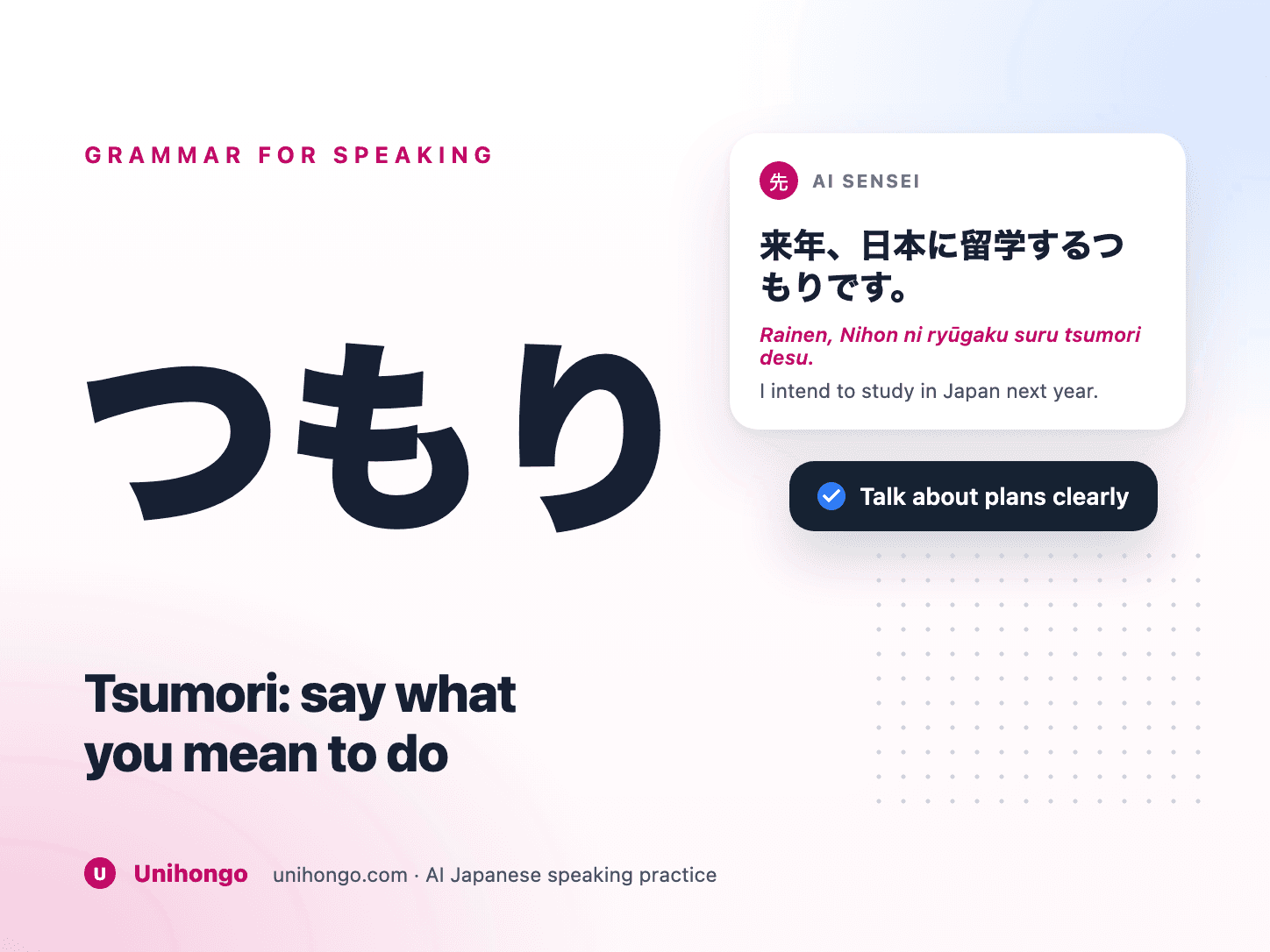
What tsumori means
Tsumori, written つもり and usually in kana, is a noun meaning intention or expectation. Like other nouns, it can be modified by a verb in front of it, so iku tsumori is literally the intention to go. Adding desu turns it into a sentence: iku tsumori desu, I intend to go.
The nuance is that the decision is already made in your head. That makes tsumori sound more committed than simply saying ikimasu and more personal than talking about a schedule. It is ideal for goals, resolutions and plans you want to sound serious about.
Because it is about your inner intention, tsumori is mainly used for yourself. For other people, you usually report their intention with tsumori rashii or tsumori mitai, or ask them directly in casual speech.
| Japanese | Romaji | Meaning |
|---|---|---|
| 来年、日本に留学するつもりです。 | Rainen, Nihon ni ryūgaku suru tsumori desu. | I intend to study in Japan next year. |
| 今日は早く寝るつもり。 | Kyō wa hayaku neru tsumori. | I'm planning to go to bed early today. (casual) |
| 週末は家でゆっくりするつもりです。 | Shūmatsu wa ie de yukkuri suru tsumori desu. | I'm going to take it easy at home this weekend. |
| 彼は会社を辞めるつもりらしい。 | Kare wa kaisha o yameru tsumori rashii. | Apparently he's planning to quit his job. |
Forming tsumori sentences
Tsumori follows the plain dictionary form for positive intentions and the nai form for negative ones. For the past, change desu to deshita, which gives you I had intended to, often implying the plan did not happen.
There are two negatives, and they mean different things. Ikanai tsumori desu, I intend not to go, is the everyday way to state a negative plan. Iku tsumori wa arimasen, I have no intention of going, is much stronger and often sounds like a firm refusal.
| Pattern | Example | Meaning | Tone |
|---|---|---|---|
| Dictionary form + つもりです | 行くつもりです | I intend to go | Firm personal plan |
| Nai form + つもりです | 行かないつもりです | I intend not to go | Neutral negative plan |
| Dictionary form + つもりはありません | 行くつもりはありません | I have no intention of going | Strong, can sound defiant |
| Dictionary form + つもりでした | 行くつもりでした | I had meant to go | Plan that fell through |
| Past form + つもりです | 行ったつもりです | I believe I went / as if I went | Belief or pretence |
| Casual: つもり / つもりだ | 行くつもり | I'm planning to go | Friends and family |
Tsumori ja nakatta: I didn't mean to
When something you did had an effect you did not intend, tsumori ja nakatta explains that it was not your intention. It is common in apologies, particularly after a comment that came across badly.
On its own, it can sound like an excuse, so pair it with an apology. Sumimasen, sonna tsumori ja nakatta n desu, sorry, I didn't mean it that way, combines both and adds the explanatory n desu.
| Japanese | Romaji | Meaning |
|---|---|---|
| そんなつもりじゃなかったんです。 | Sonna tsumori ja nakatta n desu. | I didn't mean it like that. |
| 怒らせるつもりはなかったんだ。ごめん。 | Okoraseru tsumori wa nakatta n da. Gomen. | I didn't mean to make you angry. Sorry. |
| 傷つけるつもりじゃなかった。 | Kizutsukeru tsumori ja nakatta. | I didn't mean to hurt you. |
| こんなに遅くなるつもりじゃなかったんですが。 | Konna ni osoku naru tsumori ja nakatta n desu ga. | I didn't intend to be this late... |
| 冗談のつもりだったんです。 | Jōdan no tsumori datta n desu. | I meant it as a joke. |
The last example shows that tsumori can also follow a noun with no: jōdan no tsumori, meant as a joke, or shinsetsu no tsumori, meant as a kindness.
Ta tsumori: I thought I had
When tsumori follows the past tense, the meaning changes from intention to belief. Kagi o kaketa tsumori datta, I thought I had locked the door, describes a gap between what you believed and what actually happened. This is extremely common for everyday slips.
The same pattern describes acting as if something were true. Ryokō shita tsumori de chokin suru means saving money as if you had gone on the trip, and wakai tsumori means thinking of yourself as young.
Adjectives and nouns work too: genki na tsumori, thinking you are fine, or senmonka no tsumori, acting like an expert, which is often slightly critical.
| Japanese | Romaji | Meaning |
|---|---|---|
| 鍵をかけたつもりだったんですが。 | Kagi o kaketa tsumori datta n desu ga. | I thought I had locked it... |
| メールを送ったつもりでした。 | Mēru o okutta tsumori deshita. | I was sure I had sent the email. |
| ちゃんと説明したつもりなんですけど。 | Chanto setsumei shita tsumori na n desu kedo. | I thought I had explained it properly. |
| 旅行に行ったつもりで貯金する。 | Ryokō ni itta tsumori de chokin suru. | I'll save the money as if I'd gone on the trip. |
| 自分ではまだ若いつもりです。 | Jibun de wa mada wakai tsumori desu. | In my own mind I'm still young. |
Tsumori vs ~ou to omou vs yotei
Japanese has several ways to talk about future plans, and choosing the right one changes how committed you sound. For the wider picture of talking about the future, it helps to think of these three as a scale from soft idea to fixed arrangement.
~ou to omou, formed with the volitional, means I'm thinking of doing. In the te iru form, ~ou to omotte imasu, it describes an idea you have been considering for a while. It is soft and modest, and it is often the most natural choice in polite conversation about your own plans.
Tsumori is firmer: the decision is made. Yotei is a schedule, something arranged or fixed, often involving other people, dates or bookings. It can also describe official plans that have nothing to do with personal intention, such as a train's scheduled arrival.
| Form | Example | Feels like | Best for |
|---|---|---|---|
| ~ou to omotte imasu | 転職しようと思っています | I'm thinking of changing jobs | Ideas still forming, modest tone |
| ~tsumori desu | 転職するつもりです | I intend to change jobs | Decided personal plans |
| ~yotei desu | 来月転職する予定です | I'm scheduled to change jobs next month | Arranged, fixed plans |
| Plain masu form | 来月転職します | I'm changing jobs next month | Simple statement of fact |
Yotei also works for things outside your control: densha wa jūji ni tsuku yotei desu, the train is due to arrive at ten. Tsumori could never be used there, because a train has no intentions.
Asking about someone's intentions
Asking a friend what they plan to do with tsumori is fine in casual speech: dō suru tsumori? what are you going to do? But with the wrong tone, the same question can sound confrontational, like what exactly do you think you are doing?
In polite speech, especially to someone senior, avoid tsumori desu ka. Ask about yotei instead, with the honorific go- prefix, or use a neutral question. This protects the other person from feeling that you are questioning their judgement.
| Japanese | Romaji | Meaning |
|---|---|---|
| 夏休みはどうするつもり? | Natsuyasumi wa dō suru tsumori? | What are you planning to do over summer break? (casual) |
| 週末のご予定は? | Shūmatsu no go-yotei wa? | Do you have any plans for the weekend? (polite) |
| 部長は明日いらっしゃいますか。 | Buchō wa ashita irasshaimasu ka. | Will the department manager be in tomorrow? (polite) |
| 一体どういうつもりですか。 | Ittai dō iu tsumori desu ka. | What on earth do you mean by this? (angry) |
Common learner mistakes
- Using the masu form before tsumori: ikimasu tsumori is wrong; use iku tsumori desu.
- Using tsumori for events you don't control, such as weather or trains. Use yotei or deshō instead.
- Saying tsumori wa arimasen when you mean a neutral negative plan; ikanai tsumori desu is usually softer.
- Using tsumori for every plan in a job interview, which can sound rigid. Mix in ~ou to omotte imasu and kangaete imasu.
- Confusing ta tsumori with a past intention: itta tsumori means I thought I went, while iku tsumori deshita means I had meant to go.