

What to shite means
To shite comes from the particle to and shite, the te form of suru, and literally means taking it to be. After a noun, it presents that noun as the role, capacity, status or category in which something happens. Tsūyaku to shite sanka shimashita means I took part as an interpreter: the role I had when I took part.
The noun can be a job, a position, a qualification or a purpose. It can also be a category for a thing: omiyage to shite, as a souvenir; shumi to shite, as a hobby; rei to shite, as an example. In each case, to shite answers the question in what capacity or as what?
To shite is neutral in register. You will hear it in conversation, read it in the news and write it in reports, which makes it one of the most versatile N3 patterns.
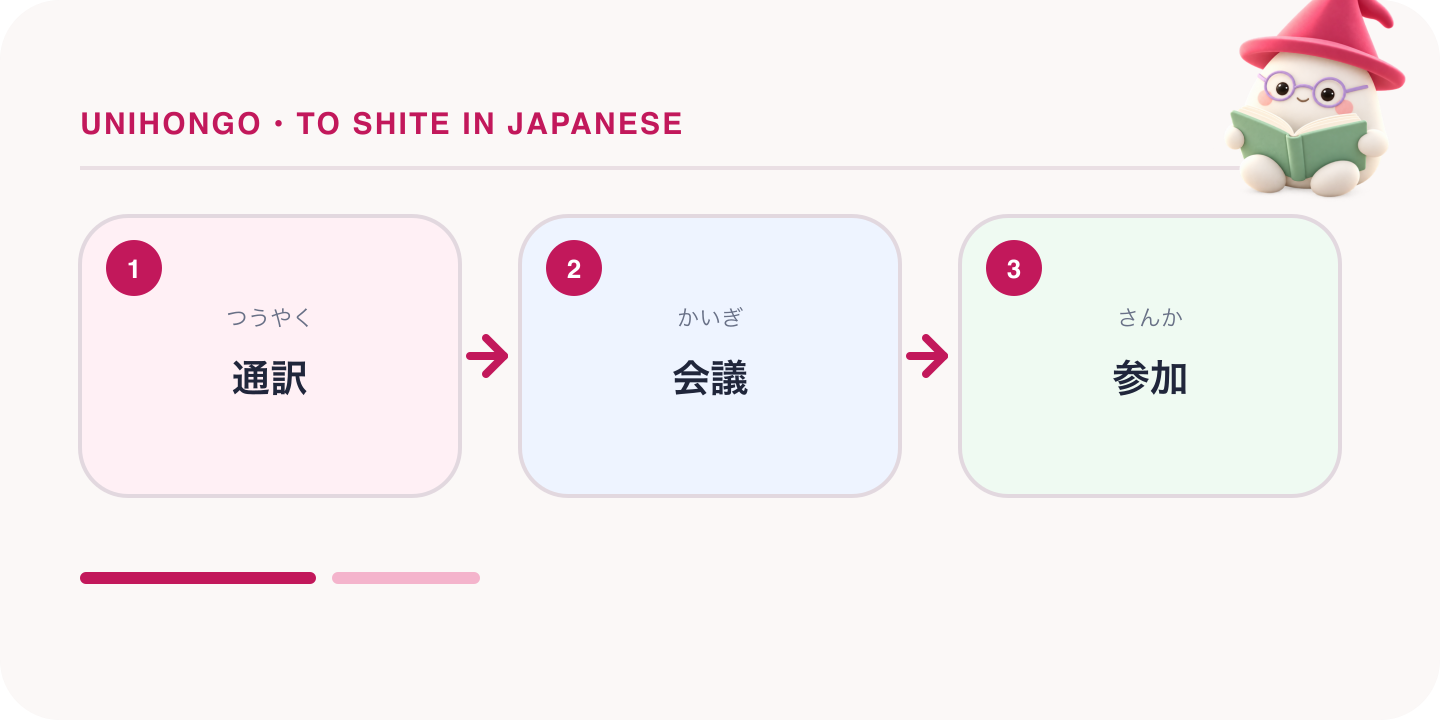
| Japanese | Romaji | Meaning |
|---|---|---|
| 通訳として会議に参加しました。 | Tsūyaku to shite kaigi ni sanka shimashita. | I attended the meeting as an interpreter. |
| 彼は医者として病院で働いています。 | Kare wa isha to shite byōin de hataraite imasu. | He works at a hospital as a doctor. |
| お土産としてお菓子を買いました。 | Omiyage to shite okashi o kaimashita. | I bought sweets as a souvenir. |
| 趣味として写真を撮っています。 | Shumi to shite shashin o totte imasu. | I take photographs as a hobby. |
| 例として、一つ紹介します。 | Rei to shite, hitotsu shōkai shimasu. | Let me give one as an example. |
Forms of to shite at a glance
Like ni totte, to shite attaches directly to a noun and then takes particles to change its role in the sentence. The polite written form to shimashite appears in formal speeches, and the adverbial to shite mo and topic to shite wa are the two you will meet most after the basic form.
| Form | Pattern | Example | Meaning |
|---|---|---|---|
| Basic | Noun + として | 教師として働く | Work as a teacher |
| Stance or standard | Noun + としては | 私としては賛成だ | Speaking for myself, I agree |
| Also or even | Noun + としても | 親としても心配だ | As a parent, too, I'm worried |
| Before a noun | Noun + としての + noun | 教師としての責任 | My responsibility as a teacher |
| Not even one | 一 + counter + として + negative | 一人として来なかった | Not a single person came |
| Taking X as Y | X を Y として | 田中さんをリーダーとして | With Tanaka as leader |
To shite wa: stance and standards
To shite wa has two related jobs. The first is stating a position: watashi to shite wa means speaking for myself or from where I stand, and kaisha to shite wa means as a company or officially. It is a polite way to give an opinion while showing it belongs to a particular role.
The second job is setting a standard for comparison, close to ni shite wa: kono heya wa hoteru to shite wa semai, this room is small for a hotel. Here to shite wa means judged as a member of that category, and what follows is often a surprise relative to that category.
| Japanese | Romaji | Meaning |
|---|---|---|
| 私としては、来週のほうがいいと思います。 | Watashi to shite wa, raishū no hō ga ii to omoimasu. | Speaking for myself, I think next week would be better. |
| 会社としては、何もコメントできません。 | Kaisha to shite wa, nani mo komento dekimasen. | As a company, we can't make any comment. |
| この部屋はホテルとしては狭いです。 | Kono heya wa hoteru to shite wa semai desu. | This room is small for a hotel. |
| 初めての作品としては、よくできています。 | Hajimete no sakuhin to shite wa, yoku dekite imasu. | For a first piece of work, it is very well done. |
| 親としては、やはり心配です。 | Oya to shite wa, yahari shinpai desu. | As a parent, I can't help worrying. |
Watashi to shite wa is also a gentle way to disagree at work. It frames your view as personal rather than as a correction of the other person.
To shite mo and to shite no
After a noun, to shite mo means also as or even as. Kyōshi to shite mo, oya to shite mo means both as a teacher and as a parent, and it lets you say that a judgement holds from more than one role.
To shite no joins the role to a following noun. Kyōshi to shite no sekinin is my responsibility as a teacher, and hito to shite no yasashisa is kindness as a human being. It is especially common with words such as sekinin, responsibility, jishin, confidence, and puraido, pride.
Do not confuse noun plus to shite mo with the clause pattern verb plus to shite mo, which means even supposing. Ashita iku to shite mo, osoku naru means even if I do go tomorrow, I will be late. That to shite mo comes from to suru, to assume, and belongs with to shitara and to sureba.
| Japanese | Romaji | Meaning |
|---|---|---|
| 教師としても、親としても、この問題は重要です。 | Kyōshi to shite mo, oya to shite mo, kono mondai wa jūyō desu. | Both as a teacher and as a parent, this issue matters to me. |
| この店はカフェとしても使えます。 | Kono mise wa kafe to shite mo tsukaemasu. | This shop can also be used as a café. |
| リーダーとしての責任を感じています。 | Rīdā to shite no sekinin o kanjite imasu. | I feel my responsibility as a leader. |
| プロとしてのプライドがあります。 | Puro to shite no puraido ga arimasu. | I have my pride as a professional. |
| 明日行くとしても、遅くなります。 | Ashita iku to shite mo, osoku narimasu. | Even if I do go tomorrow, I'll be late. |
Not even one: hitori to shite... nai
When to shite follows the number one plus a counter and the sentence ends in a negative, it means not a single one. Hitori to shite means not one person, hitotsu to shite not one thing, and ichinichi to shite not a single day. It is emphatic and slightly literary, common in writing, speeches and news.
It often combines with question words: dare hitori to shite, not a single person, and nani hitotsu to shite, not a single thing. The negative at the end is essential; without it the sentence does not make sense.
In casual speech, people are more likely to say hitori mo konakatta or daremo konakatta. The to shite version adds weight and a sense of completeness, so save it for moments where you want emphasis.
| Japanese | Romaji | Meaning |
|---|---|---|
| 誰一人として反対しなかった。 | Dare hitori to shite hantai shinakatta. | Not a single person objected. |
| 一日として休んだことがない。 | Ichinichi to shite yasunda koto ga nai. | I have never taken a single day off. |
| 同じ日は一日としてない。 | Onaji hi wa ichinichi to shite nai. | No two days are the same. |
| 何一つとして問題はありません。 | Nani hitotsu to shite mondai wa arimasen. | There is not a single problem. |
| 一度として約束を破ったことはない。 | Ichido to shite yakusoku o yabutta koto wa nai. | I have never once broken a promise. |
To shite vs ni totte and de
To shite and ni totte are easily confused because both can appear before an opinion. To shite gives a role: kyōshi to shite, in my capacity as a teacher. Ni totte gives a viewpoint for an evaluation: kyōshi ni totte, for teachers, from their standpoint. Kyōshi to shite kono shigoto o eranda means I chose this job as a teacher, while kono shigoto wa kyōshi ni totte taihen da means this job is hard for teachers.
The particle de can also mean as or in the capacity of in some set expressions, such as boranthia de sanka suru, take part as a volunteer. De is shorter and more casual; to shite makes the role explicit and is safer in formal writing.
| Pattern | Core idea | Example |
|---|---|---|
| として | Role or capacity | 教師としてできることをする |
| としては | Stance or category standard | 私としては反対です |
| にとって | Viewpoint for an evaluation | 教師にとって大切な仕事 |
| で | Casual capacity, in set phrases | ボランティアで参加する |
| にしては | Surprise against an expectation | 初心者にしては上手だ |
Common mistakes with to shite
- Using ni totte to state a position: watashi ni totte sansei desu is unnatural; say watashi to shite wa sansei desu.
- Using to shite for an evaluation from someone's standpoint: kodomo to shite muzukashii should be kodomo ni totte muzukashii.
- Adding da before to shite: say gakusei to shite, not gakusei da to shite.
- Dropping the negative in the not even one pattern: hitori to shite kita is wrong; it must be hitori to shite konakatta.
- Mixing up noun plus to shite mo, as a noun too, with verb plus to shite mo, even supposing.
- Overusing to shite for jobs in casual speech: kaishain desu is enough in an introduction; to shite is for when the role explains an action.
To shite in work and formal Japanese
Work Japanese uses to shite constantly, both for roles and for framing statements. Tantōsha to shite, as the person in charge, kaisha to shite, as a company, and chīmu to shite, as a team, all appear in meetings and emails. The pattern X o Y to shite, taking X as Y, is also common: Tanaka-san o rīdā to shite, with Tanaka as leader.
In formal speeches, you may hear to shimashite, and phrases like daihyō to shite, as a representative, open many greetings. These are worth learning as chunks because they recur almost word for word.
| Japanese | Romaji | Meaning |
|---|---|---|
| 担当者として、責任を持って対応いたします。 | Tantōsha to shite, sekinin o motte taiō itashimasu. | As the person in charge, I will take responsibility for this. |
| チームとして、目標を達成しました。 | Chīmu to shite, mokuhyō o tassei shimashita. | As a team, we achieved our goal. |
| 田中さんをリーダーとして、新しいプロジェクトが始まりました。 | Tanaka-san o rīdā to shite, atarashii purojekuto ga hajimarimashita. | A new project started with Tanaka as leader. |
| 社員の代表として、一言ご挨拶申し上げます。 | Shain no daihyō to shite, hitokoto go-aisatsu mōshiagemasu. | On behalf of the staff, I would like to say a few words. |
| 原則として、返品はできません。 | Gensoku to shite, henpin wa dekimasen. | As a rule, returns are not accepted. |
Gensoku to shite, as a rule, and shūkan to shite, as a custom, are set expressions worth memorising. You will see the first on shop notices and in terms and conditions.