

The name tag stays on: names and titles instead of he and she
English introduces a person once and then switches to he or she. Japanese introduces a person and keeps the same label. Picture everyone in the conversation wearing a name tag: Tanaka-san, sensei, buchō, okāsan. When you want to refer to that person again, you read the tag again, or, more often, you say nothing because the listener already knows who is on stage.
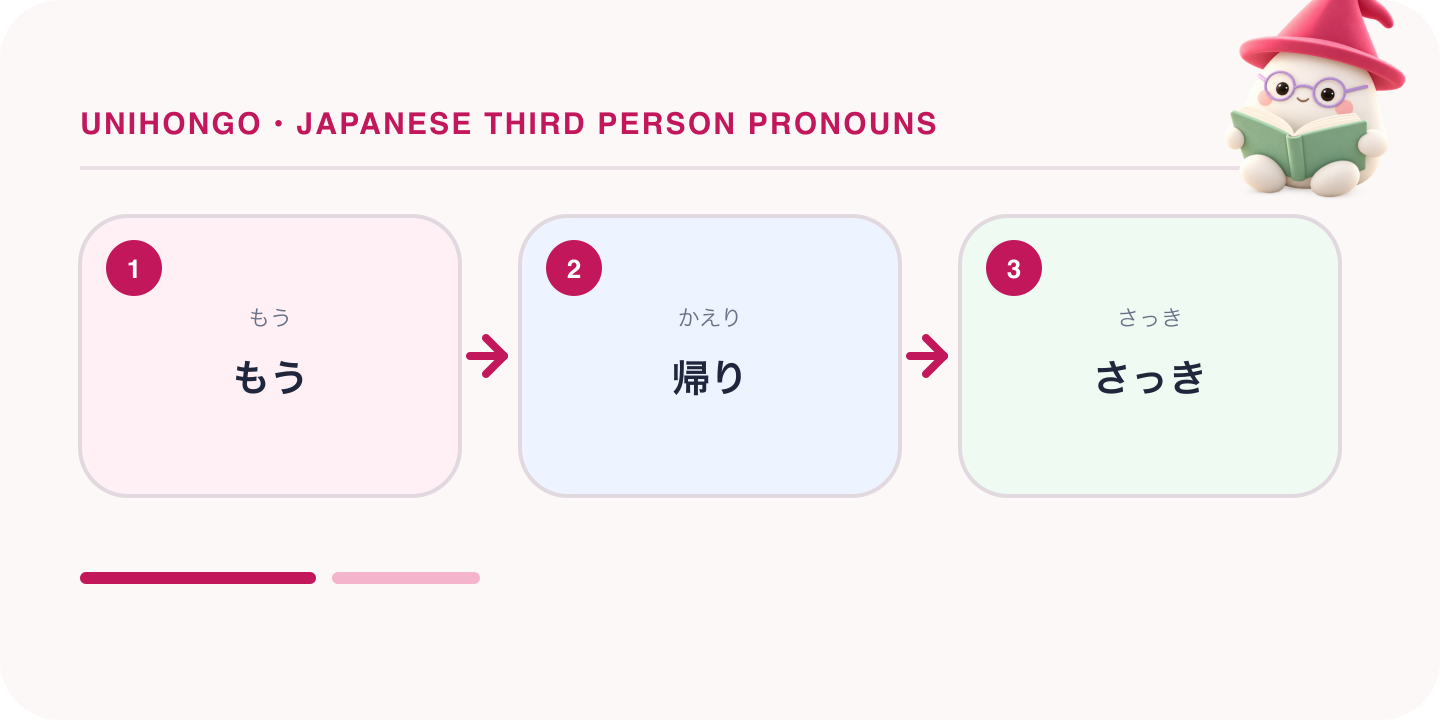
Here are two colleagues at their desks at six in the evening. One asks about Tanaka-san, and the answer does not contain any word for he or she at all. The name is said once, then silence does the work of the pronoun.
| Japanese | Romaji | Meaning |
|---|---|---|
| 田中さんはもう帰りましたか。 | Tanaka-san wa mō kaerimashita ka. | Has Tanaka-san gone home already? |
| はい、さっき帰りました。 | Hai, sakki kaerimashita. | Yes, a little while ago. (Literally: yes, went home just now.) |
| 部長は今、会議中です。 | Buchō wa ima, kaigi-chū desu. | The department manager is in a meeting at the moment. |
| 先生は何とおっしゃいましたか。 | Sensei wa nan to osshaimashita ka. | What did the teacher say? |
| 母は来週、東京に来ます。 | Haha wa raishū, Tōkyō ni kimasu. | My mother is coming to Tokyo next week. |
Kare and kanojo: what they mean and how they are built
Kare is an old pointing word, a cousin of are, that one over there. Kanojo, literally that woman, was settled on in the Meiji era, when translators needed a word for the she of European novels. That history explains the flavour: both words point from a distance and carry a trace of the printed page.
Grammatically they behave like any noun. Add no for his and her, add ra or tachi for the plural, and attach particles as usual. The table sets them beside the other ways of referring to a third person, from most respectful to roughest.
| Word | Reading | Tone and typical use |
|---|---|---|
| あの方 | ano kata | Respectful: customers, elders, people you do not know well |
| あの人 | ano hito | Neutral: that person, any gender, the everyday choice |
| 彼 | kare | He: peers, written narrative; also boyfriend |
| 彼女 | kanojo | She: peers, written narrative; also girlfriend |
| 彼ら | karera | They: a group of people, mostly written or formal |
| あの人たち | ano hitotachi | Those people: the usual spoken plural |
| あいつ | aitsu | Rough: close friends, or someone you are annoyed with |
Notice that only kare and kanojo mark gender. Ano hito, ano kata and aitsu do not, which is one more reason they are so useful: you can talk about someone without knowing or stating anything beyond the fact that they are a person.
Ano hito, sono hito, kono hito: pointing at a person
Ano hito works exactly like the other ko-so-a words. If the person is visible, kono hito is someone near you, for example in a photo you are holding, sono hito is near the listener, and ano hito is away from both of you.
When the person is not in the room, the choice depends on who knows them. Ano hito is someone you both know. Sono hito is someone only one of you knows, typically a person the other speaker has just mentioned. At a party, a friend tells you about a new neighbour you have never met, so you ask about sono hito, not ano hito.
| Japanese | Romaji | Meaning |
|---|---|---|
| あの人は誰ですか。 | Ano hito wa dare desu ka. | Who is that person over there? |
| あの方はどなたですか。 | Ano kata wa donata desu ka. | May I ask who that is? (Literally: that honoured person is who?) |
| この人は私の兄です。 | Kono hito wa watashi no ani desu. | This is my older brother. (pointing at a photo) |
| その人はどんな人ですか。 | Sono hito wa donna hito desu ka. | What is that person you mentioned like? |
| あの人、元気かな。 | Ano hito, genki ka na. | I wonder how they are doing. (someone we both know) |
Kare and kanojo as boyfriend and girlfriend
In casual speech the most frequent meaning of kanojo is girlfriend, and kare or the clearer kareshi is boyfriend. The name tag idea predicts this. If everyone in your life has a label, then the one person you call simply he or she must be someone who needs no label.
You can tell the meanings apart by the grammar. Verbs of having and getting, iru, dekiru, hoshii, and possessives such as boku no or uchi no, select the romantic meaning. Two friends catching up in a café might say the following.
| Japanese | Romaji | Meaning |
|---|---|---|
| 彼女がいますか。 | Kanojo ga imasu ka. | Do you have a girlfriend? |
| 彼氏ができました。 | Kareshi ga dekimashita. | I've got a boyfriend. (Literally: a boyfriend has come into being.) |
| 彼と映画を見に行きます。 | Kare to eiga o mi ni ikimasu. | I'm going to see a film with my boyfriend. |
| 僕の彼女は大阪に住んでいます。 | Boku no kanojo wa Ōsaka ni sunde imasu. | My girlfriend lives in Osaka. |
The third sentence could also mean with him, if a particular man has just been discussed. Speakers who want to be unambiguous say kareshi. There is no everyday equivalent of kareshi for kanojo, so kanojo has to carry both meanings.
One word changed: what the listener hears
The pairs below differ only in the word for the person. Notice how much social information that one word carries.
| Sentence | Reading | What it says |
|---|---|---|
| 山田先生は明日来ますか。 | Yamada-sensei wa ashita kimasu ka. | Is Yamada-sensei coming tomorrow? Respect stays attached to the person |
| 彼は明日来ますか。 | Kare wa ashita kimasu ka. | Is he coming tomorrow? Fine about a classmate, cold about a teacher |
| あの人は親切です。 | Ano hito wa shinsetsu desu. | That person is kind. Neutral, no information about rank |
| あの方は親切です。 | Ano kata wa shinsetsu desu. | That person is kind. The speaker is showing respect |
| 彼女と旅行しました。 | Kanojo to ryokō shimashita. | I travelled with my girlfriend, or with her: the listener will probably hear girlfriend |
| 友達と旅行しました。 | Tomodachi to ryokō shimashita. | I travelled with a friend. No romantic reading |
In the first pair, the grammar is identical and both sentences are correct Japanese. What changes is the relationship the speaker claims. Yamada-sensei keeps the teacher in the role of teacher. Kare puts the teacher on the same level as the speaker, and that levelling is what listeners feel as coldness.
Beyond the basics: where kare and kanojo sound natural
None of this means kare and kanojo are rare words. In novels, news features, essays and subtitles they are everywhere, because a narrator stands outside the social scene and has no relationship to signal.
In speech, they are natural for people on your own level or below: friends, classmates, colleagues who joined when you did, a younger sibling's friend. Usage also varies by generation and by person. Many younger speakers use kare and kanojo quite freely, and people who spend a lot of time with English tend to use them more.
| Japanese | Romaji | Meaning |
|---|---|---|
| 彼は窓を開けた。 | Kare wa mado o aketa. | He opened the window. (narrative) |
| 彼女は何も言わなかった。 | Kanojo wa nani mo iwanakatta. | She said nothing. (narrative) |
| 彼、最近忙しそうだね。 | Kare, saikin isogashisō da ne. | He seems busy lately, doesn't he? (about a friend) |
| 彼女は同じクラスの友達です。 | Kanojo wa onaji kurasu no tomodachi desu. | She's a friend from my class. |
Aitsu, yatsu and karera: rough words and plurals
Aitsu, together with koitsu and soitsu, follows the same ko-so-a pattern as ano hito but drops all politeness. Between close friends it is affectionate teasing. About anyone else it sounds contemptuous. Yatsu, guy, works the same way: ii yatsu is a good guy, said warmly about a mate. Understand these words, and leave saying them until a Japanese friend uses them with you first.
For groups, karera is the dictionary they, and it can cover a mixed group. It belongs mainly to writing and formal speech. In conversation, ano hitotachi or a name with tachi is more common.
| Japanese | Romaji | Meaning |
|---|---|---|
| あいつ、また遅刻だよ。 | Aitsu, mata chikoku da yo. | That guy's late again. |
| いいやつだよ。 | Ii yatsu da yo. | He's a good guy. |
| 彼らは来年卒業します。 | Karera wa rainen sotsugyō shimasu. | They graduate next year. |
| あの人たちは観光客です。 | Ano hitotachi wa kankōkyaku desu. | Those people are tourists. |
| 田中さんたちはもう着きました。 | Tanaka-san-tachi wa mō tsukimashita. | Tanaka-san and the others have arrived. |
Common mistakes with kare and kanojo
The first mistake is a pronoun for a superior. Learners say kare wa yasashii desu about their teacher, because English he is neutral. In Japanese this strips the title, so say sensei wa yasashii desu.
The second is repeating the pronoun. Tanaka-san wa dōryō desu. Kare wa Ōsaka shusshin desu. Kare wa tenisu ga suki desu. Each sentence is grammatical, but together they sound translated. After the first sentence, drop the subject: Ōsaka shusshin de, tenisu ga suki desu.
The third is the accidental girlfriend. Kinō kanojo to shokuji shimashita, meant as I ate with her, will usually be heard as with my girlfriend. If she is a friend, say tomodachi to or use her name.
The fourth is introducing someone with a pronoun. Kare wa Tanaka-san desu is wrong when the man is standing beside you; the set form is kochira wa Tanaka-san desu. The fifth is using kare or kanojo for your own family when talking to outsiders. Say chichi, haha, ani or ane, which already mean my father, my mother and so on.
- Teacher, boss, customer: title or name, not kare or kanojo
- Same person in the next sentence: say nothing
- A female or male friend: tomodachi or the name, to avoid the romantic reading
- Person present: kochira wa, not kare wa or ano hito wa
- Your own family: chichi, haha, ani, ane, otōto, imōto
Pronoun, name or silence: choosing in real conversation
The nearest neighbours of kare and kanojo are the name with san and the dropped subject, and in speech those two win most of the time. Use the name when the person enters the conversation or when you switch between two people. Use silence while the same person stays the topic. Use kare or kanojo when the person is a peer and repeating the name for the fourth time would feel heavy.
Other posts on this site cover first-person words such as watashi, boku and ore, the many ways of saying you, and how to address people directly. The same principle runs through all of them: Japanese prefers a label that shows the relationship over a word that only fills a grammatical slot.
In casual speech the particle after the person often disappears, as in kare, saikin isogashisō da ne. Two classmates planning a dinner show the usual rhythm: name first, then nothing.
| Japanese | Romaji | Meaning |
|---|---|---|
| 森さんは来ますか。 | Mori-san wa kimasu ka. | Is Mori-san coming? |
| 来ると言っていました。 | Kuru to itte imashita. | She said she would. (Literally: was saying will come.) |