

The core idea: amari is the overflow, and nai says there is none
The noun amari means remainder, what is left when you have taken what you need. As an adverb it keeps that sense of going past the line. So amari tabemasen does not say I eat nothing. It says my eating does not go past the line, there is no surplus: I don't eat much.
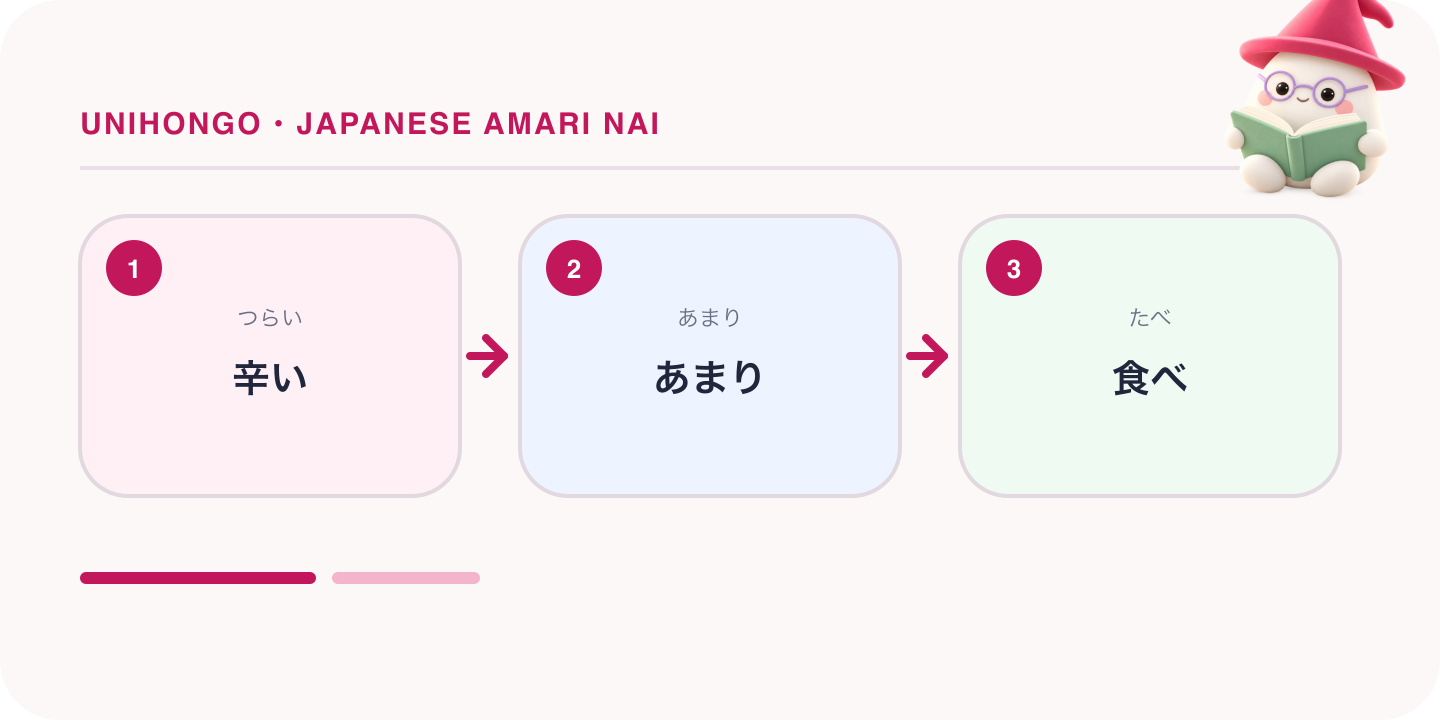
This explains why amari feels gentle. You are not denying the thing, only denying the excess. A colleague asks over lunch whether you like spicy food, and you would rather not say no outright.
| Japanese | Romaji | Meaning |
|---|---|---|
| 辛いものはあまり食べません。 | Karai mono wa amari tabemasen. | I don't eat spicy food much. (Literally: I don't eat it to excess.) |
| あまり好きじゃないです。 | Amari suki ja nai desu. | I'm not very keen on it. |
| 今日はあまり寒くないですね。 | Kyō wa amari samukunai desu ne. | It's not very cold today, is it? |
How the amari nai pattern is built
Amari is an adverb, so it does not conjugate and takes no particle. Put it before the word it limits and make that word negative in the normal way for its type. The negative is what changes, not amari.
| Pattern | Reading | Built from |
|---|---|---|
| あまり飲みません | amari nomimasen | Verb in the negative: I don't drink much |
| あまり高くないです | amari takakunai desu | I-adjective, i becomes kunai: not very expensive |
| あまり便利じゃないです | amari benri ja nai desu | Na-adjective plus ja nai: not very convenient |
| あまり時間がありません | amari jikan ga arimasen | Noun plus ga arimasen: there isn't much time |
| あまり上手に話せません | amari jōzu ni hanasemasen | Before another adverb: I can't speak very well |
Amari can sit directly before the negative word or earlier in the sentence. Amari o-sake o nomimasen and o-sake o amari nomimasen mean the same thing.
One word, three English translations
English needs three expressions where Japanese uses one, and the word that follows amari decides which. With an adjective it is degree, not very. With a verb of having or consuming it is quantity, not much. With a verb of doing it is usually frequency, not often. In each case the cup is simply not overflowing. Two friends catching up on the phone might cover all three in a minute.
| Japanese | Romaji | Meaning |
|---|---|---|
| この映画はあまり面白くなかった。 | Kono eiga wa amari omoshirokunakatta. | This film wasn't very interesting. |
| 今月はあまりお金がない。 | Kongetsu wa amari o-kane ga nai. | I don't have much money this month. |
| 最近あまり運動していません。 | Saikin amari undō shite imasen. | I haven't been exercising much lately. |
| 実家にはあまり帰りません。 | Jikka ni wa amari kaerimasen. | I don't go back to my parents' home very often. |
| 昨日はあまり寝られませんでした。 | Kinō wa amari neraremasen deshita. | I couldn't sleep much last night. |
Minimal pairs: one adverb changes the answer
Someone asks whether you drink. The four answers below are the same sentence with one word swapped, and each one places you somewhere different on the scale.
| Sentence | Reading | What it says |
|---|---|---|
| お酒をよく飲みます。 | O-sake o yoku nomimasu. | I drink often. Positive verb, high on the scale |
| お酒を飲みません。 | O-sake o nomimasen. | I don't drink. A flat statement with no degree given |
| お酒をあまり飲みません。 | O-sake o amari nomimasen. | I don't drink much. Some, but no excess |
| お酒を全然飲みません。 | O-sake o zenzen nomimasen. | I don't drink at all. The amount is zero |
Notice that the plain negative, nomimasen, can sound like a refusal or a fixed policy. Adding amari softens it to a tendency, which is why it is so common when declining food, drink and invitations.
How it sounds in conversation: anmari and the trailing amari
In speech the word is usually anmari. It is not slang, only spoken, and you can use it with desu and masu. Among friends it shortens further to anma. In writing, keep amari.
Speakers also let amari stand alone and trail off, leaving the negative unsaid. Asked how the new restaurant was, a reply of un, amari, with a small shake of the head, is a complete answer: not great. The listener supplies the rest. Amari also softens negative requests, where it asks someone not to overdo something.
| Japanese | Romaji | Meaning |
|---|---|---|
| あんまり時間がないんです。 | Anmari jikan ga nai n desu. | I don't have much time, you see. |
| あんまり無理しないでね。 | Anmari muri shinaide ne. | Don't push yourself too hard. |
| 甘いものはあんまり。 | Amai mono wa anmari. | Sweet things, not so much. |
| あまり心配しないでください。 | Amari shinpai shinaide kudasai. | Please don't worry too much. |
Beyond the basics: amari in a positive sentence
Remove the negative and the cup overflows. In positive sentences amari nearly always appears as amari ni or the stronger amari ni mo, followed by an adjective or verb, and the sentence usually goes on to say what the excess caused. Amari ni mo takai means it is excessively expensive, beyond what is reasonable.
Two related patterns are more literary. Amari no plus a noun puts the excess before the thing: amari no atsusa, heat beyond measure. A noun plus no amari, or a verb plus amari, names an emotion or effort so great that it led to an unintended result. You will meet these in novels and news reports, and a traveller telling the story of a bad trip might use the first two.
| Japanese | Romaji | Meaning |
|---|---|---|
| あまりにも高くて、買えませんでした。 | Amari ni mo takakute, kaemasen deshita. | It was so expensive that I couldn't buy it. |
| あまりに忙しくて、昼ご飯を忘れました。 | Amari ni isogashikute, hirugohan o wasuremashita. | I was so busy that I forgot lunch. |
| あまりの暑さに、何もできなかった。 | Amari no atsusa ni, nani mo dekinakatta. | The heat was so extreme that I couldn't do anything. |
| うれしさのあまり、泣いてしまいました。 | Ureshisa no amari, naite shimaimashita. | I was so happy that I cried. (Literally: in the overflow of happiness.) |
Beyond the basics: amari after a number
After a number and its counter, amari is the overflow in its most concrete form: that figure, plus a little. The extra is small and unspecified. This is the language of news, reports and speeches. It works best with round numbers, since a precise figure such as thirteen leaves no room for a remainder.
The noun also survives in arithmetic, where it is the remainder of a division, and in nouns such as amarimono, leftovers.
| Japanese | Romaji | Meaning |
|---|---|---|
| 会議に十人あまり来ました。 | Kaigi ni jū-nin amari kimashita. | Ten-odd people came to the meeting. (Literally: ten people and a remainder.) |
| 日本に来て一年あまりになります。 | Nihon ni kite ichi-nen amari ni narimasu. | It has been a little over a year since I came to Japan. |
| 十割る三は三あまり一です。 | Jū waru san wa san amari ichi desu. | Ten divided by three is three remainder one. |
Neighbours: zenzen, sonna ni, hotondo and metta ni
Four other words live near amari, and each answers a slightly different question. Zenzen is zero. Hotondo with a negative is nearly zero, hardly any. Metta ni with a negative is about frequency only: rarely, on few occasions. Sonna ni with a negative means not that much, and it needs a reference point: something the other person just said, or what people expect. If a friend says your flat must be expensive, sonna ni takakunai answers their assumption, while amari takakunai only describes the rent.
| Japanese | Romaji | Meaning |
|---|---|---|
| そんなに高くないですよ。 | Sonna ni takakunai desu yo. | It's not as expensive as you think. |
| 朝ご飯はほとんど食べません。 | Asagohan wa hotondo tabemasen. | I hardly ever eat breakfast. |
| 映画館にはめったに行きません。 | Eigakan ni wa metta ni ikimasen. | I rarely go to the cinema. |
| 英語は全然分かりません。 | Eigo wa zenzen wakarimasen. | I don't understand English at all. |
Common mistakes with amari
The first mistake is amari with a positive verb to mean a little. Amari tabemasu is wrong. Learners build it because English a little is positive, but amari only produces the meaning not much when the verb is negative. Say amari tabemasen, or sukoshi tabemasu for I eat a little.
The second is translating not often with yoku. Yoku ikimasen is wrong for I don't go often. It copies the English pattern of negating often, but Japanese switches adverbs: amari ikimasen. The same goes for takusan: takusan arimasen sounds awkward for there isn't much, and amari arimasen is what people say.
The third is using bare amari for too. Amari takai desu is wrong for it is too expensive. Without a negative you need amari ni mo takai desu or, more commonly, takasugimasu.
The fourth is the adjective negative. Amari takai ja nai is wrong, because ja nai belongs to na-adjectives and nouns. An i-adjective changes its own ending: amari takakunai.
| Japanese | Romaji | Meaning |
|---|---|---|
| 朝は少し食べます。 | Asa wa sukoshi tabemasu. | I eat a little in the morning. |
| ジムにはあまり行きません。 | Jimu ni wa amari ikimasen. | I don't go to the gym often. |
| このかばんは高すぎます。 | Kono kaban wa takasugimasu. | This bag is too expensive. |