

What kagiri means
Kagiri is the noun form of kagiru, to limit, and on its own it means a limit or an end. Kagiri aru shigen means limited resources; kagiri nai means limitless. Every grammar use keeps that idea of a boundary.
The meaning depends on what sits inside the boundary. A continuing state gives as long as: the statement is true while the state lasts. A verb of knowing gives as far as: the statement is true within what I know. A time or quantity noun gives only: the offer is limited to today. With ni and a noun, kagiru and kagitte pick one item out from all others, for praise or for bad luck.
Kagiri is usually written in kanji in adult texts, and you will see it on shop signs, in contracts and in everyday speech alike.
| Japanese | Romaji | Meaning |
|---|---|---|
| 日本にいる限り、日本語を勉強し続けます。 | Nihon ni iru kagiri, nihongo o benkyō shitsuzukemasu. | As long as I'm in Japan, I'll keep studying Japanese. |
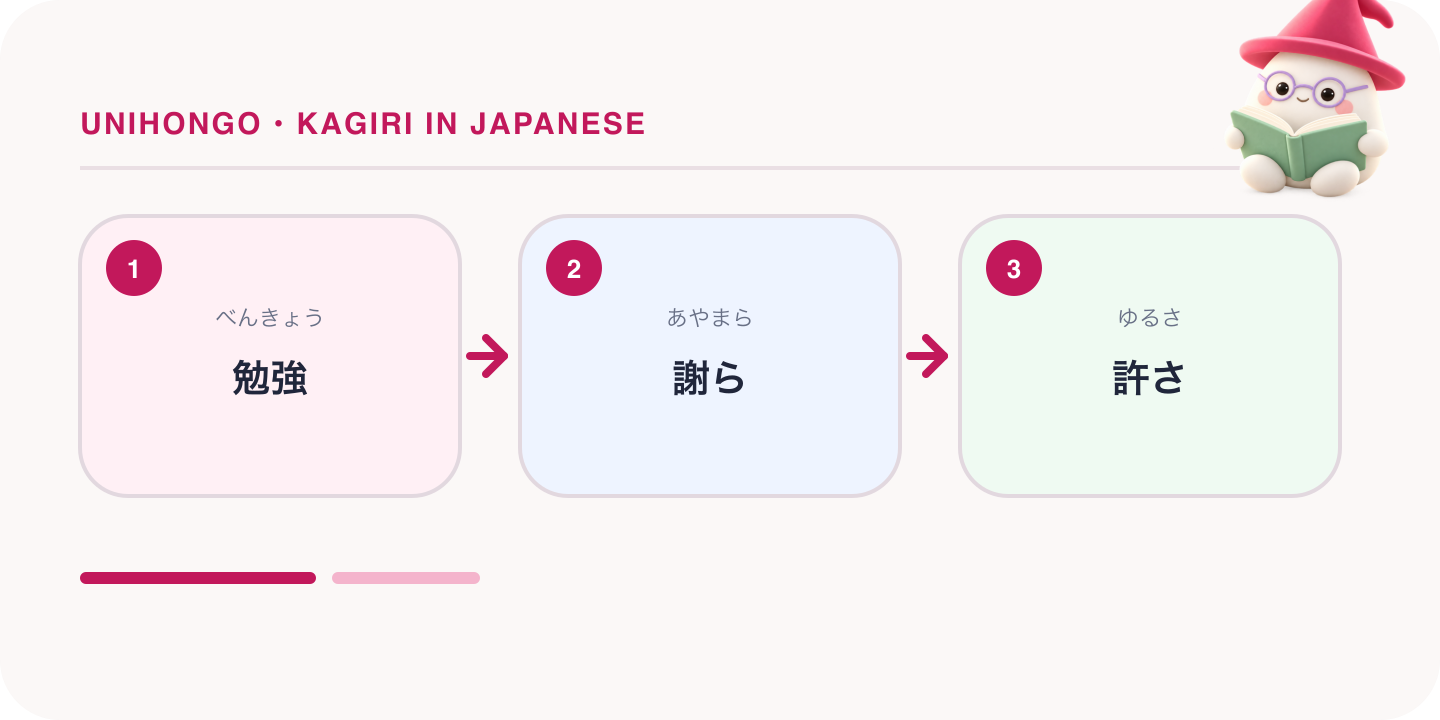
| 謝らない限り、許さない。 | Ayamaranai kagiri, yurusanai. | I won't forgive them unless they apologise. |
| 私の知る限り、彼はまだ独身です。 | Watashi no shiru kagiri, kare wa mada dokushin desu. | As far as I know, he's still single. |
| このセールは今日限りです。 | Kono sēru wa kyō kagiri desu. | This sale is today only. |
| 暑い日は冷たいそばに限る。 | Atsui hi wa tsumetai soba ni kagiru. | On a hot day, nothing beats cold soba. |
Forms of kagiri at a glance
Kagiri behaves like a noun, so it follows the plain form of verbs and adjectives, na with na adjectives and no or de aru with nouns. The ni kagiru family attaches to nouns, and to plain verbs in the nothing beats meaning.
| Pattern | Formation | Example | Meaning |
|---|---|---|---|
| As long as | Verb, te iru or adj + 限り | 元気な限り | As long as I'm healthy |
| Unless | Verb nai form + 限り | 雨が降らない限り | Unless it rains |
| As far as | 知る / 見る / 聞く + 限り(では) | 私が見た限りでは | As far as I saw |
| As much as possible | できる / 可能な + 限り | できる限り早く | As soon as possible |
| Only | Time or count noun + 限り | 今回限り | This time only |
| Extremely | Emotion adj + 限りだ | 嬉しい限りです | I'm truly delighted |
| Nothing beats | Noun or verb + に限る | 夏はビールに限る | Nothing beats beer in summer |
| Of all times | Noun + に限って | 急いでいる日に限って | On the very day I'm in a hurry |
| Not only | Noun + に限らず | 日本に限らず | Not only in Japan |
As long as and unless: kagiri and nai kagiri
After a state that continues, kagiri means as long as or while. The state is usually expressed with iru, aru, te iru, an adjective or a noun with de aru: ikite iru kagiri, as long as I live; kenkō de aru kagiri, as long as I'm healthy. The main clause states something that will hold for that whole period, often a promise or a firm rule.
With a negative verb, nai kagiri means unless. The main clause is usually negative too, or describes a situation that will not change: doryoku shinai kagiri, jōtatsu shinai, you won't improve unless you make an effort. This is one of the most useful N3 to N2 patterns in speaking because it sounds firm but reasonable.
| Japanese | Romaji | Meaning |
|---|---|---|
| 私が生きている限り、この店は続けます。 | Watashi ga ikite iru kagiri, kono mise wa tsuzukemasu. | As long as I'm alive, I'll keep this shop going. |
| 体が元気な限り、働きたいです。 | Karada ga genki na kagiri, hatarakitai desu. | I want to work for as long as I'm physically well. |
| この契約がある限り、値段は変わりません。 | Kono keiyaku ga aru kagiri, nedan wa kawarimasen. | As long as this contract stands, the price won't change. |
| 練習しない限り、上手にはなりません。 | Renshū shinai kagiri, jōzu ni wa narimasen. | You won't get better unless you practise. |
| よほどのことがない限り、明日は出社します。 | Yohodo no koto ga nai kagiri, ashita wa shussha shimasu. | Unless something serious comes up, I'll be in the office tomorrow. |
| 許可がない限り、立ち入り禁止です。 | Kyoka ga nai kagiri, tachiiri kinshi desu. | No entry without permission. |
As far as: shiru kagiri and kagiri de wa
With verbs of knowing, seeing, hearing and checking, kagiri limits a statement to the speaker's information: watashi no shiru kagiri, as far as I know; mita kagiri, from what I saw; shirabeta kagiri, as far as I checked. It is a polite way to be honest about how sure you are.
Adding de wa, kagiri de wa, stresses that the statement applies only within that range and may not be true beyond it. Kiita kagiri de wa, ii hito rashii, from what I've heard, he seems like a good person. In this meaning kagiri and kagiri de wa are often interchangeable; in the as long as meaning, de wa is not used.
| Japanese | Romaji | Meaning |
|---|---|---|
| 私が知っている限りでは、その店はもう閉店しました。 | Watashi ga shitte iru kagiri de wa, sono mise wa mō heiten shimashita. | As far as I know, that shop has already closed. |
| 見た限り、けがはなさそうです。 | Mita kagiri, kega wa nasasō desu. | From what I can see, there don't seem to be any injuries. |
| 調べた限りでは、問題は見つかりませんでした。 | Shirabeta kagiri de wa, mondai wa mitsukarimasen deshita. | As far as I checked, I didn't find any problems. |
| 聞いた限りでは、評判はいいようです。 | Kiita kagiri de wa, hyōban wa ii yō desu. | From what I've heard, it has a good reputation. |
| この資料を読む限り、計画に無理はない。 | Kono shiryō o yomu kagiri, keikaku ni muri wa nai. | Going by this document, the plan is realistic. |
Only and to the limit: kyō kagiri and dekiru kagiri
After a time or quantity noun, kagiri means only or limited to. Honjitsu kagiri, today only, and kikan kagiri, limited period, are standard on shop signs. Konkai kagiri, this time only, and ikkai kagiri, once only, appear in rules and warnings. Sono ba kagiri describes something that lasts only for the moment, like a hollow promise.
Kagiri can also mean to the limit. Dekiru kagiri and kanō na kagiri mean as much as possible, and chikara no kagiri means with all one's strength. After an emotion adjective, kagiri da means extremely: ureshii kagiri desu, I'm truly delighted, and sabishii kagiri da, it's terribly lonely. This last use is formal and common in speeches and letters.
| Japanese | Romaji | Meaning |
|---|---|---|
| 本日限り、全品半額です。 | Honjitsu kagiri, zenpin hangaku desu. | Today only, everything is half price. |
| 遅刻は今回限りにしてください。 | Chikoku wa konkai kagiri ni shite kudasai. | Please make this the last time you're late. |
| できる限り早くお返事します。 | Dekiru kagiri hayaku o-henji shimasu. | I'll reply as soon as I possibly can. |
| 力の限り走った。 | Chikara no kagiri hashitta. | I ran with everything I had. |
| 皆さんに来ていただき、嬉しい限りです。 | Minasan ni kite itadaki, ureshii kagiri desu. | I'm truly delighted that you've all come. |
| その場限りの約束はしないでください。 | Sono ba kagiri no yakusoku wa shinaide kudasai. | Please don't make promises just for the moment. |
Ni kagiru and ni kagirazu
X ni kagiru has two meanings. In conversation, it often means X is the best or nothing beats X: tsukareta toki wa neru ni kagiru, when you're tired, nothing beats sleep. The subject is usually a situation marked with wa, and X is a noun or a plain verb.
In notices and rules, ni kagiru means limited to: shiyō wa kaiin ni kagirimasu, use is limited to members. The related ni kagiri appears in offers: senchaku hyaku mei ni kagiri, for the first hundred people only.
The negative ni kagirazu means not limited to or not only: Nihon ni kagirazu, not only in Japan; kodomo ni kagirazu otona mo, not just children but adults too. It is a formal alternative to dake de naku.
| Japanese | Romaji | Meaning |
|---|---|---|
| 風邪の時は、寝るに限る。 | Kaze no toki wa, neru ni kagiru. | When you have a cold, there's nothing like sleep. |
| 旅行は平日に限る。 | Ryokō wa heijitsu ni kagiru. | Weekdays are the only time to travel. |
| 参加は二十歳以上の方に限ります。 | Sanka wa hatachi ijō no kata ni kagirimasu. | Participation is limited to those aged twenty and over. |
| 先着五十名に限り、プレゼントがあります。 | Senchaku gojū mei ni kagiri, purezento ga arimasu. | There's a gift for the first fifty people only. |
| このアニメは子どもに限らず、大人にも人気がある。 | Kono anime wa kodomo ni kagirazu, otona ni mo ninki ga aru. | This anime is popular not only with children but with adults too. |
Ni kagitte: of all times and of all people
Ni kagitte picks out one time or person as the unlucky exception. With times, it describes Murphy's law: the thing goes wrong precisely when it matters. Isoide iru toki ni kagitte, precisely when I'm in a hurry, and kasa o motte inai hi ni kagitte, on the very day I don't have an umbrella, are classic examples.
With people, ni kagitte usually appears with a negative and expresses trust: uchi no ko ni kagitte, sonna koto wa shinai, my child, of all people, would never do that. The phrase can also be neutral in notices, where it means only on: kyō ni kagitte, jūji made eigyō shimasu, today only, we are open until ten.
| Japanese | Romaji | Meaning |
|---|---|---|
| 急いでいる時に限って、電車が遅れる。 | Isoide iru toki ni kagitte, densha ga okureru. | The train is always late precisely when I'm in a hurry. |
| 傘を持っていない日に限って雨が降る。 | Kasa o motte inai hi ni kagitte ame ga furu. | It always rains on the day I don't have an umbrella. |
| 大事な日に限って寝坊してしまった。 | Daiji na hi ni kagitte nebō shite shimatta. | Of all days, I overslept on the important one. |
| 彼に限って、そんなミスはしないはずだ。 | Kare ni kagitte, sonna misu wa shinai hazu da. | He, of all people, wouldn't make a mistake like that. |
| 本日に限り、夜十時まで営業いたします。 | Honjitsu ni kagiri, yoru jūji made eigyō itashimasu. | Today only, we are open until ten at night. |
Kagiri vs aida and uchi
Aida and uchi also translate as while, and learners sometimes swap them with kagiri. Aida marks a time span: nihon ni iru aida, during my stay in Japan. Uchi means while the chance lasts: wakai uchi ni, while you're still young. Kagiri is a condition rather than a time: nihon ni iru kagiri, as long as I stay in Japan, and the main clause holds only while the condition is true.
| Pattern | Core idea | Example |
|---|---|---|
| 限り | Condition that must continue | 日本にいる限り、日本語を使う |
| 間 | Time span | 日本にいる間、京都に行った |
| うちに | Before the chance ends | 日本にいるうちに京都に行きたい |
| ない限り | Unless, firm rule | 謝らない限り許さない |
| なければ | If not, neutral | 謝らなければ許さない |
Common mistakes with kagiri
- Using kagiri for a one-off event: nihon ni itta kagiri is unnatural in the as long as meaning; the condition must be a continuing state.
- Adding de wa in the as long as meaning: ikite iru kagiri de wa sounds wrong; kagiri de wa is for knowledge and information.
- Using ni kagitte for ordinary good luck: it normally marks bad luck with times, or strong trust with people, so a neutral sentence sounds odd.
- Forgetting that ni kagiru means nothing beats in conversation: natsu wa bīru ni kagiru does not mean summer is limited to beer.
- Leaving out na with na adjectives: genki kagiri should be genki na kagiri.
- Using ni kagirazu with a verb: ni kagirazu follows nouns; for verbs, use dake de naku.