
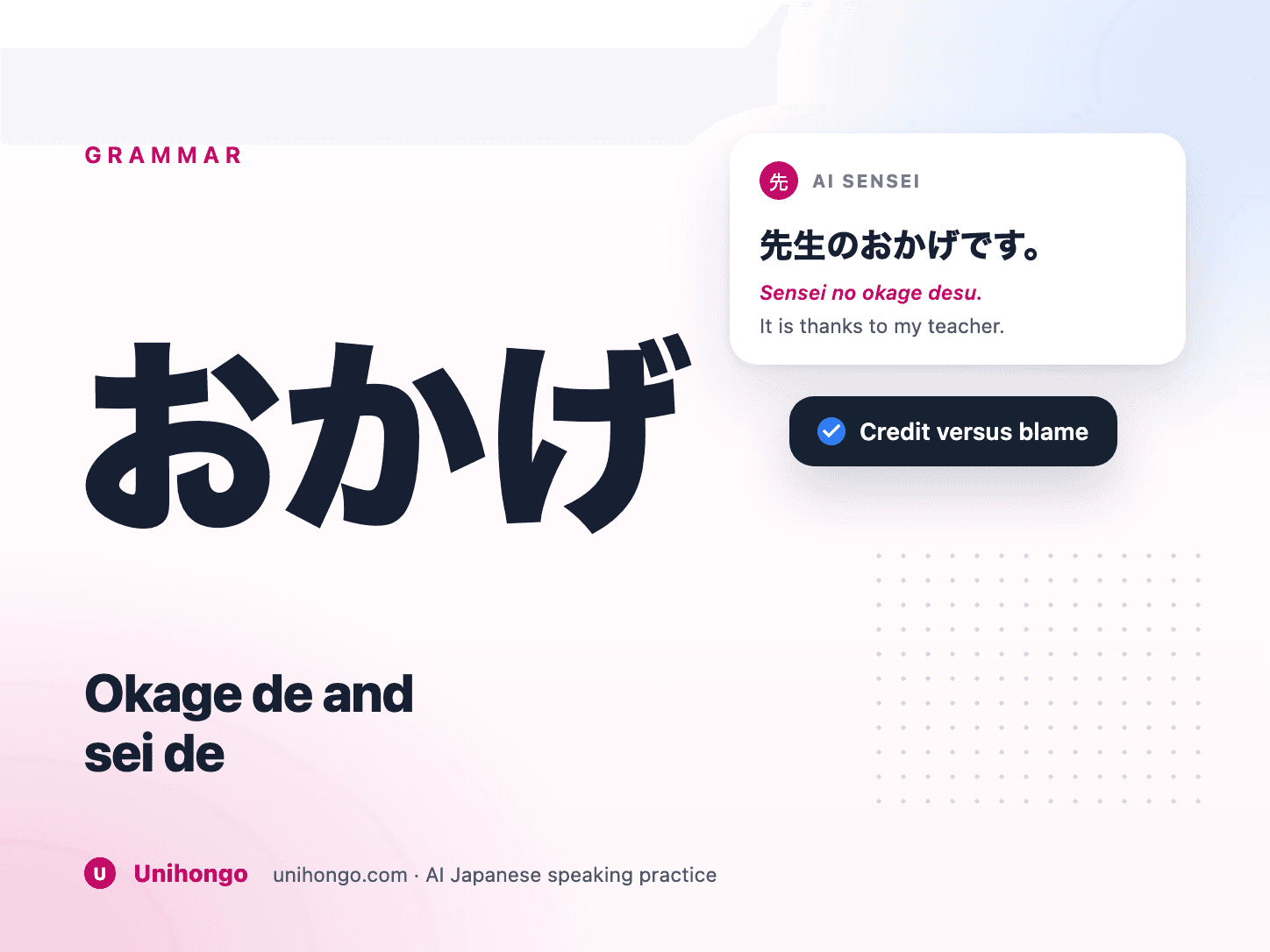
Credit on one side, blame on the other
Okage comes from the idea of shade and protection, and okage de still carries a feeling of being helped. Use it when a cause led to something you are glad about.
Sei means fault. Sei de names a cause for something unwanted, and it tends to sound like blame, especially when the cause is a person.
| Japanese | Romaji | Meaning |
|---|---|---|
| 先生のおかげで合格しました。 | Sensei no okage de gōkaku shimashita. | I passed thanks to my teacher. |
| 雨のせいで試合が中止になった。 | Ame no sei de shiai ga chūshi ni natta. | The game was cancelled because of the rain. |
| 皆さんのおかげです。 | Minasan no okage desu. | It is all thanks to everyone. |
How both attach
Okage and sei are nouns, so they attach the way nouns do: no after a noun, na after a na-adjective, and the plain form after verbs and i-adjectives. Add de to link to the result, or desu to end the sentence.
| Japanese | Romaji | Meaning |
|---|---|---|
| 薬を飲んだおかげで、よく眠れました。 | Kusuri o nonda okage de, yoku nemuremashita. | Thanks to the medicine, I slept well. |
| 寝不足のせいで、頭が痛いです。 | Nebusoku no sei de, atama ga itai desu. | My head hurts from lack of sleep. |
| 部屋が静かなおかげで、集中できます。 | Heya ga shizuka na okage de, shūchū dekimasu. | The quiet room lets me concentrate. |
| 道が狭いせいで、よく渋滞します。 | Michi ga semai sei de, yoku jūtai shimasu. | The narrow road often causes traffic jams. |
| Before okage or sei | Form to use | Example sense |
|---|---|---|
| Noun | Noun plus no | Thanks to the teacher, because of the rain |
| Verb | Plain form, often past | Because I took the medicine |
| i-adjective | Plain form | Because the road is narrow |
| na-adjective | Adjective plus na | Because the room is quiet |
Okagesama de: the polite reply
Okagesama de is a fixed polite expression used when someone asks after your health, your work or an event. It means roughly thanks to you and everyone, and it expresses general gratitude rather than crediting the listener for something specific.
It sounds warm and a little formal, which is why it is so common with neighbours, older people, clients and people you have not seen in a while.
| Japanese | Romaji | Meaning |
|---|---|---|
| おかげさまで、元気にしています。 | Okagesama de, genki ni shite imasu. | I am doing well, thank you. |
| おかげさまで、無事に終わりました。 | Okagesama de, buji ni owarimashita. | It went smoothly, thank you. |
| おかげさまで、仕事にも慣れてきました。 | Okagesama de, shigoto ni mo narete kimashita. | I am getting used to the job, thank you. |
Sarcastic thanks and self-blame
Just like thanks to you in English, okage de can be turned upside down. Said with the wrong result, it becomes a pointed complaint between people who know each other well.
Sei is also the everyday word for fault. Jibun no sei desu takes responsibility, and hito no sei ni suru means blaming someone else.
| Japanese | Romaji | Meaning |
|---|---|---|
| 君のおかげで、全部やり直しだよ。 | Kimi no okage de, zenbu yarinaoshi da yo. | Thanks to you, I have to redo everything. (sarcastic) |
| 私のせいです。すみません。 | Watashi no sei desu. Sumimasen. | It is my fault. I am sorry. |
| 人のせいにしないで。 | Hito no sei ni shinaide. | Do not blame other people. |
Sei ka and ki no sei
Adding ka softens the cause into a guess: maybe because. Sei ka is useful when you suspect a reason but are not sure, which is a very common way of talking about health and mood.
Ki no sei, literally the fault of your mind, means it is just your imagination. It is a friendly way to reassure someone or to doubt yourself.
| Japanese | Romaji | Meaning |
|---|---|---|
| 疲れているせいか、ミスが多いです。 | Tsukarete iru sei ka, misu ga ōi desu. | Maybe because I am tired, I am making a lot of mistakes. |
| 年のせいか、最近目が疲れやすい。 | Toshi no sei ka, saikin me ga tsukareyasui. | Maybe it is my age, but my eyes tire easily lately. |
| 気のせいだよ。 | Ki no sei da yo. | It is just your imagination. |
| 気のせいかな。 | Ki no sei ka na. | Maybe I imagined it. |
Neutral causes at work
When you explain a delay or a problem to a manager or a customer, sei de can sound like you are shifting the blame. Neutral cause markers state the reason and move on to what you will do about it.
Tame is formal and common in announcements. No eikyō de, due to the effects of, is standard for weather and transport. Plain de works in everyday speech.
| Japanese | Romaji | Meaning |
|---|---|---|
| 事故のため、電車が遅れています。 | Jiko no tame, densha ga okurete imasu. | Due to an accident, trains are delayed. |
| 台風の影響で、到着が遅れます。 | Taifū no eikyō de, tōchaku ga okuremasu. | Due to the typhoon, the arrival will be late. |
| 電車が遅れたため、十分ほど遅れます。 | Densha ga okureta tame, juppun hodo okuremasu. | The train was delayed, so I will be about ten minutes late. |
| 大雪で学校が休みになりました。 | Ōyuki de gakkō ga yasumi ni narimashita. | School was closed because of heavy snow. |
The other reason connectors, kara and node, have their own guide. For credit and blame, okage and sei are the ones that carry feeling.