
Four prefixes, one system
Every word in this family starts with ko, so, a or do. Ko marks what is in the speaker's territory: in your hand, on your side of the table, where you are standing. So marks what is in the listener's territory. A marks what sits outside both territories, in a shared distance. Do turns the whole thing into a question, which is why dore, dono, doko, dochira, dō and donna are simply the question members of their rows.
The endings then tell you what kind of thing is being pointed at: a bare object, a noun about to follow, a place, a polite place or direction, a manner, or a type. This is why learning the grid pays off more than learning the words one at a time. If you meet donna for the first time and you already know the row is about type or kind, you can guess konna, sonna and anna before anyone teaches them to you.
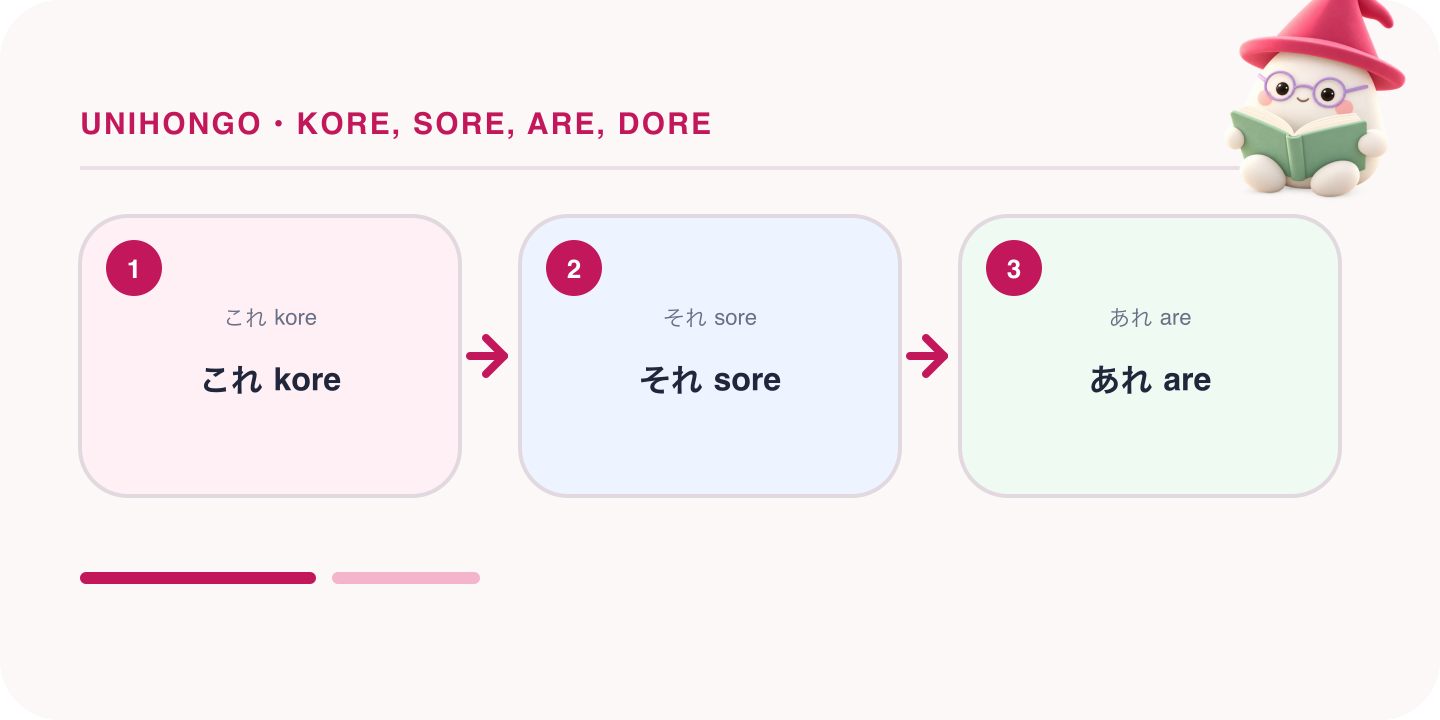
The full ko-so-a-do grid
| Row | Near me (ko) | Near you (so) | Away from both (a) | Question (do) |
|---|---|---|---|---|
| Thing, standing alone | これ kore | それ sore | あれ are | どれ dore |
| Before a noun | この kono | その sono | あの ano | どの dono |
| Place | ここ koko | そこ soko | あそこ asoko | どこ doko |
| Polite place, direction, person | こちら kochira | そちら sochira | あちら achira | どちら dochira |
| Casual direction | こっち kotchi | そっち sotchi | あっち atchi | どっち dotchi |
| Manner, how | こう kō | そう sō | ああ ā | どう dō |
| Type, kind | こんな konna | そんな sonna | あんな anna | どんな donna |
Two entries break the neat pattern and are worth flagging now. The far place word is asoko, not the ako you would predict, and the manner word ā is a long vowel written with two kana. Everything else follows the grid exactly, so drill those two aloud and the rest will look after itself.
Kore, sore, are, dore for things
These four stand alone as pronouns and usually take wa or o. Kore is what you are holding or what is right beside you; sore is what the other person is holding; are is the thing across the room or down the street that you can both see. Dore asks which one out of three or more, and it is worth pairing with the two-item question dochira, which is the correct choice when there are only two options.
| Japanese | Romaji | Meaning |
|---|---|---|
| これは何ですか? | Kore wa nan desu ka? | What is this? |
| それはペンです。 | Sore wa pen desu. | That, by you, is a pen. |
| あれは駅です。 | Are wa eki desu. | That over there is the station. |
| どれがあなたの傘ですか? | Dore ga anata no kasa desu ka? | Which one is your umbrella? |
| これをください。 | Kore o kudasai. | I will take this one, please. |
| これはいくらですか? | Kore wa ikura desu ka? | How much is this? |
| それ、ちょっと取ってください。 | Sore, chotto totte kudasai. | Could you pass me that, please? |
| あれもお願いします。 | Are mo onegai shimasu. | That one as well, please. |
Kono, sono, ano, dono before a noun
This row cannot stand alone. Kono, sono, ano and dono are always glued to the noun that follows, so you say kono hon, sono kasa, ano mise, dono densha. The mistake to kill early is kore hon, which mixes the two rows and marks a sentence as beginner Japanese immediately. If you can see or say the noun, use the kono row; if the noun is already obvious and you are pointing, use the kore row.
The noun row is also the one you need for people. Kore wa Tanaka-san desu is wrong and sounds like calling a person an object, while ano hito, that person, and the polite kochira are both fine. This is a small habit that makes a large difference in how careful your Japanese sounds.
| Japanese | Romaji | Meaning |
|---|---|---|
| この本は面白いです。 | Kono hon wa omoshiroi desu. | This book is interesting. |
| その傘は私のです。 | Sono kasa wa watashi no desu. | That umbrella by you is mine. |
| あの店はおいしいですよ。 | Ano mise wa oishii desu yo. | That restaurant over there is good. |
| どの電車に乗ればいいですか? | Dono densha ni noreba ii desu ka? | Which train should I take? |
| あの人は誰ですか? | Ano hito wa dare desu ka? | Who is that person? |
| この席、空いていますか? | Kono seki, aite imasu ka? | Is this seat free? |
| その色のほうが好きです。 | Sono iro no hō ga suki desu. | I prefer that colour. |
Koko, soko, asoko, doko for places
The place row behaves like a noun, so it takes particles freely: koko de, soko ni, asoko kara. Koko is where you are, soko is where the listener is or a spot slightly away from you, and asoko is a place clearly distant from both. Doko is the single most useful question word for travel, and the answer you hear will very often be asoko desu with a hand gesture, so train your ear for it.
| Japanese | Romaji | Meaning |
|---|---|---|
| ここはどこですか? | Koko wa doko desu ka? | Where am I? |
| トイレはどこですか? | Toire wa doko desu ka? | Where is the toilet? |
| あそこにコンビニがあります。 | Asoko ni konbini ga arimasu. | There is a convenience store over there. |
| そこに置いてください。 | Soko ni oite kudasai. | Please put it down there. |
| ここで待っています。 | Koko de matte imasu. | I will be waiting here. |
| ここから駅まで歩けますか? | Koko kara eki made arukemasu ka? | Can I walk to the station from here? |
Koko can also mean this point in time or in a process, as in koko made de shitsumon wa arimasu ka, are there any questions up to this point. That extension is common in lessons and meetings and is worth recognising even before you produce it.
Kochira, sochira, achira, dochira
This row does three jobs at once. First, it is a polite version of the place row, so a member of staff will say kochira desu rather than koko desu when showing you where something is. Second, it means direction, which is why kochira e dōzo is the standard line for this way, please. Third, it stands in for a person politely, both when introducing someone and when referring to your own side of a conversation.
Dochira is also the polite way to ask which of two, and the softened way to ask questions that would sound blunt with a direct word. Okuni wa dochira desu ka asks where someone is from more gently than doko, and dochira-sama desu ka asks who is calling on the telephone. The casual row, kotchi and dotchi, is for friends only, so keep it out of shops and offices.
| Japanese | Romaji | Meaning |
|---|---|---|
| こちらへどうぞ。 | Kochira e dōzo. | This way, please. (staff line) |
| エレベーターはこちらです。 | Erebētā wa kochira desu. | The lift is over here. (staff line) |
| こちらは田中さんです。 | Kochira wa Tanaka-san desu. | This is Mr Tanaka. |
| 出口はどちらですか? | Deguchi wa dochira desu ka? | Which way is the exit? |
| お国はどちらですか? | Okuni wa dochira desu ka? | Where are you from? |
| コーヒーと紅茶、どちらがいいですか? | Kōhī to kōcha, dochira ga ii desu ka? | Which would you like, coffee or tea? |
| どちらでもいいです。 | Dochira demo ii desu. | Either is fine. |
| こっちに来て。 | Kotchi ni kite. | Come over here. (casual) |
Kō, sō, ā, dō for manner
This row answers how rather than which. Kō means in this way, as you demonstrate something; sō means in that way, and is the root of the agreement words you hear constantly; dō asks how or what about. Ā is the rarest of the four and mostly appears in ā iu, that kind of, rather than on its own, so learn kō, sō and dō first and treat ā as recognition vocabulary.
| Japanese | Romaji | Meaning |
|---|---|---|
| こうやってください。 | Kō yatte kudasai. | Please do it like this. |
| そう思います。 | Sō omoimasu. | I think so. |
| どうやって行きますか? | Dō yatte ikimasu ka? | How do I get there? |
| どうしましたか? | Dō shimashita ka? | What happened? / Is something wrong? |
| これ、どうですか? | Kore, dō desu ka? | How about this one? |
| ああいう店が好きです。 | Ā iu mise ga suki desu. | I like that sort of restaurant. |
Konna, sonna, anna, donna for type and degree
Konna and its partners describe what kind of thing something is, and like kono they must be followed by a noun: konna mise, sonna hito, anna eiga, donna ongaku. Donna is the everyday way to ask about preferences and is far more natural than a translated what kind of question built from nani.
Add ni and the same words describe degree instead of type. Sonna ni means that much or that many and is usually used to push back gently, as in sonna ni takakunai desu, it is not that expensive. Konna ni means this much and often expresses surprise, and anna ni looks back at how much of something there was. Sonna ni is the one you will use most, because it softens a disagreement without contradicting anyone.
| Japanese | Romaji | Meaning |
|---|---|---|
| どんな音楽が好きですか? | Donna ongaku ga suki desu ka? | What kind of music do you like? |
| こんな感じです。 | Konna kanji desu. | It is like this. |
| そんな人もいますね。 | Sonna hito mo imasu ne. | There are people like that too. |
| そんなに高くないです。 | Sonna ni takakunai desu. | It is not that expensive. |
| こんなに寒い日は初めてです。 | Konna ni samui hi wa hajimete desu. | This is the first time I have seen a day this cold. |
| あんなに練習したのに、負けました。 | Anna ni renshū shita noni, makemashita. | We practised that much and still lost. |
| そんなことないです。 | Sonna koto nai desu. | Not at all. / That is not true. |
The conversational rule
Once nothing is physically present, distance stops meaning metres and starts meaning knowledge. Sore takes over what the other person has just said, because their words are in their territory. Are covers something you and the listener both know from shared experience, which is why ano hanashi and ano ken sound warm and familiar between colleagues. Kore introduces something you are about to say yourself.
| Form | What it refers to | Example | English |
|---|---|---|---|
| それ sore | What the other person just said | それはいいですね。Sore wa ii desu ne. | That sounds good. |
| その sono | A topic only the listener has raised | その話は知りませんでした。Sono hanashi wa shirimasen deshita. | I did not know about that. |
| あの ano | Something both of you already know | あの件はどうなりましたか?Ano ken wa dō narimashita ka? | What happened with that matter? |
| あれ are | A shared memory, no noun needed | あれ、よかったですね。Are, yokatta desu ne. | That was good, wasn't it. |
| これ kore | Something you are about to introduce | これはちょっと難しいんですが。Kore wa chotto muzukashii n desu ga. | This is a little difficult, but... |
| こちら kochira | Your own side or group | こちらは大丈夫です。Kochira wa daijōbu desu. | Things are fine on our side. |
The practical test before you speak: does the listener already know this thing? If yes, ano and are are available and they make the conversation sound close. If only you know it, use kore or a plain noun and introduce it properly. Using ano for something the other person has never heard of is a small but noticeable misfire, and it usually produces a puzzled pause.
Fixed expressions built on ko-so-a-do
A surprising amount of everyday politeness is made of these words, and most of it is worth learning as whole units rather than as grammar. Sō desu ne buys thinking time and signals agreement; sō desu ka registers new information; dō itashimashite answers thanks; kochira koso returns a courtesy. Anō, with the long vowel, is the polite opening sound before you interrupt a stranger.
| Japanese | Romaji | Meaning |
|---|---|---|
| そうですね。 | Sō desu ne. | That's right. / Let me think. |
| そうですか。 | Sō desu ka. | Is that so. / I see. |
| そうなんですか。 | Sō nan desu ka. | Oh really, I did not know that. |
| どういたしまして。 | Dō itashimashite. | You are welcome. |
| こちらこそ、ありがとうございます。 | Kochira koso, arigatō gozaimasu. | The thanks are mine. |
| あのう、すみません。 | Anō, sumimasen. | Um, excuse me. |
| それでは、始めましょう。 | Sore de wa, hajimemashō. | Well then, let us begin. |
| それは大変でしたね。 | Sore wa taihen deshita ne. | That must have been hard. |
Mistakes and a drill
- Never say kore hon. Choose kore on its own or kono plus a noun, and check yourself the moment a noun follows.
- Do not call a person kore or sore. Use ano hito for that person and kochira when introducing someone politely.
- Remember the position flips: what is kore to you is sore to the person opposite, so listen for the switch in their reply.
- Ask two people the same question with dochira and three or more with dore, since dochira is the two-item word.
- Practise sonna ni with three adjectives you use often, such as takai, muzukashii and tōi, to soften disagreement.
- Record yourself pointing at six objects at different distances, then move to another seat and record the same six again.