
Think in chunks, not English slots
An English sentence relies heavily on position: changing the order can change who did what. Japanese adds particles after chunks, and those labels carry much of the grammatical information. Watashi wa, tomodachi to, and kissaten de can be handled as units. The listener gathers them until the predicate completes the clause.
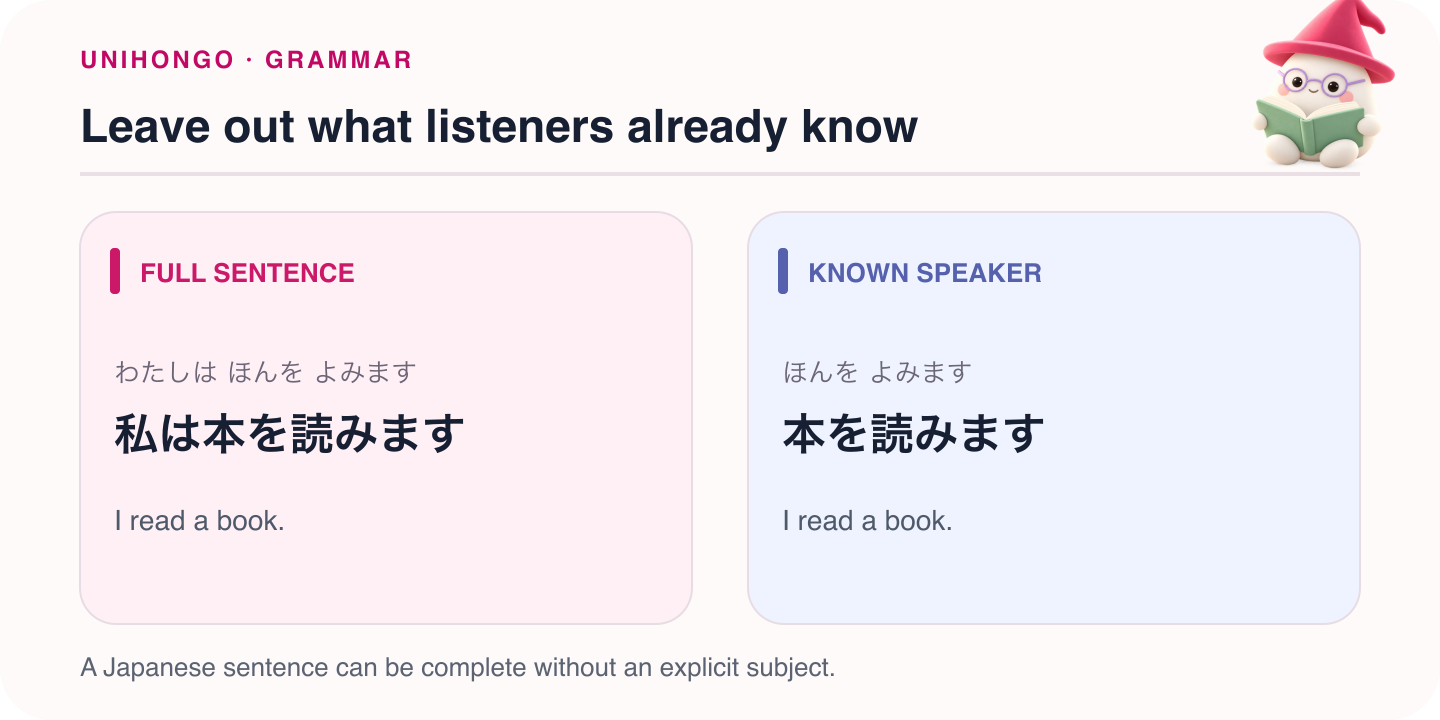
The predicate may be a verb, an adjective, or a noun plus a copula. That is why samui desu is a complete sentence meaning it is cold, and gakusei desu can mean I am a student when the topic is understood. You do not need to invent an English-style subject for every Japanese sentence.
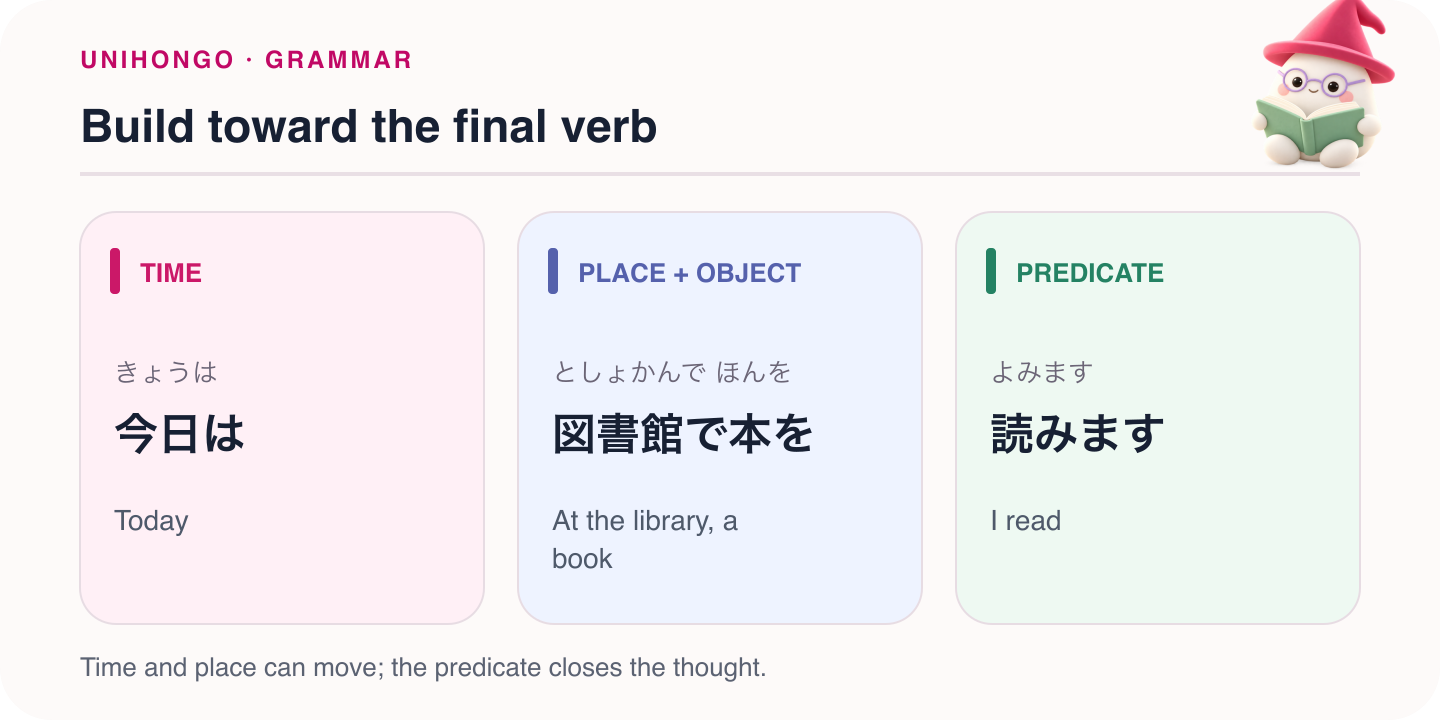
The safe beginner order
| Position | Possible chunk | Example |
|---|---|---|
| 1 | Topic | 私は watashi wa |
| 2 | Time | 明日 ashita |
| 3 | Companion | 友達と tomodachi to |
| 4 | Place | 図書館で toshokan de |
| 5 | Object | 日本語を nihongo o |
| 6 | Predicate | 勉強します benkyō shimasu |
This produces watashi wa ashita tomodachi to toshokan de nihongo o benkyō shimasu: I will study Japanese with a friend at the library tomorrow. Real speakers would probably omit watashi wa if everyone already knew whose plan was being discussed.
The predicate comes last
| Japanese | Romaji | Meaning |
|---|---|---|
| 毎朝コーヒーを飲みます。 | Maiasa kōhī o nomimasu. | I drink coffee every morning. |
| この本は面白いです。 | Kono hon wa omoshiroi desu. | This book is interesting. |
| 妹は大学生です。 | Imōto wa daigakusei desu. | My younger sister is a university student. |
Nomimasu, omoshiroi desu, and daigakusei desu tell the listener what is being asserted. When a sentence grows long, hold the earlier chunks lightly and listen for the final predicate. This habit improves listening as well as speaking.
Omission is part of natural structure
Japanese leaves out anything both speakers can recover. After dare to ikimashita ka, the reply tomodachi to ikimashita needs neither I nor there; the question already supplied the event. Omission is not laziness or incomplete grammar. It is how Japanese avoids repeating settled information.
| Japanese | Romaji | Meaning |
|---|---|---|
| 誰と行きましたか? | Dare to ikimashita ka? | Who did you go with? |
| 友達と行きました。 | Tomodachi to ikimashita. | I went with a friend. |
| もう食べましたか? | Mō tabemashita ka? | Have you eaten already? |
| はい、食べました。 | Hai, tabemashita. | Yes, I have. |
Descriptions go before nouns
Adjectives, noun phrases with no, and entire plain-form clauses all come before the noun they describe. Japanese does not use a relative pronoun equivalent to who or that. The clause kinō katta simply sits before hon in kinō katta hon, the book I bought yesterday.
| Japanese | Romaji | Meaning |
|---|---|---|
| おいしいラーメン | Oishii rāmen | Delicious ramen |
| 日本語の先生 | Nihongo no sensei | A Japanese-language teacher |
| 昨日買った本 | Kinō katta hon | The book I bought yesterday |
| 駅の近くにある店 | Eki no chikaku ni aru mise | A shop that is near the station |
Questions and sentence endings
Polite questions commonly add ka to the end without changing the rest of the order. Casual questions often use rising intonation instead. Sentence-ending particles such as ne and yo come after the predicate: ne seeks shared feeling or confirmation, while yo presents information the speaker wants the listener to notice.
| Japanese | Romaji | Meaning |
|---|---|---|
| 明日来ますか? | Ashita kimasu ka? | Will you come tomorrow? |
| 明日来る? | Ashita kuru? | Coming tomorrow? (casual) |
| おいしいですね。 | Oishii desu ne. | It is delicious, isn't it? |
| この店は安いですよ。 | Kono mise wa yasui desu yo. | This shop is inexpensive, you know. |
A five-step building routine
- Choose the final predicate first: went, want, interesting, or student.
- Add the one indispensable chunk, such as the object marked by o.
- Add time, place, destination, or companion as labelled chunks.
- Remove pronouns and repeated details that context already supplies.
- Say the sentence once at natural speed, then reuse its frame with three substitutions.