
N5 grammar map
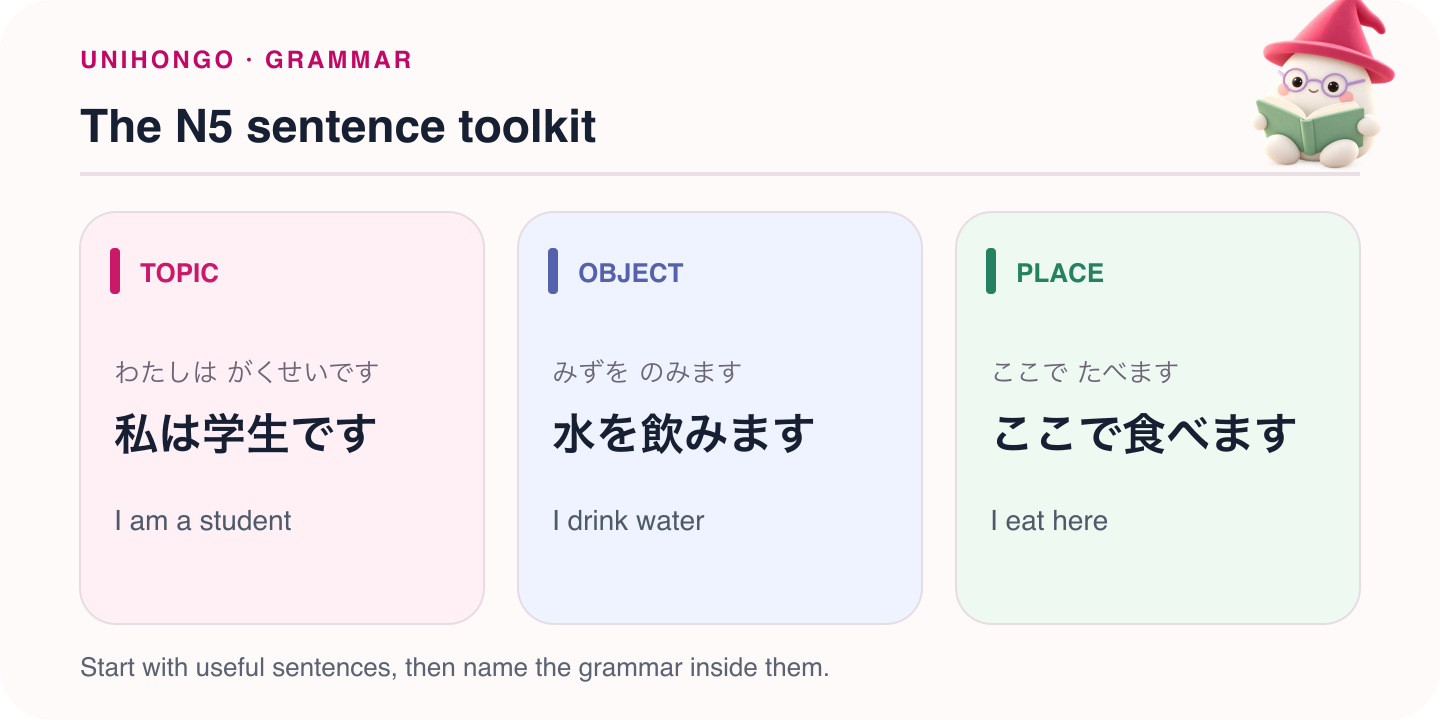
N5 grammar answers four beginner questions: what is the topic, who does the action, where does it happen, and when does it happen. Japanese uses particles after words to show these roles, so word order is more flexible than English, but the particle choice matters a lot.
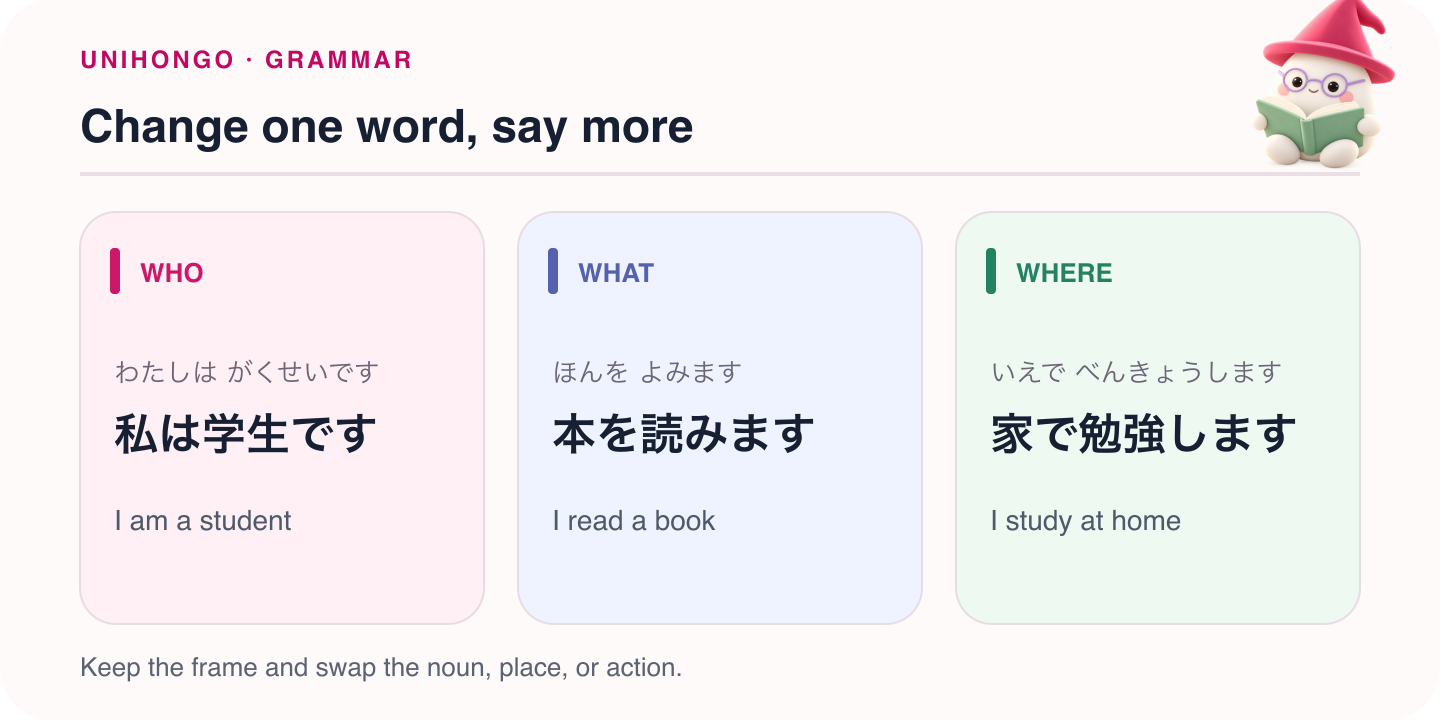
The best way to study N5 is to learn grammar as sentence frames. A frame like noun は adjective です can describe hundreds of things. A frame like verb てもいいですか can ask permission in shops, classrooms, hotels, and daily life.
Complete N5 grammar checklist
| Pattern | Meaning | Similar higher-level structure |
|---|---|---|
| N は N です | A is B | Basic identification |
| N は N ではありません | A is not B | Negative identification |
| N は N ですか | Is A B? | Yes/no questions |
| N も | also; too | Topic particle は |
| N の N | N's N; N of N | Noun modification |
| N と N | N and N | Complete noun lists |
| N や N | N, N, and so on | Incomplete noun lists |
| N から N まで | from N to N | Range |
| N より | than N; from N | Comparison/source |
| N だけ | only; just N | Limitation |
| N しか~ない | nothing but N | Limitation with negative |
| N は / が / を | topic, subject, and object marking | Core particles |
| N に / へ | to; toward; at | Destination and time |
| N で | at; by; with | Place, means, instrument |
| N と | with; and; quotation marker | Companion and quotation |
| N が あります | there is N; have N | Inanimate existence |
| N が います | there is N; have N | Animate existence |
| これ / それ / あれ | this / that / that over there | Demonstratives |
| この / その / あの N | this / that N | Demonstrative modifiers |
| ここ / そこ / あそこ | here / there / over there | Place demonstratives |
| V-ます | do; will do | Polite non-past |
| V-ません | do not; will not | Polite negative |
| V-ました | did | Polite past |
| V-ませんでした | did not | Polite past negative |
| V dictionary form | plain non-past verb | Verb base form |
| V-ない | do not; not do | Plain negative |
| V-た | did; have done | Plain past |
| い-adjective です | is adjective | Adjective predicate |
| い-adjective くないです | is not adjective | Adjective negative |
| い-adjective かったです | was adjective | Adjective past |
| な-adjective な N | N that is adjective | Adjective modifier |
| な-adjective です | is adjective | Adjective predicate |
| な-adjective ではありません | is not adjective | Adjective negative |
| N / な-adjective だった | was N; was adjective | Plain copula past |
| V-ています | is doing; is in a state | Progressive/state |
| V-てください | please do | Basic request |
| V-てもいいです | may do; it is okay to do | Permission |
| V-てはいけません | must not do | Prohibition |
| V-ないでください | please do not do | Negative request |
| V-ましょう | let's do | Suggestion |
| V-ませんか | will you; shall we | Invitation |
| V-たいです | want to do | Desire |
| N が ほしいです | want N | Desire for an object |
| そして | and; and then | Sentence connection |
| でも | but; however | Simple contrast |
| それから | after that; and then | Sequence |
| から | because | Basic reason |
| ね / よ | right? / emphasis | Sentence-final particles |
| もう / まだ | already / still; not yet | Time and completion |
| Question word + か | some; any | Indefinite reference |
| N が 好きだ / 嫌いだ | like N / dislike N | Preference |
| N が 上手だ / 下手だ | be good at N / poor at N | Ability/evaluation |
| V dictionary form のが好きだ | like doing | Activity preference |
| N が 分かる | understand N | Ability/state |
| N が できる | can do N; be completed | Ability/completion |
| N をください | please give me N | Basic request |
| N をお願いします | N, please | Polite request |
| N といっしょに | together with N | Companion |
| N の中で | among; within N | Selection/comparison |
| N で一番 | the most in N | Superlative |
| N から作る | make from N | Material/source |
| N でできる | be made of N | Material |
| N に住んでいる | live in N | State |
| V-ることがある | sometimes do | Occasional action |
| V-るのが上手だ / 下手だ | be good/bad at doing | Skill evaluation |
| V-るのが早い / 遅い | be quick/slow to do | Action speed |
Examples you can reuse
| Japanese | Romaji | Meaning |
|---|---|---|
| 私は学生です。 | Watashi wa gakusei desu. | I am a student. |
| 机の上に本があります。 | Tsukue no ue ni hon ga arimasu. | There is a book on the desk. |
| 毎朝コーヒーを飲みます。 | Maiasa kōhī o nomimasu. | I drink coffee every morning. |
| 図書館で勉強します。 | Toshokan de benkyō shimasu. | I study at the library. |
| 七時に起きます。 | Shichi-ji ni okimasu. | I wake up at seven. |
| もう一度言ってください。 | Mō ichido itte kudasai. | Please say it one more time. |
| ここで写真を撮ってもいいですか。 | Koko de shashin o totte mo ii desu ka. | May I take a photo here? |
| ここで食べないでください。 | Koko de tabenaide kudasai. | Please do not eat here. |
Common mistakes
- Putting particles before nouns. Japanese particles follow the word they mark: 学校に, not に学校.
- Using です after every verb. 食べます is complete by itself; 食べますです is incorrect.
- Confusing あります and います. Use います for people and animals, and あります for things, places, events, and abstract items.
- Overusing 私は. Japanese drops obvious subjects, so repeating 私は in every sentence sounds heavy.
How N5 connects to higher levels
Every advanced grammar point starts as an extension of these basic frames. てください becomes more polite request grammar at N4 and N3. Place で becomes formal において at N3. Simple は and が become contrast, emphasis, and topic-control tools all the way through N1.
That is why N5 deserves careful practice. Weak particle habits at N5 make N3 reading feel mysterious later. Strong N5 sentences make higher-level grammar feel like upgrades instead of separate rules.