
Two pasts, one meaning
Japanese has one past tense with two outfits. The polite past ends in mashita for verbs and deshita for nouns and na-adjectives; the plain past ends in ta or datta. Tabemashita and tabeta both mean I ate. The choice tells the listener how formal you are being, not when the action happened, so switching between them never changes the timeline of your story.
Beginners can build a lot of conversation on mashita alone, and that is a reasonable first stage. The ta form becomes unavoidable soon after, because grammar patterns attach to it: tabeta ato de, itta koto ga arimasu, futtara. Those sentences stay polite at the end while carrying a plain past in the middle, which is the arrangement the plain form guide on this blog explains in full.
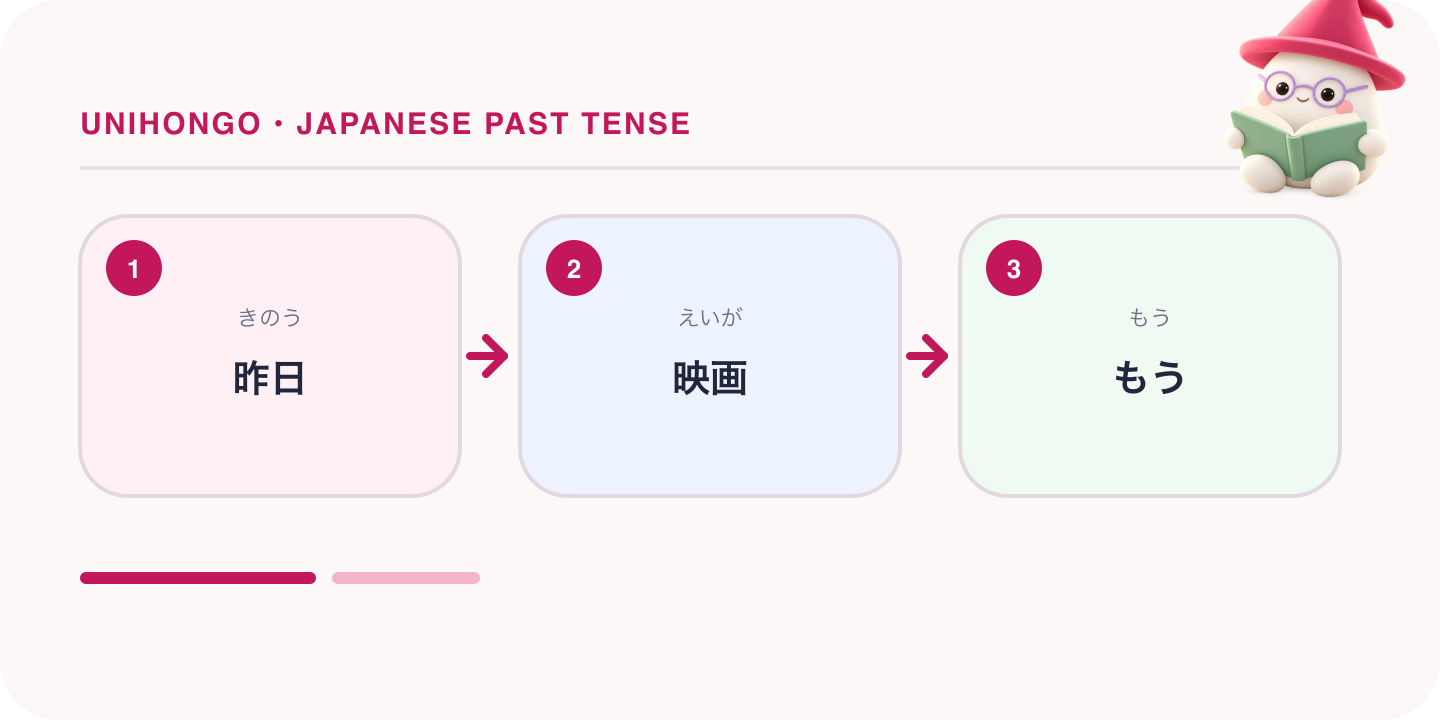
| Japanese | Romaji | Meaning |
|---|---|---|
| 昨日、映画を見ました。 | Kinō, eiga o mimashita. | I watched a film yesterday. (polite) |
| 昨日、映画を見た。 | Kinō, eiga o mita. | I watched a film yesterday. (casual) |
| もう食べましたか。 | Mō tabemashita ka. | Have you eaten yet? (polite) |
| もう食べた? | Mō tabeta? | Eaten yet? (casual) |
The polite past is the easy half
To make the polite past, take the masu form and change masu to mashita. Nomimasu becomes nomimashita, tabemasu becomes tabemashita, shimasu becomes shimashita, kimasu becomes kimashita. There are no verb classes to worry about and no sound changes, which is why this form arrives first in most courses. The polite past negative is masen deshita: nomimasen deshita.
Because the mashita ending is uniform, it also hides the verb class from you. A learner who has only drilled mashita often freezes at the plain past, since that is where godan verbs finally reveal their sound groups. Whenever you learn a new verb, note its class immediately, and say the polite past and the plain past together so the class never becomes a mystery later.
Godan sound changes in the plain past
Godan verbs change their final sound before the ta ending, and the change depends on which sound the dictionary form ends in. There are five groups. Verbs ending in ku take ita; verbs ending in gu take ida, with the voicing carried over; verbs ending in u, tsu, or ru take tta with a small tsu; verbs ending in nu, bu, or mu take nda; and verbs ending in su take shita, keeping the shi sound from the masu stem.
One verb breaks the rule. Iku, to go, should give iita by the ku pattern but instead gives itta. It is the only common exception, and it matters because iku appears constantly. Every one of these changes is identical to the te form change with ta or da in place of te or de, so if you have already worked through the te form guide you are converting knowledge rather than learning something new.
| Ending | Becomes | Example | Plain past |
|---|---|---|---|
| く ku | いた ita | 書く kaku, to write | 書いた kaita |
| ぐ gu | いだ ida | 泳ぐ oyogu, to swim | 泳いだ oyoida |
| う u | った tta | 買う kau, to buy | 買った katta |
| つ tsu | った tta | 待つ matsu, to wait | 待った matta |
| る ru (godan) | った tta | 取る toru, to take | 取った totta |
| ぬ nu | んだ nda | 死ぬ shinu, to die | 死んだ shinda |
| ぶ bu | んだ nda | 呼ぶ yobu, to call | 呼んだ yonda |
| む mu | んだ nda | 読む yomu, to read | 読んだ yonda |
| す su | した shita | 話す hanasu, to speak | 話した hanashita |
| 行く iku (exception) | った tta | 行く iku, to go | 行った itta |
Yobu and yomu both give yonda, so context does the work of telling them apart. That overlap is normal in Japanese and rarely causes confusion, because the objects differ: namae o yonda is calling a name and hon o yonda is reading a book.
Ichidan verbs and the two irregulars
Ichidan verbs, the ones whose dictionary form ends in eru or iru with a genuine ichidan stem, simply drop ru and add ta. Taberu becomes tabeta, miru becomes mita, oshieru becomes oshieta, okiru becomes okita. There are no sound groups and no exceptions, which is why identifying a verb's class is the real work and the conjugation itself is trivial once you have.
Suru becomes shita, and every compound with suru follows: benkyō suru becomes benkyō shita, denwa suru becomes denwa shita. Kuru becomes kita, written 来た, with the reading shifting from ku to ki just as it shifts to ko in konai. Beware of the lookalikes: kaeru, hairu, hashiru, shiru and kiru meaning to cut are godan, so their past forms are kaetta, haitta, hashitta, shitta and kitta, not kaeta or haita.
| Japanese | Romaji | Meaning |
|---|---|---|
| 七時に起きました。 | Shichi-ji ni okimashita. | I got up at seven. |
| 先生が漢字を教えてくれた。 | Sensei ga kanji o oshiete kureta. | The teacher taught me kanji. (casual) |
| 昨日、日本語を勉強しました。 | Kinō, Nihongo o benkyō shimashita. | I studied Japanese yesterday. |
| 友達が家に来ました。 | Tomodachi ga ie ni kimashita. | A friend came to my house. |
| 六時に家へ帰った。 | Roku-ji ni ie e kaetta. | I went home at six. (casual) |
| 駅で電車に乗りました。 | Eki de densha ni norimashita. | I got on the train at the station. |
Past forms across word types
Adjectives and nouns take the past too, and the mistake to avoid is attaching deshita to an i-adjective. Takai desu becomes takakatta desu, never takai deshita. The politeness sits in the trailing desu while the adjective itself carries the tense. Ii is irregular and becomes yokatta, which you will hear constantly on its own as a warm response meaning that is good news or I am relieved.
| Word type | Polite past | Plain past | Polite past negative | Plain past negative |
|---|---|---|---|---|
| Verb 飲む | nomimashita | nonda | nomimasen deshita | nomanakatta |
| Verb 食べる | tabemashita | tabeta | tabemasen deshita | tabenakatta |
| i-adjective 高い | takakatta desu | takakatta | takakunakatta desu | takakunakatta |
| i-adjective いい | yokatta desu | yokatta | yokunakatta desu | yokunakatta |
| na-adjective 静か | shizuka deshita | shizuka datta | shizuka ja arimasen deshita | shizuka ja nakatta |
| Noun 学生 | gakusei deshita | gakusei datta | gakusei ja arimasen deshita | gakusei ja nakatta |
The polite past negative has two acceptable shapes for adjectives and nouns: takakunakatta desu and takaku arimasen deshita both work, with the first more common in speech. Choose one and stay consistent inside a single conversation rather than mixing them sentence by sentence.
Saying what did not happen
The past negative is where hesitation shows most, because you have to build two changes at once. Politely it is easy: masu becomes masen deshita. Plainly, take the nai form, drop the final i, and add katta, giving nomanakatta, tabenakatta, ikanakatta, konakatta, shinakatta. Aru is irregular and gives nakatta, which is also the form you hear in jikan ga nakatta.
In real conversation the past negative usually carries an explanation or an apology, so practise it inside a full sentence rather than alone. Sumimasen, dekimasen deshita sounds far more natural than a bare negative, and adding a reason with node or kara softens it further. That combination is worth over-drilling, because you will need it the first time something at work does not get finished.
| Japanese | Romaji | Meaning |
|---|---|---|
| 昨日はお酒を飲みませんでした。 | Kinō wa osake o nomimasen deshita. | I didn't drink alcohol yesterday. |
| すみません、まだ終わりませんでした。 | Sumimasen, mada owarimasen deshita. | Sorry, it wasn't finished yet. |
| 時間がなかったので、行けませんでした。 | Jikan ga nakatta node, ikemasen deshita. | I had no time, so I couldn't go. |
| 誰も来なかった。 | Dare mo konakatta. | Nobody came. (casual) |
| あまり寒くなかったです。 | Amari samukunakatta desu. | It wasn't very cold. |
| 昨日は暇じゃなかった。 | Kinō wa hima ja nakatta. | I wasn't free yesterday. (casual) |
When Japanese past is not English past
Japanese ta marks that something is complete, which does not always line up with English tense. The clearest gap is with state verbs. Kekkon shite imasu means I am married, describing the state that resulted from a past event, and kekkon shimashita reports the wedding itself. The same logic gives shitte imasu for I know and sunde imasu for I live somewhere. Saying kekkon shite imashita would suggest you were married and no longer are, so the te iru form matters here.
The ta form also marks a realisation at the moment it happens. Finding your keys, you say atta, which is literally it existed but means there it is. Understanding an explanation, you say wakatta, meaning I get it now. Seeing the bus arrive, a Japanese speaker says basu ga kita even though the bus is arriving in front of them, because the arrival has just completed.
There is one more use worth recognising rather than producing: a repeated ta form as a brisk urging, as when a host says saa, suwatta suwatta to get people seated. It is friendly but very informal, common from staff at a casual restaurant or a coach with a team, and out of place toward a customer or a superior. Understand it when you hear it, and keep using kudasai yourself.
| Japanese | Romaji | Meaning |
|---|---|---|
| あ、あった。 | A, atta. | Ah, here it is. |
| わかりました。 | Wakarimashita. | I understand. / Got it. |
| バスが来た。 | Basu ga kita. | Here comes the bus. |
| 結婚しています。 | Kekkon shite imasu. | I am married. |
| 去年、結婚しました。 | Kyonen, kekkon shimashita. | I got married last year. |
| 大阪に住んでいます。 | Ōsaka ni sunde imasu. | I live in Osaka. |
| その人を知っています。 | Sono hito o shitte imasu. | I know that person. |
| さあ、座った、座った。 | Sā, suwatta, suwatta. | Come on, sit down. (very casual urging) |
| どうぞお座りください。 | Dōzo osuwari kudasai. | Please have a seat. (polite) |
Talking about yesterday and about experience
A story about yesterday is the most useful past-tense exercise there is, because it forces time words, connectors, and a chain of verbs. Time expressions such as kinō, ototoi, senshū and sankagetsu mae take no particle, while clock times take ni. Link events with sorekara for then, and use te forms to string actions before landing on a final past ending, since only the last verb in the chain needs the tense.
Experience is different from a dated event. Plain past plus koto ga arimasu means you have done something at some point, with no time specified, so Nihon e itta koto ga arimasu is I have been to Japan. Do not combine it with kinō; a specific time takes the ordinary past. The negative koto ga arimasen means you have never done it, and it is a graceful way to say you are new to something without apologising.
| Japanese | Romaji | Meaning |
|---|---|---|
| 昨日は七時に起きて、朝ご飯を食べました。 | Kinō wa shichi-ji ni okite, asagohan o tabemashita. | Yesterday I got up at seven and ate breakfast. |
| それから、電車で会社へ行きました。 | Sorekara, densha de kaisha e ikimashita. | After that, I went to the office by train. |
| 先週、京都へ行きました。 | Senshū, Kyōto e ikimashita. | I went to Kyoto last week. |
| 三か月前に日本語を始めました。 | Sankagetsu mae ni Nihongo o hajimemashita. | I started Japanese three months ago. |
| 温泉に行ったことがありますか。 | Onsen ni itta koto ga arimasu ka. | Have you ever been to a hot spring? |
| いいえ、まだ行ったことがありません。 | Iie, mada itta koto ga arimasen. | No, I have never been yet. |
| 納豆を食べたことがあります。 | Nattō o tabeta koto ga arimasu. | I have eaten natto before. |
| 週末はどうでしたか。 | Shūmatsu wa dō deshita ka. | How was your weekend? |
| とても楽しかったです。 | Totemo tanoshikatta desu. | It was really enjoyable. |
The past inside a subordinate clause
Inside a clause, the ta form does not point at the past relative to now. It points at whether that clause's action is complete relative to the main verb. Nihon e iku toki, kaban o kaimashita means I bought a bag when going to Japan, so the buying happened before departure. Nihon e itta toki, kaban o kaimashita means I bought it once I had arrived. Same main verb, opposite shopping trip, and the only difference is iku against itta.
The same principle drives several everyday patterns. Tara is built from the ta form but usually describes a future condition, so ame ga futtara means if it rains, not if it rained. Ta ato de means after doing something. Ta hō ga ii gives advice, as in yasunda hō ga ii desu, while the non-past hō ga ii sounds like a general preference. Reading these as pure past tense is the fastest way to misunderstand a sentence you otherwise know every word of.
| Japanese | Romaji | Meaning |
|---|---|---|
| 日本へ行くとき、かばんを買いました。 | Nihon e iku toki, kaban o kaimashita. | I bought a bag before going to Japan. |
| 日本へ行ったとき、かばんを買いました。 | Nihon e itta toki, kaban o kaimashita. | I bought a bag once I was in Japan. |
| 雨が降ったら、行きません。 | Ame ga futtara, ikimasen. | If it rains, I won't go. |
| 家に帰ったら、誰もいませんでした。 | Ie ni kaettara, dare mo imasen deshita. | When I got home, nobody was there. |
| 昼ご飯を食べたあとで、電話します。 | Hirugohan o tabeta ato de, denwa shimasu. | I will call after I have lunch. |
| 今日は休んだほうがいいですよ。 | Kyō wa yasunda hō ga ii desu yo. | You had better rest today. |
| 医者に行ったほうがいいと思います。 | Isha ni itta hō ga ii to omoimasu. | I think you should see a doctor. |
Mistakes to fix early
- Do not say takai deshita. The i-adjective carries the tense: takakatta desu.
- Do not build iita from iku. The past is itta, and its te form is itte.
- Do not use kekkon shimashita to mean you are currently married; use kekkon shite imasu.
- Do not pair itta koto ga arimasu with a specific time word such as kinō; use ikimashita there.
- Do not read futtara as a past tense. Tara built on the ta form usually points forward.
- Do not conjugate kaeru, hairu, hashiru or shiru as ichidan; they give kaetta, haitta, hashitta and shitta.
A week of past-tense speaking practice
- Day one and two: chant the five godan groups with three verbs each, polite past and plain past back to back.
- Day three: narrate yesterday in eight polite sentences, then again in plain form, timing yourself both ways.
- Day four: turn each of those sentences negative, giving a reason with node so the negative never stands alone.
- Day five: ask and answer five koto ga arimasu experience questions, including two you have to answer no to.
- Day six: build ten toki sentences, five with the dictionary form and five with the ta form, and say what changed.
- Day seven: retell your week to a listener who interrupts with questions, so the forms have to come out unplanned.