

The origin rule: o for native words, go for Chinese ones
Japanese vocabulary has two large layers. Native words, wago, are the ones with kun readings: namae, shigoto, kuni, heya, kimochi. Words borrowed from Chinese, kango, use on readings and are often two-kanji compounds: kazoku, jūsho, renraku, setsumei, kyōryoku. The prefix follows the layer. Native words take o, written お; Chinese-origin words take go, written ご. Both are usually spelled with the same kanji, 御, but in modern text you will almost always see the kana.
A quick test for word origin is the reading. If the word sounds like a two-syllable compound with on readings, such as ren-raku or kyō-ryoku, expect go. If it sounds like ordinary spoken Japanese, such as namae or tegami, expect o. This test is not perfect, but it sends you to the right prefix for most of the words you will need in a service or office setting.
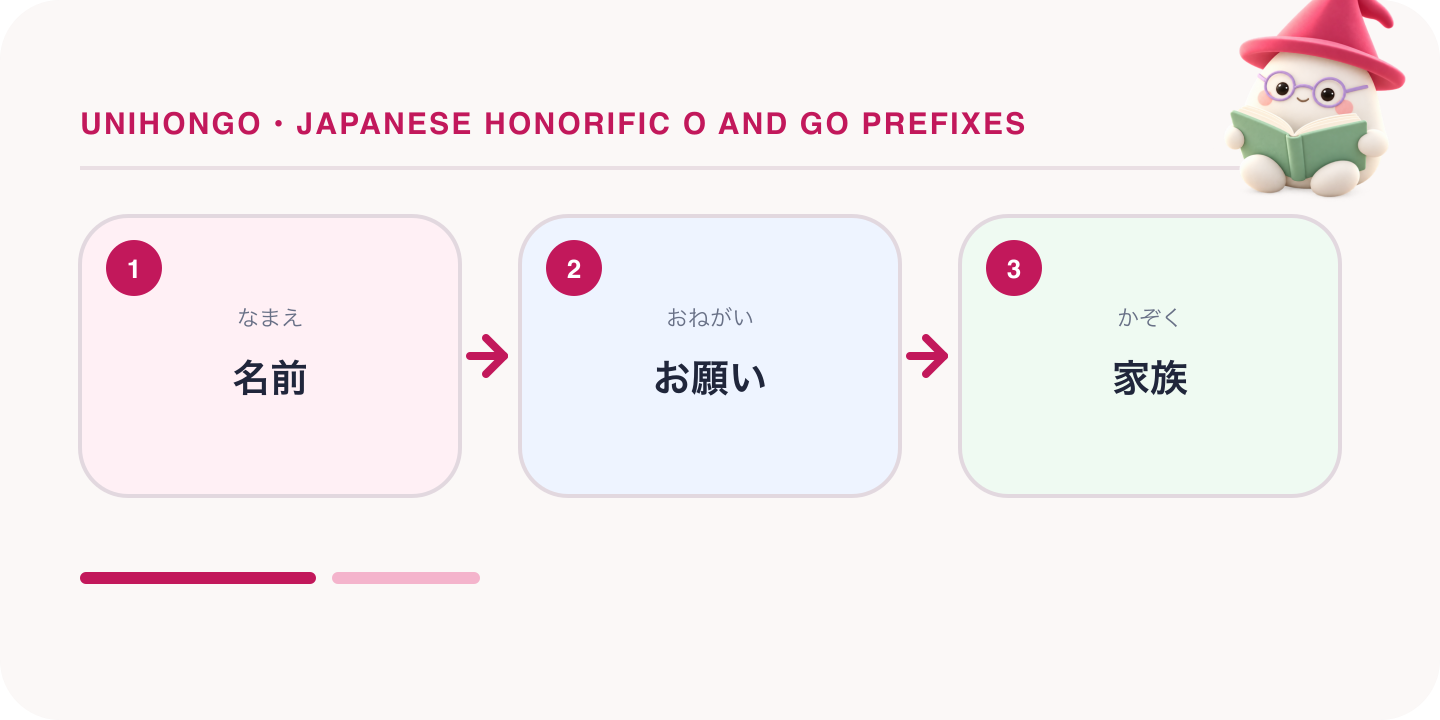
| Japanese | Romaji | Meaning |
|---|---|---|
| お名前をお願いします。 | O-namae o onegai shimasu. | Your name, please. |
| ご家族は何人ですか。 | Go-kazoku wa nan-nin desu ka. | How many people are in your family? |
| ご住所をこちらにお書きください。 | Go-jūsho o kochira ni o-kaki kudasai. | Please write your address here. |
| お仕事は何をされていますか。 | O-shigoto wa nani o sarete imasu ka. | What do you do for work? |
| ご連絡ありがとうございます。 | Go-renraku arigatō gozaimasu. | Thank you for getting in touch. |
| お国はどちらですか。 | O-kuni wa dochira desu ka. | Where are you from? |
The exceptions that break the origin rule
A handful of Sino-Japanese words take o rather than go because they entered daily life so long ago that they feel native. The ones you will meet constantly are o-denwa (telephone), o-ryōri (cooking), o-benkyō (study), o-shokuji (meal), o-jikan (time), o-henji (reply), o-kyaku (customer) and o-sōji (cleaning). Say go-denwa and a Japanese listener will pause. A few words accept both: go-henji and o-henji are both heard, go-hon and o-hon are not, but hon simply takes neither in most speech.
Loanwords written in katakana take no prefix at all in standard Japanese. Nobody says o-kōhī or go-pasokon. The exception is o-toire and o-bīru, which some older speakers use, and which you will hear in restaurants, but a learner is safest leaving all katakana words bare. When a service worker wants to be polite about a loanword, they change the sentence around it rather than the noun.
| Japanese | Romaji | Meaning |
|---|---|---|
| お電話ありがとうございます。 | O-denwa arigatō gozaimasu. | Thank you for calling. |
| お料理が上手ですね。 | O-ryōri ga jōzu desu ne. | You are a good cook. |
| お時間をいただき、ありがとうございます。 | O-jikan o itadaki, arigatō gozaimasu. | Thank you for your time. |
| お返事をお待ちしております。 | O-henji o o-machi shite orimasu. | I look forward to your reply. |
| お食事はもうお済みですか。 | O-shokuji wa mō o-sumi desu ka. | Have you already eaten? |
| コーヒーはいかがですか。 | Kōhī wa ikaga desu ka. | Would you like some coffee? (no prefix on a loanword) |
Respect versus beautification: two jobs, one prefix
The same prefix does two different things, and telling them apart solves most of the confusion. Respect use, sonkei, attaches to things that belong to or come from the listener or a respected person: their name, family, address, opinion, work, health. It points away from the speaker, so it disappears when the item is yours. You ask about someone's go-iken, their opinion, but you offer your own iken. You praise a colleague's o-shigoto, but you describe your own shigoto.
Beautification use, bika, changes the tone of the word itself rather than pointing at anyone. O-cha is simply the polite, normal word for tea; the o is not about whose tea it is. The same is true of o-kane, o-sake, o-yu (hot water), o-kome (rice), o-hana (flowers), o-kashi (sweets), o-tearai (toilet) and o-sara (plate). Women have traditionally used beautification forms more, and some, such as o-sakana or o-yasai, still sound feminine or refined, but the core set is used by everyone.
| Japanese | Romaji | Meaning |
|---|---|---|
| ご意見を聞かせてください。 | Go-iken o kikasete kudasai. | Please let me hear your opinion. (respect) |
| 私の意見は少し違います。 | Watashi no iken wa sukoshi chigaimasu. | My opinion is a little different. (no prefix on your own) |
| お茶をどうぞ。 | O-cha o dōzo. | Please have some tea. (beautification) |
| お金が足りません。 | O-kane ga tarimasen. | I do not have enough money. (beautification, even about your own) |
| お手洗いはどこですか。 | O-tearai wa doko desu ka. | Where is the toilet? |
| お菓子を買ってきました。 | O-kashi o katte kimashita. | I bought some sweets. |
Common nouns and their prefixes
The table below lists the words a learner meets most in shops, offices and hotels, with the prefix that is actually used. The Note column tells you which job the prefix does, so you know whether it stays on your own things.
| Word | Reading | Meaning | Note |
|---|---|---|---|
| お名前 | o-namae | name | respect: your own is namae |
| ご家族 | go-kazoku | family | respect: your own is kazoku |
| ご住所 | go-jūsho | address | respect: your own is jūsho |
| お仕事 | o-shigoto | work, job | respect: your own is shigoto |
| ご予約 | go-yoyaku | reservation | respect: yours is yoyaku |
| ご注文 | go-chūmon | order | respect: from staff to customer |
| お電話 | o-denwa | telephone call | exception: Sino-Japanese with o |
| お茶 | o-cha | tea | beautification: always o-cha |
| お金 | o-kane | money | beautification: always o-kane |
| お酒 | o-sake | alcohol | beautification: always o-sake |
| お湯 | o-yu | hot water | beautification: always o-yu |
| お手洗い | o-tearai | toilet | beautification: fixed word |
Note that go-chūmon and go-yoyaku are what staff say to you, and what you say when referring to the customer's or the other party's booking. When you make your own booking you say yoyaku shitai n desu ga, without go, unless you are in a very formal exchange where the whole sentence is humble.
Adjectives and verbs that take the prefix
A limited set of adjectives take o or go, almost always when they describe the listener or a respected person. I-adjectives take o: o-isogashii (busy), o-wakai (young), o-hayai (early, as in the greeting), o-utsukushii (beautiful, formal). Na-adjectives split by origin: o-genki (well), o-hima (free), o-suki (like) take o; go-shinsetsu (kind), go-rippa (splendid), go-nesshin (keen) take go. These forms are common in set expressions: o-isogashii tokoro, while you are busy; o-genki desu ka, how are you; go-shinsetsu ni, kindly.
The prefix also opens the door to honorific verb patterns, o plus the masu stem plus ni naru for respect and o plus the stem plus suru for humility. O-kaki ni narimasu ka, will you write; o-mochi shimasu, I will carry it. Sino-Japanese verbal nouns take go the same way: go-setsumei shimasu, I will explain; go-riyō kudasai, please use it. A separate post treats those verb patterns in full; here the point is that the o and go you learn for nouns are the same prefixes, obeying the same origin rule.
| Japanese | Romaji | Meaning |
|---|---|---|
| お忙しいところ、すみません。 | O-isogashii tokoro, sumimasen. | Sorry to bother you while you are busy. |
| お元気ですか。 | O-genki desu ka. | How are you? |
| ご親切にありがとうございます。 | Go-shinsetsu ni arigatō gozaimasu. | Thank you for your kindness. |
| お若いですね。 | O-wakai desu ne. | You look young. |
| ご説明します。 | Go-setsumei shimasu. | I will explain. (humble) |
| こちらをご利用ください。 | Kochira o go-riyō kudasai. | Please use this one. |
| お荷物をお持ちします。 | O-nimotsu o o-mochi shimasu. | I will carry your bags. (humble) |
Words that never take a prefix
Knowing where the prefix does not go is half the skill. The list below covers the categories that stay bare no matter how polite the situation. Rather than adding a prefix, make the surrounding verb polite, or add a softener such as yoroshikereba or sumimasen ga.
- Katakana loanwords: kōhī, pasokon, meeru, pen, terebi
- Your own name, family, opinion and work in respect contexts: namae, kazoku, iken, shigoto
- Animals, most plants and natural features: inu, neko, yama, kawa (o-hana for flowers is the main exception)
- Long Sino-Japanese compounds of three or more kanji: kenkō shindan, jūmin hyō
- Negative or unpleasant words: byōki, jiko, shakkin (o-shikko and o-naka are fused exceptions, not a pattern)
- Words that are already honorific: sensei, sama, kata (as in kono kata, this person)
The one bare-word trap that catches almost everyone is namae. Because you hear o-namae from every clerk, it starts to feel like the word itself. It is not. Watashi no namae wa Tanaka desu is correct; watashi no o-namae is wrong.
Common mistakes with o and go
The most frequent mistake is prefixing your own things. Watashi no go-kazoku, watashi no o-shigoto and watashi no o-namae all sound as if you are honouring yourself, which in Japanese reads as either comic or arrogant. The fix is a habit: any time watashi no or a humble verb is in the sentence, drop respect prefixes from your own nouns.
The second mistake is over-prefixing everything to seem polite. Learners who have heard shop staff pile up o and go copy the density into ordinary conversation, producing o-kōhī o o-nomi ni narimasu ka to a friend. Match the level of the person you are talking to. The third mistake is the wrong prefix on a Sino-Japanese word that takes o, go-denwa and go-ryōri being the commonest. The fourth is prefixing a word that is already polite, o-sensei or go-sama. And the last is dropping beautification o from o-cha, o-kane and o-tearai in an attempt to sound casual, which sounds rough rather than relaxed.
| Japanese | Romaji | Meaning |
|---|---|---|
| 私の名前は田中です。 | Watashi no namae wa Tanaka desu. | My name is Tanaka. (no prefix) |
| 家族は東京に住んでいます。 | Kazoku wa Tōkyō ni sunde imasu. | My family lives in Tokyo. (no prefix) |
| 田中さんのご家族はお元気ですか。 | Tanaka-san no go-kazoku wa o-genki desu ka. | Is your family well, Mr Tanaka? (respect) |
| コーヒー、飲む? | Kōhī, nomu? | Want a coffee? (casual, no prefix) |
| お茶、飲む? | O-cha, nomu? | Want some tea? (casual, but o-cha stays) |
| 先生に聞いてみます。 | Sensei ni kiite mimasu. | I will ask the teacher. (sensei takes no prefix) |