

The core idea: an open hand, not a fingertip
Koko is a fingertip on a map: this exact spot. Kochira is an open hand swept towards one side of the room: over this way. The first and most literal use is direction. Kochira is the side where the speaker is, sochira the side where the listener is, achira a side away from both, and dochira asks which side.
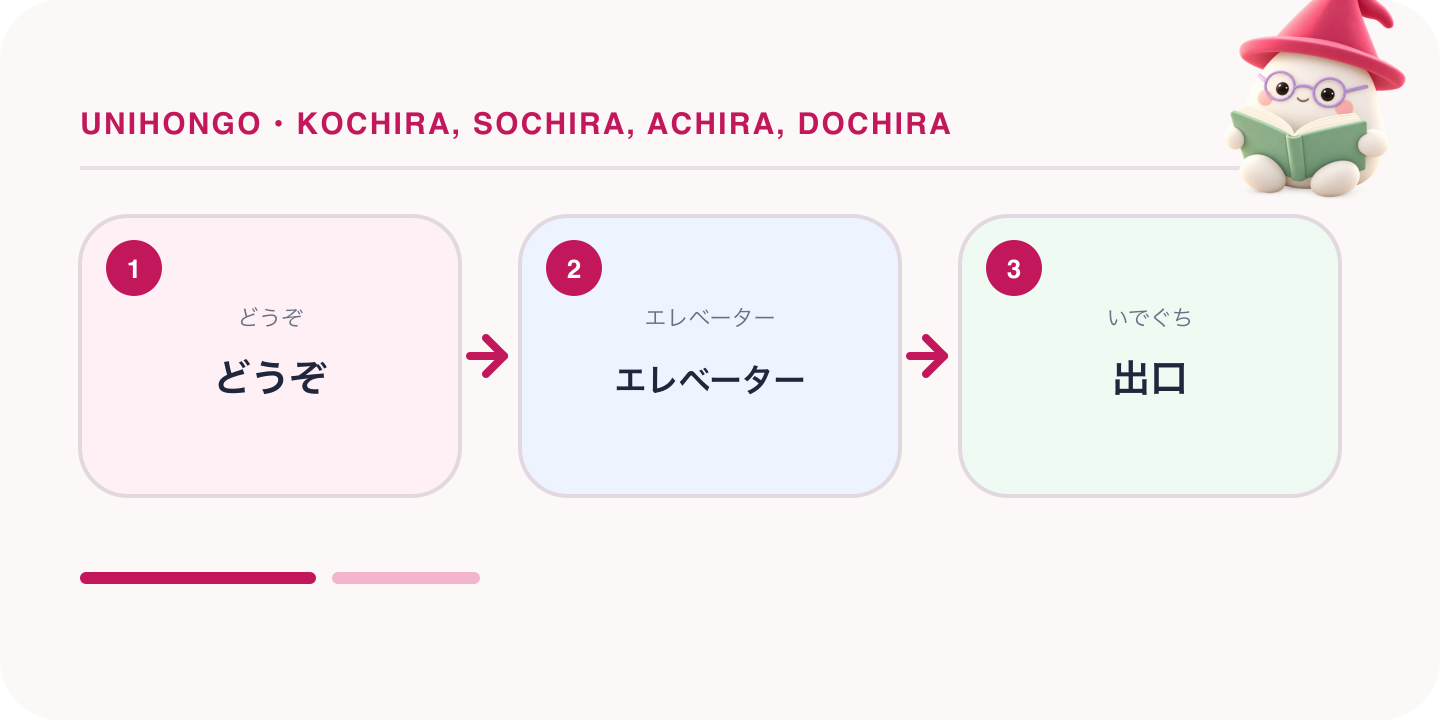
You arrive at a restaurant and the host leads you in. Later you need the exit. These are the sentences you will hear and need on the first day of any trip.
| Japanese | Romaji | Meaning |
|---|---|---|
| こちらへどうぞ。 | Kochira e dōzo. | This way, please. |
| エレベーターはあちらです。 | Erebētā wa achira desu. | The lifts are over that way. |
| 出口はどちらですか。 | Deguchi wa dochira desu ka. | Which way is the exit? |
| そちらに行ってもいいですか。 | Sochira ni itte mo ii desu ka. | May I come over to where you are? |
How it is built: four nouns and their casual forms
| Word | Reading | Casual form | Meaning |
|---|---|---|---|
| こちら | kochira | kocchi | this way; politely: here, this, I or we |
| そちら | sochira | socchi | that way, your side; politely: there, that, you |
| あちら | achira | acchi | over that way; politely: over there, that person |
| どちら | dochira | docchi | which way; politely: where, which of two, who |
All four are nouns, and that decides the grammar. They take particles like any noun, kochira e, kochira ni, kochira wa, and they need no before another noun: kochira no seki, this seat, and kochira no kata, this person. Kochira seki is not possible, because kochira is not a modifier like kono.
The casual forms swap chira for a doubled consonant plus chi. They mean the same things but belong to conversation between friends and family.
Polite replacement for koko and kore
Here is the step that makes these words so common. Pointing directly at a place or an object is felt to be a little sharp, so polite Japanese points at the general direction instead. Kochira stands in for koko and kore, sochira for soko and sore, achira for asoko and are, and dochira for doko. You are checking in at a hotel, and the clerk speaks to you like this.
You do not have to answer in the same style. A guest can say kore o onegai shimasu and sound perfectly polite. Kochira is expected from the person giving service, and from anyone speaking formally at work.
| Japanese | Romaji | Meaning |
|---|---|---|
| こちらにお名前をお願いします。 | Kochira ni o-namae o onegai shimasu. | Your name here, please. |
| こちらがお部屋の鍵です。 | Kochira ga o-heya no kagi desu. | This is your room key. |
| お手洗いはあちらにございます。 | O-tearai wa achira ni gozaimasu. | The toilets are over there. |
| こちらでよろしいですか。 | Kochira de yoroshii desu ka. | Will this one be all right? |
| お国はどちらですか。 | O-kuni wa dochira desu ka. | Where are you from? (Literally: your country is in which direction?) |
Minimal pairs: fingertip against open hand
| Sentence | Reading | What it says |
|---|---|---|
| トイレはあそこです。 | Toire wa asoko desu. | The toilet is there, at that spot: neutral, to anyone |
| トイレはあちらです。 | Toire wa achira desu. | The toilet is over that way: polite, to a guest |
| これはいくらですか。 | Kore wa ikura desu ka. | How much is this: ordinary customer speech |
| こちらはいくらですか。 | Kochira wa ikura desu ka. | How much is this one: more refined, slightly formal |
| どれがいいですか。 | Dore ga ii desu ka. | Which is best, out of three or more |
| どちらがいいですか。 | Dochira ga ii desu ka. | Which of the two is better |
In the first two pairs the facts are identical and only the manners change. The third pair is different: there the word changes the meaning, because dochira assumes exactly two candidates. A waiter holding two desserts asks dochira; a waiter in front of a full trolley asks dore.
Introducing people: kochira wa Tanaka-san desu
Kore is the word for objects, so using it for a person you wish to honour sounds like labelling a parcel. Kochira solves the problem by indicating the side where the person stands. Kochira wa Tanaka-san desu is the standard introduction. (Literally: as for this side, it is Tanaka-san.) You are at a reception with your colleague Suzuki and meet a client, Ms Tanaka.
Notice that Suzuki loses the san when you introduce him to someone outside your company, because he belongs to your side. The reply kochira koso uses kochira for the speaker: it is my side that should be saying so.
| Japanese | Romaji | Meaning |
|---|---|---|
| こちらは田中さんです。 | Kochira wa Tanaka-san desu. | This is Ms Tanaka. |
| こちらは同僚の鈴木です。 | Kochira wa dōryō no Suzuki desu. | This is my colleague Suzuki. |
| こちらこそ、よろしくお願いします。 | Kochira koso, yoroshiku onegai shimasu. | The pleasure is mine. (Literally: it is this side that asks for your favour.) |
| あちらの方はどなたですか。 | Achira no kata wa donata desu ka. | Who is the person over there? |
| こっちは友達のケン。 | Kocchi wa tomodachi no Ken. | This is my friend Ken. |
Beyond the basics: kochira and sochira on the phone
On the telephone there is nothing to point at, only two ends of a line. Kochira becomes my end, which covers me, my company and my town, and sochira becomes your end. This gives Japanese a polite way to say I and you without using watashi or anata, and anata is a word most speakers avoid with customers and strangers.
You are calling a hotel in Sapporo from Tokyo. The receptionist answers, you ask for a member of staff and chat about the weather, and she promises a call back.
| Japanese | Romaji | Meaning |
|---|---|---|
| こちらはさくらホテルでございます。 | Kochira wa Sakura Hoteru de gozaimasu. | This is the Sakura Hotel. |
| そちらに田中さんはいらっしゃいますか。 | Sochira ni Tanaka-san wa irasshaimasu ka. | Is Mr Tanaka there? |
| そちらの天気はどうですか。 | Sochira no tenki wa dō desu ka. | How is the weather where you are? |
| こちらからお電話します。 | Kochira kara o-denwa shimasu. | I will call you. (Literally: I will telephone from this side.) |
| どちら様でしょうか。 | Dochira-sama deshō ka. | May I ask who is calling? |
Docchi and dochira: a choice between two
Two options are two sides, so the direction word doubles as the word for which of two. With friends this is nearly always docchi. The answers reuse the family: kocchi for the one nearer me, socchi for the one nearer you. The full comparison pattern with yori and no hō ga has its own article; what matters here is the limit of two, and the useful extras docchi demo, either, and docchi mo, both.
The casual forms are also the everyday words for movement and position at home: kocchi kite, acchi itte. They are warm with family and friends and too familiar for a customer.
| Japanese | Romaji | Meaning |
|---|---|---|
| コーヒーと紅茶、どっちがいい? | Kōhī to kōcha, docchi ga ii? | Coffee or tea, which do you want? |
| どっちでもいいよ。 | Docchi demo ii yo. | Either is fine. |
| こっちのほうが安いね。 | Kocchi no hō ga yasui ne. | This one's cheaper, isn't it. |
| どちらもおいしいです。 | Dochira mo oishii desu. | Both are delicious. |
| こっち来て。 | Kocchi kite. | Come over here. |
Neighbours: kono kata, donata and dare
Kono kata also means this person politely. The difference is position in the sentence: kochira stands alone as a noun and suits the moment of introduction, while kono kata is the ordinary way to go on talking about the person afterwards. For who, the ladder is dare, plain; donata, polite; dochira-sama, for callers and visitors whose name you need.
| Japanese | Romaji | Meaning |
|---|---|---|
| この方は私の先生です。 | Kono kata wa watashi no sensei desu. | This person is my teacher. |
| 失礼ですが、どなたですか。 | Shitsurei desu ga, donata desu ka. | Excuse me, but who are you? |
Common mistakes with kochira and dochira
The first mistake is kore wa Tanaka-san desu in an introduction. It is wrong in tone, and it comes from English 'this is'. Kore is for things. Say kochira wa Tanaka-san desu.
The second is kochira hito or kochira seki. These are wrong because learners treat kochira like kono. Kochira is a noun and needs no: kochira no kata, kochira no seki.
The third is dochira for a choice among many, as in kono itsutsu no naka de dochira ga ii desu ka. With five options this is wrong; the direction word only has two sides. Use dore.
The fourth is anata wa dare desu ka on the phone. Each word is correct and the whole is rude, a word-for-word copy of 'who are you'. Say dochira-sama deshō ka.
The fifth is a register slip: kocchi e dōzo to a client. Learners pick up kocchi from friends and anime and use it everywhere. With customers and seniors, return to kochira.