
Three jobs, one shape
Te iru attaches to the te-form of a verb, and the whole unit behaves like a new verb: polite te imasu, plain te iru, negative te imasen, past te imashita. What changes is what the combination reports. With a verb whose action occupies time, it reports that the action is under way. With a time expression such as mainichi or shū ni ni-kai, the same shape reports a repeated habit. With a verb that names an instant change, it reports the state that the change left behind.
Because English uses one -ing form for the first two and a completely different structure for the third, learners tend to translate rather than choose. The reliable move is to sort the verb first and then predict the meaning. Once you can say which of the three a verb produces, you stop guessing and start hearing the difference in what Japanese speakers say to you.
Building the form from the dictionary form
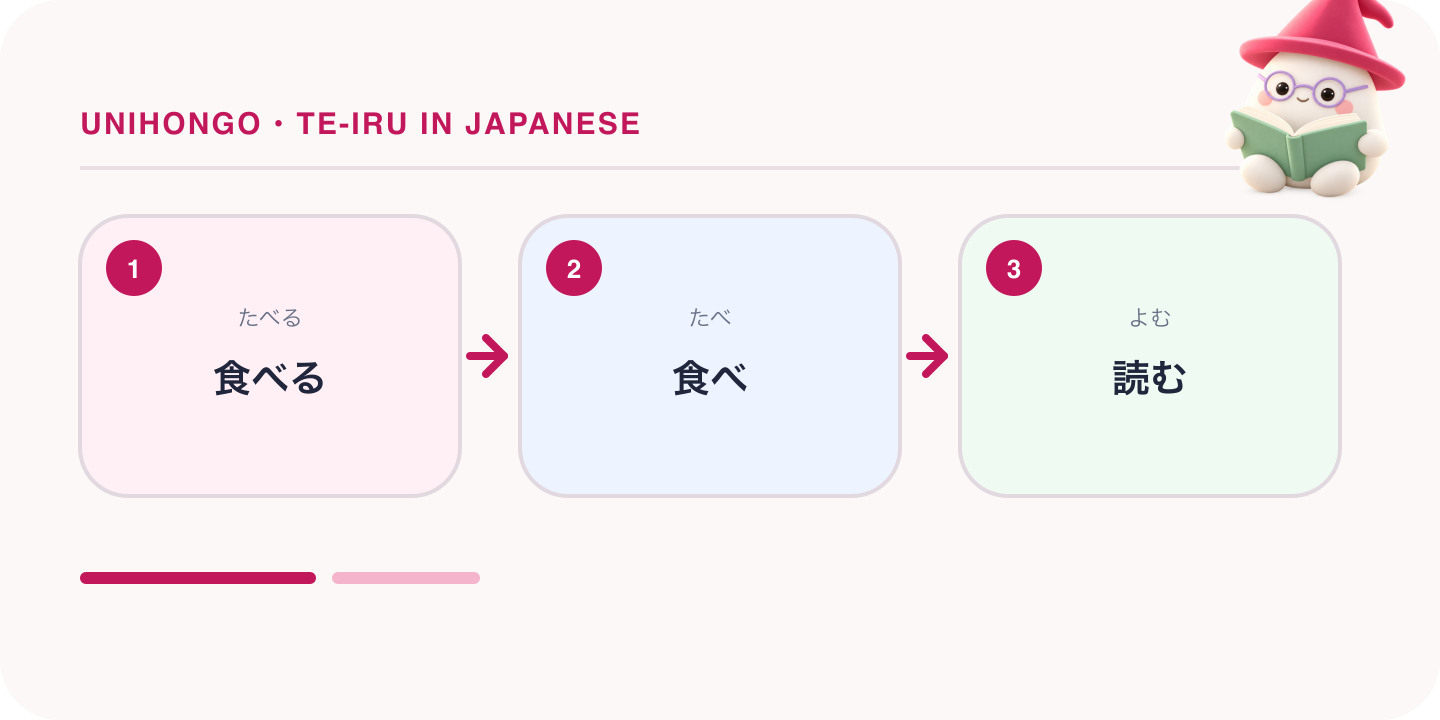
Take the dictionary form, make the te-form, and add imasu. Ichidan verbs drop ru and add te, so taberu becomes tabete and tabete imasu. Godan verbs follow the sound groups: u, tsu and ru become tte, so matsu becomes matte; mu, bu and nu become nde, so yomu becomes yonde; ku becomes ite and gu becomes ide, so kaku becomes kaite and oyogu becomes oyoide; su becomes shite, so hanasu becomes hanashite. Suru becomes shite and kuru becomes kite, and the one high-frequency exception is iku, which becomes itte. The dedicated te-form guide drills the conjugation itself if you need it.
| Japanese | Romaji | Meaning |
|---|---|---|
| 食べる → 食べています。 | Taberu → tabete imasu. | To eat, becoming I am eating. |
| 読む → 読んでいます。 | Yomu → yonde imasu. | To read, becoming I am reading. |
| 待つ → 待っています。 | Matsu → matte imasu. | To wait, becoming I am waiting. |
| 書く → 書いています。 | Kaku → kaite imasu. | To write, becoming I am writing. |
| する → しています。 | Suru → shite imasu. | To do, becoming I am doing. |
| 来る → 来ています。 | Kuru → kite imasu. | To come, becoming has come and is here. |
The verb decides the reading
| Verb type | Typical verbs | What te iru reports | Example |
|---|---|---|---|
| Action that lasts over time | 読む yomu, 書く kaku, 話す hanasu, 降る furu | The action is in progress now | 雨が降っています Ame ga futte imasu, it is raining |
| Action that lasts, with a time expression | 働く hataraku, 通う kayou, 勉強する benkyō suru | A habit or repeated action | 毎日勉強しています Mainichi benkyō shite imasu, I study every day |
| Instant change of state | 結婚する kekkon suru, 死ぬ shinu, 割れる wareru, 落ちる ochiru | The state left behind by the change | 結婚しています Kekkon shite imasu, I am married |
| Movement to a place | 行く iku, 来る kuru, 帰る kaeru | The person went or came and is still there | 大阪に行っています Ōsaka ni itte imasu, he has gone to Osaka |
| Wearing, holding, knowing | 着る kiru, 持つ motsu, 知る shiru, 住む sumu | The state of wearing, having, knowing, living | 持っています Motte imasu, I have it |
| Verbs that are already states | いる iru, ある aru, 要る iru to need | No te iru form in ordinary use | います Imasu, is present, never いています |
One useful test: ask whether the verb names something you could be halfway through. You can be halfway through reading, so yonde imasu is in progress. You cannot be halfway through dying in ordinary speech, so shinde imasu jumps to the far side of the change and means is dead. Japanese uses shini-kakete imasu or a different construction for the dying part.
Action in progress
This is the reading learners already expect, and it is the safest place to start speaking. Add ima at the front when you want to make now explicit, and expect the same shape back in the reply. Nani o shite imasu ka is the everyday question that pulls this form out of the other person, and the answer is almost never a bare masu form.
| Japanese | Romaji | Meaning |
|---|---|---|
| 今、何をしていますか? | Ima, nani o shite imasu ka? | What are you doing right now? |
| レポートを書いています。 | Repōto o kaite imasu. | I am writing a report. |
| 雨が降っています。 | Ame ga futte imasu. | It is raining. |
| 子供が公園で遊んでいます。 | Kodomo ga kōen de asonde imasu. | The children are playing in the park. |
| バスを待っています。 | Basu o matte imasu. | I am waiting for the bus. |
| すみません、道に迷っています。 | Sumimasen, michi ni mayotte imasu. | Excuse me, I am lost. |
Habit and repetition
Add a frequency or period expression and the same form stops meaning at this second. Mainichi, maiasa, saikin, kotoshi and shū ni ni-kai all push te imasu toward habit. This is how Japanese speakers answer questions about work, study and routine, so it is worth more to you than the progressive reading in a first conversation. The plain masu form is also possible here, but te imasu adds the sense of an arrangement that is currently running.
| Japanese | Romaji | Meaning |
|---|---|---|
| 銀行で働いています。 | Ginkō de hataraite imasu. | I work at a bank. |
| 毎朝六時に走っています。 | Maiasa roku-ji ni hashitte imasu. | I run at six every morning. |
| 週に三回ジムに通っています。 | Shū ni san-kai jimu ni kayotte imasu. | I go to the gym three times a week. |
| 大阪に住んでいます。 | Ōsaka ni sunde imasu. | I live in Osaka. |
| どんな仕事をしていますか? | Donna shigoto o shite imasu ka? | What kind of work do you do? |
| ソフトウェアの会社で働いています。 | Sofutowea no kaisha de hataraite imasu. | I work at a software company. |
Resulting state
Change-of-state verbs describe a moment, not a stretch: a window opens, a light goes out, a wallet falls, a person marries. Te iru with these verbs points at the world after that moment. Notice how many of them are intransitive and take ga, because you are describing a condition rather than an action someone is performing. These sentences are the ones learners avoid, and they are exactly what you need to report a problem in a shop, a hotel or an office.
| Japanese | Romaji | Meaning |
|---|---|---|
| 窓が開いています。 | Mado ga aite imasu. | The window is open. |
| 電気が消えています。 | Denki ga kiete imasu. | The light is off. |
| コップが割れています。 | Koppu ga warete imasu. | The glass is broken. |
| 財布が落ちていますよ。 | Saifu ga ochite imasu yo. | You have dropped your wallet. |
| 席が空いています。 | Seki ga aite imasu. | The seat is free. |
| エアコンが壊れています。 | Eakon ga kowarete imasu. | The air conditioner is broken. |
| お腹がすいています。 | Onaka ga suite imasu. | I am hungry. |
| ちょっと疲れています。 | Chotto tsukarete imasu. | I am a little tired. |
Kowarete imasu is the sentence that gets a problem fixed, and kowaremashita is not a good substitute: the past tense reports the moment of breaking, while te imasu reports that it is broken now and needs attention. The same holds for aite imasu and shimatte imasu when you ask whether a shop is open or closed.
The verbs learners get wrong
Six verbs cause most of the trouble because English uses a simple present for them while Japanese insists on te iru. Shiru, motsu, sumu and kiru name a change into a state, so knowing, having, living and wearing are all te iru in Japanese. Iku and kuru report that someone made the trip and is still at the other end, which is why itte imasu never means is going.
Shiru also has a famously uneven negative. The positive is shitte imasu, but for I do not know say shirimasen. Shitte imasen is possible in narrow contexts but sounds wrong as an everyday answer, and it is the single most common slip in this area.
| Japanese | Romaji | Meaning |
|---|---|---|
| 田中さんを知っていますか? | Tanaka-san o shitte imasu ka? | Do you know Tanaka? |
| はい、知っています。 | Hai, shitte imasu. | Yes, I know him. |
| いいえ、知りません。 | Iie, shirimasen. | No, I do not know him. |
| 免許を持っています。 | Menkyo o motte imasu. | I have a licence. |
| 白いシャツを着ています。 | Shiroi shatsu o kite imasu. | He is wearing a white shirt. |
| 眼鏡をかけています。 | Megane o kakete imasu. | She wears glasses. |
| 帽子をかぶっています。 | Bōshi o kabutte imasu. | He has a hat on. |
| 部長はもう帰っています。 | Buchō wa mō kaette imasu. | The manager has already gone home. |
| 田中は今、大阪に行っています。 | Tanaka wa ima, Ōsaka ni itte imasu. | Tanaka has gone to Osaka. |
| 先生はまだ来ていません。 | Sensei wa mada kite imasen. | The teacher has not arrived yet. |
Teru, the negative, and te ita
In casual speech the i of iru disappears. Tabete imasu becomes tabeteru, tabete imasen becomes tabetenai, and tabete imashita becomes tabeteta. Keep the full form with staff, teachers, clients and anyone you have just met, and let the contraction come out with friends. The negative te imasen is also how Japanese says not yet: mada tabete imasen means I have not eaten yet, while tabemasen deshita reports that you did not eat on some finished occasion.
Te imashita puts the whole thing in the past. With a durative verb it gives was doing, and with a change-of-state verb it gives was in that state at the time. Matte imashita is one of the most useful lines in the set, because it tells someone you were already waiting rather than that you waited and stopped.
| Japanese | Romaji | Meaning |
|---|---|---|
| 今、何してるの? | Ima, nani shiteru no? | What are you up to? (casual) |
| ご飯食べてる。 | Gohan tabeteru. | I am eating. (casual) |
| まだ終わってない。 | Mada owattenai. | It is not finished yet. (casual) |
| まだ食べていません。 | Mada tabete imasen. | I have not eaten yet. |
| 昨日は食べませんでした。 | Kinō wa tabemasen deshita. | I did not eat yesterday. |
| 去年は東京で働いていました。 | Kyonen wa Tōkyō de hataraite imashita. | Last year I was working in Tokyo. |
| さっきまで雨が降っていました。 | Sakki made ame ga futte imashita. | It was raining until a moment ago. |
| 三十分待っていました。 | Sanjuppun matte imashita. | I had been waiting for thirty minutes. |
Te aru and the o-to-ga shift
Te aru is the neighbour of the resulting state. It uses a transitive verb and reports that someone did the action on purpose and left the result in place, ready for a reason. The grammar shifts with the meaning: the noun that was the object with o becomes the subject with ga. Mado o akemashita, I opened the window, becomes mado ga akete arimasu, the window has been opened and left that way.
Compare the three sentences about a window and the difference becomes concrete. Mado o akete imasu describes someone in the act of opening it. Mado ga aite imasu simply reports that it is open. Mado ga akete arimasu says it is open because a person opened it and meant it to stay open. In an office, te aru is how you say the preparation is done.
| Japanese | Romaji | Meaning |
|---|---|---|
| 窓を開けています。 | Mado o akete imasu. | Someone is opening the window. |
| 窓が開いています。 | Mado ga aite imasu. | The window is open. |
| 窓が開けてあります。 | Mado ga akete arimasu. | The window has been opened and left open. |
| 会議室が予約してあります。 | Kaigishitsu ga yoyaku shite arimasu. | The meeting room has been booked. |
| ここに名前が書いてあります。 | Koko ni namae ga kaite arimasu. | A name is written here. |
| 冷蔵庫にビールが入れてあります。 | Reizōko ni bīru ga irete arimasu. | Beer has been put in the fridge for you. |
In casual speech you will also hear the object particle kept, as in yoyaku shite aru, and it is understood. Produce the ga version yourself until the pattern is automatic, because it is the form that makes the deliberate preparation reading clear.
Minimal pairs worth memorising
| Sentence A | Sentence B | What changes |
|---|---|---|
| 食べます Tabemasu, I eat or I will eat | 食べています Tabete imasu, I am eating | Masu gives a habit or a plan; te imasu puts the action under way now |
| 死にます Shinimasu, will die | 死んでいます Shinde imasu, is dead | Shinu names an instant, so te iru lands on the far side of it |
| 行きます Ikimasu, I go or I will go | 行っています Itte imasu, has gone and is there | Movement verbs give arrival and presence, never is on the way |
| 知りません Shirimasen, I do not know | 知っています Shitte imasu, I know | The positive needs te imasu; the negative drops it |
| まだ食べていません Mada tabete imasen, I have not eaten yet | 食べませんでした Tabemasen deshita, I did not eat | Te imasen leaves the action still pending; the past closes it |
| 窓が開いています Mado ga aite imasu, the window is open | 窓が開けてあります Mado ga akete arimasu, the window has been left open | Te aru adds a person who did it deliberately |
A drill that fixes the three readings
- Narrate thirty seconds of what is around you using only in-progress te imasu sentences, with no pauses to translate.
- Answer five questions about your life with habit te imasu: where you live, work, study, exercise and shop.
- Describe three things in your room that are in a state: something open, something broken, something switched off.
- Say the six troublesome verbs in full sentences, then say the shiru negative correctly twice: shirimasen, not shitte imasen.
- Take one object and produce the trio: someone opening it, its state, and its state with te aru.
- Repeat the whole set in the past with te imashita, then again casually with teru and teta.