
What koto is doing in the sentence
Koto packages a verb phrase into a noun so the rest of the sentence can talk about it. Nihon ni iku means go to Japan; nihon ni iku koto means the act of going to Japan, and once it is a noun it can be the thing that exists, the thing you can do, or the thing you decided. Every pattern in this guide is that one move followed by an ordinary verb, which is why they all end in arimasu, dekimasu, shimasu, or narimasu.
That is also why the patterns feel long. Japanese does not add a special ending for experience or ability; it makes a noun and then says the noun exists or is possible. If you keep that image, you will attach the right ending without memorising four unrelated shapes, and you will hear the pattern coming in someone else's speech as soon as koto arrives.
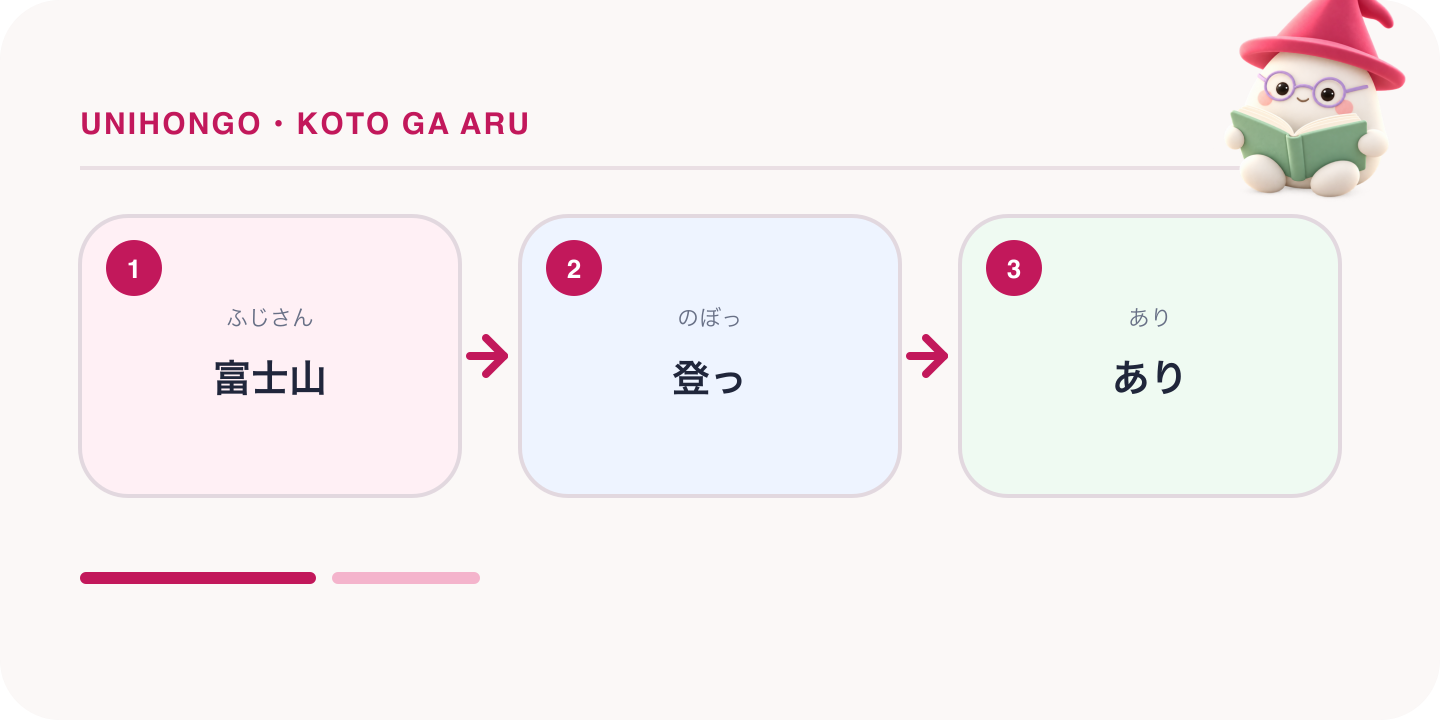
The koto patterns at a glance
| Pattern | Meaning | Example |
|---|---|---|
| V-ta + koto ga aru | Have done it at some point in life | 北海道に行ったことがあります (Hokkaidō ni itta koto ga arimasu) |
| V-dictionary + koto ga aru | It happens occasionally | 電車が遅れることがあります (Densha ga okureru koto ga arimasu) |
| V-dictionary + koto ga dekiru | Can do it, is able or permitted | ここで払うことができます (Koko de harau koto ga dekimasu) |
| V-dictionary + koto ni suru | I have decided to do it | 毎朝走ることにしました (Maiasa hashiru koto ni shimashita) |
| V-dictionary + koto ni naru | It has been decided that it will happen | 大阪で働くことになりました (Ōsaka de hataraku koto ni narimashita) |
Only the first row uses the past form of the verb. Everything else attaches to the plain dictionary form, so the visible difference between have done it and it sometimes happens is a single syllable. Say the two example sentences back to back a few times until the ta in the first one stands out to your own ear.
Building the experience form from the dictionary form
The experience pattern needs the plain past, the ta form. If you already know the te form, swap the final e for a, since the sound changes are identical: nonde becomes nonda, itte becomes itta, tabete becomes tabeta. Ichidan verbs simply drop ru and add ta. The two irregulars are suru to shita and kuru to kita, which is read kita with a short i.
| Dictionary form | Plain past | Experience form |
|---|---|---|
| 行く (iku, go) | 行った (itta) | 行ったことがあります (itta koto ga arimasu) |
| 食べる (taberu, eat) | 食べた (tabeta) | 食べたことがあります (tabeta koto ga arimasu) |
| 見る (miru, see) | 見た (mita) | 見たことがあります (mita koto ga arimasu) |
| 飲む (nomu, drink) | 飲んだ (nonda) | 飲んだことがあります (nonda koto ga arimasu) |
| 泳ぐ (oyogu, swim) | 泳いだ (oyoida) | 泳いだことがあります (oyoida koto ga arimasu) |
| 話す (hanasu, speak) | 話した (hanashita) | 話したことがあります (hanashita koto ga arimasu) |
| 待つ (matsu, wait) | 待った (matta) | 待ったことがあります (matta koto ga arimasu) |
| 登る (noboru, climb) | 登った (nobotta) | 登ったことがあります (nobotta koto ga arimasu) |
| する (suru, do) | した (shita) | したことがあります (shita koto ga arimasu) |
| 来る (kuru, come) | 来た (kita) | 来たことがあります (kita koto ga arimasu) |
Experience, not a dated event
This is the rule that decides whether a sentence sounds native. Ta koto ga aru counts something into your life history: you have climbed Mount Fuji, you have eaten nattō, you have been to a Japanese wedding. It cannot report a single event pinned to a time. As soon as you say kinō, senshū, or san-ji ni, the sentence has to become the plain polite past.
The same restriction blocks things everyone does routinely. Gohan o tabeta koto ga arimasu sounds absurd because eating is not a rare achievement. Use the pattern where the answer might genuinely be no, and use the past tense for what happened on a particular day.
| Japanese | Romaji | Meaning |
|---|---|---|
| 富士山に登ったことがあります。 | Fujisan ni nobotta koto ga arimasu. | I have climbed Mount Fuji. |
| 昨日、寿司を食べました。 | Kinō, sushi o tabemashita. | I ate sushi yesterday. |
| 日本の結婚式に行ったことがあります。 | Nihon no kekkonshiki ni itta koto ga arimasu. | I have been to a Japanese wedding. |
| 先週、京都に行きました。 | Senshū, Kyōto ni ikimashita. | I went to Kyoto last week. |
| 歌舞伎を見たことがあります。 | Kabuki o mita koto ga arimasu. | I have seen kabuki. |
| 三時に先生と話しました。 | San-ji ni sensei to hanashimashita. | I spoke with the teacher at three. |
A useful test before you speak: could you follow the sentence with itsu desu ka and expect an answer? If yes, you are describing an event, so use the past tense. If the natural follow-up is nan-kai desu ka, how many times, you are describing experience and koto ga arimasu is right.
Dictionary form plus koto ga aru for what sometimes happens
Keep the verb in the dictionary form and the same ending stops meaning experience and starts meaning frequency. Densha ga okureru koto ga arimasu tells your colleague that trains are late from time to time, not that a train was once late. Adverbs such as tama ni, toki doki, and mare ni sit naturally in front of it, and a plain negative works too: tabenai koto ga arimasu, there are times I do not eat.
| Japanese | Romaji | Meaning |
|---|---|---|
| 電車が遅れることがあります。 | Densha ga okureru koto ga arimasu. | The trains are sometimes late. |
| たまに日本語で電話することがあります。 | Tama ni nihongo de denwa suru koto ga arimasu. | Occasionally I make phone calls in Japanese. |
| 朝ごはんを食べないことがあります。 | Asagohan o tabenai koto ga arimasu. | There are times when I skip breakfast. |
| 休みの日に会社に行くことがあります。 | Yasumi no hi ni kaisha ni iku koto ga arimasu. | I sometimes go to the office on days off. |
| この店は早く閉まることがあります。 | Kono mise wa hayaku shimaru koto ga arimasu. | This shop occasionally closes early. |
Koto ga dekiru beside the potential form
Koto ga dekiru turns the verb into a noun and says it is possible. The potential form does the same job inside the verb itself: hanasu becomes hanaseru, yomu becomes yomeru, taberu becomes taberareru, kuru becomes korareru, and suru simply becomes dekiru. Both are correct, so the choice is about register. The long form sounds more formal and explicit, which suits notices, rules, and careful explanations; the potential form is shorter and dominates ordinary speech.
One detail matters when you swap them. Koto ga dekiru keeps the object marked with o, because the object still belongs to the inner verb: nihongo o hanasu koto ga dekimasu. The potential form usually takes ga instead: nihongo ga hanasemasu. Mixing the two, as in nihongo ga hanasu koto ga dekimasu, is the mistake to watch for.
| Japanese | Romaji | Meaning |
|---|---|---|
| 日本語を話すことができます。 | Nihongo o hanasu koto ga dekimasu. | I am able to speak Japanese. |
| 日本語が話せます。 | Nihongo ga hanasemasu. | I can speak Japanese. |
| ここで写真を撮ることができますか? | Koko de shashin o toru koto ga dekimasu ka? | Is it possible to take photos here? |
| カードで払うことができます。 | Kādo de harau koto ga dekimasu. | You can pay by card. |
| 漢字はまだあまり読めません。 | Kanji wa mada amari yomemasen. | I still cannot read much kanji. |
| 明日は来ることができません。 | Ashita wa kuru koto ga dekimasen. | I will not be able to come tomorrow. |
If you want one rule for speaking: use the potential form with friends and colleagues, and reach for koto ga dekimasu when you are explaining a rule, reading a sign back, or answering an interviewer who asked what you are able to do.
Koto ni suru for your decision
Koto ni suru presents a choice you made. The past koto ni shimashita is the usual conversational form, since you normally report a decision after making it. The negative attaches to the plain negative verb, not to shimasu: ikanai koto ni shimashita, I decided not to go. There is also a continuous koto ni shite imasu, which describes a rule you have set yourself and still keep, and it is the neatest way to talk about a habit you chose on purpose.
| Japanese | Romaji | Meaning |
|---|---|---|
| 毎朝走ることにしました。 | Maiasa hashiru koto ni shimashita. | I have decided to run every morning. |
| 今年、日本語の試験を受けることにしました。 | Kotoshi, nihongo no shiken o ukeru koto ni shimashita. | I decided to take the Japanese exam this year. |
| 今日は行かないことにしました。 | Kyō wa ikanai koto ni shimashita. | I decided not to go today. |
| 毎日十五分、日本語を話すことにしています。 | Mainichi jūgo-fun, nihongo o hanasu koto ni shite imasu. | I make a point of speaking Japanese for fifteen minutes a day. |
Koto ni naru when the decision arrives
Koto ni naru says the matter has become settled, without pointing at who settled it. Companies use it for transfers, offices for schedules, and people use it for news that grew out of circumstances rather than a single choice. Koto ni narimashita is how most such announcements are phrased. The continuous koto ni natte imasu describes a standing rule, which is why house rules and workplace procedures often end that way.
| Japanese | Romaji | Meaning |
|---|---|---|
| 来月、大阪で働くことになりました。 | Raigetsu, Ōsaka de hataraku koto ni narimashita. | It has been decided that I will work in Osaka next month. |
| 私が発表することになりました。 | Watashi ga happyō suru koto ni narimashita. | It has ended up that I will give the presentation. |
| 会議は金曜日に変更することになりました。 | Kaigi wa kin-yōbi ni henkō suru koto ni narimashita. | The meeting has been moved to Friday. |
| ここでは靴を脱ぐことになっています。 | Koko de wa kutsu o nugu koto ni natte imasu. | The rule here is that you take your shoes off. |
Compare the pair directly. Yameru koto ni shimashita says I decided to quit; yameru koto ni narimashita says it has been arranged that I will leave. The first takes responsibility, the second reports an outcome, and in a workplace the second is often the kinder thing to say.
Negatives and questions you will actually use
The negative of the experience pattern changes arimasu, not the verb: itta koto ga arimasen. Add ichido mo for never at all, and mada for not yet, which quietly leaves the door open. Questions are formed with ka in the usual way, and nan-kai gives you the follow-up that keeps the conversation moving.
| Japanese | Romaji | Meaning |
|---|---|---|
| 納豆を食べたことがありません。 | Nattō o tabeta koto ga arimasen. | I have never eaten nattō. |
| 一度も乗ったことがありません。 | Ichido mo notta koto ga arimasen. | I have not ridden it even once. |
| まだ行ったことがありません。 | Mada itta koto ga arimasen. | I have not been there yet. |
| 温泉に入ったことがありますか? | Onsen ni haitta koto ga arimasu ka? | Have you ever been in a hot spring? |
| 何回ありますか? | Nan-kai arimasu ka? | How many times? |
| ありますよ。二回だけですが。 | Arimasu yo. Nikai dake desu ga. | Yes, I have. Only twice, though. |
A full experience exchange
Asking about experience is one of the safest small-talk moves in Japanese, because it invites a story rather than an opinion. The pattern to copy is simple: ask with ka, answer with a count, then add a detail in the plain past. A bare hai kills the conversation, so the second sentence is the part that matters.
| Japanese | Romaji | Meaning |
|---|---|---|
| 日本に行ったことがありますか? | Nihon ni itta koto ga arimasu ka? | Have you ever been to Japan? |
| はい、二回あります。 | Hai, nikai arimasu. | Yes, twice. |
| どこに行きましたか? | Doko ni ikimashita ka? | Where did you go? |
| 京都と大阪に行きました。 | Kyōto to Ōsaka ni ikimashita. | I went to Kyoto and Osaka. |
| いつ行きましたか? | Itsu ikimashita ka? | When did you go? |
| 去年の夏に行きました。 | Kyonen no natsu ni ikimashita. | I went last summer. |
| 旅館に泊まったことがありますか? | Ryokan ni tomatta koto ga arimasu ka? | Have you ever stayed at a ryokan? |
| いいえ、まだありません。いつか泊まってみたいです。 | Iie, mada arimasen. Itsuka tomatte mitai desu. | No, not yet. I would like to try it one day. |
| すみません、日本語で話したことがあまりないんです。 | Sumimasen, nihongo de hanashita koto ga amari nai n desu. | Sorry, I have not had many chances to speak in Japanese. |
| 大丈夫ですよ。ゆっくり話しましょう。 | Daijōbu desu yo. Yukkuri hanashimashō. | That is fine. Let us speak slowly. |
| そちらはどうですか? | Sochira wa dō desu ka? | How about you? |
Notice the last line. Turning the question back with sochira wa dō desu ka or the more casual A-san wa costs one breath and doubles the length of the conversation. Prepare one experience answer with a detail attached and you will never be stranded at a bare yes.
Mistakes to fix before your next conversation
- Do not attach a date to the experience pattern; kinō, senshū, and a clock time all force the plain polite past instead.
- Do not use it for everyday actions such as eating or sleeping, where the answer could never be no.
- Keep the ta form correct: itta not ikita, nonda not nomita, kita for kuru and shita for suru.
- Negate arimasu, not the verb, so it is tabeta koto ga arimasen rather than tabenakatta koto ga arimasu.
- With koto ga dekiru, leave the object marked with o and save ga for the potential form.
- Choose koto ni shimashita for a choice you made and koto ni narimashita for an outcome that was settled around you.