
Why one phrase carries four meanings
Yō comes from a noun meaning appearance or manner, and ni turns it into an adverb. So every use of yō ni is really saying in such a manner. When it points forward at a result, it becomes so that. When it sits before naru, it describes a manner that has arrived, which is a change. Before suru, it describes a manner you impose on yourself, which is effort. Before iu, it describes the manner someone asked for, which is a relayed request. Reading it as manner rather than memorising four unrelated rules makes the family hold together.
The practical difficulty is not the meaning but the form that comes before it. Each member of the family accepts a different verb shape, and choosing the wrong shape is what makes a sentence sound translated. Learn the pattern together with the form it demands, and say them as a single chunk: hanaseru yō ni, wasurenai yō ni, suru yō ni shite imasu.
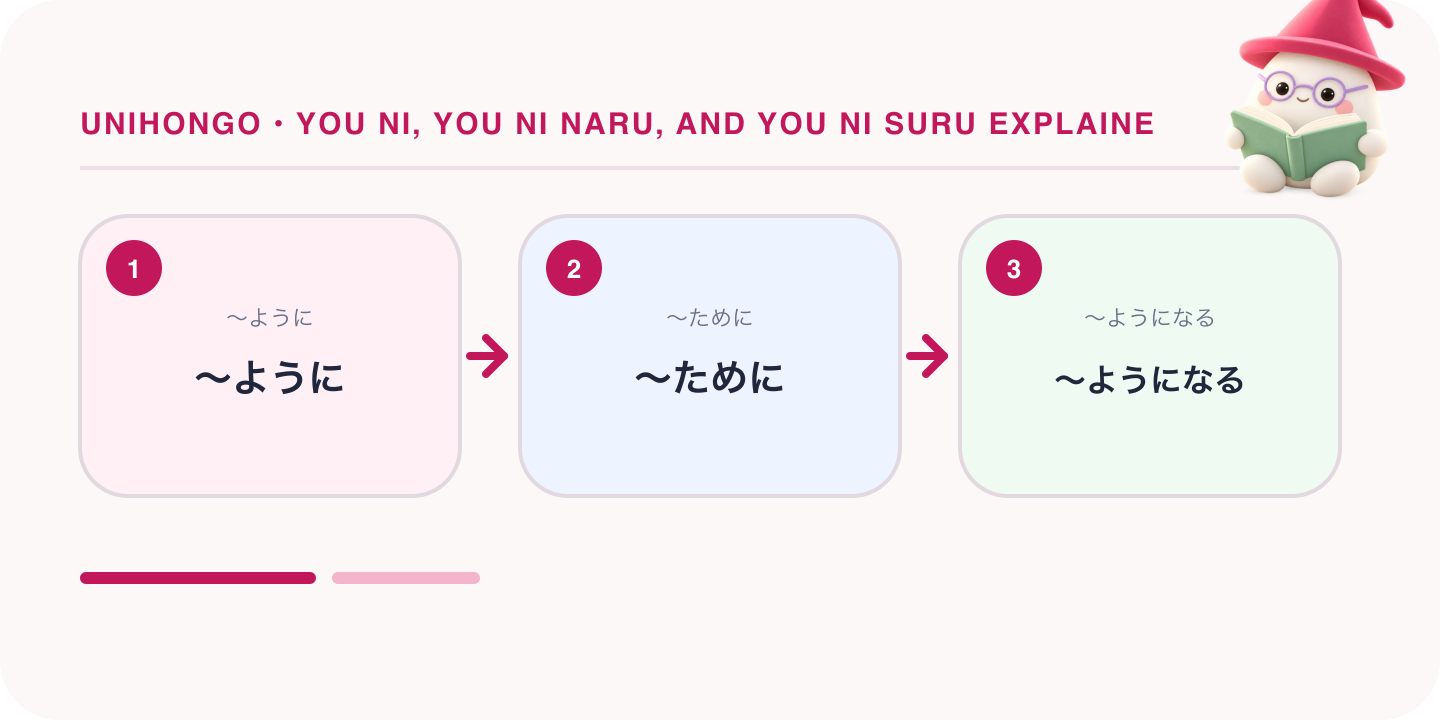
The yō ni family at a glance
| Pattern | Form before it | What it means |
|---|---|---|
| 〜ように | Potential, non-volitional, or nai form | So that, in order that (a result you cannot fully control) |
| 〜ために | Volitional dictionary form, or noun plus の | In order to (a goal you act on directly) |
| 〜ようになる | Dictionary or potential form | Come to do, become able to do |
| 〜なくなる | Nai form with i replaced by ku | Stop doing, no longer do |
| 〜ようにする | Dictionary or nai form | Make a point of doing or not doing |
| 〜ようにしている | Dictionary or nai form | Keep it up as an ongoing habit |
| 〜ように言う | Dictionary or nai form | Tell someone to do or not to do something |
| 〜のように | Noun plus の, na-adjective plus な, or plain verb | Like, as, in the way that |
| 〜ますように | Polite masu form | A wish or a prayer |
Read the middle column first. If the verb before yō ni is one you can simply decide to perform, you probably want tame ni or the suru branch of the family instead.
Yō ni for a result you cannot switch on
The purpose use of yō ni describes a state you would like to come about: someone being able to hear you, a child understanding, a train being caught. The verb before it is typically a potential form such as kikoeru, mieru or tsukaeru, a non-volitional verb such as wakaru or ma ni au, or a nai form. The main clause then gives the action you are actually taking. In speech the comma is a real pause, so say the yō ni clause, breathe, then say what you do.
The potential forms follow the ordinary rules. A godan verb shifts its final u to eru: hanasu becomes hanaseru, kaku becomes kakeru, yomu becomes yomeru, tsukau becomes tsukaeru. An ichidan verb drops ru and adds rareru: taberu becomes taberareru, miru becomes mirareru, okiru becomes okirareru. Suru becomes dekiru and kuru becomes korareru.
| Japanese | Romaji | Meaning |
|---|---|---|
| 後ろの人にも聞こえるように、大きい声で話します。 | Ushiro no hito ni mo kikoeru yō ni, ōkii koe de hanashimasu. | I speak loudly so that the people at the back can hear too. |
| 子供にも分かるように、やさしい言葉で説明します。 | Kodomo ni mo wakaru yō ni, yasashii kotoba de setsumei shimasu. | I explain in simple words so that children can understand as well. |
| すぐに使えるように、机の上に置きました。 | Sugu ni tsukaeru yō ni, tsukue no ue ni okimashita. | I put it on the desk so that it can be used straight away. |
| 間に合うように、早めに出ます。 | Ma ni au yō ni, hayame ni demasu. | I leave early so that I arrive in time. |
Yō ni versus tame ni in minimal pairs
Tame ni takes a verb you control, in plain dictionary form, and the subject of both halves is normally the same person. Yō ni takes a verb you cannot simply perform, and the two halves may even have different subjects. The pair below differs only in that choice, and both are natural Japanese with slightly different emphasis: the tame ni version stresses the goal, while the yō ni version stresses the ability you are building toward.
Nouns behave differently too. Tame ni accepts a noun with no, as in shiken no tame ni, and it also carries the meaning for the benefit of, as in kazoku no tame ni hataraite imasu. Yō ni never takes a bare noun in this purpose sense, so if your English is for my family, tame ni is the pattern you need.
| Japanese | Romaji | Meaning |
|---|---|---|
| 日本で働くために、日本語を勉強しています。 | Nihon de hataraku tame ni, Nihongo o benkyō shite imasu. | I am studying Japanese in order to work in Japan. |
| 日本で働けるように、日本語を勉強しています。 | Nihon de hatarakeru yō ni, Nihongo o benkyō shite imasu. | I am studying Japanese so that I will be able to work in Japan. |
| 試験のために、毎日勉強します。 | Shiken no tame ni, mainichi benkyō shimasu. | I study every day for the exam. |
| 家族のために働いています。 | Kazoku no tame ni hataraite imasu. | I work for my family. |
The mistake to avoid runs in both directions. Hanaseru tame ni is wrong because the potential form is not something you perform, and Nihon ni iku yō ni okane o tamete imasu is wrong because going to Japan is entirely your own decision, so it needs iku tame ni.
Nai yō ni for what you want to prevent
The negative purpose clause uses the plain nai form and no other. Wasureru becomes wasurenai, okureru becomes okurenai, hiku becomes hikanai, naru becomes naranai. This is the everyday way to say so that I do not, and it is far more common in speech than any construction built on tame ni. Note that ki o tsukete kudasai and other polite endings sit comfortably after it, so you can use these sentences with a colleague or a stranger without adjusting anything.
| Japanese | Romaji | Meaning |
|---|---|---|
| 忘れないように、メモを取ります。 | Wasurenai yō ni, memo o torimasu. | I take notes so that I do not forget. |
| 風邪をひかないように、気をつけてください。 | Kaze o hikanai yō ni, ki o tsukete kudasai. | Please take care so that you do not catch a cold. |
| 遅れないように、一本早い電車に乗ります。 | Okurenai yō ni, ippon hayai densha ni norimasu. | I take one earlier train so that I am not late. |
| 失礼にならないように、敬語を使います。 | Shitsurei ni naranai yō ni, keigo o tsukaimasu. | I use polite language so that I do not come across as rude. |
Yō ni naru is the sentence for your own progress
Naru means to become, so yō ni naru reports that a manner of doing has come into being. With a potential form it means became able to; with a plain dictionary form it means came to do something regularly. Learners often reach for dekimasu alone and end up saying nihongo ga sukoshi dekimasu for years. The yō ni narimashita version says something dekimasu cannot: that a change happened, and you are the evidence of it.
Because it reports a change, it usually appears in the past as narimashita. The future form naritai desu states a goal, and it is the honest answer to why you are studying. Add sukoshi, mae yori or dandan in front to keep the claim modest without weakening the grammar.
| Japanese | Romaji | Meaning |
|---|---|---|
| 日本語が話せるようになりました。 | Nihongo ga hanaseru yō ni narimashita. | I have become able to speak Japanese. |
| 日本語で電話ができるようになりました。 | Nihongo de denwa ga dekiru yō ni narimashita. | I can now handle phone calls in Japanese. |
| 敬語が少し使えるようになりました。 | Keigo ga sukoshi tsukaeru yō ni narimashita. | I have become able to use polite language a little. |
| 前より速く話せるようになりました。 | Mae yori hayaku hanaseru yō ni narimashita. | I can speak faster than before now. |
| 毎朝六時に起きられるようになりました。 | Maiasa roku-ji ni okirareru yō ni narimashita. | I have become able to get up at six every morning. |
| 漢字が読めるようになりたいです。 | Kanji ga yomeru yō ni naritai desu. | I want to become able to read kanji. |
Notice the particle. With a potential verb the object usually takes ga rather than o, so it is kanji ga yomeru rather than kanji o yomeru in careful speech, though o is widely heard in casual conversation.
Naku naru instead of nai yō ni naru
For the opposite change, a habit you have dropped, the tidy pattern is not nai yō ni naru. Japanese prefers the nai form with i replaced by ku, followed by naru: tabenai becomes tabenaku, shinai becomes shinaku, suwanai becomes suwanaku. This is the same rule you already use for adjectives, where takai becomes takaku narimashita. Learners who force nai yō ni narimashita are understood, but they sound like they are translating.
| Japanese | Romaji | Meaning |
|---|---|---|
| 甘い物を食べなくなりました。 | Amai mono o tabenaku narimashita. | I stopped eating sweet things. |
| 昔ほど緊張しなくなりました。 | Mukashi hodo kinchō shinaku narimashita. | I do not get as nervous as I used to. |
| 辞書を使わなくても読めるようになりました。 | Jisho o tsukawanakute mo yomeru yō ni narimashita. | I can now read without using a dictionary. |
Yō ni suru is effort, not achievement
Yō ni suru takes a dictionary form or a nai form and means to make a point of doing something. On its own, in the plain non-past, it sounds like a promise made on the spot: I will make sure to. Put into the te iru form as yō ni shite imasu, it describes a policy you have been keeping for a while, which is exactly what you need when someone asks how you study.
Keep this apart from yō ni naru. Mainichi hanasu yō ni shite imasu says you try to speak every day; hanaseru yō ni narimashita says you succeeded in becoming able to speak. Saying the second when you mean the first is the most common slip in the family, and it makes a modest learner sound boastful.
| Japanese | Romaji | Meaning |
|---|---|---|
| 毎日日本語を話すようにしています。 | Mainichi Nihongo o hanasu yō ni shite imasu. | I make a point of speaking Japanese every day. |
| 会議では日本語で質問するようにしています。 | Kaigi de wa Nihongo de shitsumon suru yō ni shite imasu. | In meetings I make a point of asking questions in Japanese. |
| 夜遅くコーヒーを飲まないようにしています。 | Yoru osoku kōhī o nomanai yō ni shite imasu. | I try not to drink coffee late at night. |
| これから遅れないようにします。 | Kore kara okurenai yō ni shimasu. | I will make sure not to be late from now on. |
| これから気をつけるようにします。 | Kore kara ki o tsukeru yō ni shimasu. | I will make a point of being careful from now on. |
Yō ni iu for passing a request on
When you report a request rather than quote it, Japanese uses a dictionary or nai form plus yō ni before verbs such as iu, tsutaeru, tanomu and onegai suru. The person who receives the instruction is marked with ni. This is everyday office and family language, and it saves you from the awkward direct quotation that beginners fall back on. The passive version, yō ni iwaremashita, is how you report an instruction you were given.
| Japanese | Romaji | Meaning |
|---|---|---|
| 田中さんに後で電話するように言ってください。 | Tanaka-san ni ato de denwa suru yō ni itte kudasai. | Please tell Tanaka to call later. |
| 息子に早く寝るように言いました。 | Musuko ni hayaku neru yō ni iimashita. | I told my son to go to bed early. |
| 医者に酒を飲まないように言われました。 | Isha ni sake o nomanai yō ni iwaremashita. | The doctor told me not to drink alcohol. |
| 部長に資料を送るように頼まれました。 | Buchō ni shiryō o okuru yō ni tanomaremashita. | The department head asked me to send the documents. |
Yō ni for like and as
The comparison use attaches to a noun with no, to a na-adjective with na, or directly to a plain verb. Before a noun it becomes yō na, and at the end of a sentence it becomes yō desu. This is the same yō you meet in the guess pattern ame ga furu yō desu, so treating it as one word with a manner meaning keeps everything consistent. The set phrase mae ni itta yō ni is the natural way to say as I mentioned earlier in a meeting.
One more use is worth memorising whole. A polite masu form plus yō ni, left hanging with no main verb, is a wish: genki ni narimasu yō ni. You will see it written on prayer plaques and hear it as a warm sign-off.
| Japanese | Romaji | Meaning |
|---|---|---|
| 山田さんのように話したいです。 | Yamada-san no yō ni hanashitai desu. | I want to speak the way Yamada does. |
| 前に言ったように、明日は休みです。 | Mae ni itta yō ni, ashita wa yasumi desu. | As I said earlier, tomorrow is a day off. |
| 夢のような話ですね。 | Yume no yō na hanashi desu ne. | It sounds like a dream, does it not. |
| 早く元気になりますように。 | Hayaku genki ni narimasu yō ni. | I hope you get well soon. |
The mistakes that give a learner away
- Using tame ni with a potential verb: say hanaseru yō ni, never hanaseru tame ni.
- Using yō ni with a fully controlled action: Nihon ni iku tame ni, not Nihon ni iku yō ni.
- Saying yō ni narimashita when you only mean you are trying, which needs yō ni shite imasu.
- Building nai yō ni narimashita for a dropped habit instead of the shorter naku narimashita.
- Dropping the pause: yō ni ends a clause, so let the sentence breathe before the main verb.
- Forgetting that a potential verb usually takes ga, as in kanji ga yomeru yō ni narimashita.