

The core idea: nara answers what is already on the table
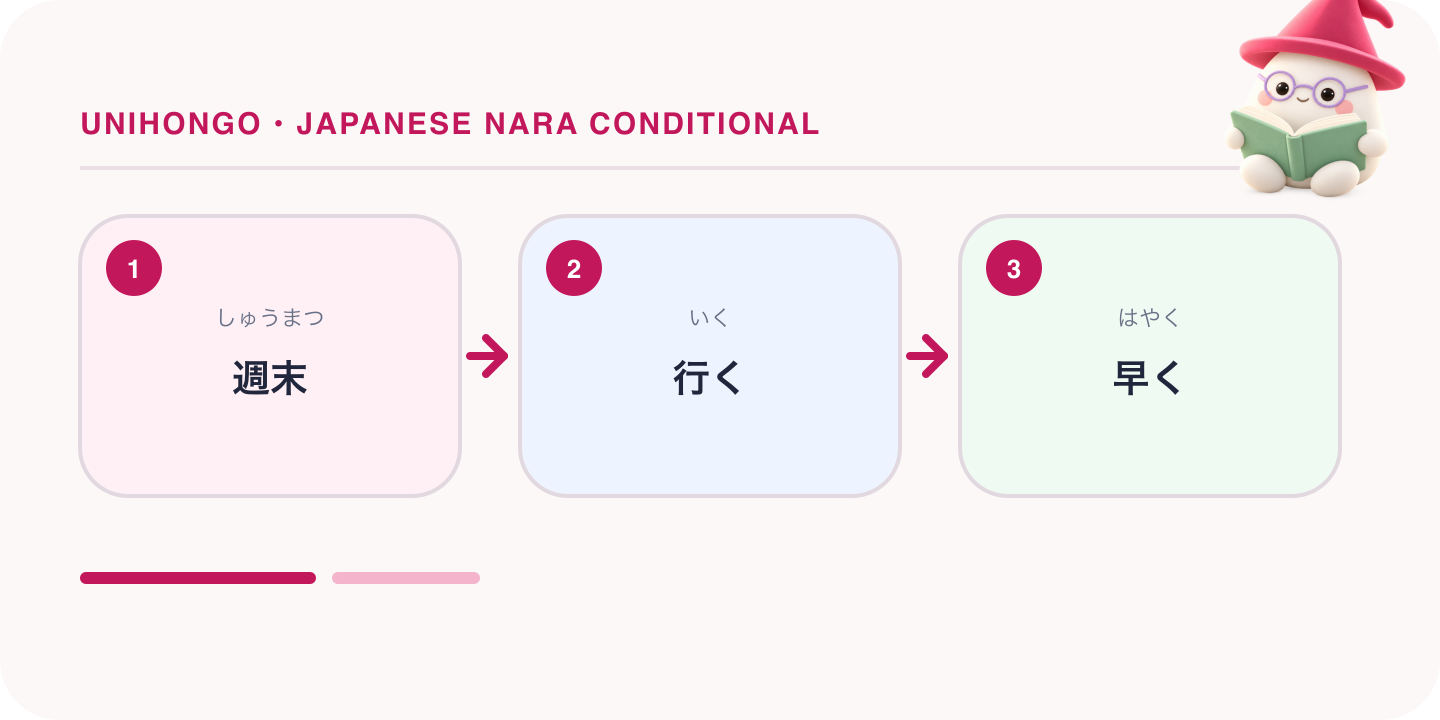
Think of a conversation as a table. Someone puts something on it: I'm going to Kyoto this weekend. Nara is the word that picks that statement up and answers it: if you're going to Kyoto, leave early. The premise was handed over, and nara acknowledges the hand-over.
The premise does not have to be spoken. If your flatmate is yawning over a film, the situation has put sleepiness on the table. What follows nara is nearly always your own contribution: advice, permission, an offer, a request or a decision.
Below, a colleague mentions her weekend plan, then come two replies to things a speaker can simply see.
| Japanese | Romaji | Meaning |
|---|---|---|
| 週末、京都に行くんです。 | Shūmatsu, Kyōto ni iku n desu. | I'm going to Kyoto at the weekend. |
| 京都に行くなら、朝早く出たほうがいいですよ。 | Kyōto ni iku nara, asa hayaku deta hō ga ii desu yo. | If you're going to Kyoto, you should leave early in the morning. |
| 眠いなら、先に寝ていいよ。 | Nemui nara, saki ni nete ii yo. | If you're sleepy, you can go to bed before me. |
| 嫌なら、無理に食べなくてもいいよ。 | Iya nara, muri ni tabenakute mo ii yo. | If you don't like it, you don't have to force it down. |
Noun plus nara: choosing a topic for advice
The simplest nara sentence needs no verb in the first half. A traveller asks the hotel receptionist where to eat sushi, and the receptionist answers sushi nara, ano mise ga oishii desu yo. Literally: if it is sushi, that shop is tasty. The traveller put sushi on the table, and nara turns it into the topic of the recommendation.
Why not simply use wa? Sushi wa would also set a topic, but it is neutral. Nara adds two things: it shows that the topic came from the other person, and it quietly limits the statement to that topic. That makes nara ideal for refusing one thing and offering another, as in the third and fourth rows.
In the last row the listener is looking for a person, and the second half is plain information, not advice.
| Japanese | Romaji | Meaning |
|---|---|---|
| 寿司なら、あの店がおいしいですよ。 | Sushi nara, ano mise ga oishii desu yo. | For sushi, that restaurant is good. |
| お土産なら、駅の地下で買えます。 | Omiyage nara, eki no chika de kaemasu. | If it's souvenirs you want, you can buy them under the station. |
| コーヒーは飲めませんが、紅茶なら飲めます。 | Kōhī wa nomemasen ga, kōcha nara nomemasu. | I can't drink coffee, but tea I can. |
| 明日は無理ですが、土曜日なら大丈夫です。 | Ashita wa muri desu ga, doyōbi nara daijōbu desu. | Tomorrow is impossible, but Saturday would be fine. |
| 田中さんなら、もう帰りましたよ。 | Tanaka-san nara, mō kaerimashita yo. | If you mean Tanaka, he has already gone home. |
How nara is built: plain forms, and no da
Nara follows the plain form. Verbs and i-adjectives need no change at all. Nouns and na-adjectives attach directly, without da.
| Pattern | Reading | Built from | Meaning |
|---|---|---|---|
| 行くなら | iku nara | Verb, plain non-past | If you are going to go |
| 行かないなら | ikanai nara | Verb, plain negative | If you are not going |
| 行ったなら | itta nara | Verb, plain past | If it is true that you went |
| 高いなら | takai nara | I-adjective | If it is expensive |
| 暇なら | hima nara | Na-adjective, no da | If you are free |
| 学生なら | gakusei nara | Noun, no da | If you are a student |
| 学生だったなら | gakusei datta nara | Noun plus datta | If you were a student |
The missing da has a reason. Nara began life as a conditional form of the copula, so gakusei nara already means if it is a student, and gakusei da nara would say is twice. Datta survives because something has to carry the past tense.
Politeness belongs to the end of the sentence. Keep the part before nara plain and make the final verb polite if the scene calls for it. Ikimasu nara is not standard.
Verb plus nara: the advice can come first in time
Here is the feature that sets nara apart from every other conditional. Because nara only accepts a premise, it says nothing about which event happens first. In Nihon ni iku nara, kamera o katta hō ga ii, the buying takes place before the trip. The plan to go is on the table now, so the advice applies now.
The last row is a well-known road safety slogan that shows both orders in one line. Literally, its second half says: if you will drive, do not drink.
| Japanese | Romaji | Meaning |
|---|---|---|
| 日本に行くなら、カメラを買ったほうがいいよ。 | Nihon ni iku nara, kamera o katta hō ga ii yo. | If you're going to Japan, you should buy a camera. |
| 車で来るなら、前の日に教えてください。 | Kuruma de kuru nara, mae no hi ni oshiete kudasai. | If you're coming by car, please tell me the day before. |
| 食べないなら、私がもらうよ。 | Tabenai nara, watashi ga morau yo. | If you're not going to eat that, I'll have it. |
| 飲んだら乗るな、乗るなら飲むな。 | Nondara noru na, noru nara nomu na. | If you've had a drink, don't drive; if you're going to drive, don't drink. |
Minimal pairs: nara beside tara and wa
Each pair below changes one element only.
| Sentence | Reading | What it says |
|---|---|---|
| 日本に行くなら、カメラを買います。 | Nihon ni iku nara, kamera o kaimasu. | If I am going to Japan, I will buy a camera. The shopping happens at home, before the flight. |
| 日本に行ったら、カメラを買います。 | Nihon ni ittara, kamera o kaimasu. | Once I have got to Japan, I will buy a camera. The shopping happens there. |
| 安いなら、買います。 | Yasui nara, kaimasu. | If it is cheap, as you tell me, I will buy it. The speaker accepts the seller's claim. |
| 安かったら、買います。 | Yasukattara, kaimasu. | If it turns out to be cheap, I will buy it. The speaker has not seen the price yet. |
| 寿司なら食べます。 | Sushi nara tabemasu. | If it is sushi, I will eat. Other dishes may be refused. |
| 寿司は食べます。 | Sushi wa tabemasu. | Sushi, I eat. A plain statement about sushi, with no condition. |
Tara is built on the past form, so in the first pair the going is complete before the buying. Nara leaves the verb in its dictionary form: the going is still a plan, and the speaker acts on the plan.
The second pair shows where the knowledge comes from. With nara you are taking somebody's word for it. With tara you are waiting to find out. The overview of all four conditionals elsewhere on this blog sets them beside to and ba.
Beyond the basics: no nara and n nara
Put no between the plain form and nara and you get no nara, which shrinks to n nara in speech. Literally it means if it is that, and the explanatory no does what it always does: it points at a fact that is already in the air. Iku n nara feels like if you really are going, as it seems.
You will hear it most after verbs and i-adjectives. After nouns and na-adjectives, plain nara is the usual choice. In casual speech many people say n dattara in the same places, with no change in meaning. Below, a parent sees a child putting on shoes, a flatmate heads for the door, a customer hears a price, and someone learns that a colleague knew about a problem all along.
| Japanese | Romaji | Meaning |
|---|---|---|
| 出かけるのなら、傘を持って行きなさい。 | Dekakeru no nara, kasa o motte ikinasai. | If you're going out, take an umbrella. |
| コンビニに行くんなら、牛乳も買ってきて。 | Konbini ni iku n nara, gyūnyū mo katte kite. | If you're off to the convenience store, get some milk too. |
| そんなに高いんなら、やめておきます。 | Sonna ni takai n nara, yamete okimasu. | If it's that expensive, I'll give it a miss. |
| 知っていたのなら、教えてほしかったです。 | Shitte ita no nara, oshiete hoshikatta desu. | If you knew, I wish you had told me. |
Why nara cannot state natural consequences
Nara needs a person who picks up a premise and answers it. When spring arrives and the cherry trees bloom, nobody is answering anything. So Haru ni naru nara, sakura ga sakimasu is wrong, and the same goes for machines and habits. Those belong to to and ba.
A second restriction has the same root. Nara treats its condition as a supposition: if it is the case that. Ten o'clock will come whether or not anyone supposes it, so Jū-ji ni naru nara, dekakemashō is also wrong. Events that are sure to arrive take tara.
The subject matter is not the problem. In the last row the forecast is the premise and the second half is a human decision, so nara is fine.
| Japanese | Romaji | Meaning |
|---|---|---|
| 春になると、桜が咲きます。 | Haru ni naru to, sakura ga sakimasu. | When spring comes, the cherry trees bloom. |
| このボタンを押すと、お湯が出ます。 | Kono botan o osu to, oyu ga demasu. | Press this button and hot water comes out. |
| 十時になったら、出かけましょう。 | Jū-ji ni nattara, dekakemashō. | Let's go out when it gets to ten. |
| 雨が降るなら、試合は中止にしましょう。 | Ame ga furu nara, shiai wa chūshi ni shimashō. | If it's going to rain, let's call the match off. |
Common mistakes with nara and where they come from
The first mistake is using nara for a sequence. Eki ni tsuku nara, denwa shimasu is wrong for I'll call when I get to the station. English uses if and when loosely, so learners reach for whichever conditional they learnt last. Arriving must be completed before the call, so the sentence needs tara: eki ni tsuitara, denwa shimasu.
The second is adding da. Ashita ame da nara, ikimasen is wrong. Learners know that nara follows the plain form and that the plain form of a noun sentence ends in da, so they apply the rule one step too far. Drop it: ashita ame nara, ikimasen.
The third is the natural consequence. Fuyu ni naru nara, samuku narimasu is wrong, because winter does not answer anyone. Say fuyu ni naru to, samuku narimasu.
The fourth is grammatical but says the wrong thing. Someone who wants to advise buying a rail pass before the trip says Nihon ni ittara, pasu o katta hō ga ii. That tells the listener to buy it after arriving. When the advice must be acted on first, only nara works: Nihon ni iku nara, pasu o katta hō ga ii.
How nara sounds in conversation: sore nara, dattara and naraba
Sore nara, in that case, points at everything that was just said and opens a sentence in polite and casual speech alike. Among friends it shrinks to a bare nara, and dattara does the same job.
Naraba is the fuller form. It belongs to writing, notices and formal speech. One more habit is worth knowing: for conditions about your own circumstances, which nobody handed to you, many speakers prefer tara, as in jikan ga attara ikimasu. Dekiru nara, if possible, is a common exception.
| Japanese | Romaji | Meaning |
|---|---|---|
| それなら、電車で行きましょう。 | Sore nara, densha de ikimashō. | In that case, let's go by train. |
| なら、いいよ。 | Nara, ii yo. | Well then, that's fine. |
| だったら、一緒に行こうか。 | Dattara, issho ni ikō ka. | In that case, shall we go together? |
| 必要ならば、ご連絡ください。 | Hitsuyō naraba, go-renraku kudasai. | Please contact us if necessary. |
| できるなら、今日中に終わらせたいです。 | Dekiru nara, kyō-jū ni owarasetai desu. | If I can, I'd like to finish it today. |