

The core idea: naru is a journey and the new state is the station
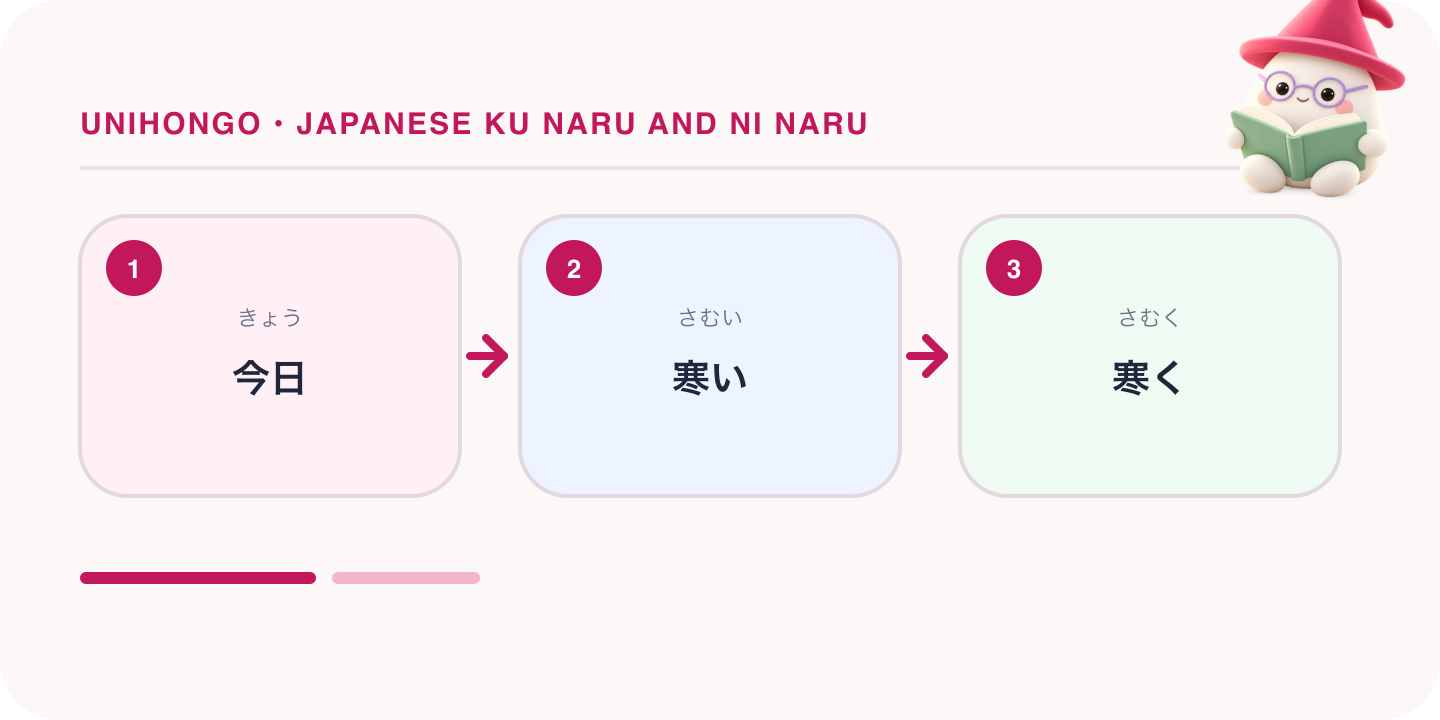
A sentence with desu is a photograph: samui desu, it is cold. A sentence with naru is a journey that ends at that photograph: samuku narimashita, it has become cold. It tells you that things were different before. That hidden before is the whole reason to choose naru.
Two neighbours meeting on an October morning do not simply report the temperature. They remark on the change, because noticing the season together is a friendly thing to do.
| Japanese | Romaji | Meaning |
|---|---|---|
| 今日は寒いですね。 | Kyō wa samui desu ne. | It's cold today, isn't it? |
| 寒くなりましたね。 | Samuku narimashita ne. | It has turned cold, hasn't it? |
| 秋になりましたね。 | Aki ni narimashita ne. | Autumn has come, hasn't it? (Literally: it has become autumn.) |
How ku naru and ni naru are built
Naru is an ordinary godan verb: narimasu, natta, natte, naranai. What changes is the word in front of it, and the rule depends on that word's type.
| Pattern | Reading | Rule and meaning |
|---|---|---|
| 寒い → 寒くなる | samui → samuku naru | I-adjective, i becomes ku: get cold |
| いい → よくなる | ii → yoku naru | Irregular, built on yoi: get better |
| 静か → 静かになる | shizuka → shizuka ni naru | Na-adjective plus ni: become quiet |
| 医者 → 医者になる | isha → isha ni naru | Noun plus ni: become a doctor |
| 食べたい → 食べたくなる | tabetai → tabetaku naru | Tai form, i becomes ku: start wanting to eat |
| 分からない → 分からなくなる | wakaranai → wakaranaku naru | Nai form, i becomes ku: stop understanding |
Tai and nai end in i and behave like i-adjectives, which is why they take ku. There is no da, na or no before ni: isha ni naru, never isha da ni naru.
I-adjectives with ku naru
Weather, prices, health and length of days are the classic subjects, since they change without anyone deciding. The thing that changes is marked with ga or wa. Here the two neighbours carry on their conversation, and one of them has recently been ill.
One fixed phrase belongs here. When you arrive late, you say osoku natte sumimasen, literally sorry for having become late. Japanese treats lateness as a state you ended up in.
| Japanese | Romaji | Meaning |
|---|---|---|
| 日が短くなりました。 | Hi ga mijikaku narimashita. | The days have got shorter. |
| 野菜が高くなりました。 | Yasai ga takaku narimashita. | Vegetables have got expensive. |
| 薬を飲んで、よくなりました。 | Kusuri o nonde, yoku narimashita. | I took some medicine and got better. |
| 遅くなってすみません。 | Osoku natte sumimasen. | I'm sorry I'm late. |
| 甘いものが食べたくなりました。 | Amai mono ga tabetaku narimashita. | I've started to fancy something sweet. |
Na-adjectives and nouns with ni naru
With nouns, ni naru covers ages, times, seasons, jobs and totals. English uses a different verb for almost every one: turn twenty, strike twelve, become a nurse, come to a thousand yen. In Japanese they are all arrivals at a station.
You will hear ni narimasu in shops, where it announces a total: zenbu de sen-en ni narimasu. Staff also use it to present an item, as in kōhī ni narimasu, here is your coffee. That second use is widely heard but often criticised as incorrect, so understand it and do not copy it. The farewell o-sewa ni narimashita, thank you for everything, literally says I came into your care.
| Japanese | Romaji | Meaning |
|---|---|---|
| 娘は来月二十歳になります。 | Musume wa raigetsu hatachi ni narimasu. | My daughter turns twenty next month. (Literally: she will arrive at twenty.) |
| もう十二時になりました。 | Mō jū-ni-ji ni narimashita. | It's twelve o'clock already. |
| 将来、医者になりたいです。 | Shōrai, isha ni naritai desu. | I want to become a doctor in the future. |
| 日本語が上手になりましたね。 | Nihongo ga jōzu ni narimashita ne. | Your Japanese has got good, hasn't it? |
| 納豆が好きになりました。 | Nattō ga suki ni narimashita. | I've come to like natto. |
| 全部で千円になります。 | Zenbu de sen-en ni narimasu. | That comes to a thousand yen in total. |
Minimal pairs: where you are on the journey
The sentences below change only the ending. Each one places the speaker at a different point on the line between the old state and the new.
| Sentence | Reading | What it says |
|---|---|---|
| 寒いです。 | Samui desu. | It is cold. A state with no history |
| 寒くなります。 | Samuku narimasu. | It will get cold. The arrival is still ahead |
| 寒くなりました。 | Samuku narimashita. | It has got cold. You have arrived, and it was not cold before |
| 寒くなってきました。 | Samuku natte kimashita. | It has been getting colder. The change is under way and noticeable |
English speakers tend to reach for the present tense, you are getting good, where Japanese uses the past. If the change is already visible, the journey has at least partly happened, so praise is jōzu ni narimashita ne. Narimasu is kept for the future and for regular facts, such as fuyu wa samuku narimasu, it gets cold in winter.
Beyond the basics: natte kita and natte iku for gradual change
Plain narimashita reports the arrival. To show the journey in motion, add kuru or iku to the te form. Natte kuru is a train coming towards you: the change has been approaching your present moment, and you now feel it. Natte iku is a train leaving your platform: the change moves on from now into the future.
So natte kimashita suits small talk about what you have noticed lately, and natte ikimasu suits forecasts and predictions. A separate article treats te kuru and te iku with other verbs.
| Japanese | Romaji | Meaning |
|---|---|---|
| 最近、暖かくなってきました。 | Saikin, atatakaku natte kimashita. | It has been getting warmer lately. |
| 日本語が面白くなってきました。 | Nihongo ga omoshiroku natte kimashita. | Japanese has started to get interesting. |
| これからもっと寒くなっていきます。 | Kore kara motto samuku natte ikimasu. | It will go on getting colder from now on. |
| 子どもの数は少なくなっていくでしょう。 | Kodomo no kazu wa sukunaku natte iku deshō. | The number of children will probably keep falling. |
Beyond the basics: the nai form and naku naru
A negative is a state too, so it can be a station. Change nai to naku and add naru: wakaranai becomes wakaranaku naru, to reach the point of not understanding. In English this comes out as stop, no longer or can't any more. The verb nai itself gives nakunaru, to run out or go missing.
What about the positive side, coming to be able to do something? A positive verb cannot take ku, so it needs a helper: the dictionary or potential form plus yō ni naru, as in hanaseru yō ni narimashita, I have become able to speak. That pattern has its own article. The negative can use either route, and naku naru is the shorter one.
| Japanese | Romaji | Meaning |
|---|---|---|
| 最近、テレビを見なくなりました。 | Saikin, terebi o minaku narimashita. | I've stopped watching television lately. |
| 説明が難しくて、分からなくなりました。 | Setsumei ga muzukashikute, wakaranaku narimashita. | The explanation was difficult and I got lost. |
| 雪で電車が動かなくなりました。 | Yuki de densha ga ugokanaku narimashita. | The trains stopped running because of the snow. |
| お金がなくなりました。 | O-kane ga nakunarimashita. | My money has run out. |
Neighbours and lookalikes: o ni naru, to naru and suru
One pattern looks like becoming and is not. O plus a verb stem plus ni naru is an honorific: o-kaeri ni narimashita means a respected person went home, not that anyone became anything. You can recognise it because the word before ni is a verb stem wearing the prefix o. Here the journey image does not apply at all. Treat it as a separate construction.
To naru is a formal relative of ni naru. It follows nouns and frames the change as a settled outcome, so it belongs to announcements, news and contracts. The pair below differs in one particle. Finally, naru describes change that happens, while suru describes change that someone causes: heya ga atatakaku narimashita, the room got warm, against heya o atatakaku shimashita, I warmed the room.
| Japanese | Romaji | Meaning |
|---|---|---|
| 社長はもうお帰りになりました。 | Shachō wa mō o-kaeri ni narimashita. | The president has already gone home. |
| 雨で試合は中止になりました。 | Ame de shiai wa chūshi ni narimashita. | The match was called off because of rain. |
| 雨で試合は中止となりました。 | Ame de shiai wa chūshi to narimashita. | The match has been cancelled owing to rain. (Formal announcement.) |
Common mistakes with naru
The first mistake is ni after an i-adjective. Samui ni narimashita is wrong. Learners meet noun plus ni naru first and extend it to everything. I-adjectives use ku: samuku narimashita.
The second is the reverse with kirei. Kireku narimashita is wrong, because kirei is a na-adjective whose final i is part of the word. Say kirei ni narimashita.
The third is dropping ni or using o with a noun. Isha narimasu and isha o narimasu are wrong. English become takes a direct object, but naru is a journey and needs its destination marked: isha ni narimasu.
The fourth is ii ni naru or iku naru. Both are wrong. Every form of ii except the plain present is built on yoi: yoku narimashita.
The fifth is tense. Nihongo ga jōzu ni narimasu ne is wrong as a compliment, since it predicts future progress. For change you can already see, use narimashita or natte kimashita.