

I-adjectives: drop i, add kute
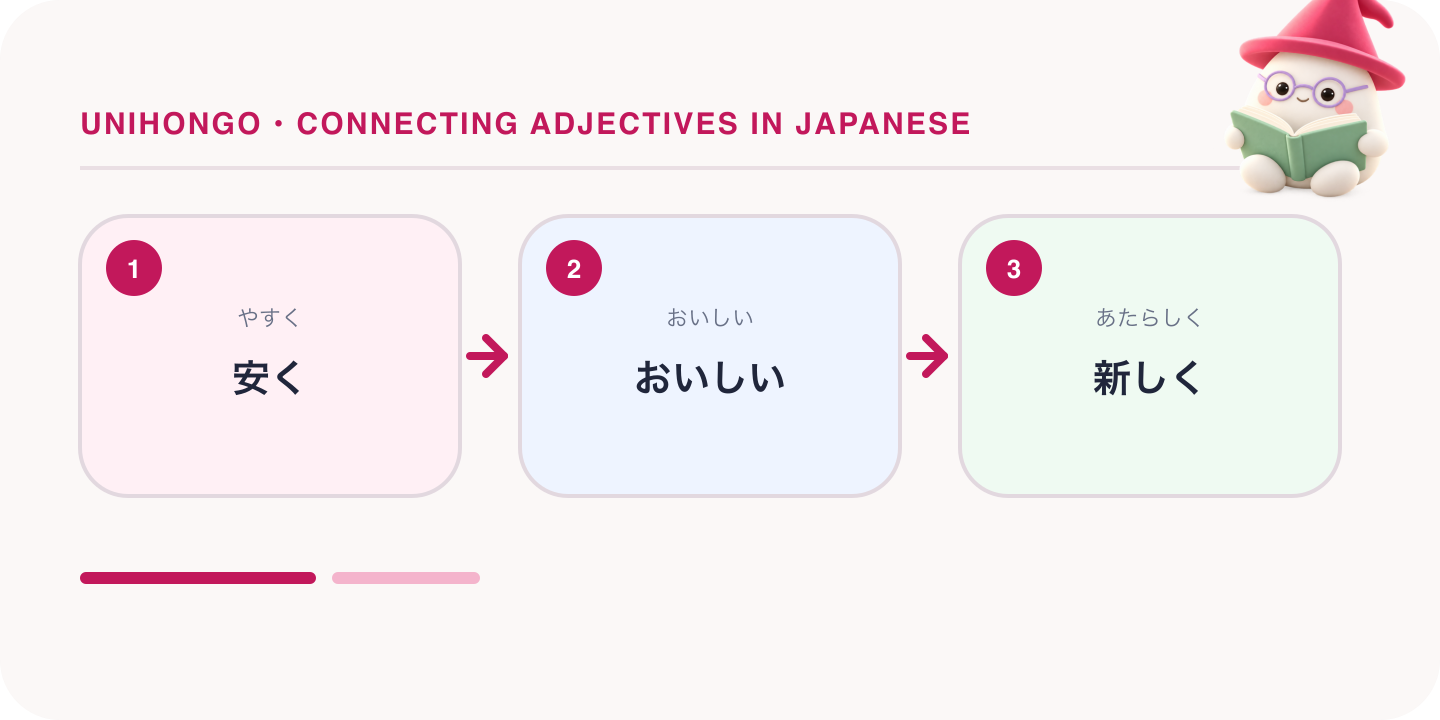
Every i-adjective ends in i in its dictionary form: takai, yasui, atarashii, omoshiroi. To connect it to another description, remove that final i and add kute. Takai becomes takakute, omoshiroi becomes omoshirokute. The joined adjective has no tense of its own; the last word in the sentence decides whether the whole thing is present, past, polite or plain.
One irregular form matters: ii, good, uses the older stem yo, so the te form is yokute. Kakkoii, cool, therefore becomes kakkoyokute. Everything else follows the rule, including long forms such as urayamashii (urayamashikute) and the tai form of verbs, which is an i-adjective too: ikitakute.
| Japanese | Romaji | Meaning |
|---|---|---|
| この店は安くておいしいです。 | Kono mise wa yasukute oishii desu. | This restaurant is cheap and delicious. |
| 新しくて大きいスーパーができました。 | Atarashikute ōkii sūpā ga dekimashita. | A new, big supermarket has opened. |
| 彼は背が高くて、髪が短いです。 | Kare wa se ga takakute, kami ga mijikai desu. | He is tall and has short hair. |
| 天気がよくて気持ちがいい。 | Tenki ga yokute kimochi ga ii. | The weather is good and it feels great. |
| 昨日の映画は長くてつまらなかった。 | Kinō no eiga wa nagakute tsumaranakatta. | Yesterday's film was long and boring. |
Na-adjectives and nouns: add de
Na-adjectives such as shizuka, kirei, benri and genki do not conjugate on their own; they borrow the copula. The te form of da is de, so the connected form is simply the adjective plus de: shizuka de, kirei de. Nouns join in exactly the same way, because a noun predicate is also noun plus da: gakusei de, Nihonjin de, ame de.
This means you can mix word classes freely. Kirei de shizuka na machi, a clean, quiet town, joins two na-adjectives with de and then attaches to the noun with na. Kare wa isha de, totemo shinsetsu desu, he is a doctor and very kind, joins a noun to a na-adjective. When a na-adjective comes last before a noun, it takes na; when it ends the sentence, it takes desu or da.
| Japanese | Romaji | Meaning |
|---|---|---|
| この部屋は静かできれいです。 | Kono heya wa shizuka de kirei desu. | This room is quiet and clean. |
| 駅から近くて便利な場所です。 | Eki kara chikakute benri na basho desu. | It is a convenient place, close to the station. |
| 彼女は日本人で、大阪の出身です。 | Kanojo wa Nihonjin de, Ōsaka no shusshin desu. | She is Japanese, from Osaka. |
| 田中さんは真面目で親切な人です。 | Tanaka-san wa majime de shinsetsu na hito desu. | Mr Tanaka is a serious, kind person. |
| 今日は休みで、天気もいい。 | Kyō wa yasumi de, tenki mo ii. | Today is a day off, and the weather is good too. |
The negative: nakute
To connect a negative description, start from the nai form and change nai to nakute. Takakunai becomes takakunakute; omoshirokunai becomes omoshirokunakute. For na-adjectives and nouns, the negative is ja nai or de wa nai, so the te form is ja nakute: shizuka ja nakute, gakusei ja nakute. Nai on its own, the negative of aru, becomes nakute too: jikan ga nakute.
Nakute has two jobs, just like kute. It can simply list a negative quality alongside another one: takakunakute oishii, not expensive and tasty. It can also give a reason: okane ga nakute kaemasen, I cannot buy it because I have no money. A third pattern, ja nakute, is used for correction: kōhī ja nakute, kōcha desu, not coffee, tea.
| Japanese | Romaji | Meaning |
|---|---|---|
| この店は高くなくておいしいです。 | Kono mise wa takakunakute oishii desu. | This restaurant is not expensive and is delicious. |
| 静かじゃなくて、ちょっとうるさい部屋でした。 | Shizuka ja nakute, chotto urusai heya deshita. | It was not a quiet room; it was a bit noisy. |
| 時間がなくて、朝ご飯を食べませんでした。 | Jikan ga nakute, asagohan o tabemasen deshita. | I had no time, so I did not eat breakfast. |
| コーヒーじゃなくて、紅茶をお願いします。 | Kōhī ja nakute, kōcha o onegai shimasu. | Not coffee, tea please. |
| 体調がよくなくて、今日は休みます。 | Taichō ga yokunakute, kyō wa yasumimasu. | I am not feeling well, so I am taking today off. |
Kute as a reason: isogashikute ikemasen
The te form of an adjective very often carries the meaning because, and this is one of the most useful patterns in daily speech. Isogashikute ikemasen means I am too busy to go. Atsukute nemurenai means it is so hot that I cannot sleep. The cause comes first, the result second, and the kute quietly links them.
This reason use has a restriction: the result should be something you do not control. Inability (ikemasen, nemurenai), feelings (ureshii, komaru, bikkuri shita) and states (tsukareta, okureta) all work. A deliberate action, a request or a suggestion does not: for I am tired, so let's go home, use tsukareta kara kaerō, not tsukarete kaerō. When you want to make the cause explicit or to persuade, kara and node are safer.
Nouns and na-adjectives do the same with de: ame de shiai ga chūshi ni natta, the match was cancelled because of rain. The reason kute also opens polite requests. Samukute, mado o shimete mo ii desu ka states the problem, then asks lightly. To ask for something to be made a certain way, adjectives use ku shite or ni shite: chiisaku shite kudasai, shizuka ni shite kudasai.
| Japanese | Romaji | Meaning |
|---|---|---|
| 今週は忙しくて、映画に行けません。 | Konshū wa isogashikute, eiga ni ikemasen. | I am busy this week, so I cannot go to the cinema. |
| 暑くて、夜眠れませんでした。 | Atsukute, yoru nemuremasen deshita. | It was so hot that I could not sleep at night. |
| 話が難しくて、よく分かりませんでした。 | Hanashi ga muzukashikute, yoku wakarimasen deshita. | The talk was difficult, so I did not understand it well. |
| 連絡がなくて、心配しました。 | Renraku ga nakute, shinpai shimashita. | There was no word from you, so I was worried. |
| 雨で試合が中止になりました。 | Ame de shiai ga chūshi ni narimashita. | The match was cancelled because of the rain. |
| 寒くて、窓を閉めてもいいですか。 | Samukute, mado o shimete mo ii desu ka. | It is cold, so may I close the window? |
| もう少し小さくしてください。 | Mō sukoshi chiisaku shite kudasai. | Please make it a little smaller. |
Order, agreement and contrast
Kute and de imply that the descriptions sit comfortably together. Yasukute oishii, cheap and tasty, works because both are good news. Yasukute mazui, cheap and bad, also works, because both explain each other. What sounds odd is joining an unwelcome quality to a welcome one with kute, as if there were no tension between them. For that, Japanese uses ga or kedo: yasui desu ga, amari oishikunai desu, it is cheap, but not very tasty.
Order is flexible but not random. Speakers usually put physical or objective facts first and the judgement last, so hirokute akarukute, sugoku ii heya desu, spacious and bright, a really good room. The last adjective is the one that carries the tense and the emphasis, so put your main point there. If a description is long, a comma pause after two or three items keeps it easy to follow.
| Japanese | Romaji | Meaning |
|---|---|---|
| 安いけど、あまりおいしくない。 | Yasui kedo, amari oishikunai. | It is cheap, but not very tasty. |
| 広くて明るくて、すごくいい部屋ですね。 | Hirokute akarukute, sugoku ii heya desu ne. | Spacious and bright; it is a really good room, isn't it? |
- Same direction, joined with kute or de: yasukute oishii, shizuka de kirei
- Opposite direction, joined with ga or kedo: yasui kedo mazui, kirei da ga takai
- Objective before subjective: ōkikute atarashikute, sugoku suteki
- Main point last: it takes the tense and the stress
- Long chains: pause after two or three, then continue
A quick test for contrast: if you could put but between the two English adjectives, do not use kute. If you could put and, kute is right.
The te forms side by side
The table shows the joining form and the negative joining form for a set of everyday words across all three classes.
| Word | Reading | Te form / negative te form |
|---|---|---|
| 高い | takai | takakute / takakunakute |
| 安い | yasui | yasukute / yasukunakute |
| いい | ii | yokute / yokunakute |
| かっこいい | kakkoii | kakkoyokute / kakkoyokunakute |
| 楽しい | tanoshii | tanoshikute / tanoshikunakute |
| ない | nai | nakute (no affirmative form) |
| 静か | shizuka | shizuka de / shizuka ja nakute |
| きれい | kirei | kirei de / kirei ja nakute |
| 便利 | benri | benri de / benri ja nakute |
| 元気 | genki | genki de / genki ja nakute |
| 学生 | gakusei | gakusei de / gakusei ja nakute |
| 雨 | ame | ame de / ame ja nakute |
Long descriptions of people and places
Real descriptions mix all of the above: an appearance, a personality, a job, a place. Start with the topic, list the objective facts with kute and de, and land on the judgement. Ane wa se ga takakute, kami ga nagakute, totemo akarui hito desu, my older sister is tall, has long hair and is a very cheerful person. Body features use the pattern se ga takai, me ga ōkii, kami ga nagai, each joined with kute.
For places, combine location, size and feel. Watashi no machi wa umi ni chikakute, shizuka de, natsu wa kankōkyaku ga ōi desu, my town is near the sea, quiet, and full of tourists in summer. Notice that a verb clause can join the chain too, using the verb's own te form or a comma break. Keep sentences to three or four descriptions; beyond that, start a new sentence with sore ni or soshite.
| Japanese | Romaji | Meaning |
|---|---|---|
| 姉は背が高くて、髪が長くて、とても明るい人です。 | Ane wa se ga takakute, kami ga nagakute, totemo akarui hito desu. | My older sister is tall, has long hair and is a very cheerful person. |
| 友達は眼鏡をかけていて、青いシャツを着ています。 | Tomodachi wa megane o kakete ite, aoi shatsu o kite imasu. | My friend wears glasses and is wearing a blue shirt. |
| 私の町は海に近くて、静かで、夏は観光客が多いです。 | Watashi no machi wa umi ni chikakute, shizuka de, natsu wa kankōkyaku ga ōi desu. | My town is near the sea, quiet, and has many tourists in summer. |
| 新しい先生は若くて、経験が豊富で、説明が分かりやすいです。 | Atarashii sensei wa wakakute, keiken ga hōfu de, setsumei ga wakariyasui desu. | The new teacher is young, very experienced, and explains things clearly. |
| この部屋は日当たりがよくて、駅から近くて、家賃も安いです。 | Kono heya wa hiatari ga yokute, eki kara chikakute, yachin mo yasui desu. | This room gets good sun, is close to the station, and the rent is cheap too. |
Common mistakes and how to fix them
The first mistake is using de with an i-adjective or kute with a na-adjective: ōkii de, kirei kute. Check the dictionary form: if it ends in i and is not one of the false friends kirei, kirai, yūmei, then kute. The second is ikute for good; the form is yokute. The third is putting tense in the middle of the chain, takakatta kute, which is never correct.
The fourth mistake is stringing contrasting qualities with kute, benri de takai, which sounds as if you have not noticed that one is a downside. Use ga or kedo. The fifth is using the reason kute before a deliberate action or a request: samukute mado o shimete kudasai is a little off, because the request is your decision. Samui node or samui kara fixes it. And finally, watch the negative: takai ja nakute is wrong for an i-adjective; it must be takakunakute.
| Japanese | Romaji | Meaning |
|---|---|---|
| 大きくてきれいな公園です。 | Ōkikute kirei na kōen desu. | It is a big, beautiful park. (kute for ōkii, na for kirei) |
| 天気がよくて、散歩しました。 | Tenki ga yokute, sanpo shimashita. | The weather was good, so I went for a walk. (yokute, not ikute) |
| 便利ですが、高いです。 | Benri desu ga, takai desu. | It is convenient, but expensive. (contrast uses ga) |
| 寒いので、窓を閉めてください。 | Samui node, mado o shimete kudasai. | It is cold, so please close the window. (node before a request) |
| 高くなくて、いい店でした。 | Takakunakute, ii mise deshita. | It was a good restaurant, not expensive. (takakunakute) |