

Keep the form problem separate from the meaning problem
If you cannot produce the te-form, a request exercise may fail before you reach the request itself. If the form is easy but the sentence is unclear, another conjugation chart may not address the difficulty. Tell Mocchi which step caused trouble. A short form check followed by a sentence task gives the tutor evidence about both without mixing every possible use into one explanation.
Begin with verbs you already understand. Adding unfamiliar meanings while learning the sound changes creates several reasons for the same wrong answer. Once the pattern is clearer, introduce new verbs gradually and check them in phrases rather than memorizing a list of disconnected endings.
Use a request to connect the form to an action
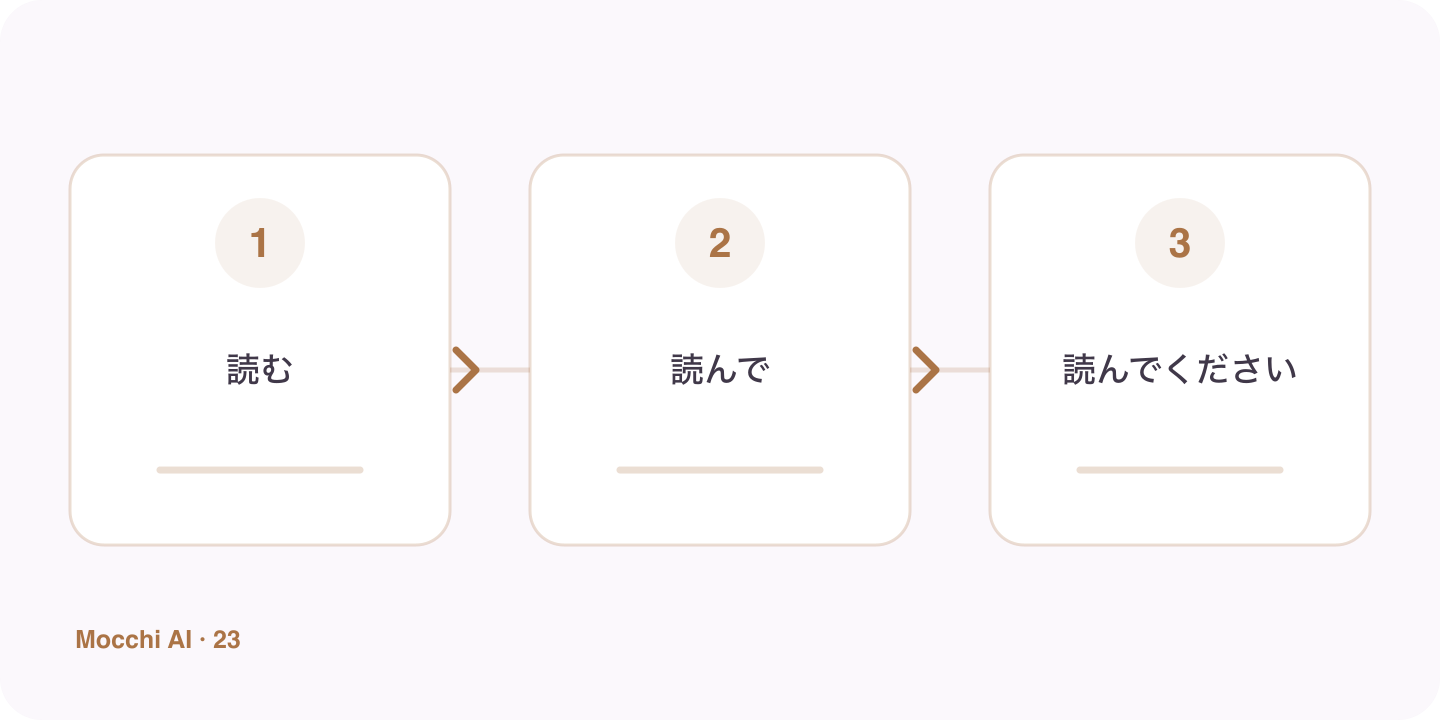
読む becomes 読んで, which can appear in 読んでください, 'Please read.' The object can be added in a sentence such as この文を読んでください, 'Please read this sentence.' After understanding the model, change the object or choose another familiar verb. The changed request asks you to retrieve the form instead of repeating the exact line you just saw.
| Japanese | Romaji | Meaning |
|---|---|---|
| この文を読んでください。 | Kono bun o yonde kudasai. | Please read this sentence. |
| 少し待ってください。 | Sukoshi matte kudasai. | Please wait a little. |
Notice forms that need explicit attention
Ask Mocchi to compare a few familiar forms, such as 書く to 書いて, 読む to 読んで, and 行く to 行って. Do not expand this into a large quiz before you can explain the forms you are using. When a form is irregular or exceptional, name it as such in your notes and revisit it in a useful phrase.
Add a simple action sequence as a second task
Once the form is available, connect two familiar actions and explain the intended sequence. Keep the vocabulary ordinary so the relation between the actions stays visible. Remember that the te-form's interpretation depends on its construction and context; practicing a simple sequence does not mean every sentence with a te-form expresses exactly the same relationship.
Return to the weak step during review
If you repeatedly make the same sound-change error, ask for a short form-focused review using fresh verbs from the relevant group. If the form is correct but the request is awkward, practice the sentence and its audience. This is where Mocchi's personalized support is useful: the next activity can address the step that failed rather than automatically repeating the whole lesson from the beginning.