

Finding the stem for every verb type
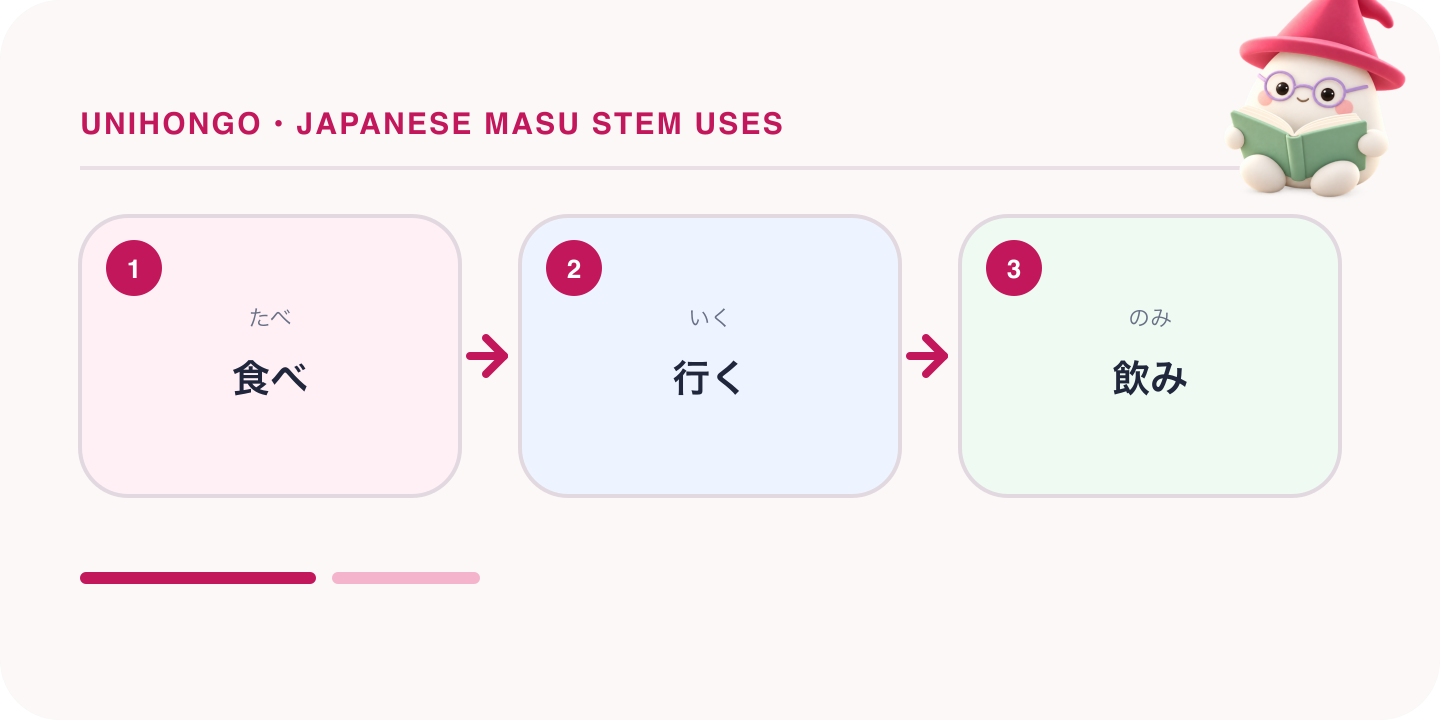
Ichidan verbs end in ru, and the stem is the dictionary form with ru removed: taberu gives tabe, miru gives mi, okiru gives oki. Godan verbs end in one of nine u sounds, and the stem changes that sound to its i column: nomu gives nomi, kaku gives kaki, hanasu gives hanashi, matsu gives machi, kau gives kai, yomu gives yomi, asobu gives asobi, shinu gives shini, kaeru (godan) gives kaeri.
The two irregular verbs are suru with the stem shi, and kuru with the stem ki. Every suru compound follows suru, so benkyō suru gives benkyō shi. If you already form the masu form confidently, you already know every stem; the only new step is to stop, remove masu, and look at what is left.
| Japanese | Romaji | Meaning |
|---|---|---|
| 食べます、食べに行く、食べ方。 | Tabemasu, tabe ni iku, tabekata. | Eat, go to eat, way of eating. |
| 飲みます、飲みながら、飲みすぎる。 | Nomimasu, nominagara, nomisugiru. | Drink, while drinking, drink too much. |
| 話します、話し始める、話し方。 | Hanashimasu, hanashihajimeru, hanashikata. | Speak, start speaking, way of speaking. |
| します、しやすい、し方。 | Shimasu, shiyasui, shikata. | Do, easy to do, way of doing. |
| 来ます、来やすい、来すぎる。 | Kimasu, kiyasui, kisugiru. | Come, easy to come to, come too often. |
Purpose with ni iku, kuru and kaeru
Stem plus ni plus a verb of movement expresses the purpose of going somewhere: eiga o mi ni iku, go to see a film; tomodachi ni ai ni kuru, come to meet a friend; hirugohan o tabe ni kaeru, go home to eat lunch. The object of the purpose verb keeps its own particle, so mi takes o before it and ai takes ni.
Nouns that pair with suru can skip the verb: kaimono ni iku, sanpo ni iku, ryokō ni iku. The movement verb can be anything that moves you: iku, kuru, kaeru, deru, modoru, hairu. It does not work with verbs that are not movement, so you cannot say tabe ni suru.
| Japanese | Romaji | Meaning |
|---|---|---|
| 週末、映画を見に行きませんか。 | Shūmatsu, eiga o mi ni ikimasen ka. | Would you like to go and see a film at the weekend? |
| 友達が会いに来てくれました。 | Tomodachi ga ai ni kite kuremashita. | A friend came to see me. |
| ちょっとコンビニに買い物に行ってきます。 | Chotto konbini ni kaimono ni itte kimasu. | I am just popping to the convenience store to buy something. |
| 昼ご飯を食べに一度家に帰ります。 | Hirugohan o tabe ni ichido ie ni kaerimasu. | I will go home once to eat lunch. |
| 本を借りに図書館へ行きました。 | Hon o kari ni toshokan e ikimashita. | I went to the library to borrow a book. |
Nagara, yasui and nikui, sugiru in brief
Three of the most common stem patterns each have a full guide on this blog, so here is only the shape. Stem plus nagara means while doing, with the same person doing both actions and the main action in the second clause: ongaku o kikinagara benkyō suru, study while listening to music. Stem plus yasui and nikui mean easy to and hard to, and the result is an i-adjective: yomiyasui hon, an easy book to read; wakarinikui setsumei, an explanation that is hard to follow.
Stem plus sugiru means to do too much, and the result is an ichidan verb that conjugates freely: tabesugita, I ate too much; nomisuginaide, do not drink too much. All three also attach to adjective stems, which is worth noticing: sugiru gives takasugiru, and yasui and nikui do not, but nagara can follow certain nouns such as zannen nagara.
| Japanese | Romaji | Meaning |
|---|---|---|
| 音楽を聞きながら勉強します。 | Ongaku o kikinagara benkyō shimasu. | I study while listening to music. |
| この本は字が大きくて読みやすいです。 | Kono hon wa ji ga ōkikute yomiyasui desu. | This book has big print and is easy to read. |
| この薬は苦くて飲みにくい。 | Kono kusuri wa nigakute nominikui. | This medicine is bitter and hard to take. |
| 昨日は食べすぎて、お腹が痛い。 | Kinō wa tabesugite, onaka ga itai. | I ate too much yesterday and my stomach hurts. |
| 働きすぎないでくださいね。 | Hatarakisuginaide kudasai ne. | Please do not overwork. |
Hajimeru, owaru, tsuzukeru and other aspect verbs
Stem plus hajimeru means to start doing: furihajimeru, start to rain; yomihajimeru, start reading. Stem plus owaru means to finish doing: yomiowaru, finish reading; tabeowaru, finish eating. Stem plus tsuzukeru means to keep doing: hashiritsuzukeru, keep running. These make ichidan or godan verbs according to the second element, so hajimeru and tsuzukeru conjugate as ichidan and owaru as godan.
Related second elements include dasu, which marks a sudden start (nakidasu, burst into tears), kakeru, being about to or halfway through (yomikakeru, start and leave unfinished), and naosu, doing again (kakinaosu, rewrite). Dasu is more abrupt than hajimeru; hajimeru is neutral and can describe a planned start.
| Japanese | Romaji | Meaning |
|---|---|---|
| 急に雨が降り始めました。 | Kyū ni ame ga furihajimemashita. | It suddenly began to rain. |
| やっとレポートを書き終わりました。 | Yatto repōto o kakiowarimashita. | I finally finished writing the report. |
| 三年間、日本語を勉強し続けています。 | Sannenkan, Nihongo o benkyō shitsuzukete imasu. | I have kept studying Japanese for three years. |
| 子どもが突然泣き出した。 | Kodomo ga totsuzen nakidashita. | The child suddenly burst out crying. |
| この本は読みかけです。 | Kono hon wa yomikake desu. | I have started this book but not finished it. |
| もう一度書き直してください。 | Mō ichido kakinaoshite kudasai. | Please rewrite it once more. |
Kata, tai and the stems that become adjectives
Stem plus kata makes a noun meaning the way of doing: tsukaikata, how to use; kakikata, how to write; ikikata, a way of life. Because the result is a noun, the object before it takes no rather than o: kanji no kakikata, not kanji o kakikata. For suru verbs, the natural form is shikata, and for a general how to, yarikata is common.
Stem plus tai makes an i-adjective meaning want to: ikitai, tabetai, kaitai. It conjugates like any i-adjective, ikitakatta, ikitakunai, ikitakute, and its object may take ga or o. Tai is only for your own wishes or direct questions to a listener; a third person's wish is tagatte iru. Stem plus sō also makes an adjective, describing how something looks about to happen: furisō, looks like rain; okisō, looks about to fall.
| Japanese | Romaji | Meaning |
|---|---|---|
| この漢字の書き方を教えてください。 | Kono kanji no kakikata o oshiete kudasai. | Please teach me how to write this kanji. |
| 切符の買い方が分かりません。 | Kippu no kaikata ga wakarimasen. | I do not know how to buy a ticket. |
| いつか北海道に行きたいです。 | Itsuka Hokkaidō ni ikitai desu. | I want to go to Hokkaido some day. |
| 弟は新しいゲームを買いたがっている。 | Otōto wa atarashii gēmu o kaitagatte iru. | My younger brother wants to buy a new game. |
| 今にも雨が降りそうです。 | Ima ni mo ame ga furisō desu. | It looks like it is about to rain. |
Compound verbs and nouns built from stems
The stem is also the glue inside compound verbs, where two verbs combine into one meaning: mochiaruku (carry around) from motsu and aruku, kakikomu (write in) from kaku and komu, hikidasu (pull out) from hiku and dasu, tobikomu (jump in), miokuru (see someone off), kikitoru (catch what is said). The first verb is always the stem; the second carries the conjugation.
Stems become nouns on their own, hanashi (a talk), yasumi (a rest, a holiday), odori (a dance), kaeri (the way home), and combine into compound nouns: nomimono (drink), tabemono (food), yomikaki (reading and writing), machiawase (meeting up), tabehōdai (all you can eat), kaimono (shopping). Recognising the stem inside these words makes hundreds of vocabulary items feel transparent.
| Word | Reading | Built from and meaning |
|---|---|---|
| 持ち歩く | mochiaruku | motsu + aruku: carry around |
| 書き込む | kakikomu | kaku + komu: write in, fill in |
| 引き出す | hikidasu | hiku + dasu: pull out, withdraw |
| 見送る | miokuru | miru + okuru: see someone off |
| 聞き取る | kikitoru | kiku + toru: catch what is said |
| 飲み物 | nomimono | nomu + mono: a drink |
| 食べ放題 | tabehōdai | taberu + hōdai: all you can eat |
| 待ち合わせ | machiawase | matsu + awaseru: meeting up |
| 休み | yasumi | yasumu: rest, day off, holiday |
| 帰り | kaeri | kaeru: the way home, return |
| 生き方 | ikikata | ikiru + kata: a way of life |
| 読み書き | yomikaki | yomu + kaku: reading and writing |
The bare stem in formal and written Japanese
In news, reports, essays and business email, the bare stem does the job the te form does in speech: it ends one clause and moves on to the next. Kaigi ni shusseki shi, iken o nobeta means attended the meeting and gave an opinion. This is the original continuative use, and it is where the name renyōkei comes from. It sounds neutral and crisp in writing but stiff in conversation.
Two things to watch. The stem does not carry negation or tense; those come from the final verb. And in speech, the stem still appears in fixed polite expressions such as o-machi kudasai (please wait), o-kake kudasai (please sit) and o-yasumi nasai (good night), which are all o plus the stem. Once you spot that, honorific requests stop looking like separate vocabulary.
| Japanese | Romaji | Meaning |
|---|---|---|
| 会議に出席し、意見を述べた。 | Kaigi ni shusseki shi, iken o nobeta. | Attended the meeting and gave an opinion. (written style) |
| 朝六時に起き、軽く運動をする。 | Asa rokuji ni oki, karuku undō o suru. | Gets up at six in the morning and does light exercise. |
| 資料を確認し、明日ご連絡いたします。 | Shiryō o kakunin shi, ashita go-renraku itashimasu. | I will check the documents and contact you tomorrow. |
| 少々お待ちください。 | Shōshō o-machi kudasai. | Please wait a moment. |
| どうぞお掛けください。 | Dōzo o-kake kudasai. | Please take a seat. |
Common mistakes and how to fix them
The most common error is attaching a pattern to the wrong form: taberu ni iku, nomu nagara, iku tai. All of these need the stem: tabe ni iku, nominagara, ikitai. A second is forming godan stems with the wrong vowel: hanasu gives hanashi, not hanasi or hanase; matsu gives machi; kaeru (return) gives kaeri.
Learners also confuse the stem with the te form in formal writing, or use the bare stem in casual conversation, where it sounds like reading aloud. Keep stems for writing and te forms for talk. With kata, remember the particle switch: tsukaikata needs no before it, not o. And do not use tai for other people's wishes; tagaru or the te form of hoshii covers that.
- Stem, not dictionary form, before ni iku, nagara, tai, sugiru, kata, yasui and nikui
- Godan stems shift to the i column: hanashi, machi, kaki, kai, kaeri
- Suru gives shi and kuru gives ki; shikata is the way, shiyasui is easy to do
- Kata is a noun, so kanji no kakikata, not kanji o kakikata
- Bare stem clause joining belongs in writing, not in conversation
- Tai for yourself, tagatte iru for a third person
If you get one thing from this guide, make it the habit of saying the stem aloud when you learn a new verb: taberu, tabe; nomu, nomi; hanasu, hanashi. Everything in this article follows from that one syllable.