

Kara and made for time: ku-ji kara go-ji made
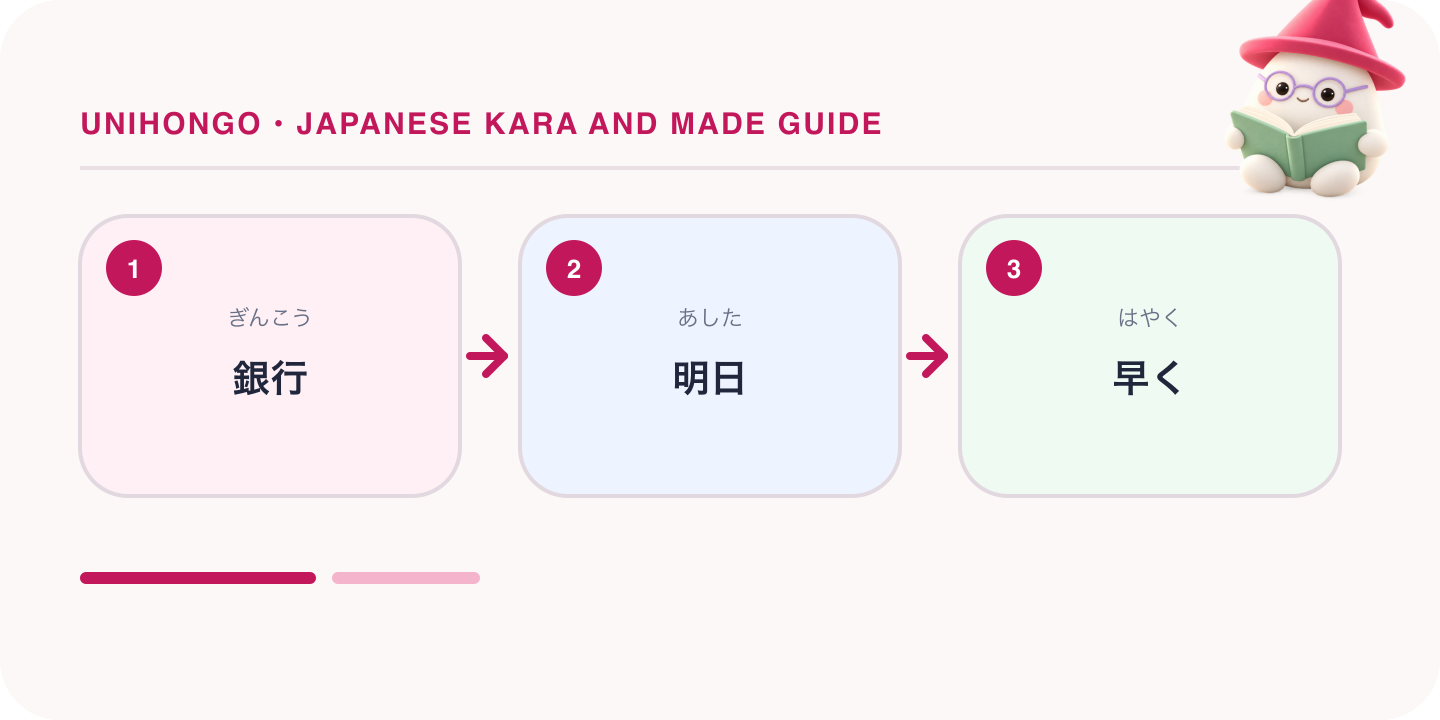
The first job of the pair is to frame a period. Kara follows the start and made follows the end: ginkō wa ku-ji kara san-ji made desu, the bank is open from nine to three. Either particle can stand alone. Ashita kara means from tomorrow, and it is the standard way to announce a change: ashita kara hayaku okimasu, from tomorrow I'm getting up early. Getsuyōbi made means until Monday, and it says how far something continues.
The verb after made must be something that lasts: work, wait, stay, be open, sleep. Go-ji made hatarakimasu means I work right up to five. If the verb is a single event that happens once, such as submit, arrive or decide, Japanese switches to made ni, and the section on deadlines below explains why.
| Japanese | Romaji | Meaning |
|---|---|---|
| 銀行は九時から三時までです。 | Ginkō wa ku-ji kara san-ji made desu. | The bank is open from nine to three. |
| 明日から早く起きます。 | Ashita kara hayaku okimasu. | From tomorrow I'll get up early. |
| 月曜日まで休みです。 | Getsuyōbi made yasumi desu. | I'm off until Monday. |
| 何時から何時まで働いていますか。 | Nan-ji kara nan-ji made hataraite imasu ka. | What hours do you work? |
| 去年から日本語を勉強しています。 | Kyonen kara Nihongo o benkyō shite imasu. | I've been studying Japanese since last year. |
| 夜遅くまで起きていました。 | Yoru osoku made okite imashita. | I was up until late at night. |
Kara and made for place: Tōkyō kara Ōsaka made
The same pair frames space. Tōkyō kara Ōsaka made shinkansen de ikimasu, I take the bullet train from Tokyo to Osaka. Kara marks where something starts or comes from, and that includes origins: Amerika kara kimashita, I came from America; kono mēru wa buchō kara desu, this email is from the manager. Made marks how far you go: eki made aruite ikimasu, I walk as far as the station.
Made and e both point towards a place, but they feel different. Eki e ikimasu says the station is the direction or destination; eki made ikimasu says the station is the limit of the journey, and it is the natural choice when you are talking about distance, fares or time taken. Ni sits between them and is the everyday destination marker: eki ni ikimasu. When you ask how far or how long, made is the particle: eki made dono kurai desu ka, how far is it to the station?
| Japanese | Romaji | Meaning |
|---|---|---|
| 東京から大阪まで新幹線で行きます。 | Tōkyō kara Ōsaka made shinkansen de ikimasu. | I take the bullet train from Tokyo to Osaka. |
| アメリカから来ました。 | Amerika kara kimashita. | I came from America. |
| 駅まで歩いて行きます。 | Eki made aruite ikimasu. | I walk as far as the station. |
| 駅までどのくらいですか。 | Eki made dono kurai desu ka. | How far is it to the station? |
| このメールは部長からです。 | Kono mēru wa buchō kara desu. | This email is from the manager. |
| 家から会社まで一時間かかります。 | Ie kara kaisha made ichi-jikan kakarimasu. | It takes an hour from home to work. |
Kara as because: samui kara
After a full clause, kara stops meaning from and means because. The reason comes first and the result second: samui kara, mado o shimemasu, because it's cold, I'll close the window. The clause before kara can be plain, samui kara, or polite, samui desu kara, and the polite version is what you use with people you do not know well. Kara can also end a sentence when the result is already clear: dōshite ikanai no? Isogashii kara. Why aren't you going? Because I'm busy.
Kara gives a subjective, personal reason and sounds direct. No de, covered in the guide to the particle no, gives a more objective reason and sounds softer, which is why no de is the safer choice in requests and apologies: okurete sumimasen, densha ga okureta no de. When you are simply explaining a decision, kara is natural. Note also the difference from the noun cause with de: kaze de yasumimashita uses de because kaze is a noun, while kaze o hiita kara yasumimashita uses kara because it is a clause.
| Japanese | Romaji | Meaning |
|---|---|---|
| 寒いから、窓を閉めます。 | Samui kara, mado o shimemasu. | It's cold, so I'll close the window. |
| 明日は休みですから、ゆっくり寝ます。 | Ashita wa yasumi desu kara, yukkuri nemasu. | Tomorrow's a day off, so I'll sleep in. |
| どうして行かないの? 忙しいから。 | Dōshite ikanai no? Isogashii kara. | Why aren't you going? Because I'm busy. |
| 風邪を引いたから、休みました。 | Kaze o hiita kara, yasumimashita. | I caught a cold, so I took the day off. |
| 危ないから、気をつけてください。 | Abunai kara, ki o tsukete kudasai. | It's dangerous, so please be careful. |
Made as even: kodomo made
After a noun, made can mean even, and it marks the far end of a scale. Kodomo made shitte iru, even the children know it, implies that everyone knows. Sensei made waratta, even the teacher laughed, implies the joke was strong enough to reach the least likely person. The item after made is the surprising extreme, and the rest of the scale is understood to be included.
Mo also adds an item, but without the sense of an extreme: sensei mo waratta simply says the teacher laughed too. Made says the teacher was the last person you expected. With places, Hokkaidō made ikimashita can mean as far as Hokkaido or even to Hokkaido; both readings share the idea of reaching a far point.
| Japanese | Romaji | Meaning |
|---|---|---|
| 子供まで知っています。 | Kodomo made shitte imasu. | Even the children know it. |
| 先生まで笑いました。 | Sensei made waraimashita. | Even the teacher laughed. |
| デザートまで食べました。 | Dezāto made tabemashita. | I even ate dessert. |
| 雨の日まで練習しています。 | Ame no hi made renshū shite imasu. | He practises even on rainy days. |
| 犬まで喜んでいます。 | Inu made yorokonde imasu. | Even the dog is pleased. |
Made ni: deadlines
Made ni means by, and it marks a deadline. The action after made ni happens once, at any moment before the limit: kin'yōbi made ni repōto o dashimasu, I'll submit the report by Friday. Compare kin'yōbi made repōto o kakimasu, I'll be writing the report until Friday, where the writing continues right up to the end. The verb type decides: a continuous state or action takes made, a single completed event takes made ni.
This pair is one of the most common errors in learner Japanese, and the separate post on made versus made ni goes through many more examples. For this guide, the working test is to ask whether the action stops at the time or is finished before it. Waiting, working and staying stop at the time, so they take made. Arriving, submitting, finishing and deciding are done before it, so they take made ni.
| Japanese | Romaji | Meaning |
|---|---|---|
| 金曜日までにレポートを出します。 | Kin'yōbi made ni repōto o dashimasu. | I'll submit the report by Friday. |
| 金曜日までレポートを書きます。 | Kin'yōbi made repōto o kakimasu. | I'll be writing the report until Friday. |
| 五時までに来てください。 | Go-ji made ni kite kudasai. | Please come by five. |
| 五時まで待ちます。 | Go-ji made machimasu. | I'll wait until five. |
| 来週までに決めましょう。 | Raishū made ni kimemashō. | Let's decide by next week. |
Kara made pairs and te kara
Kara and made work together beyond simple spans. Kara made can pair with question words: itsu kara itsu made, from when until when; doko kara doko made, from where to where. Together they can also frame an amount of change: san-nin kara go-nin made, from three to five people. Prices and ages work the same way: sen-en kara ni-sen-en made, from one to two thousand yen.
Te kara is a separate pattern built from the te form of a verb plus kara, and it means after doing something: gohan o tabete kara, dekakemasu, I'll go out after eating. It sets the order of two actions. Do not confuse it with the plain past plus kara, tabeta kara, which means because I ate. Te kara is also common in giving instructions: te o aratte kara, tabete kudasai, wash your hands, then eat.
| Japanese | Romaji | Meaning |
|---|---|---|
| いつからいつまで日本にいますか。 | Itsu kara itsu made Nihon ni imasu ka. | From when until when will you be in Japan? |
| どこからどこまで歩きましたか。 | Doko kara doko made arukimashita ka. | From where to where did you walk? |
| ご飯を食べてから、出かけます。 | Gohan o tabete kara, dekakemasu. | I'll go out after eating. |
| 手を洗ってから、食べてください。 | Te o aratte kara, tabete kudasai. | Wash your hands, then eat. |
| 日本に来てから、三年になります。 | Nihon ni kite kara, san-nen ni narimasu. | It's been three years since I came to Japan. |
| 仕事が終わってから、電話します。 | Shigoto ga owatte kara, denwa shimasu. | I'll call after work finishes. |
Summary table of kara and made patterns
The table lines up the uses with one model phrase each, so you can identify which pattern you are hearing.
| Pattern | Reading | Use and meaning |
|---|---|---|
| 九時から | ku-ji kara | Start time: from nine |
| 五時まで | go-ji made | End time: until five |
| 去年から | kyonen kara | Since: since last year |
| 東京から | Tōkyō kara | Origin: from Tokyo |
| 駅まで | eki made | Limit in space: as far as the station |
| 部長から | buchō kara | Source: from the manager |
| 寒いから | samui kara | Reason: because it's cold |
| 子供まで | kodomo made | Even: even the children |
| 金曜日までに | kin'yōbi made ni | Deadline: by Friday |
| いつからいつまで | itsu kara itsu made | Span question: from when until when |
| 食べてから | tabete kara | Sequence: after eating |
| 来てから三年 | kite kara san-nen | Since a clause: three years since coming |
Common mistakes with kara and made
The biggest one is made for a deadline: go-ji made kite kudasai sounds like keep coming until five; a single arrival needs made ni. The second is kara for a noun cause: kaze kara yasumimashita should be kaze de yasumimashita, because kaze is a noun, not a clause. The third is tabeta kara for after eating; the sequence pattern is tabete kara, and tabeta kara means because I ate.
Learners also over-use kara as because in polite requests, where it can sound as if you are pushing your own reasons; no de is softer. And when giving directions with distance, ni is fine for the destination, but made is what you want for how far: eki made go-fun desu, it's five minutes to the station.
- Use made ni for a one-off deadline, made for a continuing action
- A noun cause takes de; a clause reason takes kara
- Te kara is after, ta kara is because
- Kara before a polite ending is fine: isogashii desu kara
- Made keeps ni and de before it: tomodachi ni made
- Prefer no de over kara in requests and apologies
For the full head-to-head with many more verbs, the post on made versus made ni covers the deadline problem in depth; this article is the complete map of kara and made themselves.