

Toka after one example: the friendly suggestion
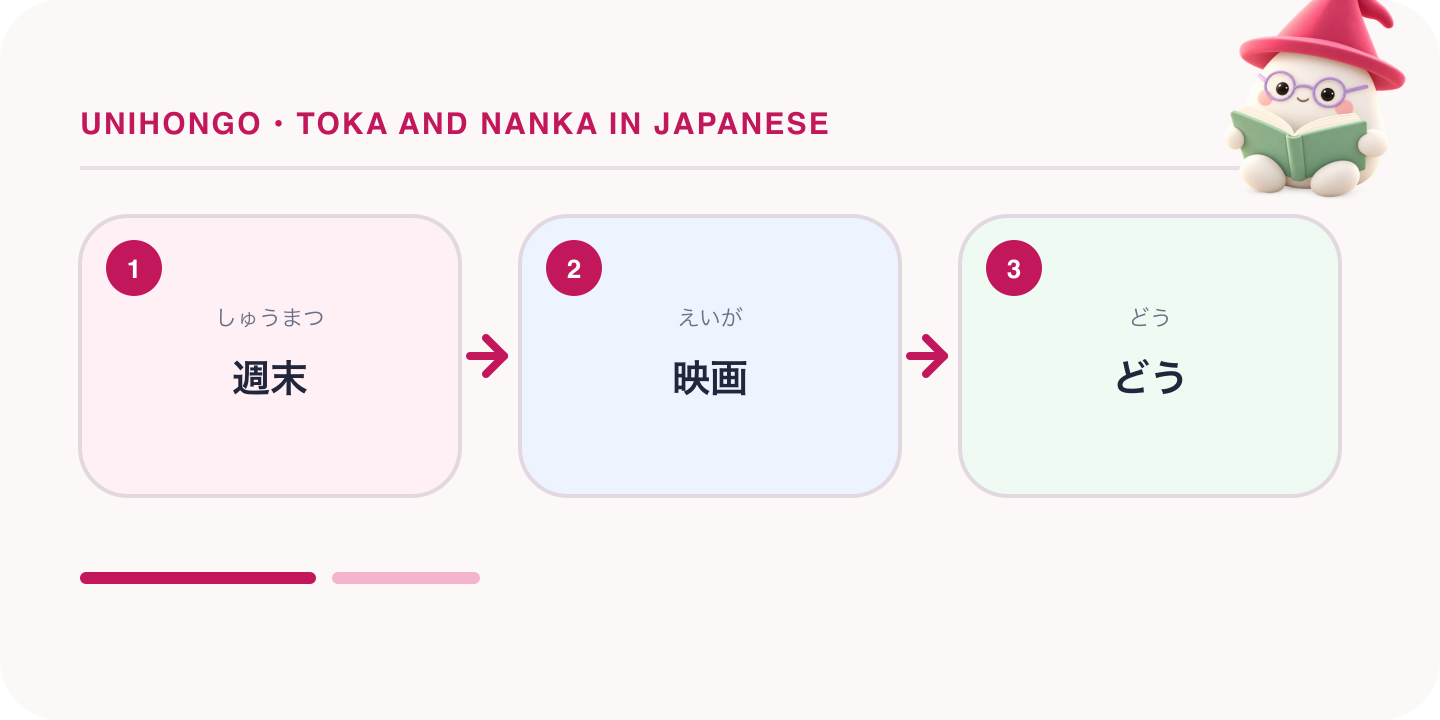
The most useful spoken job of toka is not listing at all. It follows a single item and tells the listener that this item is just an example. Eiga toka dō? does not mean films and things; it means how about a film, or something along those lines? By marking your idea as one of several, you hand the choice back to the other person, which is exactly what a polite suggestion in Japanese should do.
This is why natives reach for toka when inviting, recommending and advising. Kōhī toka nomu? invites you for a coffee without insisting on coffee, and byōin toka itta hō ga ii yo suggests seeing a doctor without lecturing.
Toka also attaches to whole clauses: kuru toka itteta kedo means they were saying they might come, or something, with a shade of doubt about the exact words.
| Japanese | Romaji | Meaning |
|---|---|---|
| 週末、映画とかどう? | Shūmatsu, eiga toka dō? | How about a film or something at the weekend? |
| コーヒーとか飲む? | Kōhī toka nomu? | Fancy a coffee or something? |
| 病院とか行ったほうがいいよ。 | Byōin toka itta hō ga ii yo. | You should see a doctor or something. |
| お土産はお菓子とかでいいと思う。 | Omiyage wa okashi toka de ii to omou. | For a souvenir, sweets or something would be fine. |
| 来るとか言ってたけど、どうかな。 | Kuru toka itteta kedo, dō ka na. | They said they might come, but who knows. |
| カフェとかで話そうか。 | Kafe toka de hanasō ka. | Shall we talk at a café or somewhere? |
Nanka as filler: buying a second and marking an impression
Nanka at the start of a sentence, or in the middle of one, is the Japanese equivalent of like, kind of or I don't know. Nanka tsukareta means I'm kind of tired; nanka hen means it's somehow weird. The word does not name anything. It tells the listener that what follows is an impression, not a measured conclusion, and it gives the speaker a beat to find the next word.
Because it marks impressions, nanka is the natural opener for feelings you cannot fully explain. Nanka iya da, I just don't like it, is what people say when they cannot give a reason, and nanka chigau, it's somehow not right, rejects a draft or a plan without a detailed critique. The vagueness says the feeling is real but the speaker is not claiming authority.
| Japanese | Romaji | Meaning |
|---|---|---|
| なんか疲れた。 | Nanka tsukareta. | I'm kind of tired. |
| なんか変じゃない? | Nanka hen ja nai? | Isn't it kind of weird? |
| なんか嫌だな、それ。 | Nanka iya da na, sore. | I just don't like that, somehow. |
| この色、なんか違う気がする。 | Kono iro, nanka chigau ki ga suru. | This colour feels somehow off. |
| 俺なんかにできるかな。 | Ore nanka ni dekiru ka na. | I wonder if someone like me can do it. |
| なんか、いい感じだね。 | Nanka, ii kanji da ne. | It's got a nice feel to it, somehow. |
Nanka meaning something like and nanka as a soft example
The second nanka is a noun-like word meaning something or something like, and it usually follows a noun. Nomimono nanka iru? means do you want a drink or anything? Here nanka behaves almost exactly like toka: it names one item and hints at others. The difference is tone. Toka is neutral. Nanka following a noun is a shade more casual and often a shade more dismissive, as if the item does not matter much.
That slight dismissiveness is why nanka after a noun fits offers and refusals rather than recommendations. Purezento nanka iranai yo refuses a present gracefully; okane nanka nai complains lightly about money. If you are recommending something you value, use toka instead: kono mise toka oishii yo. Ore nanka, someone like me, is the same humble put-down turned on yourself.
| Japanese | Romaji | Meaning |
|---|---|---|
| 飲み物なんかいる? | Nomimono nanka iru? | Do you want a drink or anything? |
| プレゼントなんかいらないよ。 | Purezento nanka iranai yo. | I don't need a present or anything. |
| お金なんかないよ。 | Okane nanka nai yo. | I haven't got any money or anything. |
| 雨の日なんか、家で映画見てる。 | Ame no hi nanka, ie de eiga miteru. | On rainy days and the like, I watch films at home. |
| この店とかおいしいよ。 | Kono mise toka oishii yo. | This place, for one, is good. |
Nante for modesty, surprise and dismissal
Nante is toka's opinionated cousin. It quotes something and adds an attitude, usually surprise, modesty or scorn. After your own things it is humble: watashi no nihongo nante mada mada desu, my Japanese is nothing yet. After an unexpected event it is surprised: kimi ga kuru nante, fancy you coming. After a rejected idea it is dismissive: sonna koto nante dekinai, there's no way I can do that.
Because nante carries attitude, it is the word that pairs best with compliments. When someone praises you, a nante reply is the classic modest deflection, and it works in polite speech as well as casual speech. Nante followed by an exclamation of surprise is also a warm way to react to good news: gōkaku shita nante, sugoi, you passed, that's amazing.
Nante can also mean things like, as in kōhī nante dō?, where it overlaps with toka but adds feeling. Treat nante as an emotional word and toka as a neutral one.
| Japanese | Romaji | Meaning |
|---|---|---|
| 私の日本語なんてまだまだです。 | Watashi no nihongo nante mada mada desu. | My Japanese is nothing yet. |
| 君が来るなんて思わなかった。 | Kimi ga kuru nante omowanakatta. | I never thought you would come. |
| 合格したなんて、すごいね。 | Gōkaku shita nante, sugoi ne. | You passed? That's amazing. |
| そんなことなんてできないよ。 | Sonna koto nante dekinai yo. | There's no way I can do something like that. |
| 私の料理なんて、大したことないよ。 | Watashi no ryōri nante, taishita koto nai yo. | My cooking is nothing special. |
| 嘘なんてつかないよ。 | Uso nante tsukanai yo. | I wouldn't do something like lie. |
Tari in speech: doing things like this and that
Tari is the verb-shaped member of the family. It takes the ta form of a verb and adds ri, and it presents an action as one of several. Nichiyōbi wa sōji shitari means on Sundays I do things like cleaning. The sentence is complete even though a second tari never arrives, and in speech it usually does not.
Natives use a single tari to describe a habit without committing to a schedule, and to soften a suggestion in the same way toka does: sanpo shitari shitara? is gentle because the walk is only an example.
A single tari also works as a complete answer: nani shiteta? Netetari. The vagueness is friendly; it says the day was unremarkable and you will not bore anyone with details.
| Japanese | Romaji | Meaning |
|---|---|---|
| 日曜日は掃除したり、買い物したり。 | Nichiyōbi wa sōji shitari, kaimono shitari. | On Sundays I do things like cleaning and shopping. |
| 散歩したりしたら? | Sanpo shitari shitara? | How about going for a walk or something? |
| 何してた?寝てたり。 | Nani shiteta? Netetari. | What were you up to? Sleeping and the like. |
| 週末は友達と飲んだりしてる。 | Shūmatsu wa tomodachi to nondari shiteru. | At weekends I do things like drinking with friends. |
| 休みの日は映画を見たりします。 | Yasumi no hi wa eiga o mitari shimasu. | On days off I do things like watching films. |
The vague words at a glance
The table gathers the family so you can compare job and register. Only nanka as a filler is truly casual; the rest survive in polite sentences as long as the verb endings are polite.
| Word | Reading | Job in speech and register |
|---|---|---|
| とか | toka | one example standing for more; neutral, fine in polite speech |
| なんか (filler) | nanka | kind of, somehow; casual only, softens a whole sentence |
| なんか (after noun) | nanka | or anything, a thing like; casual, slightly dismissive |
| なんて | nante | something like, with modesty or surprise; any register |
| たり | tari | doing things like; neutral, complete with one verb |
| とかさ | toka sa | toka with the casual particle sa; friends only |
| なんかさ | nanka sa | filler opener that asks for attention; friends only |
| とかじゃなくて | toka ja nakute | not something like that; correcting a guess |
| なんていうか | nan te iu ka | how should I put it; polite hesitation, any register |
| なんだか | nandaka | somehow; a softer, slightly more literary nanka |
Nan te iu ka and nandaka are the ones to carry into polite speech when you want a hedge. Nandaka samui desu ne, it's somehow cold, isn't it, is a perfectly good office remark, whereas nanka samui would sound like you were talking to a classmate.
Why natives vagueify, and when they do not
Softening is a social tool. A definite statement can feel like it closes the conversation, leaving the listener only agree or disagree. A vague one leaves a door open: toka lets the other person choose, nanka lets the speaker retreat from an opinion without embarrassment, and nante lets someone accept praise without appearing proud.
There are situations where vagueness is unwelcome. Giving directions, confirming a time, reporting a problem to a doctor and answering a customer's question all call for precision, and natives drop the hedges there. Ashita no sanji toka ni kimasu is annoying to the person waiting; ashita no sanji ni kimasu is what they want to hear.
- Use toka when inviting, suggesting or recommending, so the choice stays open
- Use nanka when reporting a feeling you cannot fully justify
- Use nante when accepting a compliment or reacting to surprising news
- Use tari when describing habits or an unremarkable day
- Drop all of them when giving times, numbers, addresses or medical facts
A good test is to ask whether the listener needs to act on what you say. If they do, be precise. If they only need to feel included or reassured, a little vagueness is kinder.
Mistakes and overuse
The biggest problem with these words is not using them wrongly but using them everywhere. A learner who has just discovered nanka can produce nanka kyō nanka tsukareta kara nanka kaeru, which sounds like every sentence is being apologised for. Aim for one hedge per sentence at most, and let some sentences go without any.
The second problem is putting toka into precise contexts. Roku-ji toka ni aimashō sounds indecisive when you are actually fixing a time; say roku-ji ni aimashō unless the time is genuinely flexible, and keep toka away from instructions.
The third is using nanka as a filler in polite speech. Nanka, kaigi no shiryō ga, in a meeting sounds unprepared; replace it with anō or nan te iu ka. Finally, do not confuse the dismissive nanka with the question word nani ka: nani ka nomimasu ka is a polite offer, nanka nomu? is the casual version, and the two should not be swapped.
| Japanese | Romaji | Meaning |
|---|---|---|
| 六時に会いましょう。 | Roku-ji ni aimashō. | Let's meet at six. (precise, no toka) |
| 何か飲みますか。 | Nani ka nomimasu ka. | Would you like something to drink? (polite) |
| なんか飲む? | Nanka nomu? | Want something to drink? (casual) |
| なんていうか、少し不安です。 | Nan te iu ka, sukoshi fuan desu. | How should I put it, I'm a little worried. (polite hedge) |
| 週末は映画とか見るくらいです。 | Shūmatsu wa eiga toka miru kurai desu. | At weekends I do little more than watch films or so. |