

What mai means
Mai is the negative counterpart of the volitional form. Where the volitional ikō expresses intention or invitation, and the conjectural iku darō expresses a guess, mai combines both in the negative: ikumai can mean I will not go or someone probably will not go.
Which meaning applies depends on the subject. With a first-person subject and a verb you can control, mai is usually a resolution: I will not do it. With a third-person subject, or with events outside anyone's control, it is a guess: it probably will not happen.
Mai belongs to written and formal Japanese. It gives a sentence a firm, literary tone, and you will see it in novels, essays, editorials and speeches. In everyday conversation it sounds old-fashioned or theatrical, except in a few fixed expressions.
| Japanese | Romaji | Meaning |
|---|---|---|
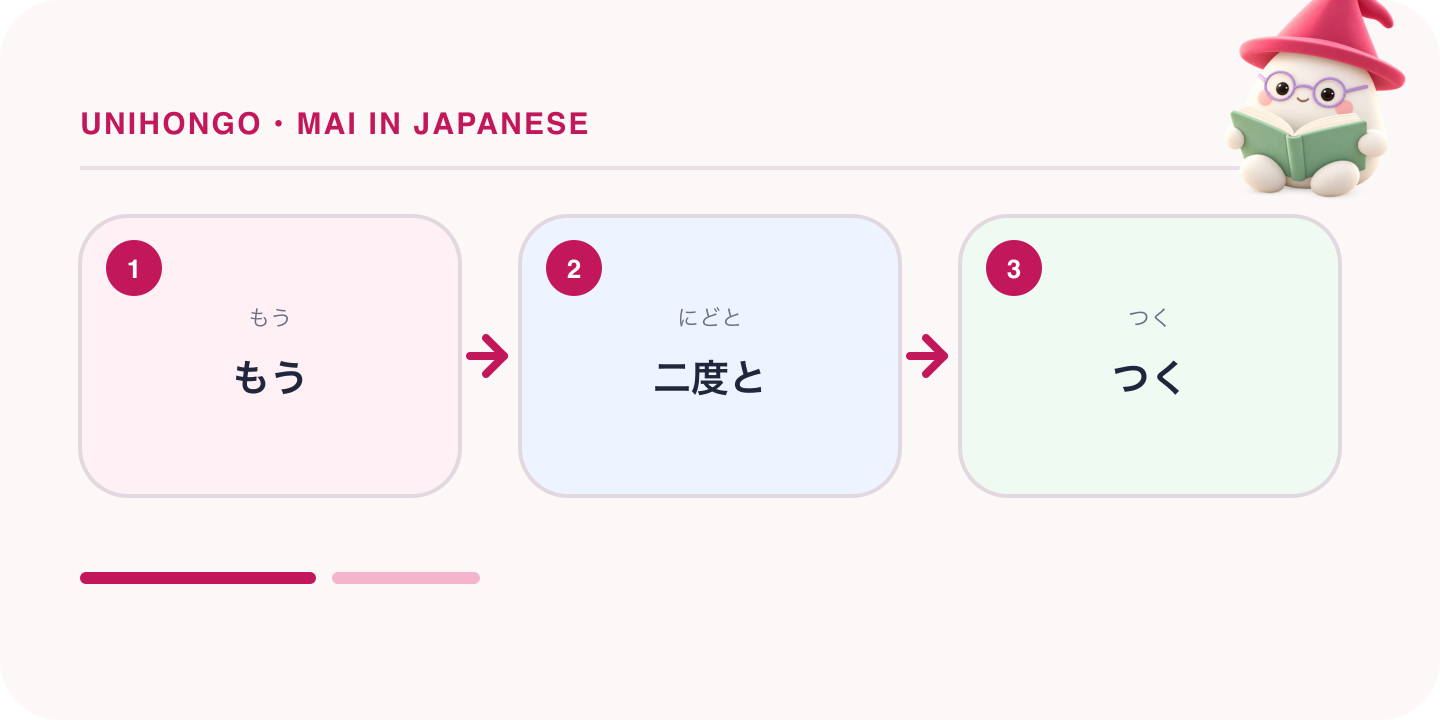
| もう二度と嘘はつくまい。 | Mō nidoto uso wa tsukumai. | I will never tell a lie again. |
| この雨では、彼は来るまい。 | Kono ame de wa, kare wa kurumai. | In this rain, he probably won't come. |
| そんなことはあるまい。 | Sonna koto wa arumai. | That's hardly likely. |
| 同じ失敗は繰り返すまい。 | Onaji shippai wa kurikaesumai. | I will not repeat the same mistake. |
How to form mai
Godan verbs take the dictionary form plus mai: iku becomes ikumai, nomu becomes nomumai. Ichidan verbs take either the dictionary form plus mai or the stem plus mai: taberumai and tabemai are both used, with taberumai perhaps more common in modern writing.
The irregular verbs are where the quirks lie. Suru has three forms: surumai, sumai, the old classical form, and shimai. Kuru has kurumai, komai and, less commonly, kimai. Grammars disagree slightly on which are standard, so treat all of them as recognisable and choose surumai or kurumai if you need to write one.
For nouns and na-adjectives, use de wa arumai or ja arumai, and for i-adjectives use ku wa arumai or ku mo arumai. The polite form masumai exists, as in ikimasumai, but it is very old-fashioned and rarely used today.
| Verb type | Dictionary form | Mai form | Notes |
|---|---|---|---|
| Godan | 行く iku | 行くまい ikumai | Dictionary form + まい |
| Godan | 飲む nomu | 飲むまい nomumai | Dictionary form + まい |
| Ichidan | 食べる taberu | 食べるまい taberumai / 食べまい tabemai | Both used |
| Ichidan | 見る miru | 見るまい mirumai / 見まい mimai | Both used |
| Irregular | する suru | するまい surumai / しまい shimai / すまい sumai | Sumai is classical |
| Irregular | 来る kuru | 来るまい kurumai / 来まい komai / kimai | Komai is traditional |
| Existence | ある aru | あるまい arumai | Very common in set phrases |
| Noun | 学生だ gakusei da | 学生ではあるまい gakusei de wa arumai | Probably not a student |
Meaning one: I will not
The volition meaning is a firm resolution by the speaker, and it often pairs with nidoto, never again, or kesshite, absolutely not. It has the tone of a vow made to oneself, which is why it appears in diaries, novels and dramatic moments.
In running text, first-person mai often appears with to omou or to kokoro ni kimeru, I decided in my heart, to show that it is an internal decision.
| Japanese | Romaji | Meaning |
|---|---|---|
| 二度とあの店には行くまい。 | Nidoto ano mise ni wa ikumai. | I'll never go to that shop again. |
| 決して諦めまい。 | Kesshite akiramemai. | I will never give up. |
| もう彼には頼るまいと決めた。 | Mō kare ni wa tayorumai to kimeta. | I decided I would no longer rely on him. |
| 同じ失敗はしまいと心に誓った。 | Onaji shippai wa shimai to kokoro ni chikatta. | I swore to myself I would not make the same mistake. |
Meaning two: probably not
The conjecture meaning is a negative guess, roughly equal to nai darō or nai to omou. It is typical of commentary and narration, where a writer judges what is unlikely.
Arumai, from aru, is especially common here. De wa arumai ka, isn't it perhaps, is a formal way to raise a possibility in essays: kore wa mondai de wa arumai ka, might this not be a problem? It works like de wa nai darō ka.
| Japanese | Romaji | Meaning |
|---|---|---|
| この計画は簡単には進むまい。 | Kono keikaku wa kantan ni wa susumumai. | This plan will probably not go smoothly. |
| 彼がそんなことを言うはずはあるまい。 | Kare ga sonna koto o iu hazu wa arumai. | There's no way he would say something like that. |
| これは偶然ではあるまい。 | Kore wa gūzen de wa arumai. | This is surely no coincidence. |
| それが問題の本質ではあるまいか。 | Sore ga mondai no honshitsu de wa arumai ka. | Might that not be the heart of the problem? |
| まさか雪は降るまい。 | Masaka yuki wa furumai. | Surely it won't snow. |
Mai to omou and mai to suru
Mai to omou means I intend not to or I have resolved not to, and mai to suru means try not to or make an effort not to. Both are the negative equivalents of yō to omou and yō to suru.
Mai to suru often describes a visible effort, especially in narrative: namida o misemai to shita, she tried not to show her tears. Like yō to suru, it can describe someone else's effort from outside.
| Japanese | Romaji | Meaning |
|---|---|---|
| もう甘い物は食べまいと思う。 | Mō amai mono wa tabemai to omou. | I've decided not to eat sweets any more. |
| 彼女は涙を見せまいとした。 | Kanojo wa namida o misemai to shita. | She tried not to show her tears. |
| 笑うまいとしたが、無理だった。 | Waraumai to shita ga, muri datta. | I tried not to laugh, but I couldn't help it. |
| 遅れまいと走った。 | Okuremai to hashitta. | I ran so as not to be late. |
Yō ka mai ka and u ga mai ga
Yō ka mai ka pairs the volitional with mai to mean whether to or not: ikō ka ikumai ka mayou, hesitate over whether to go. It usually appears with mayou, to be torn, or nayamu, to worry over. In speech, people say ikō ka dō ka or iku ka dō ka instead.
U ga mai ga and u to mai to mean whether or not, it makes no difference: ame ga furō ga furumai ga, shiai wa aru, the match goes ahead whether it rains or not. The second half says something that holds either way. In speech, this becomes te mo nakute mo or ka dō ka ni kakawarazu.
| Japanese | Romaji | Meaning |
|---|---|---|
| 行こうか行くまいか迷っている。 | Ikō ka ikumai ka mayotte iru. | I can't decide whether to go or not. |
| 言おうか言うまいか、ずっと悩んだ。 | Iō ka iumai ka, zutto nayanda. | I agonised over whether to say it or not. |
| 雨が降ろうが降るまいが、試合は行われる。 | Ame ga furō ga furumai ga, shiai wa okonawareru. | The match will be held whether it rains or not. |
| 君が信じようと信じまいと、これは事実だ。 | Kimi ga shinjiyō to shinjimai to, kore wa jijitsu da. | Whether you believe it or not, this is the truth. |
Fixed expressions you will actually hear
Some mai expressions are alive in everyday speech. The best known is ja arumai shi, it is not as if..., used to push back: kodomo ja arumai shi, hitori de ikeru yo, I'm not a child, I can go on my own. The shi gives a reason, and the whole phrase sounds lively rather than stiff.
Others include mono de wa arumai, surely not, and wake de mo arumai, it's not as if. You will also hear nidoto... mai in films and dramas when a character makes a vow.
| Japanese | Romaji | Meaning |
|---|---|---|
| 子供じゃあるまいし、一人で行けるよ。 | Kodomo ja arumai shi, hitori de ikeru yo. | I'm not a child, I can go on my own. |
| 初めてじゃあるまいし、心配しないで。 | Hajimete ja arumai shi, shinpai shinai de. | It's not my first time, so don't worry. |
| 夢じゃあるまいし。 | Yume ja arumai shi. | It's not as if this is a dream. |
| 世界が終わるわけでもあるまい。 | Sekai ga owaru wake de mo arumai. | It's not as if the world is ending. |
Mai vs modern spoken equivalents
For speaking, you will almost always want a modern form. Negative intention becomes nai tsumori or nai yō ni suru, and negative guess becomes nai darō or nai to omou. Using mai in conversation can sound like a line from a period drama.
| Meaning | Written: mai | Spoken equivalent |
|---|---|---|
| I will not go again | 二度と行くまい | もう二度と行かない |
| I resolve not to eat sweets | 甘い物は食べまいと思う | 甘い物は食べないようにする |
| He probably won't come | 彼は来るまい | 彼は来ないだろう |
| Tried not to laugh | 笑うまいとした | 笑わないようにした |
| Whether to go or not | 行こうか行くまいか | 行くかどうか |
| Whether it rains or not | 降ろうが降るまいが | 降っても降らなくても |
- Common mistake: attaching mai to the nai form. Ikanaimai is wrong; mai already contains the negative.
- Common mistake: using mai for other people's intentions. Kare wa ikumai means he probably won't go, not he intends not to go.
- Common mistake: using mai in polite conversation with a superior; it sounds stiff and dramatic. Use itashimasen or nai yō ni itashimasu.