

What kuse ni means
Kuse ni links a fact about a person with something that person does, and says that the second does not fit the first. You are a beginner, yet you give everyone advice. He has money, yet he never pays. The speaker is not just noting a contrast; they are criticising the person for it.
That feeling of blame is the whole point of the pattern. In English you might add a sneer to even though or say and yet he still..., or use a phrase like for someone who. Japanese builds the attitude into the grammar, which makes kuse ni easy to recognise and easy to misuse.
Kuse ni is usually written in hiragana, くせに. It comes from the noun kuse, habit or peculiarity, which is written 癖 when used on its own.
| Japanese | Romaji | Meaning |
|---|---|---|
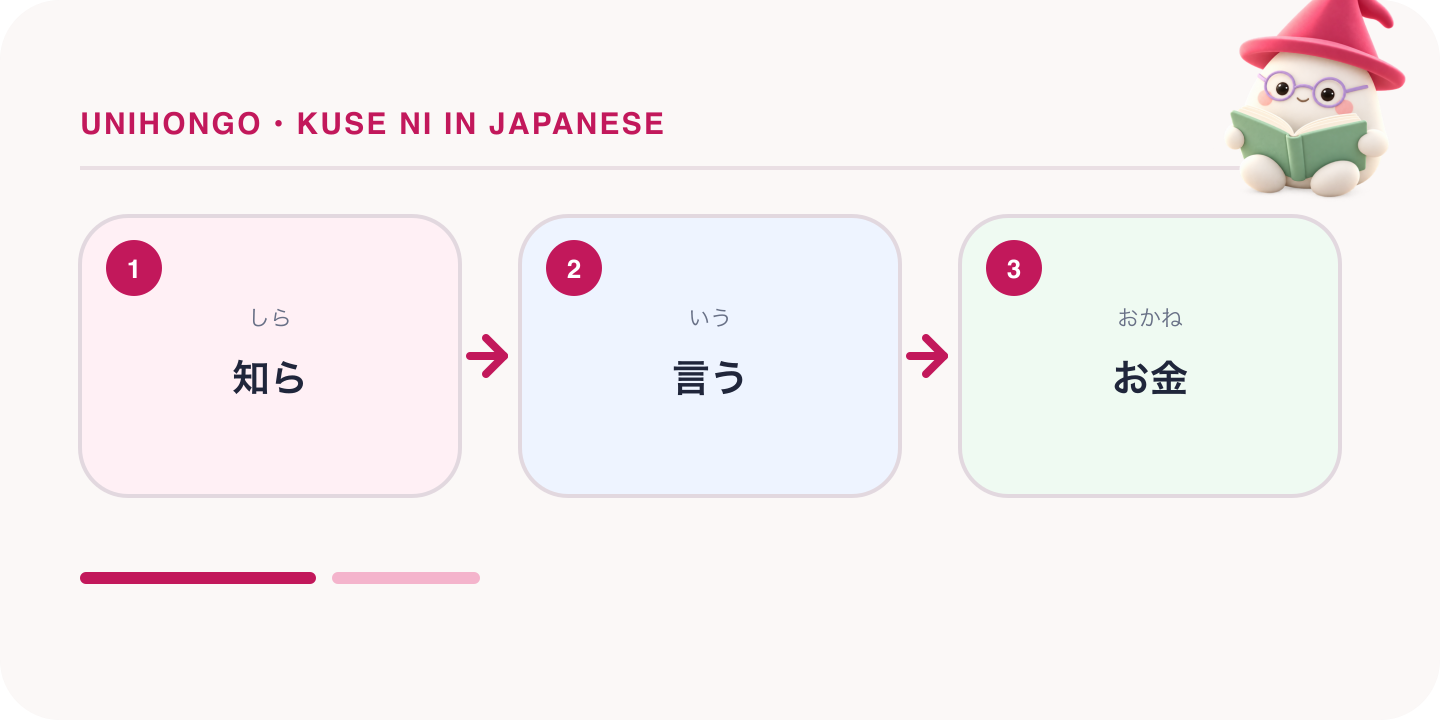
| 何も知らないくせに、偉そうなことを言うな。 | Nani mo shiranai kuse ni, erasō na koto o iu na. | Don't act so superior when you don't know anything. |
| お金があるくせに、いつも払わない。 | Okane ga aru kuse ni, itsumo harawanai. | He's got money, yet he never pays. |
| 自分でやらないくせに、文句ばかり言う。 | Jibun de yaranai kuse ni, monku bakari iu. | She never does it herself, but she complains about everything. |
| 新人のくせに、生意気だ。 | Shinjin no kuse ni, namaiki da. | He's cheeky for a new hire. |
How to form kuse ni
Kuse is a noun, so kuse ni attaches the same way noni and other noun-based patterns do. Verbs and i-adjectives use their plain form. Na-adjectives keep na, and nouns take no. Both present and past forms are possible.
| Word type | Connection | Example | Meaning |
|---|---|---|---|
| Verb | Plain form + くせに | 知っているくせに shitte iru kuse ni | Even though you know |
| Verb (past) | Plain past + くせに | 約束したくせに yakusoku shita kuse ni | Even though you promised |
| I-adjective | Plain form + くせに | 若いくせに wakai kuse ni | Even though you're young |
| Na-adjective | Stem + なくせに | 下手なくせに heta na kuse ni | Even though you're bad at it |
| Noun | Noun + のくせに | 子供のくせに kodomo no kuse ni | Even though you're a child |
The grammar restrictions
Kuse ni has two firm restrictions that noni does not. First, both clauses must be about the same person. The first clause states a fact about them, and the second describes their behaviour or attitude. You cannot say ame ga futte iru kuse ni, kare wa dekaketa, it's raining yet he went out, because the rain is not the person you are criticising. Use noni there.
Second, kuse ni is almost always about someone other than the speaker: the listener or a third person. Criticising yourself with kuse ni is unusual and sounds odd in most contexts. When you are frustrated with yourself, noni is the natural choice.
It also tends to describe a person's ongoing traits and behaviour rather than one-off events outside their control. The target is always a person, or occasionally an animal treated like one, never weather, prices or a machine.
| Japanese | Romaji | Meaning |
|---|---|---|
| 雨が降っているのに、彼は出かけた。 | Ame ga futte iru noni, kare wa dekaketa. | Even though it's raining, he went out. |
| 彼は風邪をひいているくせに、飲みに行った。 | Kare wa kaze o hiite iru kuse ni, nomi ni itta. | He's got a cold, yet he went out drinking. |
| たくさん勉強したのに、合格できなかった。 | Takusan benkyō shita noni, gōkaku dekinakatta. | I studied a lot, but I still didn't pass. |
The first example uses noni because the subject changes from the rain to him. The second keeps him as the subject of both halves, so kuse ni fits and adds the speaker's disapproval. The third is about the speaker's own disappointment, so noni is the only natural option.
Kuse ni vs noni
Both patterns translate as even though, and they attach in exactly the same way. The difference is attitude and scope. Noni reports that the result goes against expectation, often with surprise, disappointment or frustration. Kuse ni points a finger at a person.
Noni can also end a sentence to express regret: motto hayaku kureba yokatta noni, if only you'd come earlier. Kuse ni can end a sentence too, but then it is a pointed accusation, as in the next section.
| Japanese | Romaji | Meaning |
|---|---|---|
| 日曜日なのに、仕事に行った。 | Nichiyōbi na noni, shigoto ni itta. | Even though it was Sunday, I went to work. |
| 知っているのに、教えてくれなかった。 | Shitte iru noni, oshiete kurenakatta. | She knew, but she didn't tell me. (disappointed) |
| 知っているくせに、教えてくれなかった。 | Shitte iru kuse ni, oshiete kurenakatta. | She knew, and still didn't tell me. (resentful) |
| Feature | のに noni | くせに kuse ni |
|---|---|---|
| Core feeling | Surprise, disappointment, frustration | Criticism, contempt, blame |
| Subjects | Can differ between clauses | Must be the same person |
| About yourself | Yes, very common | Rarely |
| About situations | Yes, weather, prices, events | No, only people |
| Sentence-final use | Regret: ...のに | Accusation: ...くせに |
| Polite speech | Possible with care | Avoid |
Sentence-final kuse ni and playful teasing
Kuse ni often ends a sentence, with the second half left unsaid. Nani mo shiranai kuse ni! You don't even know anything! The listener fills in the criticism. This is common in arguments, and in dramas and manga it is a stock line.
Between close friends, couples and family, the same structure can be playful. Hontō wa ureshii kuse ni, you're secretly happy, really, teases someone who is pretending not to care. The tone of voice, a smile and the relationship make it affectionate rather than hostile. As a learner, it is safer to understand this use than to try it, until you know the people well.
| Japanese | Romaji | Meaning |
|---|---|---|
| 何も知らないくせに! | Nani mo shiranai kuse ni! | You don't know anything! (so stay out of it) |
| 本当は嬉しいくせに。 | Hontō wa ureshii kuse ni. | You're secretly pleased, really. |
| 自分だって食べたかったくせに。 | Jibun datte tabetakatta kuse ni. | You wanted to eat it too, admit it. |
| 怖いくせに、強がっちゃって。 | Kowai kuse ni, tsuyogatchatte. | You're scared, but you're pretending to be brave. |
Kuse as a noun: habits and quirks
On its own, kuse is an everyday noun meaning a habit, usually an unconscious one, or a quirk. The standard pattern is verb plain form plus kuse ga aru, to have a habit of doing something. It usually describes small, personal habits rather than deliberate routines; for daily routines such as jogging, people say shūkan.
Kuse also appears in useful compounds. Kuchiguse is a phrase someone says all the time. Nekuse is hair that sticks up after sleeping. Kusege is naturally wavy or unruly hair. Kuse ga tsuyoi describes something or someone with a strong, distinctive character, such as a strongly flavoured food or an eccentric person, and can be neutral or mildly negative.
| Japanese | Romaji | Meaning |
|---|---|---|
| 爪をかむ癖があります。 | Tsume o kamu kuse ga arimasu. | I have a habit of biting my nails. |
| 考えるとき、髪を触る癖がある。 | Kangaeru toki, kami o sawaru kuse ga aru. | She touches her hair when she's thinking. |
| 「なるほど」が彼の口癖です。 | Naruhodo ga kare no kuchiguse desu. | Naruhodo is his favourite phrase. |
| 朝、寝癖がひどかった。 | Asa, nekuse ga hidokatta. | My bedhead was terrible this morning. |
| 悪い癖を直したい。 | Warui kuse o naoshitai. | I want to break a bad habit. |
| このチーズは癖が強い。 | Kono chīzu wa kuse ga tsuyoi. | This cheese has a strong, distinctive flavour. |
Common mistakes with kuse ni
- Using kuse ni for neutral contrast. Nichiyōbi na kuse ni, shigoto ni itta sounds as if Sunday itself is being blamed. Use noni.
- Changing the subject between clauses: kare ga shiranai kuse ni, watashi ga setsumei shita. Both halves must describe the same person.
- Criticising yourself with kuse ni. For your own frustration, use noni: renshū shita noni, machigaeta.
- Forgetting na or no: heta kuse ni and kodomo kuse ni are wrong. Say heta na kuse ni and kodomo no kuse ni.
- Using it at work or with customers. Even when you are annoyed, kuse ni in polite speech sounds like a personal attack.
- Mixing up the two kuse. Kare no kuse means his habit, but aitsu no kuse ni, for someone like him, is the critical pattern. Context and the ni tell you which one you are hearing.