
Find the Head Noun in Japanese Relative Clauses With Mocchi

When a Japanese sentence feels long, ask Mocchi to help you find the noun a preceding clause describes. Identifying that head noun can make the sentence structure clearer before you translate every word or attempt a similar clause yourself.

Mocchi highlights a Japanese noun and the short clause placed before it to identify which item is meant
What you need to know

Find the Head Noun in Japanese Relative Clauses With Mocchi

Japanese noun-modifying clauses place describing information before the noun. A learner reading from the start may spend effort treating the first verb as the sentence's final action, then become confused when the sentence continues. Work with a short clause and a familiar head noun first. Identify what the clause says about the noun, then return to the main action. This gives you a reading strategy and a controlled way to practice your own descriptions.

Locate the noun the earlier words describe.

Separate the describing clause from the main action.

Keep the first example short and concrete.

Build a new description with a different noun or event.

Start by asking which noun is being described

When a sentence contains a verb followed by a noun, check whether the earlier words form a description of that noun. Ask Mocchi to help identify the boundary without translating the whole sentence first. A familiar noun such as book, person, or place makes the exercise easier to picture, so you can spend attention on the relationship between the parts.

Do not begin with a dense passage containing several embedded clauses. A short example can reveal the pattern more clearly. Once you can identify the describing information and head noun reliably, increase the length or introduce less familiar vocabulary as a separate challenge.

Separate the described book from the reading action

In 昨日買った本を読みます, 昨日買った describes 本: the book bought yesterday. The main action is reading that book. Ask Mocchi to keep these two pieces separate in the explanation. Then change the description to a book received from a friend and see whether you can still identify the same head noun before interpreting the whole sentence.
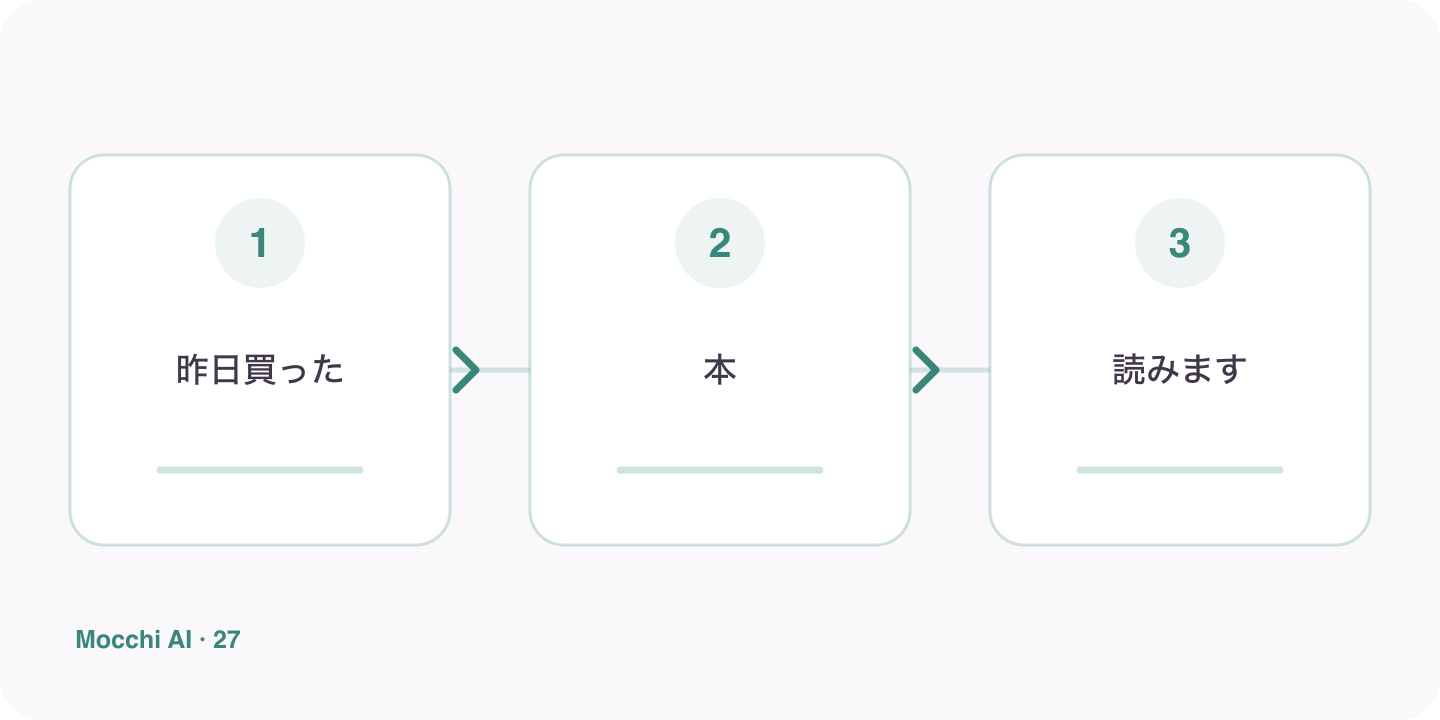
A describing clause leads into a head noun and then the main sentence action
Find the noun being described before deciding how the whole sentence fits together.
JapaneseRomajiMeaning
昨日買った本を読みます。Kinō katta hon o yomimasu.I read the book I bought yesterday.
友達にもらった本を読みます。Tomodachi ni moratta hon o yomimasu.I read the book I received from a friend.

Explain the structure without copying the translation

State the item first in your explanation, then say what identifies it and what happens to it in the main sentence. This is a check on structure, not a demand to produce an elegant translation immediately. If you can only repeat a whole translated sentence, ask for a changed description and try the same analysis again.

Build one noun phrase of your own

Choose a familiar item and describe it with a short event: a film you watched, a meal you made, or a place you visited. Keep the event simple and use vocabulary you know. Ask Mocchi to check the noun phrase before you place it into a larger sentence. This separates composing the description from managing additional particles and the final verb.

Use a longer sentence only after the short one is clear

When you add another phrase, keep marking the head noun and main action so the new length does not conceal the structure. If a sentence becomes confusing, reduce it to the noun phrase and rebuild. Mocchi can vary the examples around a remembered weak point, but your own explanation of which information belongs to which noun is what makes the practice useful beyond the original lesson.

Key points

A practical way to improve

Ask Mocchi for a short sentence containing a noun-modifying clause. Mark the head noun, explain which item the clause identifies, and state the main action separately. Then make a description of a different familiar item using a short past event. Ask for feedback on the structure before adding another clause or more advanced vocabulary.

  1. 1

    Choose one clear goal

    Focus each session on a situation or skill you can actually use.

  2. 2

    Practice actively

    Say complete answers aloud instead of only reading or recognizing Japanese.

  3. 3

    Review and repeat

    Keep useful corrections and revisit the same skill until it feels natural.

FAQ

Frequently asked questions

Does Japanese use an English-style relative pronoun in this pattern?

These common noun-modifying examples do not require a separate word corresponding directly to English who or which. Focus on the clause before the noun and the role of the noun in the larger sentence.

Why do I lose track after the first verb?

You may be treating a verb inside the modifying clause as the main sentence ending. Look ahead for the noun being described, then identify the larger sentence's main action separately.

Should I translate the sentence word by word?

A word-by-word gloss can help with vocabulary, but it may hide the structure. First identify the noun phrase and main action, then explain how the describing clause narrows or characterizes the noun.

Find the noun before untangling the whole sentence

Use Mocchi to practice one clear clause and a changed description rather than immediately adding longer sentences.