

The core meaning
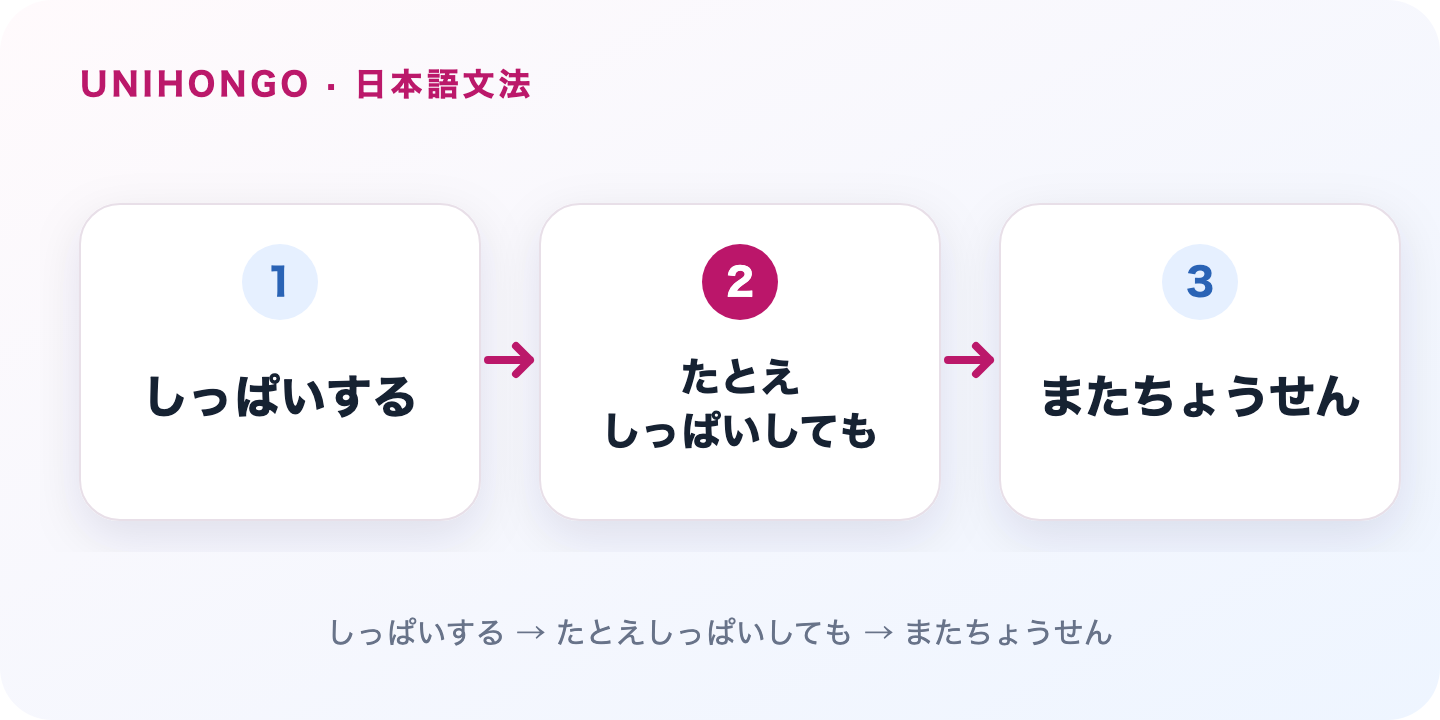
たとえ失敗しても、もう一度挑戦します means 'Even if I fail, I will try again.' The adverb たとえ sets up a concession, while ても marks the condition. The first clause can be a real risk or an imagined worst case. The main clause usually expresses a steady intention, belief or result despite that risk.
| Japanese | Romaji | Meaning |
|---|---|---|
| たとえ失敗しても、もう一度挑戦します。 | Tatoe shippai shite mo, mō ichido chōsen shimasu. | Even if I fail, I'll try again. |
| たとえ高くても、必要なら買います。 | Tatoe takakute mo, hitsuyō nara kaimasu. | Even if it's expensive, I'll buy it if necessary. |
How to form it
Put たとえ before the conditional idea, then attach ても to the て form of a verb or い adjective: たとえ負けても, たとえ高くても. With a noun or な adjective use でも: たとえ雨でも, たとえ不便でも. たとえ without a matching concessive ending is usually incomplete.
| Use | Japanese form | Meaning |
|---|---|---|
| Verb | たとえ負けても | Even if we lose |
| い adjective | たとえ高くても | Even if it is expensive |
| Noun or な adjective | たとえ雨でも | Even if it rains |
Natural examples
Read each sentence for the relationship between the first idea and the second. The English translation gives a natural meaning, while the Japanese wording shows exactly where the pattern attaches.
| Japanese | Romaji | Meaning |
|---|---|---|
| たとえ反対されても、自分の考えを伝えます。 | Tatoe hantai sarete mo, jibun no kangae o tsutaemasu. | Even if people oppose me, I'll explain my view. |
| たとえ雨でも、祭りは行われます。 | Tatoe ame demo, matsuri wa okonawaremasu. | The festival will be held even if it rains. |
Compare the nearby pattern
雨が降ったら、家にいます gives a condition that changes your behavior. 雨が降っても、行きます says the behavior remains unchanged. たとえ大雨が降っても、行きます adds emphasis: even heavy rain will not change it. The grammar is about overcoming the condition, not predicting whether it will happen.
| Japanese | Romaji | Meaning |
|---|---|---|
| 雨が降ったら、行きません。 | Ame ga futtara, ikimasen. | If it rains, I won't go. |
| たとえ雨が降っても、行きます。 | Tatoe ame ga futte mo, ikimasu. | Even if it rains, I'll go. |
The two examples may describe similar situations, but they lead the listener to different conclusions. Choose the form that matches the claim you really intend to make.
Common mistake to avoid
Do not use たとえ with たら when your intention is 'even if': たとえ雨が降ったら is a mismatch for this meaning. Use たとえ雨が降っても. Also avoid implying a guaranteed outcome from an uncertain condition; the first clause remains hypothetical.
- たとえ emphasizes a concession
- Pair it with ても or でも
- The conclusion holds despite the condition
- たら changes the outcome instead
Try it yourself
Choose something you intend to do despite an obstacle. Say it first with ても, then add たとえ and make the obstacle more serious. Keep the main decision unchanged.
Say your sentence once slowly while looking at the Japanese pattern. Then say it again without reading. If your second clause changes from a possibility to a fact, or from advice to a requirement, revise it so the grammar still matches your meaning.