

The core idea: ni pins something to one point
Start with the simplest case, where something is. With the verbs iru and aru, to exist, and sumu, to live, ni marks the spot: eki no mae ni imasu, I am in front of the station. Nothing is happening there; the sentence only fixes a position, the way a pin fixes a note to a board. That is the difference from de, which sets the stage for an activity.
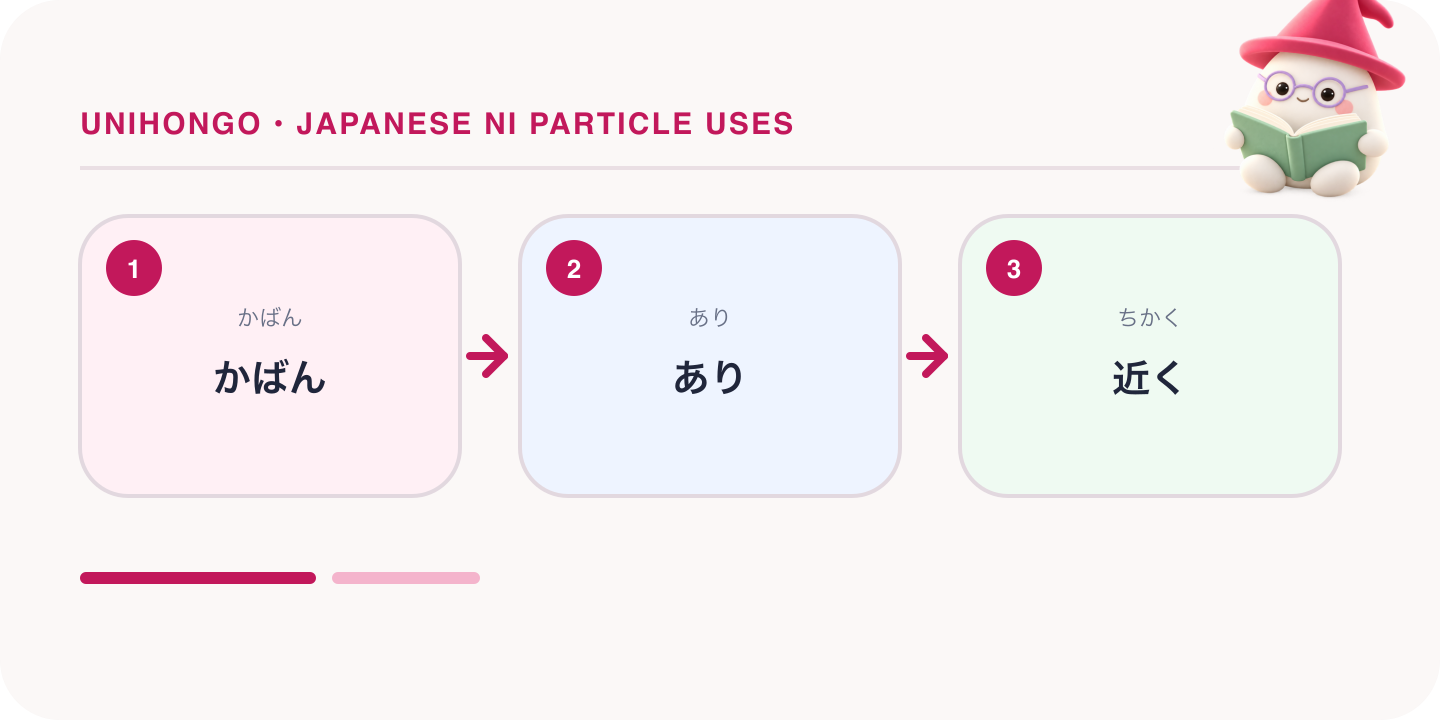
The pattern is a place noun, then ni, then a verb of existence. Position words such as ue, on top, naka, inside, and mae, in front, slot in with no: kaban no naka ni. In the scene below, two friends are trying to find each other by phone in a busy station, then chatting once they meet, in polite speech.
| Japanese | Romaji | Meaning |
|---|---|---|
| 今、駅の前にいます。 | Ima, eki no mae ni imasu. | I'm in front of the station now. |
| 鍵はかばんの中にあります。 | Kagi wa kaban no naka ni arimasu. | The keys are in my bag. |
| 近くにコンビニがありますか。 | Chikaku ni konbini ga arimasu ka. | Is there a convenience store nearby? |
| 姉は大阪に住んでいます。 | Ane wa Ōsaka ni sunde imasu. | My older sister lives in Osaka. |
| 父は銀行に勤めています。 | Chichi wa ginkō ni tsutomete imasu. | My father works for a bank. |
Destinations and clock times: where and when the pin lands
When something moves, ni marks the point where the movement ends. This covers iku, kuru and kaeru, and also smaller arrivals: hairu, enter, noru, get on, suwaru, sit down, oku, put, tsuku, arrive. Basu ni norimasu is literally I ride onto the bus; the bus is where you end up. English hides this, which is why get on the bus tempts learners towards o.
Time works the same way. A clock time, a day of the week or a date is a fixed point on the calendar, and ni pins the event to it: roku-ji ni okimasu, getsuyōbi ni aimasu. Now the exception, which you can predict. Kyō, ashita, raishū and mainichi are not fixed points. Their meaning shifts with the day you say them, so there is nothing to pin and they take no ni.
| Japanese | Romaji | Meaning |
|---|---|---|
| 来週、京都に行きます。 | Raishū, Kyōto ni ikimasu. | I'm going to Kyoto next week. |
| 八時のバスに乗ります。 | Hachi-ji no basu ni norimasu. | I take the eight o'clock bus. |
| ここに荷物を置いてください。 | Koko ni nimotsu o oite kudasai. | Please put your luggage here. |
| 毎朝六時に起きます。 | Maiasa roku-ji ni okimasu. | I get up at six every morning. |
| 月曜日に会議があります。 | Getsuyōbi ni kaigi ga arimasu. | There's a meeting on Monday. |
| 明日、何時に着きますか。 | Ashita, nan-ji ni tsukimasu ka. | What time do you arrive tomorrow? |
The person on the receiving end
Give, send, teach, show, phone and ask all need someone for the action to reach, and that person takes ni: haha ni hana o agemashita, I gave flowers to my mother. The thing given takes o and the person takes ni, so the two are never confused, whatever order you say them in.
With morau, receive, kariru, borrow, and narau, learn, the thing flows towards you, yet the other person still takes ni. Here the image has to be turned around, and it is better to see that clearly. Ni pins the other person in the exchange; the verb tells you the direction. Kara, from, is equally correct with these three verbs.
| Japanese | Romaji | Meaning |
|---|---|---|
| 母に花をあげました。 | Haha ni hana o agemashita. | I gave my mother flowers. |
| 友達にメールを送ります。 | Tomodachi ni mēru o okurimasu. | I'll send my friend an email. |
| 先生に質問しました。 | Sensei ni shitsumon shimashita. | I asked the teacher a question. |
| 駅員に道を聞きました。 | Ekiin ni michi o kikimashita. | I asked a station attendant the way. |
| 兄に自転車を借りました。 | Ani ni jitensha o karimashita. | I borrowed a bicycle from my older brother. |
How it is built: seven patterns with ni
Ni follows a noun directly in every use but one: for purpose it follows the masu stem of a verb, the form you get by removing masu.
| Pattern | Reading | How it is formed |
|---|---|---|
| 机の上にある | tsukue no ue ni aru | Place noun, ni, verb of existence |
| 駅に着く | eki ni tsuku | Place noun, ni, verb of movement: the end point |
| 三時に会う | san-ji ni au | Clock time, day or date, then ni |
| 友達に貸す | tomodachi ni kasu | Person, ni: the one the action reaches |
| 食べに行く | tabe ni iku | Verb masu stem, ni, then iku, kuru or kaeru |
| 元気になる | genki ni naru | Noun or na-adjective, ni naru; i-adjectives use ku naru |
| 週に一回 | shū ni ikkai | Period, ni, count: frequency |
The first four rows are the beginner's ni, and they give you a complete working picture. The last three come next.
Beyond the basics: purpose and result
A trip can have a purpose as well as a destination, and the purpose is pinned with ni too. Hirugohan o tabe ni ikimasu is literally I go to the eating of lunch. Because the purpose is the target of a journey, the main verb must be a verb of coming or going. For other verbs, Japanese uses tame ni instead. Activity nouns need no stem: kaimono ni ikimasu.
Change has an end point as well. Naru, to become, and suru, to make or decide, take ni for the final state: isha ni narimashita, shizuka ni narimashita. I-adjectives are the exception, and the reason is mechanical: they have their own adverb form in ku, so they do not borrow ni. Samui becomes samuku narimashita. In a café, kōhī ni shimasu is how you announce your choice.
| Japanese | Romaji | Meaning |
|---|---|---|
| 昼ご飯を食べに行きませんか。 | Hirugohan o tabe ni ikimasen ka. | Shall we go and have lunch? |
| 週末、友達が遊びに来ました。 | Shūmatsu, tomodachi ga asobi ni kimashita. | A friend came over at the weekend. |
| 財布を取りに帰ります。 | Saifu o tori ni kaerimasu. | I'm going back home to get my wallet. |
| 娘は医者になりました。 | Musume wa isha ni narimashita. | My daughter became a doctor. |
| 私はコーヒーにします。 | Watashi wa kōhī ni shimasu. | I'll have coffee. (Literally: I'll make it coffee.) |
Passive, causative and frequency: three later uses
In a passive sentence the person affected is the subject, and the doer takes ni: sensei ni homeraremashita, I was praised by the teacher. As with morau, the pin is turned around. The action comes from the ni person rather than going to them, and what ni still does is fix the other party in the event. In a causative sentence, the person made to act takes ni when the verb already has an object marked with o.
Frequency brings the pin back to the calendar. Shū ni ikkai is literally in a week, one time: the week is fixed as the unit and the count follows.
| Japanese | Romaji | Meaning |
|---|---|---|
| 先生に褒められました。 | Sensei ni homeraremashita. | I was praised by the teacher. |
| 帰り道で雨に降られました。 | Kaerimichi de ame ni furaremashita. | I got rained on on the way home. |
| 母は弟に野菜を食べさせました。 | Haha wa otōto ni yasai o tabesasemashita. | My mother made my little brother eat his vegetables. |
| 週に一回、日本語のクラスがあります。 | Shū ni ikkai, Nihongo no kurasu ga arimasu. | I have a Japanese class once a week. |
| 一日に三回、薬を飲んでください。 | Ichi-nichi ni san-kai, kusuri o nonde kudasai. | Please take the medicine three times a day. |
Minimal pairs: ni beside its neighbours de, e and to
Three particles overlap with ni. In each pair only the particle changes.
| Sentence | Reading | What it says |
|---|---|---|
| ここに書いてください。 | Koko ni kaite kudasai. | Write on this: the writing should end up here, on the form |
| ここで書いてください。 | Koko de kaite kudasai. | Do your writing here: at this counter, not elsewhere |
| 公園に行く | kōen ni iku | Go to the park: the park is the end point |
| 公園へ行く | kōen e iku | Head for the park: the park is the direction |
| 友達に会う | tomodachi ni au | See a friend: you go to them, or come across them |
| 友達と会う | tomodachi to au | Meet up with a friend: both of you arranged it |
The first pair is worth saying aloud at a bank or city office, where you will hear both. Ni marks where the result lands and de marks where the activity is carried out. With e the difference is small, and ni is the commoner of the two in conversation, so when unsure, choose ni. With to the difference is one-way against mutual. Existing posts compare each of these pairs across many more verbs.
Spoken reality: which ni gets dropped
In casual speech the ni of destination is often dropped, since a place followed by iku can hardly be anything else. The ni of frequency is dropped so often that shū ikkai appears on signs and timetables. The ni of time, recipient and passive is normally kept, even among friends, because nothing else in the sentence shows the role of the noun. Ni has no politeness level of its own, and it sounds the same in a chat and in a business email.
| Japanese | Romaji | Meaning |
|---|---|---|
| どこ行くの? | Doko iku no? | Where are you off to? |
| ちょっとコンビニ行ってくる。 | Chotto konbini itte kuru. | I'm just popping to the convenience store. |
| 週三回ジムに通ってる。 | Shū san-kai jimu ni kayotteru. | I go to the gym three times a week. |
Common mistakes with ni and what causes them
Ashita ni ikimasu is wrong. Having learned that time takes ni, learners add it to every time word. Ashita moves with the speaker, so say ashita ikimasu.
Toshokan ni benkyō shimasu is wrong. English at covers both being somewhere and doing something there. Studying is an activity, so the library is a stage, not a pin: toshokan de benkyō shimasu.
Samui ni narimashita is wrong. It comes from copying shizuka ni narimashita. I-adjectives change their ending instead: samuku narimashita.
Taberu ni ikimasu is wrong. English go to eat uses the basic form of the verb, and the dictionary form feels like its twin. Purpose ni needs the masu stem: tabe ni ikimasu.
Sensei o shitsumon shimashita is wrong. In English you ask the teacher, a direct object. In Japanese the question is the thing asked and the teacher is where it is sent: sensei ni shitsumon shimashita.