

Two ways to say just did
Both forms attach to the plain past tense of a verb, the ta form: tabeta bakari, tabeta tokoro, kita bakari, kita tokoro. After that they behave like nouns: add desu to be polite, da in casual speech, or nothing at all. The grammar is easy. The difficulty is the meaning.
Ta bakari looks backwards from the speaker's point of view. It says: this happened recently, and that recency explains something, such as why I am still unsure of the office, why the paint is wet or why I am not hungry. Because it is about feeling rather than measurement, the gap can be anything from a minute to a year. Joining a company last month is bakari. Eating lunch last month is not.
Ta tokoro looks at the clock. It says the action has just this moment reached its end. The speaker is still where it happened and nothing else has yet occurred.
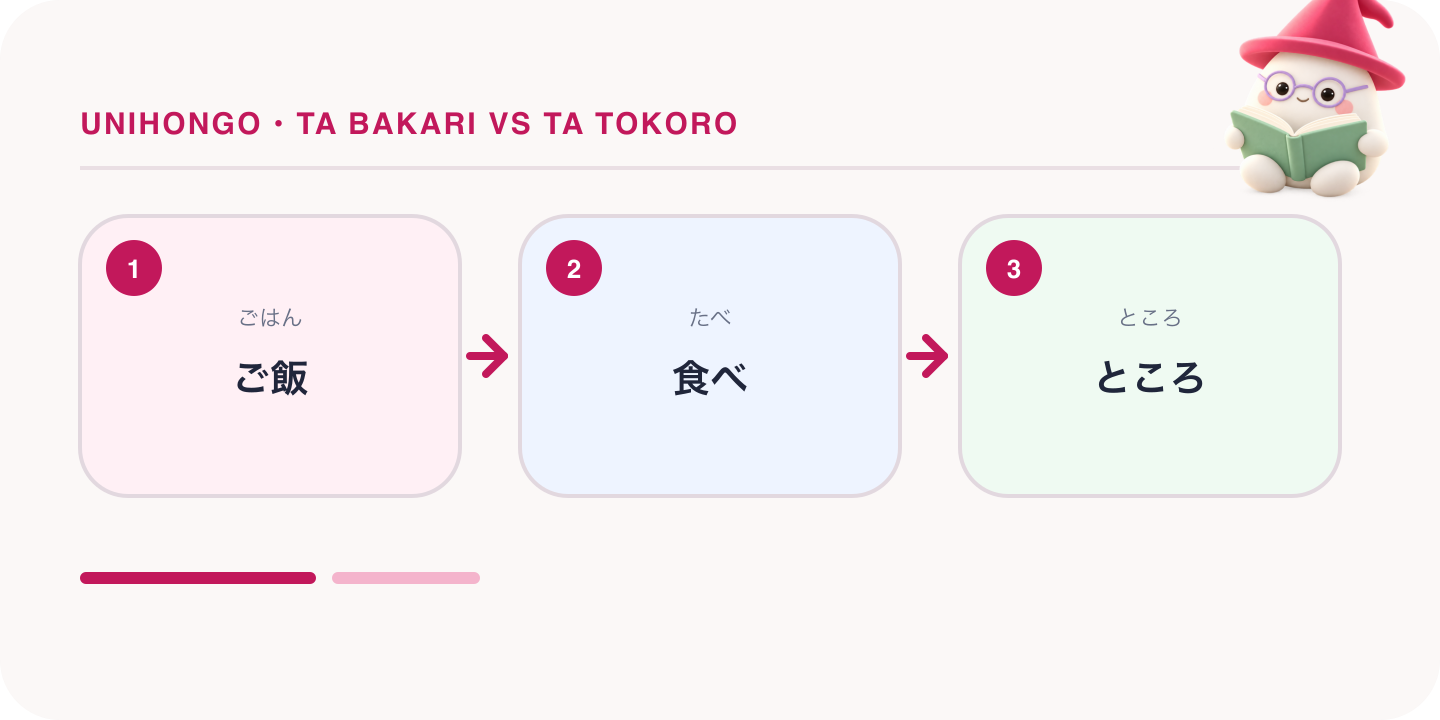
| Japanese | Romaji | Meaning |
|---|---|---|
| 昼ご飯を食べたばかりです。 | Hirugohan o tabeta bakari desu. | I just had lunch (so I'm not hungry). |
| 昼ご飯を食べたところです。 | Hirugohan o tabeta tokoro desu. | I've just this moment finished lunch. |
| 先月、日本に来たばかりです。 | Sengetsu, Nihon ni kita bakari desu. | I only came to Japan last month. |
| 今、駅に着いたところです。 | Ima, eki ni tsuita tokoro desu. | I've just arrived at the station. |
| この会社に入ったばかりで、まだ慣れていません。 | Kono kaisha ni haitta bakari de, mada narete imasen. | I only just joined this company, so I'm not used to it yet. |
| 今、メールを送ったところだよ。 | Ima, mēru o okutta tokoro da yo. | I just sent the email right now. |
Ta bakari: recent in your mind
The word bakari also means only or nothing but, and that colour survives in ta bakari. When you say hajimeta bakari desu, I have only just started, you are making a small excuse or setting expectations. That is why ta bakari is so common in self-introductions and apologies: it explains a gap in knowledge or a lack of progress.
The recency scale stretches with the size of the event. Buying a coffee is recent for a few minutes. Moving house is recent for a few months. Getting married or starting a business is recent for a year or more. Native speakers pick the form by how fresh the change feels, not by counting days, so kyonen umareta bakari no akachan, a baby born only last year, is perfectly natural.
Ta bakari often connects to a following clause with de or na node to give the reason, and it sits in front of nouns as ta bakari no.
| Japanese | Romaji | Meaning |
|---|---|---|
| 日本語を勉強し始めたばかりです。 | Nihongo o benkyō shihajimeta bakari desu. | I've only just started studying Japanese. |
| 引っ越したばかりで、まだ荷物が多いです。 | Hikkoshita bakari de, mada nimotsu ga ōi desu. | I've only just moved, so there are still lots of boxes. |
| 買ったばかりのスマホを落としてしまった。 | Katta bakari no sumaho o otoshite shimatta. | I dropped the phone I had only just bought. |
| 起きたばかりなので、まだ眠いです。 | Okita bakari na node, mada nemui desu. | I've only just got up, so I'm still sleepy. |
| 去年結婚したばかりなんです。 | Kyonen kekkon shita bakari nan desu. | We only got married last year, you see. |
| 彼は退院したばかりだから、無理させないで。 | Kare wa taiin shita bakari da kara, muri sasenaide. | He has only just left hospital, so don't push him. |
Ta tokoro: this very moment
Tokoro literally means place, and the three tokoro forms describe where you are in an action. Ta tokoro is the finishing line. The speaker has just crossed it and is reporting from the spot. Because of that, ta tokoro cannot describe anything that happened before now, and it cannot be combined with past time words such as kinō, sakki or senshū.
Ta tokoro is very common in two situations: answering a phone or message with where you are, and the moment someone walks in, ima owatta tokoro desu, I just finished. Chōdo, exactly, adds emphasis. Ima and chōdo do not compete with ta tokoro; they reinforce it. In casual speech you will hear the clipped toko, as in ima tsuita toko.
| Japanese | Romaji | Meaning |
|---|---|---|
| ちょうど今、会議が終わったところです。 | Chōdo ima, kaigi ga owatta tokoro desu. | The meeting has just this moment ended. |
| 今、家に帰ってきたところです。 | Ima, ie ni kaette kita tokoro desu. | I've just got home. |
| ケーキが焼けたところだから、熱いよ。 | Kēki ga yaketa tokoro da kara, atsui yo. | The cake has just come out, so it's hot. |
| 彼女に電話したところ、留守でした。 | Kanojo ni denwa shita tokoro, rusu deshita. | When I called her, she was out. |
| 今着いたとこ。どこにいる? | Ima tsuita toko. Doko ni iru? | Just got here. Where are you? |
| ちょうどお茶を入れたところなので、どうぞ。 | Chōdo ocha o ireta tokoro na node, dōzo. | I've just made tea, so please have some. |
Ru tokoro and te iru tokoro: before and during
The same tokoro attaches to the dictionary form and the te iru form to mark the moments before and during an action. Ru tokoro means you are about to start: your hand is on the door handle, the kettle is boiling, you have not yet begun. Te iru tokoro means you are in the middle of it: half the report is written, the pan is on the heat.
These three forms are a matched set. If a friend asks whether you have eaten, you can answer with ima taberu tokoro, tabete iru tokoro or tabeta tokoro depending on the state of your plate. All three usually take ima or chōdo, because they describe the present moment.
Ru tokoro is also a polite way to decline without saying no: ima kara dekakeru tokoro na node, I'm just about to go out, so. Te iru tokoro is what you say when someone calls at a bad time. Both leave the listener to draw the conclusion.
| Japanese | Romaji | Meaning |
|---|---|---|
| 今から出かけるところです。 | Ima kara dekakeru tokoro desu. | I'm just about to go out. |
| ちょうど電話しようと思っていたところです。 | Chōdo denwa shiyō to omotte ita tokoro desu. | I was just thinking of calling you. |
| 今、資料を作っているところです。 | Ima, shiryō o tsukutte iru tokoro desu. | I'm in the middle of making the materials. |
| 今、お風呂に入っているところなので、後でかけ直します。 | Ima, ofuro ni haitte iru tokoro na node, ato de kakenaoshimasu. | I'm in the bath right now, so I'll call back later. |
| もう少しで終わるところです。 | Mō sukoshi de owaru tokoro desu. | I'm just about to finish. |
| ご飯を食べるところだったのに。 | Gohan o taberu tokoro datta noni. | I was just about to eat, too. |
Ima, sakki and the tokoro forms side by side
Ima means now and covers this moment and the near future. Sakki means a little earlier, anything from a few minutes to a couple of hours ago. Neither word says whether an action is finished, ongoing or about to start, which is what the tokoro forms add. The table shows which combinations sound natural.
| Pattern | Reading | Meaning and typical time gap |
|---|---|---|
| 今食べるところ | ima taberu tokoro | About to eat, not started; this moment |
| 今食べているところ | ima tabete iru tokoro | In the middle of eating; this moment |
| 今食べたところ | ima tabeta tokoro | Just this moment finished eating |
| さっき食べた | sakki tabeta | Ate a little while ago; minutes to hours |
| さっき食べたばかり | sakki tabeta bakari | Ate only a short while ago, still full |
| 今朝食べたばかり | kesa tabeta bakari | Only ate this morning, feels recent |
| 先月来たばかり | sengetsu kita bakari | Only came last month, still new here |
| 去年始めたばかり | kyonen hajimeta bakari | Only started last year, still a beginner |
| さっき食べたところ | sakki tabeta tokoro | Unnatural: sakki clashes with this moment |
| 昨日着いたところ | kinō tsuita tokoro | Unnatural: use kinō tsuita bakari |
Notice the last two rows. Sakki and kinō both push the action into the past, and ta tokoro refuses to go there. Swap in bakari and the sentence is fine. Going the other way, bakari happily takes ima as well: ima kita bakari desu is a natural answer when someone asks whether you have been waiting long.
Register: polite, casual and written
All of these forms work at every politeness level, because the level lives in what follows. Ta bakari desu and ta tokoro desu are standard polite speech for the office, the clinic and the phone. Ta bakari da and ta tokoro da are casual, and dropping the copula entirely, as in tsuita toko, is friendly and quick.
For humble and honorific speech, change the verb, not the pattern. Tadaima modorimashita, I'm back, is the set phrase for returning to the office, and tokoro attaches to the plain form, not the masu form.
In writing, ta bakari appears in emails and reports without any change. Ta tokoro is more spoken and tends to appear in dialogue, chat messages and phone calls. In formal written Japanese you will more often see ta tokoro de aru or the pattern ta tokoro, followed by a result, meaning upon doing X.
- Polite speech: tsuita tokoro desu, hajimeta bakari desu
- Casual speech: tsuita tokoro, tsuita toko, hajimeta bakari da yo
- Text messages: ima tsuita toko, sakki okita bakari
- Office return: tadaima modorimashita, or ima modotta tokoro desu
- Formal writing: ta bakari de aru, ta tokoro de aru
Common mistakes and how to fix them
The most frequent error is using ta tokoro for something that is no longer this moment. Kinō Nihon ni kita tokoro desu sounds like a contradiction to a Japanese ear; make it kita bakari desu. The reverse error is milder: ta bakari for something you literally finished a second ago is acceptable, it simply loses the sense of right now that tokoro would give.
Second, learners attach tokoro to the wrong verb form. Taberu tokoro, tabete iru tokoro and tabeta tokoro are the only three options; tabemasu tokoro and tabete tokoro do not exist. Third, watch the state verbs. Shitte iru, to know, and sunde iru, to live, describe ongoing states, so sunde iru tokoro does not mean I am in the middle of living. Use ta bakari with these: Tōkyō ni sumihajimeta bakari desu, I only just started living in Tokyo.
Finally, ta bakari carries a hint of only or excuse, so repeating it after every achievement can sound apologetic. To simply report good news, plain past tense with saikin, recently, is often more natural: saikin kekkon shimashita.
| Japanese | Romaji | Meaning |
|---|---|---|
| 昨日日本に来たばかりです。 | Kinō Nihon ni kita bakari desu. | I only came to Japan yesterday. (not kita tokoro) |
| 東京に住み始めたばかりです。 | Tōkyō ni sumihajimeta bakari desu. | I've only just started living in Tokyo. |
| 今、書いているところなので、少し待ってください。 | Ima, kaite iru tokoro na node, sukoshi matte kudasai. | I'm in the middle of writing it, so please wait a moment. |
| 最近、新しい仕事を始めました。 | Saikin, atarashii shigoto o hajimemashita. | I recently started a new job. |
| 今出たところなので、十分で着きます。 | Ima deta tokoro na node, juppun de tsukimasu. | I've just left, so I'll be there in ten minutes. |