
Compare たら and なら With Mocchi Through Timing and Context

Practice たら and なら by examining timing and the premise of the conversation, not by replacing every English if with the same form. Ask Mocchi to explain one clear contrast and let you choose a new example before introducing the other Japanese conditionals.

Mocchi compares a Japanese action after arrival with advice based on a stated travel plan
What you need to know

Compare たら and なら With Mocchi Through Timing and Context

Conditional expressions carry relationships that an isolated English translation can hide. A request to call after arriving differs from advice offered because someone says they plan to visit a place. Work with a short scenario and identify what the speaker assumes and when the next action happens. This is a starting comparison, not a complete rulebook for all uses of たら, なら, と, and ば. A focused contrast is easier to test and review than a large chart of exceptions.

Describe the situation before choosing the form.

Check whether one event must happen first.

Notice a premise supplied by the conversation.

Compare a small pair before adding every conditional.

Begin with a situation rather than four English glosses

Tell Mocchi what the speaker is trying to do: give advice, request an action after an event, describe a regular result, or imagine a possibility. These intentions help identify a useful contrast. A chart where every form is translated as if does not show enough information to explain why a particular sentence sounds appropriate in its context.

Keep the first examples ordinary and concrete. Arrival, a phone call, a trip, and preparation are easier to arrange on a timeline than an abstract argument. Once the relationship is understandable, move to another context and check whether the same explanation still applies.

Compare a later action with advice about a premise

着いたら、電話してください asks for a call after arrival. 日本に行くなら、日本語を少し練習しておくといいです offers preparation advice on the premise that the listener is going to Japan. In the second example, the preparation is useful before the trip. Ask Mocchi to discuss that difference explicitly instead of assigning both sentences the same vague time relationship.
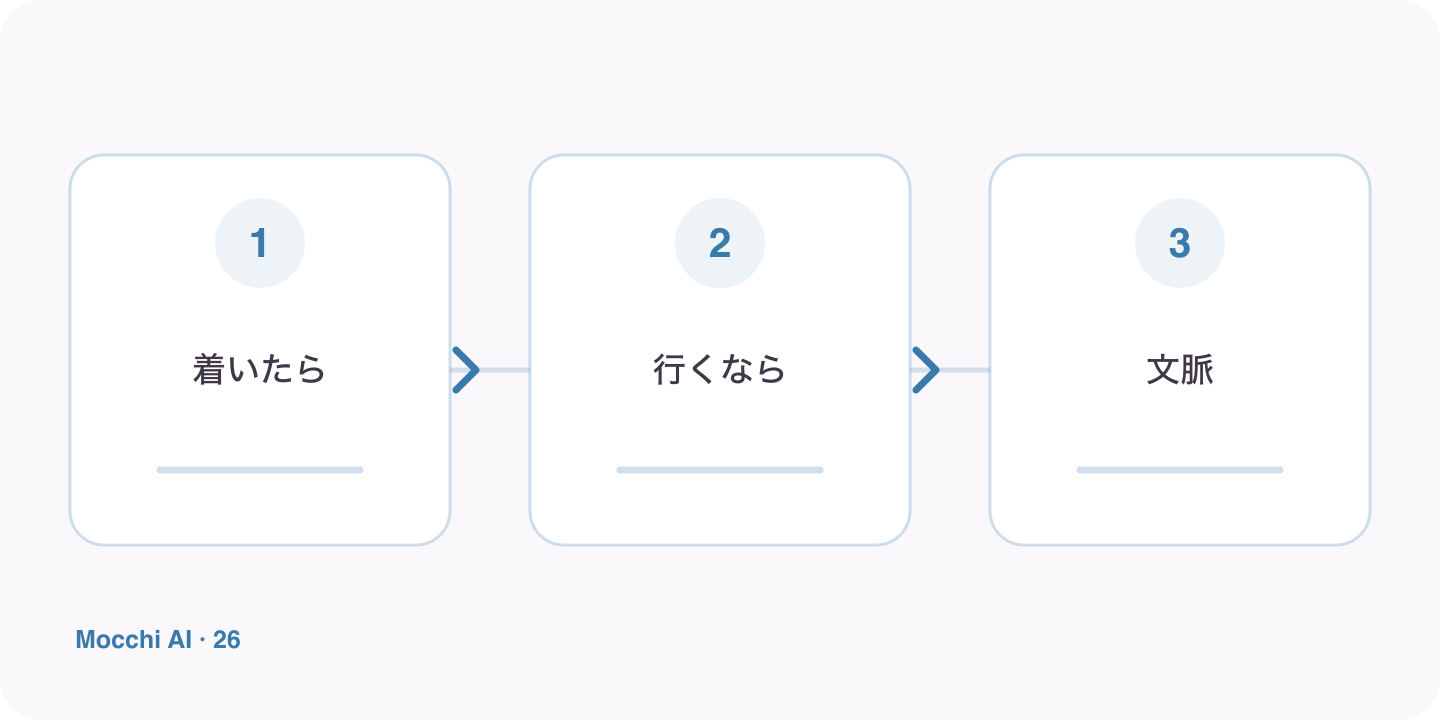
Arrival followed by a call is contrasted with advice given on the premise of a trip
Ask whether the sentence depends on an event happening first or responds to a premise already under discussion.
JapaneseRomajiMeaning
着いたら、電話してください。Tsuitara, denwa shite kudasai.Please call when you arrive.
日本に行くなら、日本語を少し練習しておくといいです。Nihon ni iku nara, Nihongo o sukoshi renshū shite oku to ii desu.If you are going to Japan, it is a good idea to practice some Japanese beforehand.

State the timing before checking your answer

Explain which event has happened, which is only planned, and when the suggested action should occur. If that explanation is unclear, simplify the scenario before changing the grammar. A correct form chosen without a clear interpretation may be a guess; a clear interpretation with a mistaken form gives the tutor a more precise teaching opportunity.

Ask about alternative versions with their own contexts

Some sentences can use another construction with a changed emphasis or situation. Ask Mocchi to explain that context instead of treating every substitution as automatically impossible. At the same time, do not assume that two plausible translations make the Japanese versions interchangeable. Preserve the exact intention and ask what changes when the form changes.

Review the decision on another day

Save the kind of contrast you practiced, such as action after arrival versus preparation advice. At a later visit, request new events and explain them before choosing a form. Add other conditionals when the first distinction is usable, and consult a trusted grammar source when an unusual example remains uncertain. A gradual comparison builds a more dependable understanding than memorizing a broad shortcut that fits only the original pair.

Key points

A practical way to improve

Ask Mocchi for a scenario where someone should call after arriving, then one where a friend offers advice about a stated trip. Explain the timing and assumed information before choosing a form. Change the destination or the advice and try again. If a sentence could work with more than one construction, request the context and meaning for each version rather than accepting a bare right-or-wrong label.

  1. 1

    Choose one clear goal

    Focus each session on a situation or skill you can actually use.

  2. 2

    Practice actively

    Say complete answers aloud instead of only reading or recognizing Japanese.

  3. 3

    Review and repeat

    Keep useful corrections and revisit the same skill until it feels natural.

FAQ

Frequently asked questions

Can I translate every English if with たら?

No single English word explains all the choices in Japanese. たら is useful in many contexts, but the intended relationship, timing, and kind of following statement still matter. Learn the construction through complete situations.

Does なら always mean the first action happens before the second?

No. Advice based on someone's plan can concern preparation before the planned event. Check what is being treated as the premise rather than imposing one event order on every なら sentence.

Should I learn と and ば in the same session?

Only if you can keep the contrasts clear. It is often more useful to practice one pair and return later for another comparison, using fresh examples and explicit reasons for each choice.

Give the conditional a situation to express

Use Mocchi to compare what happens first and what the speaker already takes as the premise.