

The core meaning
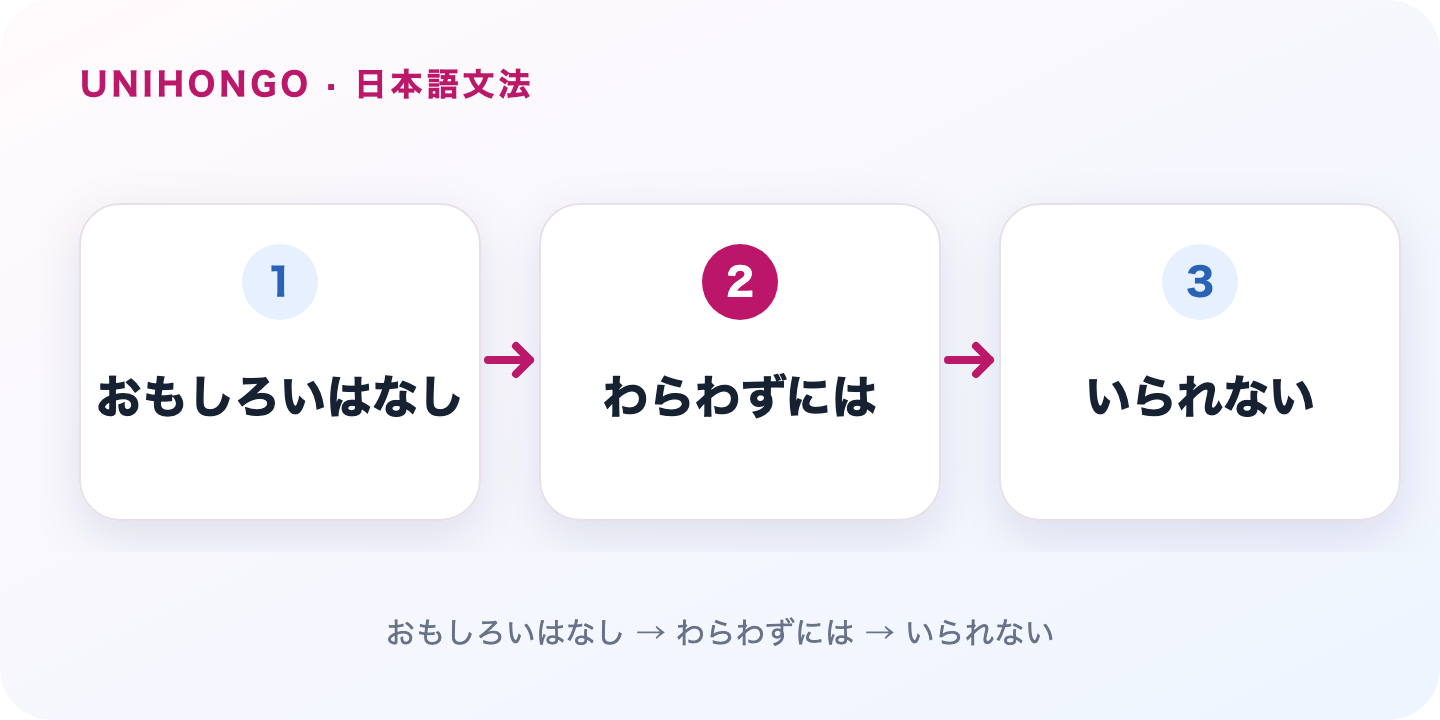
その話を聞いて、笑わずにはいられなかった means the speaker could not help laughing. The expression usually describes a strong internal reaction: laughing, crying, worrying, checking or speaking up. The negative-looking ず is part of the construction; the whole phrase means that remaining without the action is impossible.
| Japanese | Romaji | Meaning |
|---|---|---|
| その話を聞いて、笑わずにはいられなかった。 | Sono hanashi o kiite, warawazu ni wa irarenakatta. | I couldn't help laughing when I heard the story. |
| 映画の最後で泣かずにはいられませんでした。 | Eiga no saigo de nakazu ni wa iraremasen deshita. | I couldn't help crying at the end of the film. |
How to form it
Take the negative stem of a verb and add ずにはいられない: 笑う → 笑わずにはいられない, 食べる → 食べずにはいられない. する changes to せず. The polite form is ずにはいられません. In speech, ないではいられない is a related form and often feels a little less written.
| Use | Japanese form | Meaning |
|---|---|---|
| Godan | 笑わずにはいられない | Cannot help laughing |
| Ichidan | 食べずにはいられない | Cannot resist eating |
| する | 確認せずにはいられない | Cannot help checking |
Natural examples
Read each sentence for the relationship between the first idea and the second. The English translation gives a natural meaning, while the Japanese wording shows exactly where the pattern attaches.
| Japanese | Romaji | Meaning |
|---|---|---|
| 結果が気になって、確認せずにはいられない。 | Kekka ga ki ni natte, kakunin sezu ni wa irarenai. | I'm so curious about the result that I can't help checking. |
| 困っている人を見ると、声をかけずにはいられません。 | Komatte iru hito o miru to, koe o kakezu ni wa iraremasen. | When I see someone in trouble, I can't help offering a word. |
Compare the nearby pattern
話さなくてはいけない means 'I must speak' because of duty or necessity. 話さずにはいられない means 'I cannot keep from speaking' because of an urge or feeling. English 'have to' can cover both, so check whether the pressure comes from outside or inside the speaker.
| Japanese | Romaji | Meaning |
|---|---|---|
| 発表で話さなくてはいけません。 | Happyō de hanasanakute wa ikemasen. | I have to speak at the presentation. |
| この気持ちは話さずにはいられません。 | Kono kimochi wa hanasazu ni wa iraremasen. | I can't keep myself from talking about how I feel. |
The two examples may describe similar situations, but they lead the listener to different conclusions. Choose the form that matches the claim you really intend to make.
Common mistake to avoid
Do not form する as しず; the special negative stem is せず. And do not read the two negatives as 'I can avoid doing it.' The construction resolves to 'I cannot remain without doing it,' so the action happens or feels unavoidable.
- An internal reaction feels unavoidable
- Use negative stem + ずにはいられない
- する becomes せず
- なくてはいけない expresses external obligation
Try it yourself
Choose a story, film or message that caused a strong reaction. Describe the trigger and the reaction with ずにはいられない. Then contrast it with one action you must do because of a rule.
Say your sentence once slowly while looking at the Japanese pattern. Then say it again without reading. If your second clause changes from a possibility to a fact, or from advice to a requirement, revise it so the grammar still matches your meaning.