

What bakari ka means
Bakari means only or nothing but, and ka here works like a rhetorical question: is it only this? No, there is more. X bakari ka Y means not only X, but also Y, and Y is usually the more surprising, more extreme or harder-to-believe point.
The tone is emotional. Speakers use bakari ka when they are impressed, shocked or annoyed. The second half very often contains mo, also, or sae, even, which reinforces the idea of going further: kanji bakari ka, hiragana sae yomenai, he can't even read hiragana, let alone kanji.
Bakari ka works in both positive and negative situations. Kono mise wa yasui bakari ka, totemo oishii, this shop is not only cheap but really tasty, is praise. Kare wa okurete kita bakari ka, ayamari mo shinakatta, not only was he late, he didn't even apologise, is a complaint.
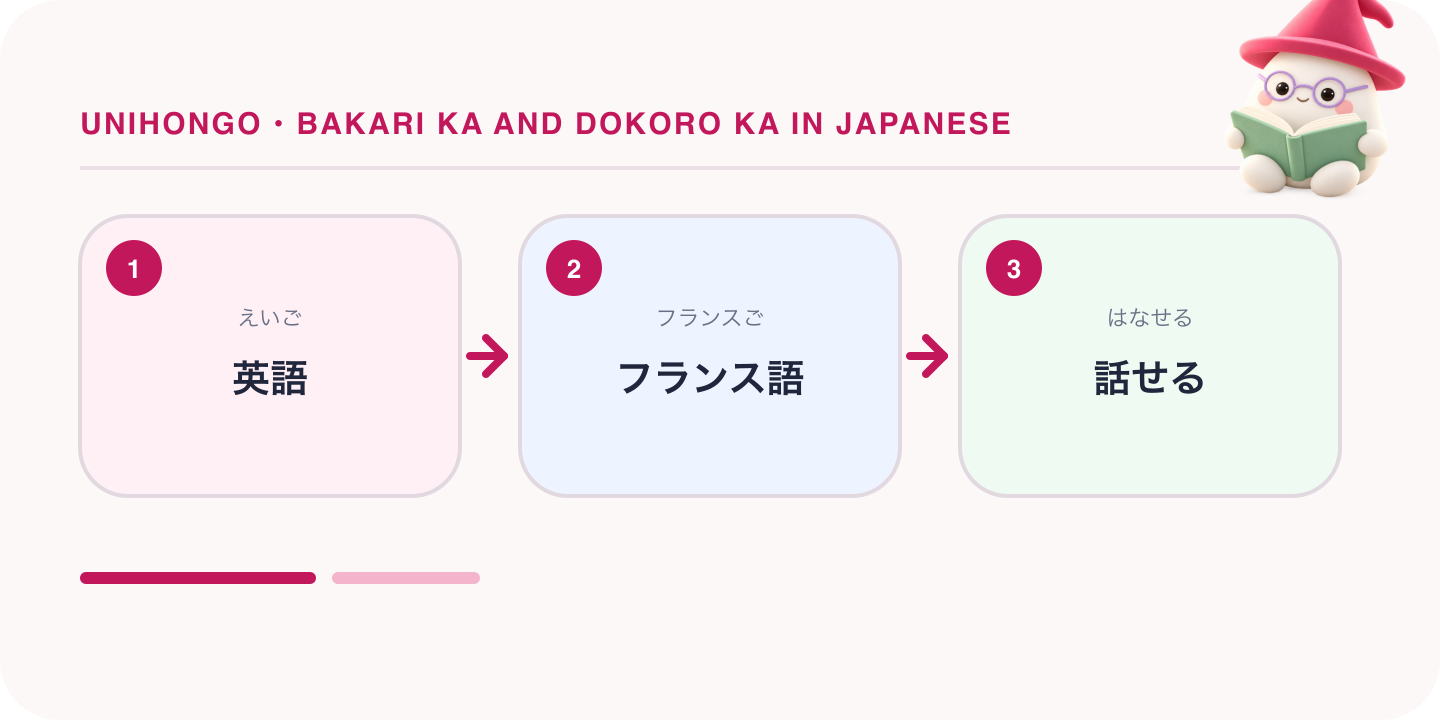
| Japanese | Romaji | Meaning |
|---|---|---|
| 彼は英語ばかりか、フランス語も話せる。 | Kare wa eigo bakari ka, furansugo mo hanaseru. | He speaks not only English but French too. |
| この店は安いばかりか、とてもおいしい。 | Kono mise wa yasui bakari ka, totemo oishii. | This place isn't just cheap, it's really good. |
| 彼は遅れて来たばかりか、謝りもしなかった。 | Kare wa okurete kita bakari ka, ayamari mo shinakatta. | Not only was he late, he didn't even apologise. |
| 雨ばかりか、雷まで鳴り出した。 | Ame bakari ka, kaminari made naridashita. | Not only was it raining, it started thundering too. |
| その子は漢字ばかりか、ひらがなさえ読めない。 | Sono ko wa kanji bakari ka, hiragana sae yomenai. | That child can't even read hiragana, let alone kanji. |
How to form bakari ka
Bakari ka follows the plain form of verbs and i-adjectives, na-adjectives with na, and nouns directly. The past tense is allowed before it. Bakari de naku is a close variant with the same meaning, slightly less emphatic.
| Type | Pattern | Example | Meaning |
|---|---|---|---|
| Noun | Noun + ばかりか | 子供ばかりか大人も | Not only children but adults too |
| Verb | Plain form + ばかりか | 遅刻したばかりか | Not only was he late |
| I-adjective | Plain form + ばかりか | 高いばかりか | Not only expensive |
| Na-adjective | Stem + な + ばかりか | 便利なばかりか | Not only convenient |
| Variant | …ばかりでなく | 味ばかりでなく | Not just the taste |
What dokoro ka means
Dokoro literally means place, and dokoro ka carries the sense of it's not even at that point. It has two related uses.
The first is far from, the opposite: the expectation in the first half is wrong, and the reality goes the other way. Kaze ga naoru dokoro ka, motto hidoku natta, far from getting better, my cold got worse, is a classic example.
The second is let alone or never mind: the first item is a bigger thing, and the second half says that even a smaller, more basic thing is not possible. Kuruma dokoro ka, jitensha mo kaenai, I can't even afford a bicycle, let alone a car. Here dokoro ka runs from big to small, the reverse of bakari ka.
In the positive direction, dokoro ka can also mean not just... but much more: hitori dokoro ka, jū-nin mo kita, not just one person but ten people came.
| Japanese | Romaji | Meaning |
|---|---|---|
| 風邪が治るどころか、もっとひどくなった。 | Kaze ga naoru dokoro ka, motto hidoku natta. | Far from getting better, my cold got worse. |
| 休むどころか、寝る時間もない。 | Yasumu dokoro ka, neru jikan mo nai. | Far from resting, I don't even have time to sleep. |
| 車どころか、自転車も買えない。 | Kuruma dokoro ka, jitensha mo kaenai. | I can't even buy a bike, let alone a car. |
| 褒められるどころか、怒られた。 | Homerareru dokoro ka, okorareta. | Far from being praised, I got told off. |
| 一人どころか、十人も来た。 | Hitori dokoro ka, jū-nin mo kita. | Not just one person, ten people came. |
| 漢字どころか、ひらがなもまだ書けない。 | Kanji dokoro ka, hiragana mo mada kakenai. | I can't even write hiragana yet, never mind kanji. |
How to form dokoro ka
Dokoro ka follows nouns directly, the plain form of verbs and i-adjectives, and na-adjectives either with na or directly on the stem. In speech you will also hear dokoro ja naku and the polite dokoro ka... desu.
| Type | Pattern | Example | Meaning |
|---|---|---|---|
| Noun | Noun + どころか | 貯金どころか | Far from savings |
| Verb | Plain form + どころか | 減るどころか | Far from decreasing |
| I-adjective | Plain form + どころか | 安いどころか | Far from cheap |
| Na-adjective | Stem (+ な) + どころか | 静か(な)どころか | Far from quiet |
| Idiom | …どころではない / どころじゃない | 勉強どころじゃない | No time for studying |
Dokoro ja nai: this is no time for
The related idiom dokoro de wa nai, casually dokoro ja nai, means this is no time for or I'm in no position to. Something more pressing makes the first thing impossible to think about: shiken mae de, asobi dokoro ja nai, it's right before exams, so fun is out of the question.
It also works as a strong, slightly dramatic reply. If a friend asks whether you are tired, tsukareta dokoro ja nai yo means tired isn't the word, I'm exhausted. The meaning is that the reality is far beyond what was suggested.
| Japanese | Romaji | Meaning |
|---|---|---|
| 試験前で、遊びどころじゃない。 | Shiken mae de, asobi dokoro ja nai. | It's right before exams, so fun is out of the question. |
| 忙しくて、旅行どころではありません。 | Isogashikute, ryokō dokoro de wa arimasen. | I'm too busy to even think about travelling. |
| 疲れたどころじゃないよ。 | Tsukareta dokoro ja nai yo. | Tired isn't the word. |
| お腹が痛くて、食事どころじゃなかった。 | Onaka ga itakute, shokuji dokoro ja nakatta. | My stomach hurt so much that eating was out of the question. |
Bakari ka vs dake de naku vs dokoro ka
All three can translate as not only, but they differ in tone and in how the second half relates to the first.
Dake de naku (or dake ja naku in speech) is the neutral workhorse. It simply adds another item, it can be used for positive or negative facts, and it can be followed by a request, invitation or intention. Bakari ka is stronger and more emotional; the second item is more surprising or extreme, and the second half is a statement of fact. Dokoro ka goes furthest: it either denies the first idea outright (far from X, the opposite) or says that even a lesser thing is not true (let alone).
| Pattern | Core idea | Emotion | Request after it? | Example |
|---|---|---|---|---|
| だけでなく | X and also Y | Neutral | Yes | 英語だけでなく日本語も勉強してください |
| ばかりか | Not only X but even Y | Surprise, admiration, complaint | No | 英語ばかりか中国語も話せる |
| どころか (opposite) | Far from X, the reverse | Strong | No | 減るどころか増えた |
| どころか (let alone) | Not even Y, never mind X | Strong | No | 車どころか自転車もない |
A useful test: if the second half contradicts what the first half suggests, only dokoro ka works. Yasumu bakari ka, neru jikan mo nai is wrong, because not having time to sleep contradicts resting; the correct choice is yasumu dokoro ka.
Common mistakes
- Using bakari ka or dokoro ka before a request: kanji bakari ka, hiragana mo oboete kudasai is unnatural. Use dake de naku.
- Using bakari ka when the second half contradicts the first: that is the job of dokoro ka.
- Getting the direction of let alone wrong: with dokoro ka, the first item is the bigger or harder one (kuruma dokoro ka, jitensha mo), and the second is the more basic one.
- Using bakari ka for self-praise: watashi wa eigo bakari ka, furansugo mo hanaseru can sound boastful. For your own abilities, dake de naku is more modest.
- Forgetting mo or sae in the second half: sentences without them can sound incomplete, especially with bakari ka.
- Confusing bakari ka with bakari, only or nothing but: asonde bakari iru means doing nothing but play, a different pattern.
In real use: news, reviews and complaints
Bakari ka is common in reviews, news and essays, where writers stack one surprising fact on top of another. Dokoro ka is common in complaints and stories about things going wrong, and in everyday conversation as dokoro ja nai.
| Japanese | Romaji | Meaning |
|---|---|---|
| このホテルは駅に近いばかりか、朝食も無料だ。 | Kono hoteru wa eki ni chikai bakari ka, chōshoku mo muryō da. | This hotel is not only close to the station, breakfast is free too. |
| 売り上げは伸びるどころか、下がり続けている。 | Uriage wa nobiru dokoro ka, sagari tsuzukete iru. | Far from growing, sales keep falling. |
| 値段が高いばかりか、サービスも悪かった。 | Nedan ga takai bakari ka, sābisu mo warukatta. | Not only was it expensive, the service was bad too. |
| 新しいイヤホンなのに、音が出ないどころか、充電もできない。 | Atarashii iyahon na noni, oto ga denai dokoro ka, jūden mo dekinai. | They're new earphones, yet there's no sound, and they won't even charge. |