

The core idea: the noun carries the meaning, suru carries the grammar
Take the noun benkyō, study. It cannot show tense or politeness, because nouns do not conjugate. Now attach suru, the plain verb to do, and you have a full verb: benkyō suru. Think of suru as a handle that fits any tool. The noun is the tool and changes from verb to verb. The handle is always the same one.
Two things follow at once. First, you conjugate only suru, so every suru verb in the language conjugates identically. Second, the noun keeps its own character, including the particles it likes. Denwa, a phone call, goes to someone, so the person takes ni. Sanpo, a walk, moves through a place, so the park takes o. You are telling a new colleague about your week.
| Japanese | Romaji | Meaning |
|---|---|---|
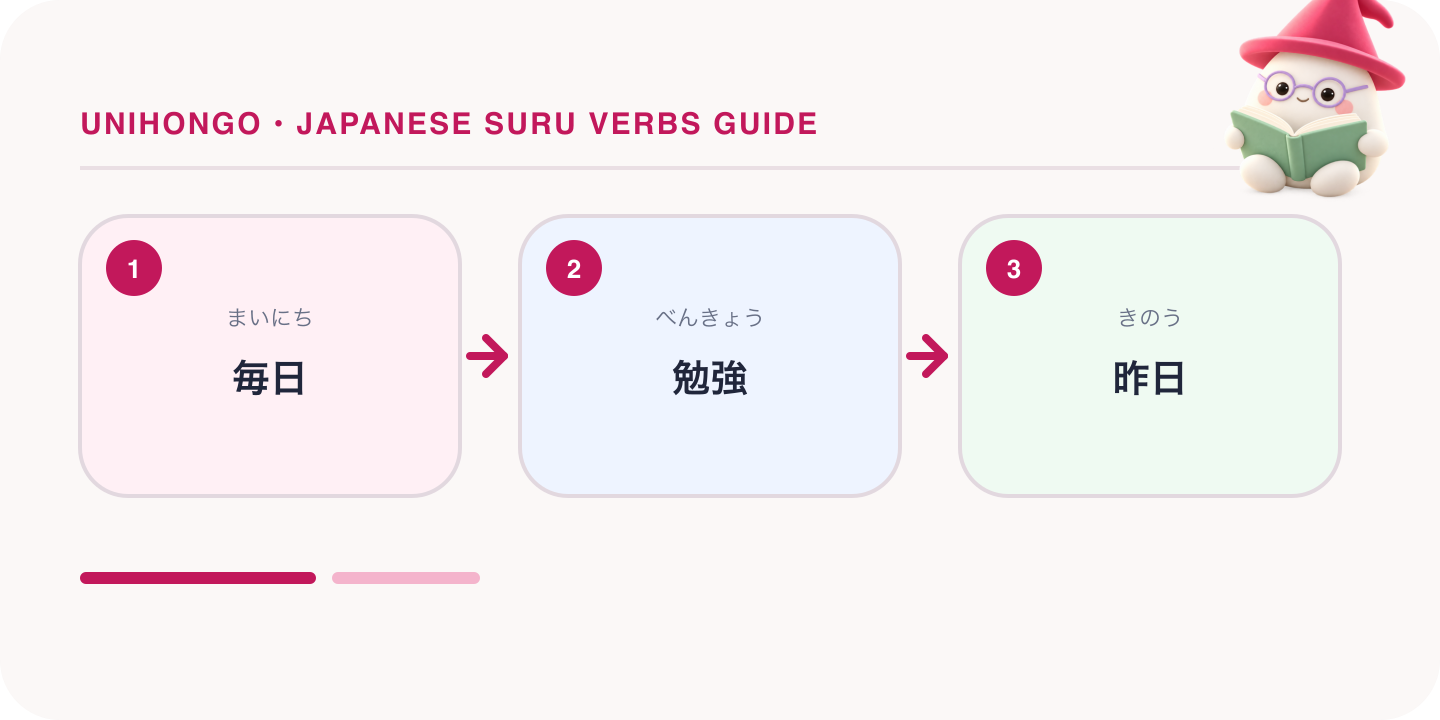
| 毎日、日本語を勉強します。 | Mainichi, Nihongo o benkyō shimasu. | I study Japanese every day. |
| 昨日、母に電話しました。 | Kinō, haha ni denwa shimashita. | I phoned my mother yesterday. |
| 公園を散歩しませんか。 | Kōen o sanpo shimasen ka. | Shall we take a walk in the park? |
| 姉は去年結婚しました。 | Ane wa kyonen kekkon shimashita. | My older sister got married last year. |
Conjugation table: only suru changes
Suru is one of the two irregular verbs of Japanese, but it is irregular in the same way everywhere. Here is benkyō suru in the forms you will need first.
| Form | Reading | Name | Meaning |
|---|---|---|---|
| 勉強する | benkyō suru | Dictionary form | Study, will study |
| 勉強します | benkyō shimasu | Polite form | Study, will study |
| 勉強しない | benkyō shinai | Plain negative | Do not study |
| 勉強した | benkyō shita | Plain past | Studied |
| 勉強して | benkyō shite | Te form | Studying, study and |
| 勉強したい | benkyō shitai | Tai form | Want to study |
| 勉強しよう | benkyō shiyō | Volitional | Let's study |
| 勉強すれば | benkyō sureba | Ba conditional | If one studies |
| 勉強できる | benkyō dekiru | Potential | Can study |
| 勉強させる | benkyō saseru | Causative | Make or let someone study |
| 勉強される | benkyō sareru | Passive | Be studied |
| 勉強しろ | benkyō shiro | Imperative | Study! |
Notice that the stem wanders between shi, su, sa and se. That is the irregular part, and it is worth saying the column aloud until it is automatic. The guides to verb groups and verb conjugation on this blog set suru beside the regular verbs.
With and without o: minimal pairs and the one-o rule
Because the noun is a real noun, it can step away from suru and become its object: benkyō o suru. Literally: do study. The meaning does not change. What changes is the space left in the clause.
A Japanese clause has room for one direct object. In Nihongo o benkyō suru, the whole verb is benkyō suru and its object is Nihongo. If you put o after benkyō, the object slot is taken, and Nihongo has to attach to the noun with no: Nihongo no benkyō o suru. Literally: do the study of Japanese. Two o particles in one clause are not accepted.
| Japanese | Romaji | Meaning |
|---|---|---|
| 週末は部屋の掃除をします。 | Shūmatsu wa heya no sōji o shimasu. | At the weekend I clean my room. |
| 料理はしますが、洗濯はしません。 | Ryōri wa shimasu ga, sentaku wa shimasen. | I do the cooking, but not the laundry. |
| 買い物をしてから帰ります。 | Kaimono o shite kara kaerimasu. | I'll do some shopping and then go home. |
| 長い旅行をしたいです。 | Nagai ryokō o shitai desu. | I want to take a long trip. |
| Sentence | Reading | What it says |
|---|---|---|
| 日本語を勉強します。 | Nihongo o benkyō shimasu. | I study Japanese. One verb, and Japanese is its object. |
| 日本語の勉強をします。 | Nihongo no benkyō o shimasu. | I do Japanese study. Study is the object, and Japanese describes it. |
| 田中さんに電話します。 | Tanaka-san ni denwa shimasu. | I'll phone Tanaka. Compact and neutral. |
| 田中さんに電話をします。 | Tanaka-san ni denwa o shimasu. | The same meaning. The call is presented a little more as a task. |
| 毎日運動をする。 | Mainichi undō o suru. | I exercise every day. A plain statement. |
| 毎日運動はする。 | Mainichi undō wa suru. | Exercise, at least, I do every day. Wa hints that something else is not being done. |
The third pair shows why the separated form is useful. Once the noun stands alone, it can take wa, mo or dake, and it can be described: nagai ryokō o shita, I took a long trip. An adjective needs a noun to describe, so nagai ryokō shita, with no particle, is only heard in loose casual speech.
Loanword verbs: kopī suru, kyanseru suru
A Japanese verb has to end in a particular sound and fit a conjugation pattern, which makes foreign verbs hard to import. Nouns have no such requirement. So English verbs enter Japanese as nouns, and suru makes them verbs on the spot: kopī suru, literally do a copy. This is why the family keeps growing.
Be ready for meanings that have narrowed. Sain suru means to sign your name. Kanningu suru means to cheat in an exam. A small number of loanwords take the ending ru directly instead, such as saboru, to skip class or work, and guguru, to search online, but these are informal exceptions. You are at the office, asking a colleague for help before a business trip.
| Japanese | Romaji | Meaning |
|---|---|---|
| この書類を三枚コピーしてください。 | Kono shorui o san-mai kopī shite kudasai. | Please make three copies of this document. |
| 予約をキャンセルしたいんですが。 | Yoyaku o kyanseru shitai n desu ga. | I'd like to cancel my reservation. |
| メールをチェックしましたか。 | Mēru o chekku shimashita ka. | Have you checked your email? |
| アプリをダウンロードしました。 | Apuri o daunrōdo shimashita. | I downloaded the app. |
| ここにサインしてください。 | Koko ni sain shite kudasai. | Please sign here. |
Which nouns can take suru, and which cannot
The handle fits only tools that do something. A noun accepts suru when it names an action, an event or a change: sōji, cleaning, ryokō, travel, shitsumon, a question, seikō, success, anshin, relief. Why not the others? Suru means do, and you cannot do a desk.
Three groups catch learners. Objects and places never take suru. Nouns for something you have use ga aru: kyōmi ga aru, to be interested, ninki ga aru, to be popular. Na-adjectives such as genki and shizuka describe states and take da. Shizuka ni suru exists, but it means to make something quiet, which is a different pattern.
In the other direction, suru is more generous than the word noun suggests. Many sound-symbolic words and adverbs take it and become verbs of feeling or manner. A friend is describing the moment before a job interview, and then a lazy weekend.
| Japanese | Romaji | Meaning |
|---|---|---|
| 胸がどきどきします。 | Mune ga dokidoki shimasu. | My heart is pounding. |
| 本当にびっくりしました。 | Hontō ni bikkuri shimashita. | I was really surprised. |
| 週末は家でゆっくりします。 | Shūmatsu wa ie de yukkuri shimasu. | I'll take it easy at home at the weekend. |
| 日本の歴史に興味があります。 | Nihon no rekishi ni kyōmi ga arimasu. | I'm interested in Japanese history. |
Beyond the basics: dekiru, nasaru and itasu
If suru is a handle, it can be swapped for a different handle without touching the noun. Three swaps matter. Dekiru is the potential: yoyaku dekiru, can reserve. Nasaru is the honorific, used for the actions of someone you respect, and its polite form is the slightly irregular nasaimasu. Itasu is the humble form, used for your own actions towards someone you respect.
You will hear nasaru and itasu from staff long before you need to produce them. For your own speech, learn o-negai itashimasu first. For honorific suru verbs, many speakers choose the passive-shaped sareru, as in shusseki saremasu ka, will you attend, which is lighter than nasaru. The scenes: a customer on a booking site, a waiter, a receptionist, the end of an email.
| Japanese | Romaji | Meaning |
|---|---|---|
| ネットで予約できますか。 | Netto de yoyaku dekimasu ka. | Can I book online? |
| この駐車場は誰でも利用できます。 | Kono chūshajō wa dare demo riyō dekimasu. | Anyone can use this car park. |
| お飲み物は何になさいますか。 | O-nomimono wa nani ni nasaimasu ka. | What would you like to drink? |
| 会議室へご案内いたします。 | Kaigishitsu e go-annai itashimasu. | I will show you to the meeting room. |
| よろしくお願いいたします。 | Yoroshiku o-negai itashimasu. | Thank you in advance for your help. |
Beyond the basics: one-kanji suru verbs such as aisuru and sassuru
A small group of verbs is written with a single kanji plus suru: aisuru, to love, sassuru, to sense or guess, yakusuru, to translate. Here the core idea fits less well, and it is better to admit it. The first part is not an independent noun in the same way, and the two parts cannot be separated: ai o suru is wrong.
Their conjugation is also less tidy. Aisuru has forms that behave like an ordinary godan verb, so its negative is aisanai and its potential is aiseru, while aishimasu and aishite look like suru. Yakusuru is often simply yakusu. Treat each of these as a separate vocabulary item and check a dictionary for its forms.
| Japanese | Romaji | Meaning |
|---|---|---|
| 家族を愛しています。 | Kazoku o aishite imasu. | I love my family. |
| お気持ちをお察しします。 | O-kimochi o o-sasshi shimasu. | I understand how you must feel. |
| この文を英語に訳してください。 | Kono bun o Eigo ni yakushite kudasai. | Please translate this sentence into English. |
Neighbours and spoken reality: yaru, naru and what gets dropped
Suru has two neighbours. Yaru is a rougher, more casual do. It can replace suru when the noun stands apart as an object, shukudai o yaru, but it cannot be attached directly: benkyō yaru is not said. Naru, to become, is the mirror image of suru. Chūshi ni suru means somebody cancels the event, and chūshi ni naru means the event ends up cancelled, with nobody named. Separate posts on this blog cover both pairs.
In conversation, o between the noun and suru is dropped more often than it is kept, and shite iru shrinks to shiteru. In messages and headlines even suru can vanish, leaving the noun to stand for the whole verb.
| Japanese | Romaji | Meaning |
|---|---|---|
| 今、勉強してる。 | Ima, benkyō shiteru. | I'm studying right now. |
| 宿題、もうやった? | Shukudai, mō yatta? | Have you done your homework yet? |
| 試合は中止になりました。 | Shiai wa chūshi ni narimashita. | The match has been cancelled. |
Common mistakes with suru verbs
The first mistake is the double o: Nihongo o benkyō o shimasu is wrong. Learners know both patterns and blend them. Choose one: Nihongo o benkyō shimasu, or Nihongo no benkyō o shimasu.
The second is copying English particles. Tomodachi o denwa shimashita and kare o kekkon shimashita are wrong, because in English you call someone and marry someone. In Japanese the noun decides: a call goes to a person, tomodachi ni denwa shimashita, and a marriage is with a person, kare to kekkon shimashita.
The third is inventing a potential from suru: benkyō sureru and benkyō shirareru are wrong. Learners apply the regular potential rules to an irregular verb. The potential is a different handle altogether: benkyō dekiru.
The fourth is adding suru to nouns that do not name actions: kyōmi suru and genki suru are wrong. English has verbs such as interest, so the gap is not obvious. Say kyōmi ga aru and genki da.