
Use Mocchi to Practice ある and いる in Real Sentences

Practice ある and いる with clear people-and-things examples before adding difficult edge cases. Ask Mocchi to help you say what exists, where it is, and how that differs from describing an action happening at the same place.

Mocchi compares a person and a book in simple Japanese existence sentences at a familiar location
What you need to know

Use Mocchi to Practice ある and いる in Real Sentences

In common beginner existence sentences, いる is used for people and animals, while ある is used for things such as books and tables. That contrast is a useful starting point, but the lesson also needs the rest of the sentence: the item, the location, and the relationship expressed by the particles. Use familiar objects and places, make your own description, and ask about special cases separately when they actually arise in your reading or conversation.

Start with clear examples before unusual edge cases.

Name what exists as well as where it is.

Keep existence separate from an activity at a place.

Change the object or person in your own sentence.

Choose an ordinary scene you can picture

A familiar room gives existence sentences a concrete purpose. Decide what is in the room and where each item is located. You can invent the whole scene, so there is no need to share a photograph of a private space. Tell Mocchi which words you already know and keep the first set small enough that the main challenge is the sentence pattern.

Begin with clear cases: a person, a cat, a book, or a chair. Complicated examples involving fictional beings or objects treated as animate can wait until the ordinary contrast is understandable. A beginner exercise works best when a wrong answer reveals the target difficulty rather than an obscure exception.

Build the sentence around the thing or person

机の上に本があります means 'There is a book on the desk.' 部屋に友達がいます means 'A friend is in the room.' Read what exists and where it is, then notice the verb used in each example. Change one detail at a time so you can see how the parts fit together before making a longer description.
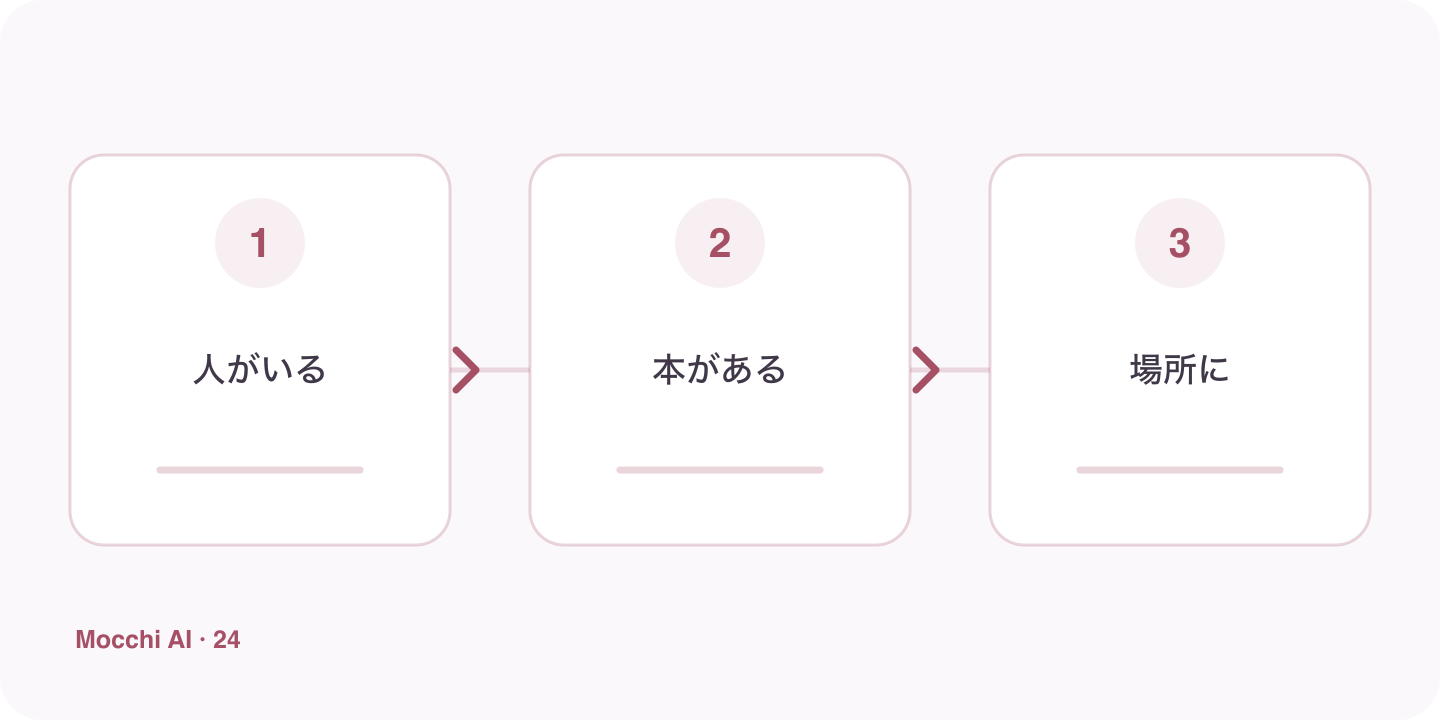
A person uses いる and a book uses ある in the beginner examples, followed by a location sentence
Start with clear people-and-things examples, then build the location sentence around what exists there.
JapaneseRomajiMeaning
机の上に本があります。Tsukue no ue ni hon ga arimasu.There is a book on the desk.
部屋に友達がいます。Heya ni tomodachi ga imasu.A friend is in the room.

Do not confuse existence with an action at a place

A person can be in a room and also study there, but these are different sentence relationships. Compare a simple existence description with a sentence about studying. Ask Mocchi to identify what the location phrase contributes in each one. This helps you understand the particle choice instead of memorizing that the room noun always appears with the same particle.

Make a new description without copying the layout

Move the book to another familiar place or replace the friend with a family member in an invented scene. Attempt the sentence before opening the model and explain the verb choice. If you can only answer while the original is visible, keep the task small and practice retrieval rather than adding more room vocabulary immediately.

Review special cases only with enough context

When you encounter an existence sentence that seems to break your beginner expectation, bring the surrounding text and ask what the speaker is presenting. Do not assume that the ordinary examples were useless or that a single new shortcut explains everything. Mocchi can help compare contexts, while a trusted reference is useful for checking an unusual or consequential interpretation that remains uncertain.

Key points

A practical way to improve

Imagine a simple room and choose two objects and one person. Ask Mocchi to help you describe where each is, then try a changed location without copying the model. Add one action that a person does in the room and explain why that sentence is no longer only an existence statement. If you miss a particle, review the relationship rather than repeating the object name alone.

  1. 1

    Choose one clear goal

    Focus each session on a situation or skill you can actually use.

  2. 2

    Practice actively

    Say complete answers aloud instead of only reading or recognizing Japanese.

  3. 3

    Review and repeat

    Keep useful corrections and revisit the same skill until it feels natural.

FAQ

Frequently asked questions

Should I use movement as the only test for ある and いる?

That shortcut can mislead. Begin with common people, animals, and ordinary objects, and learn unusual cases in context. Something does not need to be visibly moving at the moment for a normal いる sentence to describe it.

Why does an existence sentence use に for a place?

In these examples, に marks where the person or thing exists. Compare that with で in a sentence describing an action performed at the place, rather than treating every English at as the same Japanese relationship.

Can I learn exceptions later?

Yes. Start with a dependable set of ordinary examples, then ask about a special case when you encounter it. Trying to cover every unusual use immediately may obscure the sentence pattern you need most often.

Describe what is there before adding more detail

Use Mocchi to connect ある and いる to a small room description you can change and check.