
Closed lists and open lists
Beginner courses teach to as the word for and, and it works, but it makes a promise. Pan to tamago o kaimashita tells the listener that the basket held bread and eggs, full stop. If you actually bought seven things and named two, a Japanese listener may take you literally and ask about the rest. That mismatch is behind a lot of stiff-sounding learner speech.
An open list solves it. Ya, toka, nado and yara all say these are examples. English does this with words like and stuff or things like, but Japanese chooses between them by register rather than by meaning, so the same three items can be listed four ways depending on whether you are writing a report or messaging a friend. The core guide to particles covers to as a joiner; here the question is what to use when the list is deliberately unfinished.
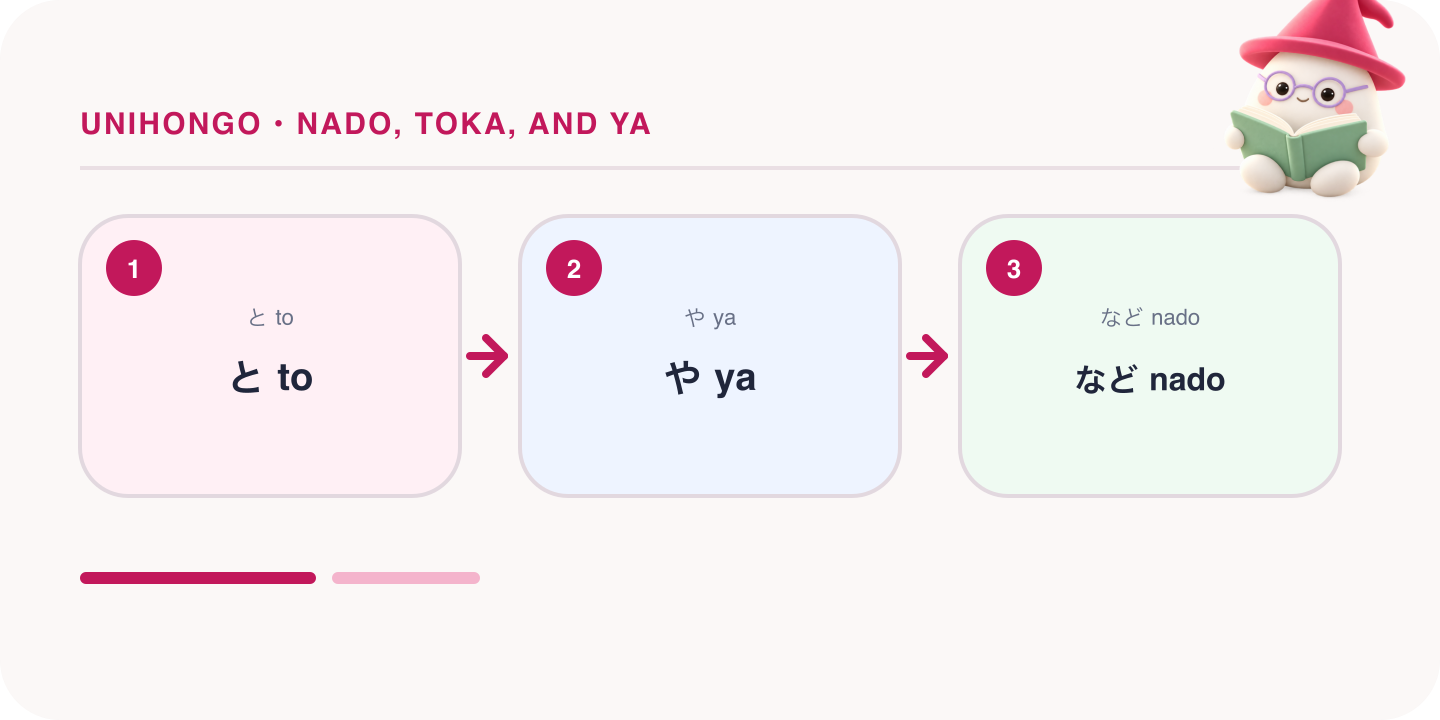
The listing words at a glance
| Word | Joins | Register | Nuance |
|---|---|---|---|
| と to | Nouns | All registers | A complete list, nothing left out |
| や ya | Nouns only | Neutral to written | A sample; often closed with nado |
| など nado | Ends a list, or one noun | Polite and written | And so on; also modest about yourself |
| とか toka | Nouns and plain verbs | Spoken and relaxed | A sample, or a hedge on one item |
| やら yara | Nouns, repeated | Spoken, slightly literary | A jumble, usually with exasperation |
| なんか nanka | One noun | Casual | Softens an offer or belittles the noun |
| なんて nante | Noun or clause | Casual | Disbelief, or dismissal of the noun |
Read the table as a ladder rather than a set of synonyms. Moving down it makes your Japanese more spoken and more loaded with attitude, and the bottom two rows stop being about listing at all.
Ya: the neutral open list
Ya sits between the nouns, never at the end, and it joins nouns only. It sounds even-tempered, which is why it dominates written Japanese, news and business speech. In conversation it is perfectly usable but slightly tidier than most people bother to be, so a friend describing their fridge would probably reach for toka instead.
Ya very often pairs with nado on the last item, which makes the openness explicit: pan ya tamago nado. The particle that would have marked the whole phrase, such as o or ga, goes after nado rather than after each noun. Learners sometimes attach a particle to every item, which sounds like a form being filled in rather than a sentence.
| Japanese | Romaji | Meaning |
|---|---|---|
| パンや卵を買いました。 | Pan ya tamago o kaimashita. | I bought bread, eggs and so on. |
| パンや卵などを買いました。 | Pan ya tamago nado o kaimashita. | I bought bread, eggs and other things. |
| 京都や大阪へ行きました。 | Kyōto ya Ōsaka e ikimashita. | I went to Kyoto, Osaka and other places. |
| 資料や写真などをお送りします。 | Shiryō ya shashin nado o o-okuri shimasu. | I will send the documents, photographs and so on. |
| 週末は洗濯や掃除をします。 | Shūmatsu wa sentaku ya sōji o shimasu. | At the weekend I do laundry, cleaning and the like. |
| 会議には田中さんや山田さんが来ます。 | Kaigi ni wa Tanaka-san ya Yamada-san ga kimasu. | Tanaka, Yamada and others will come to the meeting. |
Nado: and so on, and modest about yourself
Nado closes a list politely. It can follow a ya list, a to list or a single noun, and it always signals that more could be said. In announcements and business writing it is the default, and its slightly more formal variant nado to is common in reported speech. Spoken casually, nado shortens to nanka and nante, which is where the attitude creeps in.
Nado has a second life as a modesty marker about yourself or your own things. Watashi nado ni wa totemo dekimasen means somebody like me could not possibly do it, and it is a graceful way to decline a compliment or an assignment above your level. The same construction pointed at another person would be rude, which is the single most useful thing to remember about this family of words.
| Japanese | Romaji | Meaning |
|---|---|---|
| 飲み物などはいかがですか。 | Nomimono nado wa ikaga desu ka? | Would you like a drink or something? |
| ペンやノートなどが必要です。 | Pen ya nōto nado ga hitsuyō desu. | You will need a pen, a notebook and so on. |
| 東京や大阪などの都市を回りました。 | Tōkyō ya Ōsaka nado no toshi o mawarimashita. | I toured cities such as Tokyo and Osaka. |
| 私などにはとてもできません。 | Watashi nado ni wa totemo dekimasen. | Someone like me could not possibly do it. |
| 私などでよろしいでしょうか。 | Watashi nado de yoroshii deshō ka? | Would somebody like me really be suitable? |
| 遅れるなどとは言っていません。 | Okureru nado to wa itte imasen. | I never said anything about being late. |
In a shop or a restaurant you will hear nado constantly in staff speech, because it keeps an offer open without pressing. Copying that habit makes your own offers sound less blunt: kōhī nado wa ikaga desu ka is softer than kōhī wa ikaga desu ka.
Toka: the spoken workhorse
Toka is what most people actually say. It goes after each item rather than between them, so both nouns carry it, and it can trail off after the last one without any grammar to finish it. It also attaches to plain-form verbs, which ya cannot do, letting you list sample activities as easily as sample objects.
Because it is relaxed, toka is fine with friends, colleagues you are comfortable with, and shop staff in casual settings, but it thins out a formal email. In writing, swap each toka for ya and close with nado. Keep the same nouns and only the register changes, which is a good self-check exercise.
| Japanese | Romaji | Meaning |
|---|---|---|
| パンとか卵とか買いました。 | Pan toka tamago toka kaimashita. | I bought bread and eggs and stuff. |
| 映画を見るとか買い物に行くとかしたいです。 | Eiga o miru toka kaimono ni iku toka shitai desu. | I want to do things like watch a film or go shopping. |
| ラーメンとかうどんとかが好きです。 | Rāmen toka udon toka ga suki desu. | I like ramen, udon, that sort of thing. |
| 疲れたとか言っていました。 | Tsukareta toka itte imashita. | He said something about being tired. |
| 土曜日とか日曜日とかは空いていますか。 | Doyōbi toka nichiyōbi toka wa aite imasu ka? | Are you free on Saturday or Sunday or thereabouts? |
| 京都とか行ったことありますか。 | Kyōto toka itta koto arimasu ka? | Have you been to Kyoto or anywhere like that? |
Toka on a single item as a hedge
The most useful trick with toka has nothing to do with lists. Put it on one noun and it stops being a demand and becomes a suggestion: kōhī toka dō desu ka offers coffee while leaving the door open to anything else. This is a standard softening move when inviting somebody, proposing a time, or raising a topic you are not sure about.
The same hedge works on reported speech, where toka distances you from the exact wording. Ashita wa muri toka itte imashita means they said something along the lines of tomorrow being impossible, which is honest when you did not catch every word. Learners who never hedge come across as unusually definite, and this one particle fixes it.
| Japanese | Romaji | Meaning |
|---|---|---|
| コーヒーとか飲みませんか。 | Kōhī toka nomimasen ka? | Would you like to have a coffee or something? |
| 明日とかどうですか。 | Ashita toka dō desu ka? | How about tomorrow or thereabouts? |
| 映画とか、どうかな。 | Eiga toka, dō ka na. | Maybe a film or something? (casual) |
| ちょっと相談とかいいですか。 | Chotto sōdan toka ii desu ka? | Could I run something by you, if that is all right? |
| 明日は無理とか言っていました。 | Ashita wa muri toka itte imashita. | They said something like tomorrow being impossible. |
| 六時とかでも大丈夫ですか。 | Roku-ji toka demo daijōbu desu ka? | Would around six or so also be all right? |
Yara: the jumbled list
Yara repeats after each item like toka, but it colours the list with the feeling that it was all too much. Sōji yara sentaku yara de isogashii desu paints a weekend buried under chores rather than a tidy pair of tasks. It is common in spoken complaints and in slightly literary narration, and it sounds odd in a neutral report.
Two items is the normal shape, and the phrase usually leads into a reason or a state: de isogashii, de taihen deshita. Do not use yara for a shopping list you feel fine about; the exasperation is not optional, and a listener will hear it.
| Japanese | Romaji | Meaning |
|---|---|---|
| 掃除やら洗濯やらで忙しいです。 | Sōji yara sentaku yara de isogashii desu. | I am busy with cleaning, laundry and heaven knows what else. |
| 会議やら出張やらで大変でした。 | Kaigi yara shutchō yara de taihen deshita. | What with meetings and business trips, it was rough. |
| 書類やら手続きやらが残っています。 | Shorui yara tetsuzuki yara ga nokotte imasu. | There are still forms and procedures and all the rest of it. |
| 雨やら風やらでひどい一日でした。 | Ame yara kaze yara de hidoi ichinichi deshita. | Between the rain and the wind it was a terrible day. |
If you want the same busy picture without the sighing, use ya or toka and add taihen deshita separately. That keeps the facts and drops the mood, which is often what a workplace conversation needs.
Nanka and nante: softening and belittling
Nanka is the casual descendant of nado. On an offer it softens: o-cha nanka dō is friendlier than o-cha wa dō. On yourself it is modest: watashi nanka mada mada desu. On a task you resent, it belittles: benkyō nanka shitakunai. The direction depends entirely on what it is attached to, which is why one word can sound kind in one sentence and sour in the next.
Nante does the same work with more force, and it adds a note of disbelief with clauses: kare ga kuru nante omoimasen deshita. The warning is simple. Attached to another person, nante and nanka read as writing that person off, so ano hito nante shiranai sounds cold. About yourself it is modesty; about others it is dismissal. When in doubt with a person, drop it and use a plain wa.
| Japanese | Romaji | Meaning |
|---|---|---|
| お茶なんかどうですか。 | O-cha nanka dō desu ka? | How about some tea or something? |
| 私なんかまだまだです。 | Watashi nanka mada mada desu. | Someone like me still has a long way to go. |
| 宿題なんてしたくない。 | Shukudai nante shitakunai. | I do not want to do homework of all things. (casual) |
| 彼が来るなんて思いませんでした。 | Kare ga kuru nante omoimasen deshita. | I never imagined that he would come. |
| 日本語なんて簡単だよ。 | Nihongo nante kantan da yo. | Japanese is easy, honestly. (dismissive, casual) |
| 失敗なんて気にしないでください。 | Shippai nante ki ni shinaide kudasai. | Please do not worry about a little failure. |
The same list at four registers
These rows hold the items steady and change only the listing word, so you can hear the register move rather than guess at it. Say them one after another and notice how badly the last two would read in a formal email, and how stiff the first two would sound in a message to a friend. The second group does the same with a weekend, where yara adds tiredness that none of the others carry.
| Japanese | Romaji | Meaning |
|---|---|---|
| 資料と議事録を送ります。 | Shiryō to gijiroku o okurimasu. | I will send the documents and the minutes. (complete list) |
| 資料や議事録などをお送りいたします。 | Shiryō ya gijiroku nado o o-okuri itashimasu. | I will send the documents, minutes and related material. (formal email) |
| 資料や議事録などを送ります。 | Shiryō ya gijiroku nado o okurimasu. | I will send the documents, minutes and so on. (neutral) |
| 資料とか議事録とか送りますね。 | Shiryō toka gijiroku toka okurimasu ne. | I will send the documents and minutes and things. (spoken) |
| 資料とか議事録とか送るね。 | Shiryō toka gijiroku toka okuru ne. | I will send the docs and minutes and stuff. (chat, casual) |
| 週末は買い物と映画に行きました。 | Shūmatsu wa kaimono to eiga ni ikimashita. | At the weekend I went shopping and to the cinema. |
| 週末は買い物や映画などに行きました。 | Shūmatsu wa kaimono ya eiga nado ni ikimashita. | At the weekend I went shopping, to the cinema and so on. |
| 週末は買い物とか映画とか行きました。 | Shūmatsu wa kaimono toka eiga toka ikimashita. | At the weekend I went shopping and to the cinema and stuff. |
| 週末は買い物やら映画やらで疲れました。 | Shūmatsu wa kaimono yara eiga yara de tsukaremashita. | Between shopping and the cinema, the weekend wore me out. |
| 週末は映画なんか見ていました。 | Shūmatsu wa eiga nanka mite imashita. | At the weekend I was watching films and suchlike. |
Email versus chat
- In a formal email, join nouns with ya and close with nado; keep toka, yara, nanka and nante out entirely.
- In a workplace chat, toka is fine with colleagues you speak plainly to, but keep nante away from people's names.
- In an announcement or a notice, nado is expected, and its absence can make a list sound exhaustive by mistake.
- When speaking to a customer, prefer nado over nanka even though you are speaking rather than writing.
- When talking about yourself modestly, nado in polite speech and nanka in casual speech both work.
- If you are unsure of the register, use ya plus nado; it is never wrong, only slightly tidy.
A drill that fixes the habit
- Name three things in your bag with to, then say the same three with ya and nado, then with toka.
- Answer kinō nani o shimashita ka with a toka list of two verbs in plain form rather than one activity.
- Offer somebody a drink twice, once with wa and once with nado, and listen for the softer version.
- Describe a busy week with yara and then rewrite it neutrally with ya, keeping the same two nouns.
- Say one modest sentence about yourself with nado, then check that you never point it at anybody else.
- Propose a meeting time with toka on a single item, and have your partner counter-propose the same way.