
Use Mocchi to Separate に and で in Place Expressions

When you practice に and で with Mocchi, ask what the place is doing in the sentence: a destination, a location of existence, or the setting for an action. Begin with these common uses instead of assigning one particle permanently to each place word.

Mocchi compares a destination, an existing object, and an action happening at a Japanese location
What you need to know

Use Mocchi to Separate に and で in Place Expressions

A learner may remember 'library plus で' from a study example and then choose it again when the sentence means going to the library. The noun has not changed, but the relationship has. Use a small set of familiar places and vary the event around them. This makes the grammatical decision visible. The exercise covers common place expressions; it does not claim to explain every meaning of either particle in Japanese.

Read the verb before choosing a place particle.

Separate destination, existence, and action location.

Keep the place familiar while changing its role.

Review the relationship rather than a fixed word pair.

A place word does not determine its particle alone

Words such as school, station, and library describe places, but the sentence can relate to those places in different ways. You can go to a station, be at a station, or buy something there. Ask Mocchi to keep the noun constant while changing the event. This prevents the exercise from becoming a memory test of which particle happened to appear next to a word in your first textbook example.

Use verbs you understand. If the verb is unfamiliar, you may not have the information needed to choose the relationship. Ask for its meaning in a short phrase, then return to the particle decision. This keeps a vocabulary gap from masquerading as an unexplained grammar failure.

Compare three roles with one familiar place

学校に行きます makes the school a destination. 学校にいます locates the speaker at school. 学校で勉強します places the studying activity there. All three can be understandable beginner examples, but they ask different questions about the place. Explain those roles before moving to more complicated sentences with unfamiliar vocabulary or multiple clauses.
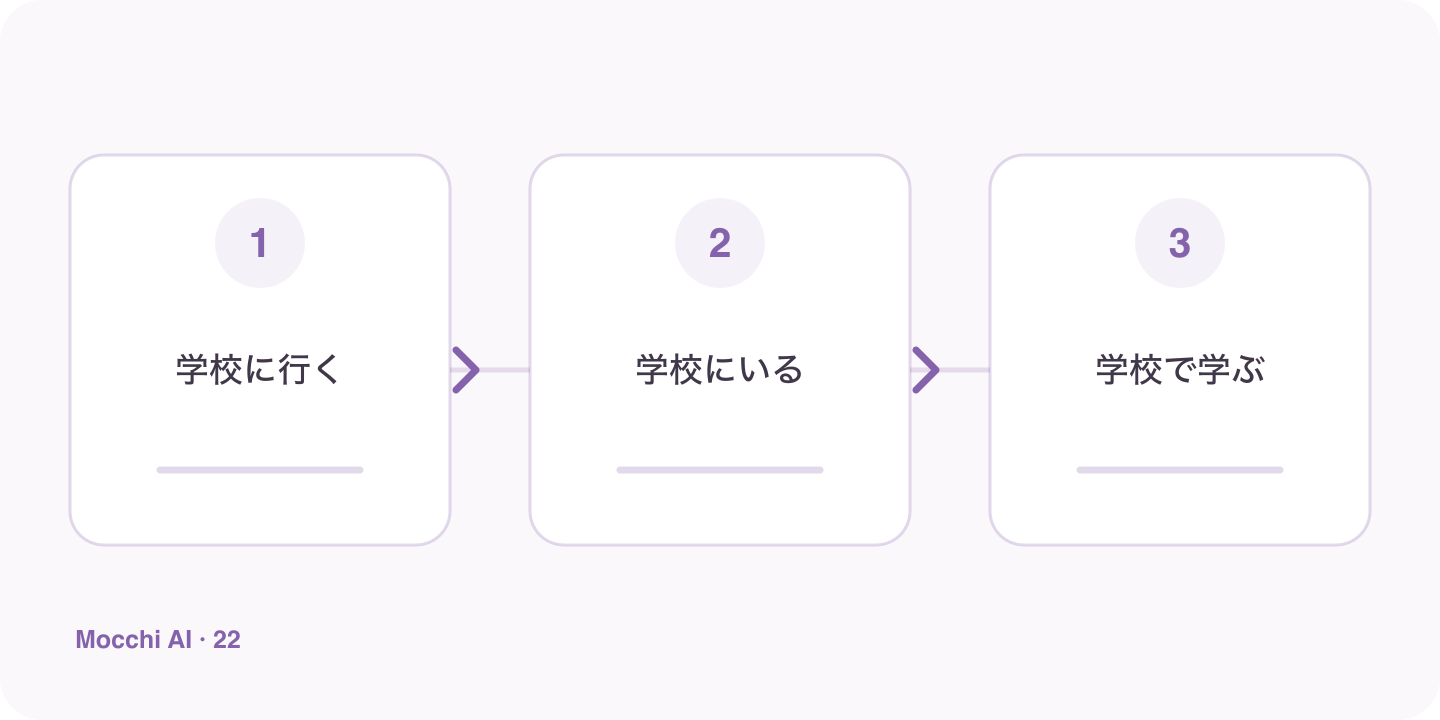
A destination uses に, an existence location uses に, and a place of action uses で in the illustrated examples
The same place can take different particles because its relationship to the event changes.
JapaneseRomajiMeaning
学校に行きます。Gakkō ni ikimasu.I go to school.
学校にいます。Gakkō ni imasu.I am at school.
学校で勉強します。Gakkō de benkyō shimasu.I study at school.

Use a reason before checking the answer

After selecting a particle, state the relationship in one short sentence: the action happens there, the person exists there, or the place is the destination. If your reason does not match the event, ask Mocchi to explain the mismatch. A correct answer with an incorrect reason is a useful warning that the next example may still cause trouble.

Mix the roles after supported practice

An exercise that announces 'these are all destination sentences' removes part of the decision. Once the first examples are clear, ask for a mixed set and read each verb before answering. Change the places too, but keep the vocabulary manageable. This gives you practice recognizing which relationship is present rather than simply repeating the particle used in the previous question.

Save the exact contrast you still need

If you confuse existence and action location, name that pair in your review request rather than asking to study particles in general. If you only miss destinations with unfamiliar verbs, target those phrases first. Mocchi's learning context becomes more useful when the review note identifies a decision that can be tested in a fresh sentence. Later, study other uses of に and で as separate targets instead of assuming that this place-focused routine explains them all.

Key points

A practical way to improve

Choose one place, such as a school or library, and ask Mocchi for three short situations: going there, being there, and doing an activity there. Choose the particle and explain the relationship in each case. Then repeat with a different place and a different action. If you miss one, check whether an unfamiliar verb caused the problem before requesting another grammar explanation.

  1. 1

    Choose one clear goal

    Focus each session on a situation or skill you can actually use.

  2. 2

    Practice actively

    Say complete answers aloud instead of only reading or recognizing Japanese.

  3. 3

    Review and repeat

    Keep useful corrections and revisit the same skill until it feels natural.

FAQ

Frequently asked questions

Does で always mean at?

No. English prepositions are not reliable one-to-one labels for Japanese particles. In this exercise, で marks where an action happens, but the particle also has other uses that should be learned in their own contexts.

Why can the same place use に in another sentence?

Because the place may be a destination or a location where something exists rather than the setting for an action. Read the event and the verb, not only the place noun.

Should I learn all uses of に at the same time?

Not necessarily. Start with a manageable contrast and add other functions later. A focused practice target makes it easier to identify why an answer was wrong and what to review next.

Choose the relationship, not a memorized pair

Let Mocchi vary the event around a familiar place so the particle has a clear purpose.