
The comparison patterns at a glance
Japanese adjectives do not inflect for comparison. Takai is high, higher, and highest all at once, and the sentence around it supplies the rest. That is good news, because it means you never conjugate anything new here: you only learn where to place yori, hō ga, ichiban, and hodo. Six patterns cover almost everything you will say.
| Pattern | Model sentence | Use it when |
|---|---|---|
| AはBより + adjective | 東京は大阪より大きいです。 Tōkyō wa Ōsaka yori ōkii desu. | Describing A, with B as the yardstick |
| BよりAの方が + adjective | 大阪より東京の方が大きいです。 Ōsaka yori Tōkyō no hō ga ōkii desu. | Choosing or recommending A |
| AとBとどちらが + adjective ですか | コーヒーと紅茶とどちらがいいですか。 Kōhī to kōcha to dochira ga ii desu ka? | Asking about exactly two |
| Group + で / の中で いちばん | 日本で一番高い山です。 Nihon de ichiban takai yama desu. | Naming the top of a group |
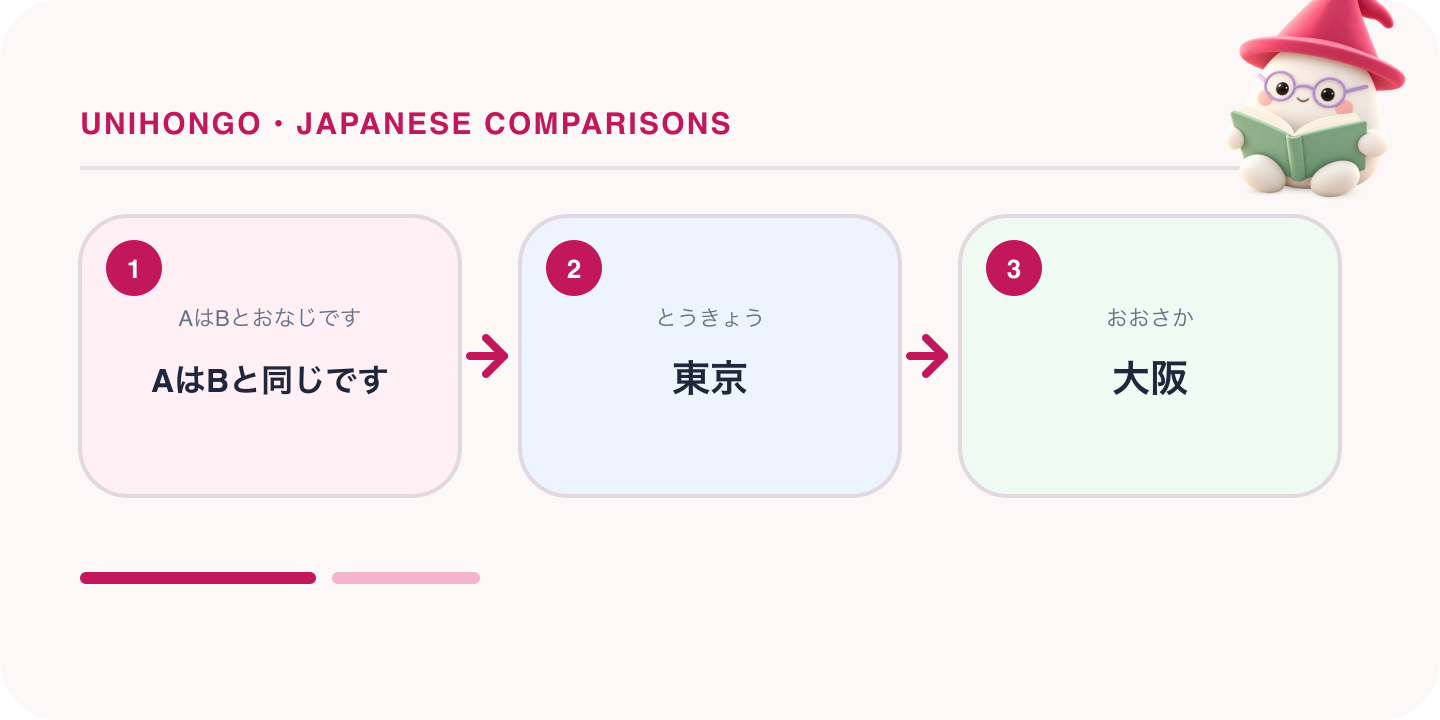
| AはBと同じです | 値段は同じです。 Nedan wa onaji desu. | There is no difference worth stating |
| AはBほど + negative | 大阪は東京ほど大きくないです。 Ōsaka wa Tōkyō hodo ōkiku nai desu. | Saying A falls short, gently |
A wa B yori: the plain comparison
Yori attaches to the yardstick, the thing you are measuring against, and sits directly before the adjective. The literal order is A, as for it, compared with B, is big. Nothing else changes, so any adjective sentence you can already say becomes a comparison by inserting two words. Both i-adjectives and na-adjectives work: benri desu becomes basu yori benri desu.
One habit to break early is adding a word for than twice. English speakers sometimes produce motto yori, trying to reproduce more than. Yori already carries the comparison, so motto is only used when there is no yardstick in the sentence at all.
| Japanese | Romaji | Meaning |
|---|---|---|
| 東京は大阪より大きいです。 | Tōkyō wa Ōsaka yori ōkii desu. | Tokyo is bigger than Osaka. |
| 今日は昨日より寒いです。 | Kyō wa kinō yori samui desu. | Today is colder than yesterday. |
| 電車はバスより便利です。 | Densha wa basu yori benri desu. | The train is more convenient than the bus. |
| この店はあの店より安いです。 | Kono mise wa ano mise yori yasui desu. | This shop is cheaper than that one. |
| 日本語は英語より難しいと思います。 | Nihongo wa Eigo yori muzukashii to omoimasu. | I think Japanese is harder than English. |
Hou ga and the word order that sounds natural
Hō means side or direction, so A no hō ga literally means the A side is. It marks the winner rather than the yardstick, and it is what a Japanese speaker reaches for when answering a question or making a recommendation. Notice the particles: the yardstick keeps yori, and the winner takes no hō ga, with ga rather than wa.
Word order is where this pattern goes wrong. Both orders are grammatical, but placing the yori phrase first and the hō ga phrase second is far more common in speech, because it builds to the point: Ōsaka yori Tōkyō no hō ga ōkii desu. If you lead with the hō ga phrase, the yori phrase can sound like an afterthought. With a noun, hō follows no; with a verb, it follows the plain form directly.
| Japanese | Romaji | Meaning |
|---|---|---|
| 大阪より東京の方が大きいです。 | Ōsaka yori Tōkyō no hō ga ōkii desu. | Tokyo is the bigger of the two. |
| 魚より肉の方が好きです。 | Sakana yori niku no hō ga suki desu. | I like meat more than fish. |
| 夏より冬の方がいいです。 | Natsu yori fuyu no hō ga ii desu. | I prefer winter to summer. |
| 車より電車の方が速いです。 | Kuruma yori densha no hō ga hayai desu. | The train is faster than the car. |
| こちらの方が少し高いです。 | Kochira no hō ga sukoshi takai desu. | This one is slightly more expensive. |
Asking about two things
For exactly two items, the question word is dochira, and the frame is A to B to dochira ga. The second to is optional in casual speech but very common, and dochira cannot be replaced by dore here, because dore needs three or more. In casual conversation dochira shortens to dotchi, and among friends the whole question is often just dotchi ga ii.
| Japanese | Romaji | Meaning |
|---|---|---|
| コーヒーと紅茶とどちらがいいですか。 | Kōhī to kōcha to dochira ga ii desu ka? | Which would you prefer, coffee or tea? |
| 犬と猫とどちらが好きですか。 | Inu to neko to dochira ga suki desu ka? | Which do you like better, dogs or cats? |
| 猫の方が好きです。 | Neko no hō ga suki desu. | I like cats better. |
| どちらも好きです。 | Dochira mo suki desu. | I like them both. |
| どちらでもいいです。 | Dochira demo ii desu. | Either is fine. |
| どっちがいい? | Dotchi ga ii? | Which do you want? (casual) |
Answer with the hō ga pattern, not with a bare noun. Neko desu is understandable but flat; neko no hō ga suki desu sounds like a real reply and gives your partner something to ask about next.
Ichiban and the group marker
Ichiban means number one and simply sits in front of the adjective: ichiban takai, the highest; ichiban suki, favourite. The part learners forget is the group. English can leave it implicit, but Japanese usually states the field of comparison first, marked with de after a place, a time span, or a broad category, and with no naka de when the group is a set of members you have named or can point at.
The other detail worth noticing is that the subject of a superlative sentence often takes ga rather than wa, because you are identifying which member wins. Kudamono no naka de ringo ga ichiban suki desu is the natural shape, and switching to wa there makes the sentence sound like a contrast instead of an answer.
| Japanese | Romaji | Meaning |
|---|---|---|
| 日本で一番高い山は富士山です。 | Nihon de ichiban takai yama wa Fuji-san desu. | The highest mountain in Japan is Mount Fuji. |
| 果物の中でりんごが一番好きです。 | Kudamono no naka de ringo ga ichiban suki desu. | Of all fruit, I like apples best. |
| 一年で八月が一番暑いです。 | Ichinen de hachi-gatsu ga ichiban atsui desu. | August is the hottest month of the year. |
| クラスで田中さんが一番日本語が上手です。 | Kurasu de Tanaka-san ga ichiban Nihongo ga jōzu desu. | Tanaka is the best at Japanese in the class. |
| この三つの中でこれが一番いいです。 | Kono mittsu no naka de kore ga ichiban ii desu. | Of these three, this one is the best. |
Asking about three or more
Once the group has three or more members, dochira is out and you choose the question word by category: dore for a set of things in front of you, nani for an open field, dare for people, doko for places, and itsu for times. Keep the group phrase at the front and the question word straight after it, so the listener knows the field before they hear the question.
| Japanese | Romaji | Meaning |
|---|---|---|
| この中でどれが一番いいですか。 | Kono naka de dore ga ichiban ii desu ka? | Which of these is the best? |
| 日本料理で何が一番おいしいですか。 | Nihon-ryōri de nani ga ichiban oishii desu ka? | What is the tastiest Japanese dish? |
| クラスで誰が一番早く来ますか。 | Kurasu de dare ga ichiban hayaku kimasu ka? | Who arrives earliest in the class? |
| 日本でどこが一番きれいでしたか。 | Nihon de doko ga ichiban kirei deshita ka? | Where was the most beautiful place in Japan? |
| 一週間でいつが一番忙しいですか。 | Isshūkan de itsu ga ichiban isogashii desu ka? | Which day of the week is busiest for you? |
A common slip is asking nani ga ichiban suki desu ka about people. Use dare for people and dochira when there are only two, and the question will sound native straight away.
Saying two things are the same
Onaji is unusual: it looks like a na-adjective but attaches directly to a noun with no na and no no, so it is onaji daigaku, the same university, never onaji na daigaku. To compare two items, mark the second with to: kore wa are to onaji desu. For approximate equality, use to onaji gurai plus the adjective, which is the everyday way to say just as tall or about as expensive.
| Japanese | Romaji | Meaning |
|---|---|---|
| この二つは同じです。 | Kono futatsu wa onaji desu. | These two are the same. |
| これは私のと同じです。 | Kore wa watashi no to onaji desu. | This is the same as mine. |
| 弟は私と同じぐらい背が高いです。 | Otōto wa watashi to onaji gurai se ga takai desu. | My younger brother is about as tall as me. |
| 値段はほとんど同じですね。 | Nedan wa hotondo onaji desu ne. | The prices are almost the same. |
| 兄と同じ大学に通っています。 | Ani to onaji daigaku ni kayotte imasu. | I attend the same university as my older brother. |
Hodo: the gentle negative comparison
A wa B hodo plus a negative says that A does not reach B's level. It is not simply the opposite of yori, because it keeps B as the standard everyone accepts and quietly places A below it, which sounds far more modest than declaring a winner. That is why it is the polite way to talk about yourself next to someone else: watashi wa ane hodo ryōri ga jōzu ja arimasen.
The rule that must not be broken is the negative ending. Ōsaka wa Tōkyō hodo ōkii desu is not a sentence; it has to be ōkiku nai desu or ōkiku arimasen. Hodo also pairs neatly with omotta, giving omotta hodo muzukashiku nakatta desu, meaning it was not as hard as I thought.
| Japanese | Romaji | Meaning |
|---|---|---|
| 大阪は東京ほど大きくないです。 | Ōsaka wa Tōkyō hodo ōkiku nai desu. | Osaka is not as big as Tokyo. |
| 今日は昨日ほど寒くないですね。 | Kyō wa kinō hodo samuku nai desu ne. | It is not as cold today as yesterday. |
| 思ったほど難しくなかったです。 | Omotta hodo muzukashiku nakatta desu. | It was not as difficult as I had expected. |
| 私は姉ほど料理が上手じゃありません。 | Watashi wa ane hodo ryōri ga jōzu ja arimasen. | I am not as good at cooking as my older sister. |
Comparing actions and quantities
You can compare verbs as easily as nouns. Attach hō ga to the plain present form of the verb, and use the plain form before yori too: aruku yori hashiru hō ga hayai desu. When the sentence is advice rather than a description, Japanese switches the verb before hō ga into the plain past, which is why hayaku itta hō ga ii desu means you had better go early. That past form carries no past meaning at all.
Quantities work the same way, with the counter or amount word taking the adjective slot. Kono hō ga ryō ga ōi desu says this one has more. If you want to name the gap, put the amount before the adjective: ni-hyaku en takai desu, two hundred yen more expensive.
| Japanese | Romaji | Meaning |
|---|---|---|
| 電車で行く方が早いです。 | Densha de iku hō ga hayai desu. | Going by train is quicker. |
| 読むより話す方が難しいです。 | Yomu yori hanasu hō ga muzukashii desu. | Speaking is harder than reading. |
| 自分で作る方が安いですよ。 | Jibun de tsukuru hō ga yasui desu yo. | Making it yourself is cheaper. |
| 早く行った方がいいですよ。 | Hayaku itta hō ga ii desu yo. | You had better go early. |
| こちらの方が二百円高いです。 | Kochira no hō ga nihyaku-en takai desu. | This one is two hundred yen more expensive. |
Degree words that size the gap
A comparison without a degree word states only the direction. Adding one tells the listener how big the difference is, and these words are what make a comparison sound like an opinion rather than a measurement. They sit immediately before the adjective, so they slot into any pattern above without further changes.
| Word | Romaji | Meaning | Example |
|---|---|---|---|
| もっと | motto | More (no yardstick stated) | もっと大きいのはありますか。 Motto ōkii no wa arimasu ka? |
| もう少し | mō sukoshi | A little more | もう少し安いのがいいです。 Mō sukoshi yasui no ga ii desu. |
| ずっと | zutto | Far, by a wide margin | こちらの方がずっと便利です。 Kochira no hō ga zutto benri desu. |
| 少し | sukoshi | Slightly | 少し高いですが、いいですね。 Sukoshi takai desu ga, ii desu ne. |
| ちょっと | chotto | A bit (spoken) | ちょっと遠いです。 Chotto tōi desu. |
| はるかに | haruka ni | Vastly (formal) | はるかに多いです。 Haruka ni ōi desu. |
| あまり〜ない | amari ... nai | Not very | あまり変わりません。 Amari kawarimasen. |
| そんなに〜ない | sonna ni ... nai | Not that much | そんなに違いません。 Sonna ni chigaimasen. |
Motto and yori do not appear together. If the yardstick is already in the sentence, drop motto and let yori do the work; if you are asking a shop assistant for something bigger with no yardstick, motto is exactly right.
Answering a comparison with a reason
In Japanese conversation a comparison question is usually an invitation to say why, and a one-word answer closes the topic. Give the choice with hō ga, then attach a reason with kara or node, or add a second sentence. Node is a little softer and more polite; kara is more direct and fine among friends. If you truly cannot choose, say so and then commit anyway with shiite ieba, meaning if I had to pick.
| Japanese | Romaji | Meaning |
|---|---|---|
| 静かだから、こちらの方がいいです。 | Shizuka da kara, kochira no hō ga ii desu. | This one is better because it is quiet. |
| 値段が安いので、こちらにします。 | Nedan ga yasui node, kochira ni shimasu. | I will take this one, since it is cheaper. |
| 味は同じぐらいですが、量が多い方を選びます。 | Aji wa onaji gurai desu ga, ryō ga ōi hō o erabimasu. | They taste about the same, so I will pick the larger portion. |
| どちらとも言えませんが、強いて言えば夏です。 | Dochira tomo iemasen ga, shiite ieba natsu desu. | I cannot really say, but if I had to choose, summer. |
| どうしてそちらの方が好きなんですか。 | Dōshite sochira no hō ga suki nan desu ka? | Why do you prefer that one? |