
Why omission is normal and still risky for you
Japanese drops anything recoverable from context, and this is not laziness or informality; it is how the language works. A conversation in which every subject is stated sounds odd, and learners who over-specify are immediately identifiable.
The risk is not the omission itself but the assumption underneath it. Omitting a subject means trusting that the listener is tracking the same topic you are, and a learner's sense of what is currently the topic is often slightly off, particularly a few turns into a conversation.
So the goal is not more explicitness in general. It is explicitness in the specific places where your assumption and theirs might differ.
Where ambiguity actually arises
Ambiguity is not spread evenly. Most learner misunderstandings come from a small number of structures where Japanese encodes information that English carries with word order, and where getting it wrong reverses the meaning rather than blurring it.
Giving and receiving verbs are the largest source, because they encode both direction and who benefited, and there is no neutral option to fall back on.
| Structure | What is ambiguous | Cost when wrong |
|---|---|---|
| Dropped subject | Who did it | High |
| Giving and receiving | Direction of the favour | High |
| Causative | Who made whom act | High |
| Passive | Who was affected | Medium |
| Dropped object | What was acted on | Medium |
| Bare time expression | When exactly | Medium |
The top three are worth checking deliberately while you speak. The rest are usually repaired by context without anyone noticing.
Adding the minimum that fixes it
The correction is smaller than learners expect. In most cases one word restores the meaning, and adding a whole clause of explanation is what makes speech sound heavy.
A topic marker at the start of the sentence is usually enough, because it resets what the following sentences are about and the omissions after it become recoverable again.
| Japanese | Romaji | Meaning |
|---|---|---|
| 私は行きませんでした。 | Watashi wa ikimasen deshita. | I did not go. (subject restored) |
| 田中さんが持ってきてくれました。 | Tanaka-san ga motte kite kuremashita. | Tanaka brought it for me. |
| 私が彼に説明しました。 | Watashi ga kare ni setsumei shimashita. | I explained it to him. |
| 部長に行かせました。 | Buchō ni ikasemashita. | I had the manager go. (causative) |
| 先週の金曜日です。 | Senshū no kin'yōbi desu. | Last Friday. (not just Friday) |
| その件についてですが、 | Sono ken ni tsuite desu ga, | Regarding that matter, |
Giving and receiving, the biggest single trap
The giving and receiving verbs encode who did the favour and who benefited, and there is no way to avoid choosing. Using the wrong one does not produce a vague sentence; it produces a clear sentence with the roles reversed, which is much harder for a listener to repair.
It is worth drilling these specifically, because they are frequent, the error is invisible to you, and the consequence is a listener with a confidently wrong picture.
| Japanese | Romaji | Meaning |
|---|---|---|
| 友達に本をあげました。 | Tomodachi ni hon o agemashita. | I gave my friend a book. |
| 友達に本をもらいました。 | Tomodachi ni hon o moraimashita. | I received a book from my friend. |
| 友達が本をくれました。 | Tomodachi ga hon o kuremashita. | My friend gave me a book. |
| 手伝ってあげました。 | Tetsudatte agemashita. | I helped them. (can sound patronising) |
| 手伝ってもらいました。 | Tetsudatte moraimashita. | I had them help me. |
| 手伝ってくれました。 | Tetsudatte kuremashita. | They helped me. |
The fourth one carries a warning. Saying you did someone a favour can sound condescending, and the receiving form is usually the safer way to describe the same event.
Confirming instead of over-specifying
The alternative to being precise in advance is checking afterwards, and it is often cheaper. A short confirmation catches the misunderstanding at the point where it can still be fixed in one sentence.
Confirm the practical consequence rather than the language. Asking whether your Japanese was clear invites a polite yes; asking whether you will meet at three gets a real answer.
| Japanese | Romaji | Meaning |
|---|---|---|
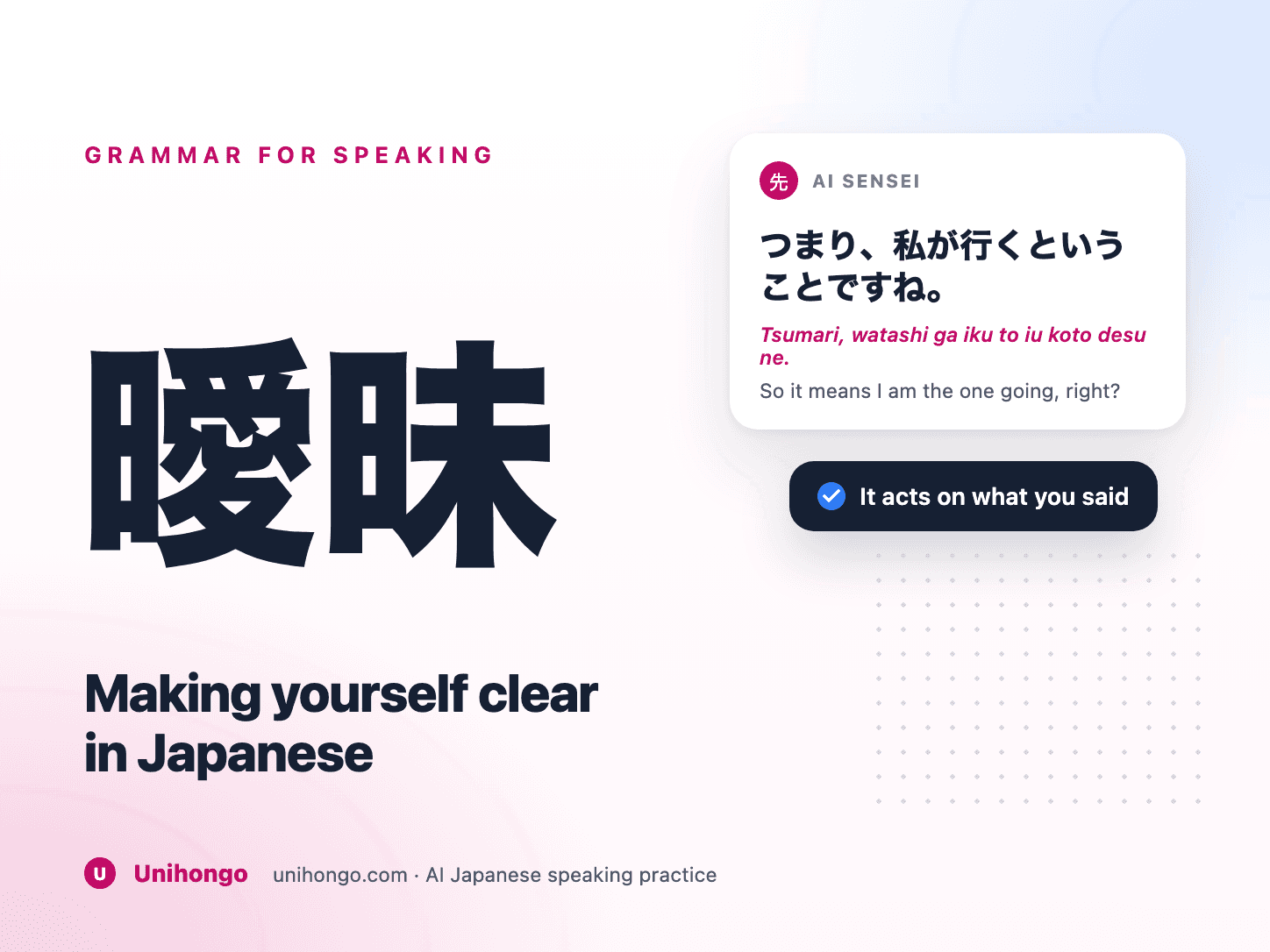
| つまり、私が行くということですね。 | Tsumari, watashi ga iku to iu koto desu ne. | So it means I am the one going, right? |
| 確認ですが、三時でよろしいですか。 | Kakunin desu ga, san-ji de yoroshii desu ka. | To confirm, is three o'clock all right? |
| どちらがやることになりますか。 | Dochira ga yaru koto ni narimasu ka. | Which of us will be doing it? |
| 私の理解で合っていますか。 | Watashi no rikai de atte imasu ka. | Is my understanding correct? |
| 念のため、もう一度言いますね。 | Nen no tame, mō ichido iimasu ne. | Just in case, let me say it once more. |
| メールでも送っておきます。 | Mēru demo okutte okimasu. | I will send it by email as well. |
Finding out what you actually said
The hard part of this whole topic is that ambiguity is invisible from the inside. Your sentence was clear to you, because you knew what you meant, and a polite listener who guessed correctly will never mention that they guessed.
What exposes it is a listener who acts on what you said. Practising with an AI Sensei in Unihongo's immersive 3D classroom is useful here precisely because the response follows the sentence you produced rather than the one you intended, so a dropped subject or a reversed giving verb surfaces immediately as a reply that does not fit.
The session report closes it, because sentences that were grammatical but carried the wrong meaning appear there as corrections. That is a category a human conversation partner will almost never raise with you.
Aim for clear rather than complete. The target is that a listener cannot reasonably reconstruct a different sentence, not that every element is stated.