
Why your sentences stop after seven words
In English you can start a sentence with almost no plan, because the verb comes early and the rest can be appended. Japanese does not allow that. The verb, and with it the tense, the politeness level and the negation, arrives at the end, so committing to a long sentence means holding the ending in mind through everything that precedes it.
The second difficulty is modification order. A clause that describes a noun comes before it, so the sentence about the restaurant you went to last week starts with last week and went and only then reaches the restaurant. That reversal is what makes learners abandon a sentence halfway.
The fix is not more grammar. It is a small number of joints that let you keep going without having decided the ending, plus a habit of adding one clause at a time rather than planning the whole thing.
Connectors that extend a sentence safely
A safe connector is one that does not force a decision about what follows. The te-form is the safest of all: it strings events together and leaves tense and politeness to be settled at the very end, which is precisely the flexibility a real-time speaker needs.
Kedo is the second workhorse. It introduces a contrast but is used far more loosely than the English but, and it is entirely normal to trail off after it.
| Connector | Joins | Commits you to | Risk |
|---|---|---|---|
| ~て | Sequence, cause | Nothing | Very low |
| から | Reason before result | A result clause | Low |
| ので | Softer reason | A result clause | Low |
| けど | Contrast, softening | Nothing | Very low |
| たら | Condition | A consequence | Medium |
| ながら | Simultaneous action | Same subject | Medium |
Start with the two low-risk rows. Adding kara and node to your automatic set roughly doubles your average sentence length on its own.
Adding a reason without restarting
The most useful extension is a reason, because almost every statement invites one and because a reason turns a bare fact into something the listener can respond to. In Japanese the reason can come before or after the main clause, and the after position is the easier one in speech: say the thing, then explain it.
Node is softer than kara and is the safer default in polite conversation, particularly when the reason is an excuse or a refusal.
| Japanese | Romaji | Meaning |
|---|---|---|
| 今日は早く帰ります。明日、朝が早いので。 | Kyō wa hayaku kaerimasu. Ashita, asa ga hayai node. | I am leaving early today, since tomorrow starts early. |
| それ、いいですね。色が好きだから。 | Sore, ii desu ne. Iro ga suki da kara. | That is nice, because I like the colour. |
| まだ決めていません。情報が足りなくて。 | Mada kimete imasen. Jōhō ga tarinakute. | I have not decided, as I do not have enough information. |
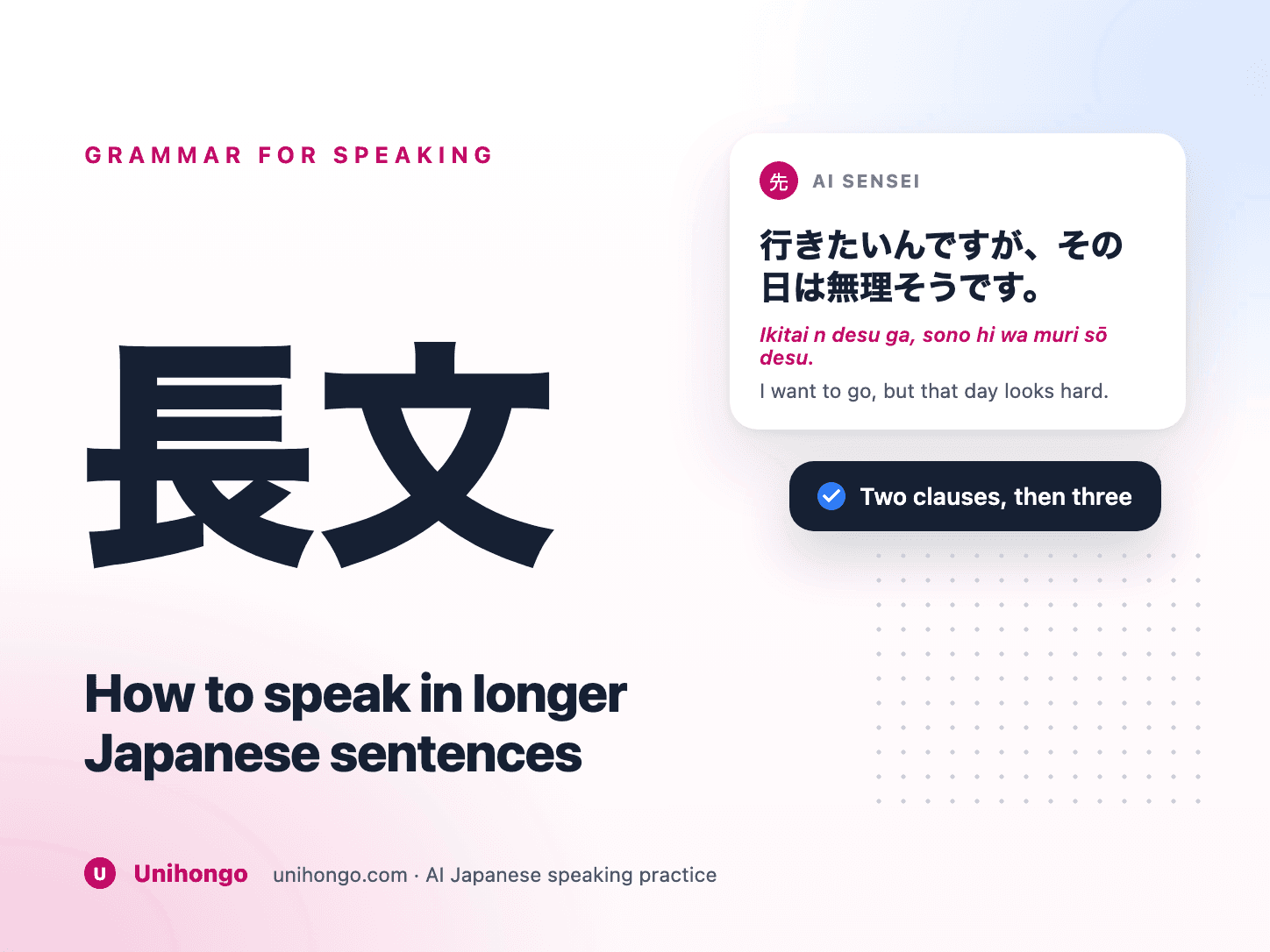
| 行きたいんですが、その日は無理そうです。 | Ikitai n desu ga, sono hi wa muri sō desu. | I want to go, but that day looks impossible. |
| 少し高いけど、質はいいと思います。 | Sukoshi takai kedo, shitsu wa ii to omoimasu. | It is a little expensive, but I think the quality is good. |
| 時間があれば、寄ってみます。 | Jikan ga areba, yotte mimasu. | If I have time, I will drop in. |
Putting the extras in a fixed order
Once a sentence has more than a couple of elements, deciding their order becomes its own load. Japanese word order is flexible, but there is a default that sounds unmarked, and using it every time means one fewer decision while speaking.
The default runs from the broadest frame to the narrowest: when, where, with whom, what, how, then the verb. Anything you want to emphasise can be moved to the front, but if you do not care, the default is always available and always sounds fine.
- Time first: kinou, raishuu, mainichi.
- Then place, marked with de for an action or ni for a destination.
- Then the people involved, marked with to.
- Then the object, marked with o.
- Then the manner, then the verb, which carries tense and politeness.
Practise by building one sentence up a slot at a time: verb only, then object plus verb, then place, then time. Each pass is a complete sentence, so you can stop wherever you run out.
Knowing where to stop
Longer is not automatically better. Spoken Japanese uses shorter units than written Japanese, and a four-clause sentence delivered slowly by a learner is harder for the listener than two clean sentences. The target for conversation is two clauses, occasionally three.
A useful stopping rule: if you cannot yet see the verb that will end the sentence, do not add another clause. Finish, breathe, and start a new sentence with the extra idea.
| Japanese | Romaji | Meaning |
|---|---|---|
| ちょっと長くなりました。まとめると…… | Chotto nagaku narimashita. Matomeru to... | That got a bit long. To sum up... |
| 一度切りますね。 | Ichido kirimasu ne. | Let me stop there for a moment. |
| 続きを言ってもいいですか。 | Tsuzuki o itte mo ii desu ka. | May I say the rest? |
| 先に結論を言います。 | Saki ni ketsuron o iimasu. | I will give the conclusion first. |
| 細かいところは後で説明します。 | Komakai tokoro wa ato de setsumei shimasu. | I will explain the details later. |
| ここまでで、大丈夫でしょうか。 | Koko made de, daijōbu deshō ka. | Is what I have said so far all right? |
A drill that grows sentence length on purpose
Sentence length grows when it is trained directly, not as a side effect of more vocabulary. The drill is small: take a sentence you can already produce automatically, extend it by exactly one clause, and repeat the extended version until it is as automatic as the original was.
Do this with five sentences a week and the effect compounds, because the extended versions become the new base. After a month the two-clause form is the default and three-clause sentences start appearing on their own.
Conversation is where you find out whether the extension held. Speaking with an AI Sensei in Unihongo's immersive 3D classroom puts the sentences under real time pressure, and the session report shows where you dropped back to short forms. Saving the connectors that failed as flashcards, so they come round again before the next session, closes the loop.
Track one number: the average number of clauses per sentence in a ninety-second recording. It is crude and it moves, which is exactly what you want from a metric.