

Use a role map before a conjugation chart
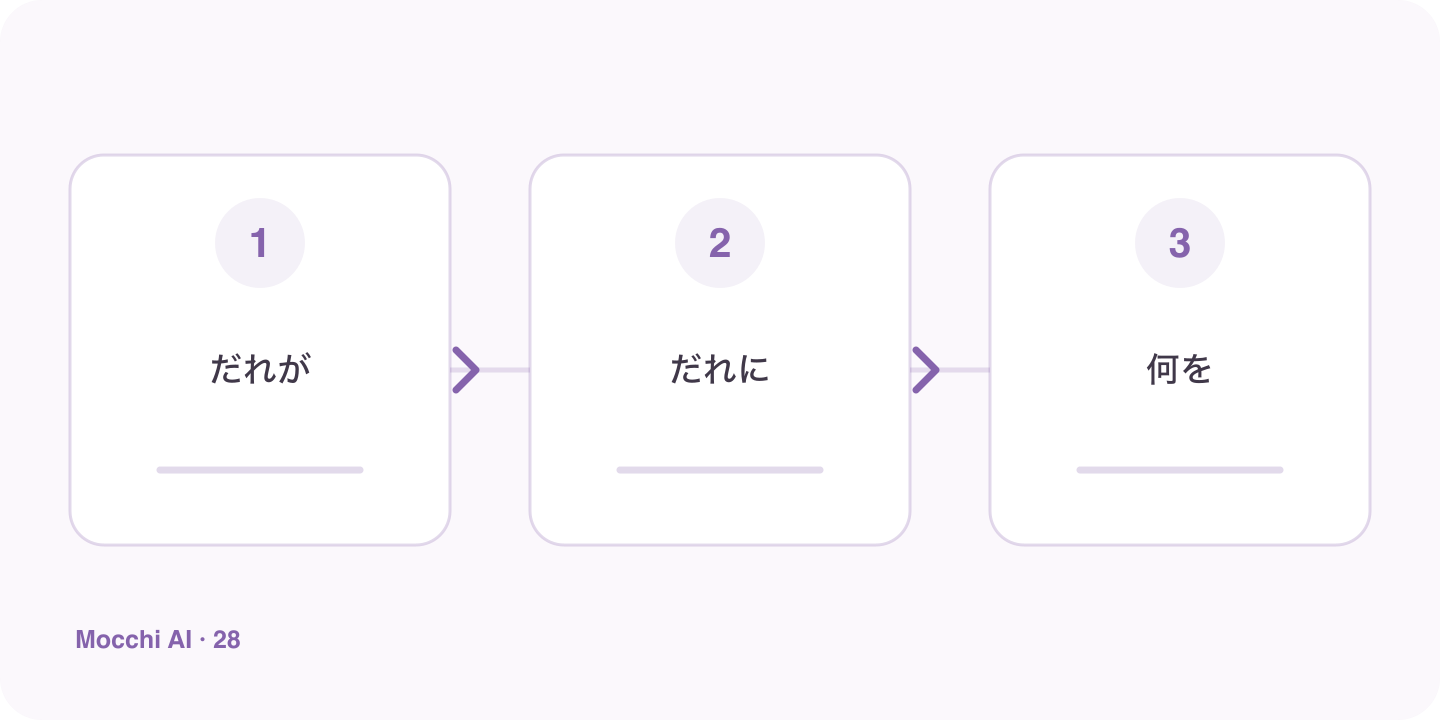
Write a small description of the event in a language you understand comfortably. Identify the actor, the action, and the person affected or causing the action. Tell Mocchi which relationship you intend to express. This makes the later Japanese form a way of representing an event rather than an ending selected because the question happens to mention passive or causative.
Keep names and events fictional when practicing relationships from work or family life. The grammar exercise needs the roles, not private details. A simple teacher-and-student or friend-and-friend example can make the contrast visible without the complexity of a real dispute or sensitive situation.
Compare being praised with making someone wait
先生にほめられました describes being praised by the teacher. 友達を待たせました describes causing a friend to wait. These examples have different participants and events, so explain each one independently before comparing the forms. Ask Mocchi to identify the role of the person mentioned and then provide a fresh scenario where you must make that judgment yourself.
| Japanese | Romaji | Meaning |
|---|---|---|
| 先生にほめられました。 | Sensei ni homeraremashita. | I was praised by the teacher. |
| 友達を待たせました。 | Tomodachi o matasemashita. | I made my friend wait. |
Check meaning before accepting a well-formed sentence
A sentence can contain a correctly built verb form and still express the wrong event. After writing an answer, explain in plain language who did what to whom. If that explanation reverses the intended roles, correct the interpretation before focusing on stylistic details. This gives feedback a clear priority and prevents a polished rewrite from hiding the original misunderstanding.
Separate the form drill when that is the weak step
If the role map is clear, ask for a small conjugation practice using verbs you already know. State whether the exercise concerns passive or causative and check the relevant form. Once it is available, return to a mixed scenario where the required construction is not announced. This creates a bridge between producing an ending on demand and choosing a form that expresses the situation.
Add nuanced cases gradually and with context
After the straightforward examples are stable, bring a real reading sentence that seems different and include the surrounding context. Ask Mocchi what interpretation is supported and which part of the construction creates it. Check an uncertain explanation against a trusted source before relying on it in an important message. A personal review note should identify whether the remaining problem concerns roles, form, particles, or contextual nuance, not merely label the whole topic difficult.