

The word family that takes ga
English uses ordinary transitive verbs for like, understand, can, want and need, so English speakers expect an object particle. Japanese uses adjectives and stative verbs for the same ideas, and none of those can take an object. What English calls the object becomes the grammatical subject of a state, and subjects take ga.
The core members are suki (like), kirai (dislike), hoshii (want), jōzu (good at), heta (bad at), hitsuyō (necessary), wakaru (understand), dekiru (can do), aru (exist, have) and iru (exist, for people and animals). Related words behave the same way: daisuki, tokui, nigate, kowai, urayamashii, and the potential form of every verb.
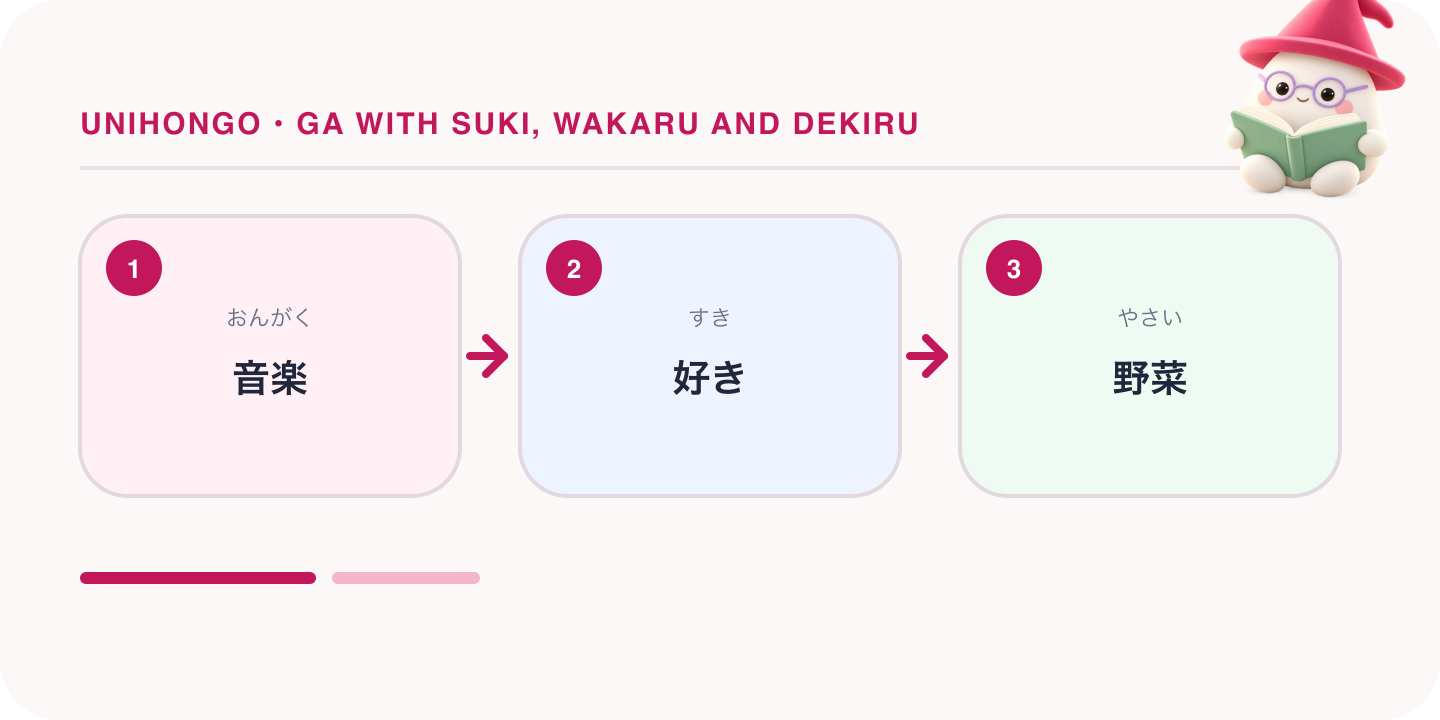
| Japanese | Romaji | Meaning |
|---|---|---|
| 私は日本の音楽が好きです。 | Watashi wa Nihon no ongaku ga suki desu. | I like Japanese music. |
| 弟は野菜が嫌いです。 | Otōto wa yasai ga kirai desu. | My younger brother dislikes vegetables. |
| 新しい自転車が欲しいです。 | Atarashii jitensha ga hoshii desu. | I want a new bicycle. |
| 田中さんは料理が上手です。 | Tanaka-san wa ryōri ga jōzu desu. | Ms Tanaka is good at cooking. |
| 今週はもっと時間が必要です。 | Konshū wa motto jikan ga hitsuyō desu. | I need more time this week. |
| 中国語が少し分かります。 | Chūgokugo ga sukoshi wakarimasu. | I understand a little Chinese. |
Why the logic works: states, not actions
Think of sushi ga suki desu as sushi is pleasing, and nihongo ga wakarimasu as Japanese is clear to me. In both, the thing is the subject and the person is the background against which the state holds. That is why the person takes wa: watashi wa, as for me, sushi is pleasing. Once you see the sentence that way, ga stops looking like an exception.
The same idea explains dekiru and the potential form. Piano ga dekimasu means piano is doable, and kanji ga yomemasu means kanji are readable. Aru and iru are the clearest case: okane ga arimasu literally says money exists, and the English I have money is a translation of a sentence with no possessor verb at all.
This is also why these words rarely take a volitional or imperative form in natural speech. You cannot decide to be clear on something or order someone to have money. Wakarō to suru exists but means try to understand, and the effort verb underneath is suru, not wakaru.
| Japanese | Romaji | Meaning |
|---|---|---|
| ピアノができます。 | Piano ga dekimasu. | I can play the piano. |
| この漢字が読めますか。 | Kono kanji ga yomemasu ka. | Can you read this kanji? |
| お金があまりありません。 | Okane ga amari arimasen. | I do not have much money. |
| 教室に学生が三人います。 | Kyōshitsu ni gakusei ga sannin imasu. | There are three students in the classroom. |
| 意味がよく分かりました。 | Imi ga yoku wakarimashita. | I understood the meaning well. |
Wa and ga inside the same sentence
A full sentence in this family usually has two nouns: the person and the thing. The person is the topic and takes wa; the thing is the subject of the state and takes ga. Watashi wa neko ga suki desu. In real conversation the person is often dropped because it is obvious, which is why textbooks show neko ga suki desu on its own.
The ga on the thing can change to wa when that thing becomes the topic or is being contrasted. Sakana wa suki desu ga, niku wa kirai desu, I like fish but I dislike meat: both particles are wa because the sentence is comparing the two. Nihongo wa wakarimasu ga, kankokugo wa wakarimasen works the same way. Wa here does not mark the person; it marks the item under discussion.
So the question is never which particle goes with suki; it is which noun is the topic. A neutral statement keeps ga on the thing. A contrast or a reply about a previously mentioned item switches it to wa. Two wa in one sentence is fine when both nouns are contrasted.
| Japanese | Romaji | Meaning |
|---|---|---|
| 私は犬が好きですが、猫はちょっと苦手です。 | Watashi wa inu ga suki desu ga, neko wa chotto nigate desu. | I like dogs, but I am not so keen on cats. |
| 英語は分かりますが、フランス語は分かりません。 | Eigo wa wakarimasu ga, Furansugo wa wakarimasen. | I understand English, but not French. |
| この店のラーメンは好きです。 | Kono mise no rāmen wa suki desu. | I do like this shop's ramen. (as for this one) |
| 時間はありますが、お金はありません。 | Jikan wa arimasu ga, okane wa arimasen. | I have time, but no money. |
| 車は運転できますが、バイクはできません。 | Kuruma wa unten dekimasu ga, baiku wa dekimasen. | I can drive a car, but not a motorbike. |
The potential form and dekiru
Every verb has a potential form: yomu becomes yomeru, taberu becomes taberareru, suru becomes dekiru. Because a potential verb describes ability rather than an action, its object traditionally takes ga: kanji ga yomeru, sashimi ga taberareru. This is the same grammar as suki, and the same wa switch applies under contrast.
In modern speech, o is also common with potential verbs, especially when the sentence is long, when there is already a ga in it, or with verbs of effort such as o-kane o tameru koto ga dekiru. Both are accepted by native speakers, but ga remains the safer choice in exams and formal writing. With the noun plus dekiru pattern, such as unten ga dekiru, ga is the normal particle.
One trap is the koto ga dekiru construction. Here the verb inside keeps its usual o, and the ga marks the whole ability: sushi o taberu koto ga dekimasu. Learners sometimes write sushi ga taberu koto ga dekimasu, which is wrong because taberu in its dictionary form is an ordinary transitive verb.
| Japanese | Romaji | Meaning |
|---|---|---|
| 日本語の新聞が読めるようになりました。 | Nihongo no shinbun ga yomeru yō ni narimashita. | I have become able to read Japanese newspapers. |
| 辛いものが食べられません。 | Karai mono ga taberaremasen. | I cannot eat spicy food. |
| 漢字を書くことができます。 | Kanji o kaku koto ga dekimasu. | I am able to write kanji. |
| 運転ができますか。 | Unten ga dekimasu ka. | Can you drive? |
| ここでは写真が撮れません。 | Koko de wa shashin ga toremasen. | You cannot take photos here. |
The tai form: where o and ga both appear
Tai turns a verb into an i-adjective meaning want to: tabetai, ikitai, kaitai. Because it is an adjective, the old rule marks its object with ga, mizu ga nomitai, and older textbooks still teach that form. Because the verb underneath is still felt as an action, modern speakers very often keep o: mizu o nomitai. Both are correct.
There is a mild difference in feel. Ga puts the spotlight on the thing wanted, so sushi ga tabetai sounds like a craving for sushi in particular. O keeps the focus on the action, so sushi o tabetai sounds like an ordinary plan. With longer objects and with verbs of movement, o dominates: tomodachi to eiga o mitai, not ga.
Hoshii, wanting a thing, is a pure adjective and takes only ga. Te hoshii, wanting someone to do something, marks the person with ni and the thing with the verb's own particle: tomodachi ni tetsudatte hoshii, I want my friend to help.
| Japanese | Romaji | Meaning |
|---|---|---|
| 冷たい水が飲みたい。 | Tsumetai mizu ga nomitai. | I want a cold drink of water. |
| 週末は映画を見たいです。 | Shūmatsu wa eiga o mitai desu. | I want to see a film at the weekend. |
| 新しい靴が欲しい。 | Atarashii kutsu ga hoshii. | I want new shoes. |
| 母に来て欲しいです。 | Haha ni kite hoshii desu. | I want my mother to come. |
| 何が食べたいですか。 | Nani ga tabetai desu ka. | What do you want to eat? |
The ga words at a glance
This table gathers the most common members of the family with the particle on the thing. The person, when stated, takes wa in all of them.
| Word | Reading | Pattern and meaning |
|---|---|---|
| 好き | suki | X ga suki desu: like X |
| 大好き | daisuki | X ga daisuki desu: love X |
| 嫌い | kirai | X ga kirai desu: dislike X |
| 欲しい | hoshii | X ga hoshii desu: want X |
| 上手 | jōzu | X ga jōzu desu: good at X (about others) |
| 得意 | tokui | X ga tokui desu: good at X (about yourself) |
| 下手 | heta | X ga heta desu: bad at X |
| 苦手 | nigate | X ga nigate desu: not good with X, dislike X |
| 必要 | hitsuyō | X ga hitsuyō desu: need X |
| 分かる | wakaru | X ga wakaru: understand X |
| できる | dekiru | X ga dekiru: can do X |
| ある / いる | aru / iru | X ga aru / iru: there is X, have X |
Notice jōzu and tokui. Jōzu is praise for other people; saying watashi wa nihongo ga jōzu desu about yourself sounds boastful. For your own skills, use tokui, and for your weaknesses nigate is softer than heta.
Near relatives that look similar but behave differently
Not every emotion word takes ga. Suki is an adjective, but the verb aisuru, to love, is transitive and takes o: kanojo o aishite iru. Konomu, to prefer, also takes o. Wakaru takes ga, but rikai suru, to comprehend, takes o: naiyō o rikai shimashita. Shiru, to know, takes o as well: sono hito o shitte imasu. Learners who overgeneralise ga produce sono hito ga shitte imasu, which means that person knows.
Hitsuyō takes ga, but the verb iru, to need, also takes ga in standard Japanese: jikan ga irimasu. It is written 要る and is unrelated to iru for people, which is 居る. Motsu, to hold or possess, is transitive: kuruma o motte imasu. So Japanese has both okane ga aru and okane o motte iru, and the difference is only the verb.
- Suki, kirai take ga; aisuru, konomu take o
- Wakaru takes ga; rikai suru, shiru take o
- Dekiru and potential verbs take ga; the plain verb inside koto ga dekiru keeps o
- Hitsuyō and iru (need) take ga; motomeru (seek, request) takes o
- Aru and iru (exist) take ga; motsu (possess) takes o
The pattern is that a plain transitive verb keeps o and a state keeps ga. When you meet a new word, ask whether it names something you do or something that is true about you.
Common mistakes and how to fix them
The most frequent error is o with suki, hoshii or wakaru: nihongo o wakarimasu, kōhī o hoshii desu. These are easy to hear as learner Japanese, and the fix is simply to switch to ga. Say the sentence with is liked or is clear in your head and the o will feel wrong.
The second error is putting ga on the person: watashi ga sushi ga suki desu as a neutral statement. That double ga means I am the one who likes sushi and sounds like an answer to who. Use wa for the person unless you are contrasting or answering dare ga.
The third is forgetting the wa switch under contrast. Sakana ga suki desu ga, niku ga kirai desu is grammatical but sounds flat; with contrast, both become wa. The fourth is mixing jōzu and tokui, praising yourself with jōzu. And the fifth is the koto ga dekiru trap: keep o on the inner verb. Small things, but they mark the difference between a learner and a speaker.
| Japanese | Romaji | Meaning |
|---|---|---|
| 日本語が分かります。 | Nihongo ga wakarimasu. | I understand Japanese. (not o) |
| コーヒーが欲しいです。 | Kōhī ga hoshii desu. | I would like a coffee. (not o) |
| 私は寿司が好きです。 | Watashi wa sushi ga suki desu. | I like sushi. (wa on the person) |
| 私は英語が得意です。 | Watashi wa Eigo ga tokui desu. | I am good at English. (tokui, not jōzu, for yourself) |
| ピアノを弾くことができます。 | Piano o hiku koto ga dekimasu. | I can play the piano. (o inside koto ga dekiru) |