

How to form tsutsu
Tsutsu attaches to the masu stem of a verb, the part before masu: nomi from nomimasu, tabe from tabemasu, shi from shimasu. It does not attach to nouns or adjectives, and it cannot take a negative directly.
The three uses share the same stem. Add mo for although, and add aru, or arimasu in polite form, for a change in progress. In writing, tsutsu aru often appears as tsutsu ari, followed by a comma, in long sentences.
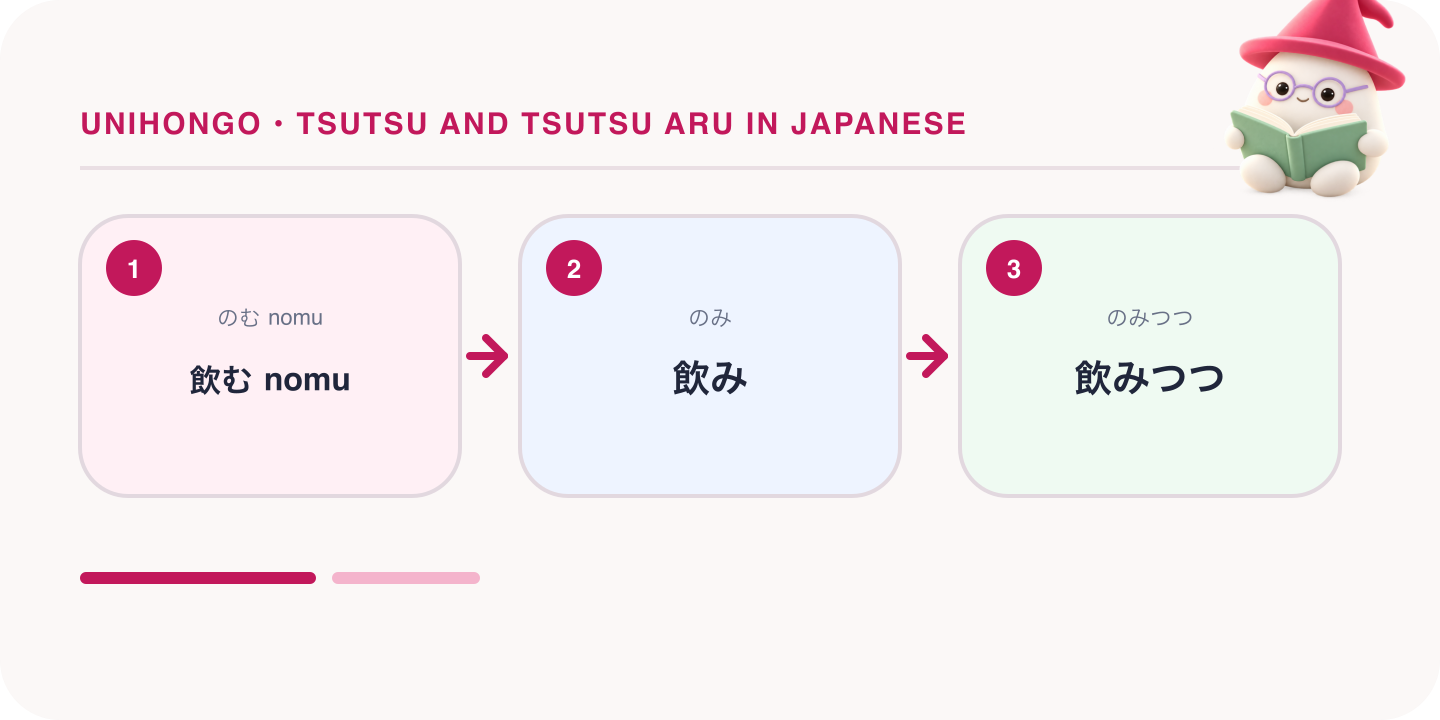
| Verb | Masu stem | つつ | つつも | つつある |
|---|---|---|---|---|
| 飲む nomu | 飲み | 飲みつつ | 飲みつつも | Not typical |
| 考える kangaeru | 考え | 考えつつ | 考えつつも | 考えつつある |
| 知る shiru | 知り | 知りつつ | 知りつつも | Not used |
| 増える fueru | 増え | 増えつつ | 増えつつも | 増えつつある |
| する suru | し | しつつ | しつつも | しつつある |
| 来る kuru | 来 ki | 来つつ | 来つつも | 来つつある |
Tsutsu as while: the formal nagara
In its basic use, tsutsu joins two actions done by the same subject at the same time. The main action comes second; the tsutsu action is the background. Kawa o nagametsutsu, sanpo shita means I took a walk while gazing at the river.
The meaning is the same as nagara, but the register is higher. You will see tsutsu in essays, formal letters, speeches and business documents, especially with verbs of thinking and considering, such as kangaeru, omou and kentō suru.
A common formal use is combining an action with a wish or feeling in closing lines. Minasama no go-kenkō o inoritsutsu means while praying for your good health, and it appears at the end of letters and speeches.
| Japanese | Romaji | Meaning |
|---|---|---|
| 川を眺めつつ、散歩をした。 | Kawa o nagametsutsu, sanpo o shita. | I took a walk while gazing at the river. |
| お客様の意見を参考にしつつ、改善を進めます。 | Okyakusama no iken o sankō ni shitsutsu, kaizen o susumemasu. | We will make improvements while taking customer feedback into account. |
| 費用を考えつつ、計画を立てる必要がある。 | Hiyō o kangaetsutsu, keikaku o tateru hitsuyō ga aru. | We need to plan while keeping costs in mind. |
| 皆様のご健康を祈りつつ、ご挨拶とさせていただきます。 | Minasama no go-kenkō o inoritsutsu, go-aisatsu to sasete itadakimasu. | Wishing you all good health, I will close my remarks here. |
| 安全に配慮しつつ、作業を行ってください。 | Anzen ni hairyo shitsutsu, sagyō o okonatte kudasai. | Please carry out the work while paying attention to safety. |
Tsutsu mo: although, even while
Adding mo turns tsutsu into a concessive: although, even though or while at the same time. The first part states what the person knows, thinks or feels, and the second part describes an action that goes against it. Plain tsutsu can carry this meaning too, especially with shiru and omou, but mo makes it clear.
The most common combinations are to shiritsutsu mo, while knowing that, and to omoitsutsu mo, while thinking that. They often describe regret or giving in to temptation, and they are useful in reflective writing and in apologies.
| Japanese | Romaji | Meaning |
|---|---|---|
| 体に悪いと知りつつも、タバコをやめられない。 | Karada ni warui to shiritsutsu mo, tabako o yamerarenai. | Although I know it's bad for me, I can't give up smoking. |
| 早く寝ようと思いつつも、つい夜更かししてしまう。 | Hayaku neyō to omoitsutsu mo, tsui yofukashi shite shimau. | Even though I mean to go to bed early, I always end up staying up late. |
| 悪いと知りつつ、嘘をついてしまった。 | Warui to shiritsutsu, uso o tsuite shimatta. | I told a lie, knowing it was wrong. |
| 彼は文句を言いつつも、最後まで手伝ってくれた。 | Kare wa monku o iitsutsu mo, saigo made tetsudatte kureta. | He grumbled, but he helped right to the end. |
| 返事をしなければと思いつつ、一週間が過ぎてしまいました。 | Henji o shinakereba to omoitsutsu, isshūkan ga sugite shimaimashita. | I kept meaning to reply, but a week has gone by. |
The last example is a standard apology in emails: it admits you knew you should have replied and gives the reader a sense of sincere regret. Follow it with mōshiwake gozaimasen.
Tsutsu aru: a change in progress
Tsutsu aru describes something moving gradually towards a new state: is increasing, is recovering, is disappearing. It is typical of news reports, business analysis and academic writing, where trends matter.
It works best with verbs of change, such as fueru, to increase, heru, to decrease, kawaru, to change, kaifuku suru, to recover, and hatten suru, to develop. The sense is that the change has started but is not yet complete.
Tsutsu aru is less natural with verbs that describe an ongoing activity with no endpoint, like taberu or hashiru. For those, te iru is the normal choice.
| Japanese | Romaji | Meaning |
|---|---|---|
| 景気は回復しつつある。 | Keiki wa kaifuku shitsutsu aru. | The economy is recovering. |
| 海外からの観光客が増えつつあります。 | Kaigai kara no kankōkyaku ga fuetsutsu arimasu. | The number of overseas tourists is steadily increasing. |
| 若者の働き方が変わりつつある。 | Wakamono no hatarakikata ga kawaritsutsu aru. | The way young people work is changing. |
| この伝統は失われつつある。 | Kono dentō wa ushinawaretsutsu aru. | This tradition is being lost. |
| 新しい技術が生活の一部になりつつある。 | Atarashii gijutsu ga seikatsu no ichibu ni naritsutsu aru. | New technology is becoming part of everyday life. |
| 台風が近づきつつあります。 | Taifū ga chikazukitsutsu arimasu. | A typhoon is approaching. |
Tsutsu vs nagara
Both patterns attach to the masu stem, and both have a while and an although meaning. The differences are register and range. Nagara works in any context, from casual chat to writing. Tsutsu is formal and mostly written.
Nagara also extends beyond verbs in its although meaning: zannen nagara, unfortunately, semai nagara mo, small though it is, and kodomo nagara, though only a child. Tsutsu never does this; it only follows verbs.
| Point | ながら | つつ |
|---|---|---|
| Register | Neutral, spoken and written | Formal, mostly written |
| While (same subject) | 音楽を聞きながら勉強する | 音楽を聞きつつ勉強する |
| Although | 知っていながら | 知りつつも |
| With adjectives or nouns | 狭いながらも, 残念ながら | Not possible |
| Change in progress | Not possible | 増えつつある |
| Casual conversation | Natural | Sounds stiff |
Tsutsu aru vs te iru
Te iru has several meanings: an ongoing action, a resulting state or a habit. With change verbs, it often describes the result: shinde iru means is dead, kekkon shite iru means is married, fuete iru can mean has increased. Tsutsu aru isolates the process: the change is under way and still moving.
That makes tsutsu aru useful when you want to be precise about a trend. Jinkō ga hette iru can mean the population has fallen or is falling; jinkō ga heritsutsu aru clearly means the population is in the process of falling.
| Japanese | Romaji | Meaning |
|---|---|---|
| 人口が減っている。 | Jinkō ga hette iru. | The population has fallen, or is falling. |
| 人口が減りつつある。 | Jinkō ga heritsutsu aru. | The population is steadily falling. |
| 木が枯れている。 | Ki ga karete iru. | The tree is dead, withered. |
| 木が枯れつつある。 | Ki ga karetsutsu aru. | The tree is dying, slowly withering. |
Common mistakes with tsutsu
- Using different subjects: watashi ga benkyō shitsutsu, haha ga ryōri shita is wrong. Like nagara, tsutsu needs the same subject for both actions; use aida ni for different subjects.
- Attaching tsutsu to adjectives or nouns: semaitsutsu is wrong; use semai nagara mo.
- Using tsutsu aru with activity verbs: tabetsutsu aru sounds odd for I am eating. Use tabete iru.
- Using tsutsu aru with stative verbs: itsutsu aru and aritsutsu aru are not used; state verbs do not change.
- Using tsutsu in casual chat: terebi o mitsutsu gohan o tabeta sounds stiff between friends. Say terebi o minagara.
- Forgetting the masu stem with suru verbs: write kentō shitsutsu, not kentō suru tsutsu.
Where you will meet tsutsu
Tsutsu is a reading and listening skill first. You will meet it in news about the economy and society, in company reports and press releases, in formal letters and in speeches at ceremonies. Recognising the three uses quickly makes these texts much easier to follow.
For speaking, a few chunks are worth making your own: to shiritsutsu mo for admitting a weakness, to omoitsutsu for apologising for a delay, and tsutsu aru when presenting trends in a meeting. Used in the right place, they make your formal Japanese sound polished.
| Japanese | Romaji | Meaning |
|---|---|---|
| 売上は順調に伸びつつあります。 | Uriage wa junchō ni nobitsutsu arimasu. | Sales are growing steadily. |
| ご意見を踏まえつつ、検討いたします。 | Go-iken o fumaetsutsu, kentō itashimasu. | We will consider this while taking your opinions into account. |
| ご連絡しなければと思いつつ、遅くなってしまいました。 | Go-renraku shinakereba to omoitsutsu, osoku natte shimaimashita. | I had been meaning to contact you, and I'm sorry it has taken so long. |
| 新しい生活にも慣れつつあります。 | Atarashii seikatsu ni mo naretsutsu arimasu. | I am gradually getting used to my new life. |