
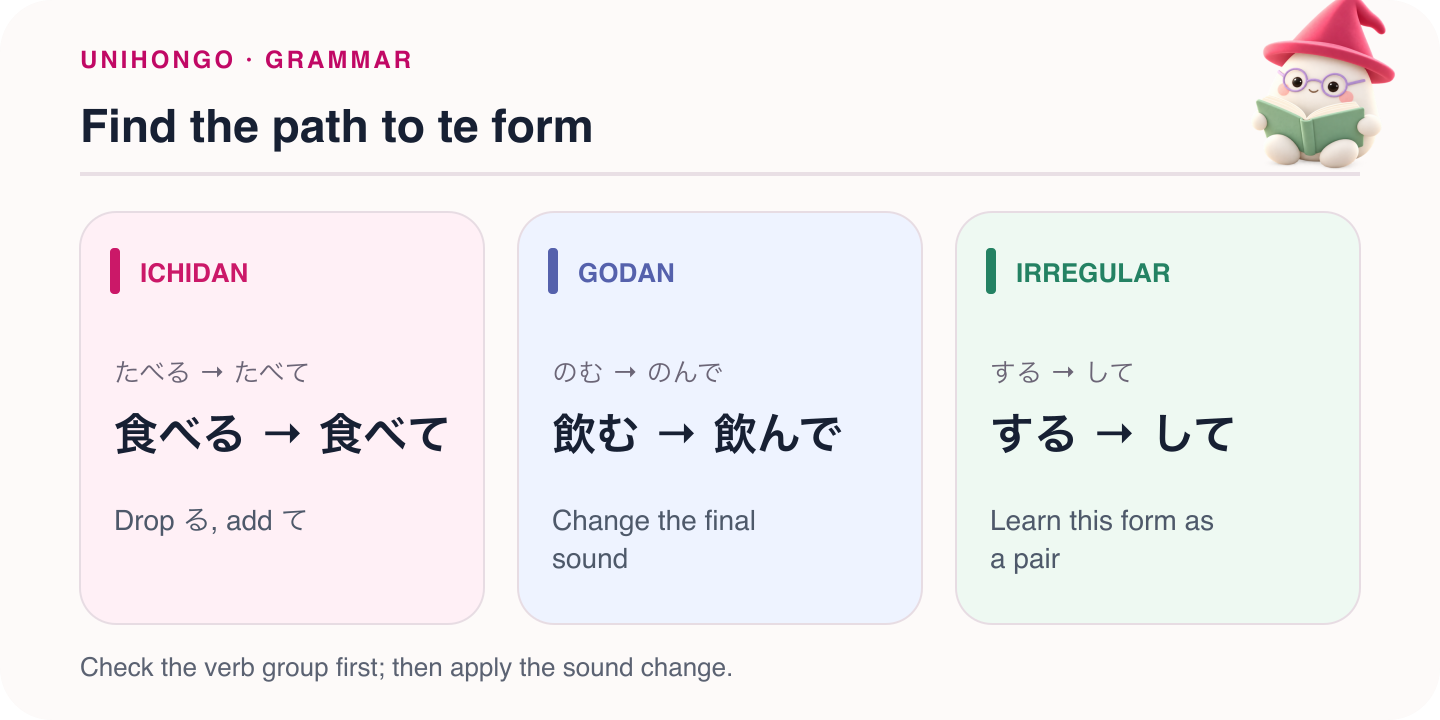
First identify the verb group
Ru-verbs, often called ichidan verbs, drop the final ru before adding te. U-verbs, or godan verbs, change their final sound according to a pattern. Suru and kuru are irregular. The dictionary ending alone does not always reveal the group: kaeru, to return, is an u-verb, while kaeru, to change, can be a ru-verb depending on the word.
For speaking, store common verbs with their te-form from the day you learn them. Taberu-tabete and kaeru-kaette are more useful memory units than abstract labels by themselves.
The complete te-form chart
| Dictionary ending | Change | Example |
|---|---|---|
| Ru-verb る | る → て | 食べる → 食べて taberu → tabete |
| う・つ・る | → って | 待つ → 待って matsu → matte |
| む・ぶ・ぬ | → んで | 読む → 読んで yomu → yonde |
| く | → いて | 書く → 書いて kaku → kaite |
| ぐ | → いで | 泳ぐ → 泳いで oyogu → oyoide |
| す | → して | 話す → 話して hanasu → hanashite |
| する | → して | 勉強する → 勉強して benkyō suru → benkyō shite |
| 来る | → 来て | kuru → kite |
| 行く exception | → 行って | iku → itte |
Connect actions in sequence
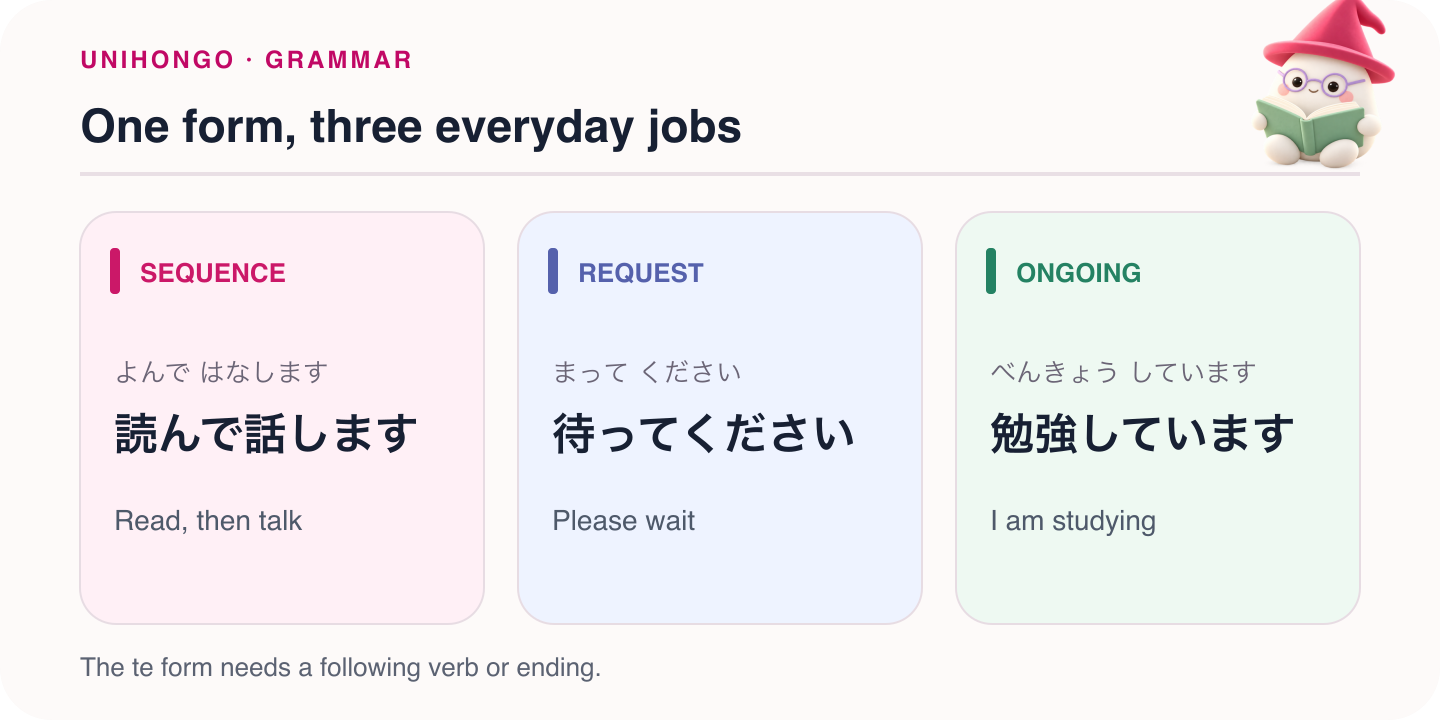
A te-form can link actions performed in sequence. Only the final verb carries politeness and tense, so the earlier verbs stay in te-form. This is especially useful when describing routines, trips, or what happened yesterday.
| Japanese | Romaji | Meaning |
|---|---|---|
| 朝ご飯を食べて、学校に行きます。 | Asagohan o tabete, gakkō ni ikimasu. | I eat breakfast and then go to school. |
| 駅で友達に会って、映画を見ました。 | Eki de tomodachi ni atte, eiga o mimashita. | I met a friend at the station and watched a film. |
| ドアを開けて、入ってください。 | Doa o akete, haitte kudasai. | Open the door and come in, please. |
Make requests with te kudasai
| Japanese | Romaji | Meaning |
|---|---|---|
| もう一度言ってください。 | Mō ichido itte kudasai. | Please say it one more time. |
| ゆっくり話してください。 | Yukkuri hanashite kudasai. | Please speak slowly. |
| ちょっと待ってください。 | Chotto matte kudasai. | Please wait a moment. |
Te kudasai is a direct polite request. It works well for instructions and service situations, but can sound commanding when asking a favour from an equal. Te moraemasu ka or te kuremasu ka softens a personal request by asking whether the listener can do it for you.
Describe ongoing states with te imasu
Te imasu can describe an action in progress, a repeated activity, or a state resulting from a change. Context and the verb decide which reading fits. Kekkon shite imasu means is married, not is marrying right now, because marriage is the resulting state.
| Japanese | Romaji | Meaning |
|---|---|---|
| 今、本を読んでいます。 | Ima, hon o yonde imasu. | I am reading a book now. |
| 東京で働いています。 | Tōkyō de hataraite imasu. | I work in Tokyo. |
| 結婚しています。 | Kekkon shite imasu. | I am married. |
| 毎日、日本語を勉強しています。 | Mainichi, nihongo o benkyō shite imasu. | I study Japanese every day. |
Ask permission and state prohibition
| Japanese | Romaji | Meaning |
|---|---|---|
| ここに座ってもいいですか? | Koko ni suwatte mo ii desu ka? | May I sit here? |
| 写真を撮ってもいいです。 | Shashin o totte mo ii desu. | You may take photos. |
| ここで食べてはいけません。 | Koko de tabete wa ikemasen. | You must not eat here. |
| 入っても大丈夫ですか? | Haitte mo daijōbu desu ka? | Is it okay if I come in? |
Te mo ii asks or grants permission; te wa ikemasen states that an action is not allowed. In conversation, te mo daijōbu desu ka is another useful way to ask whether an action will cause a problem.
A drill that transfers to conversation
- Round one: convert ten dictionary forms to te-form without a sentence.
- Round two: attach te kudasai to all ten without pausing.
- Round three: attach te imasu and say whether each result means now, habit, or state.
- Round four: use te mo ii desu ka in a realistic roleplay such as a cafe, train, or office.
- Round five: tell a three-action story with two te-forms and one final past-tense verb.