
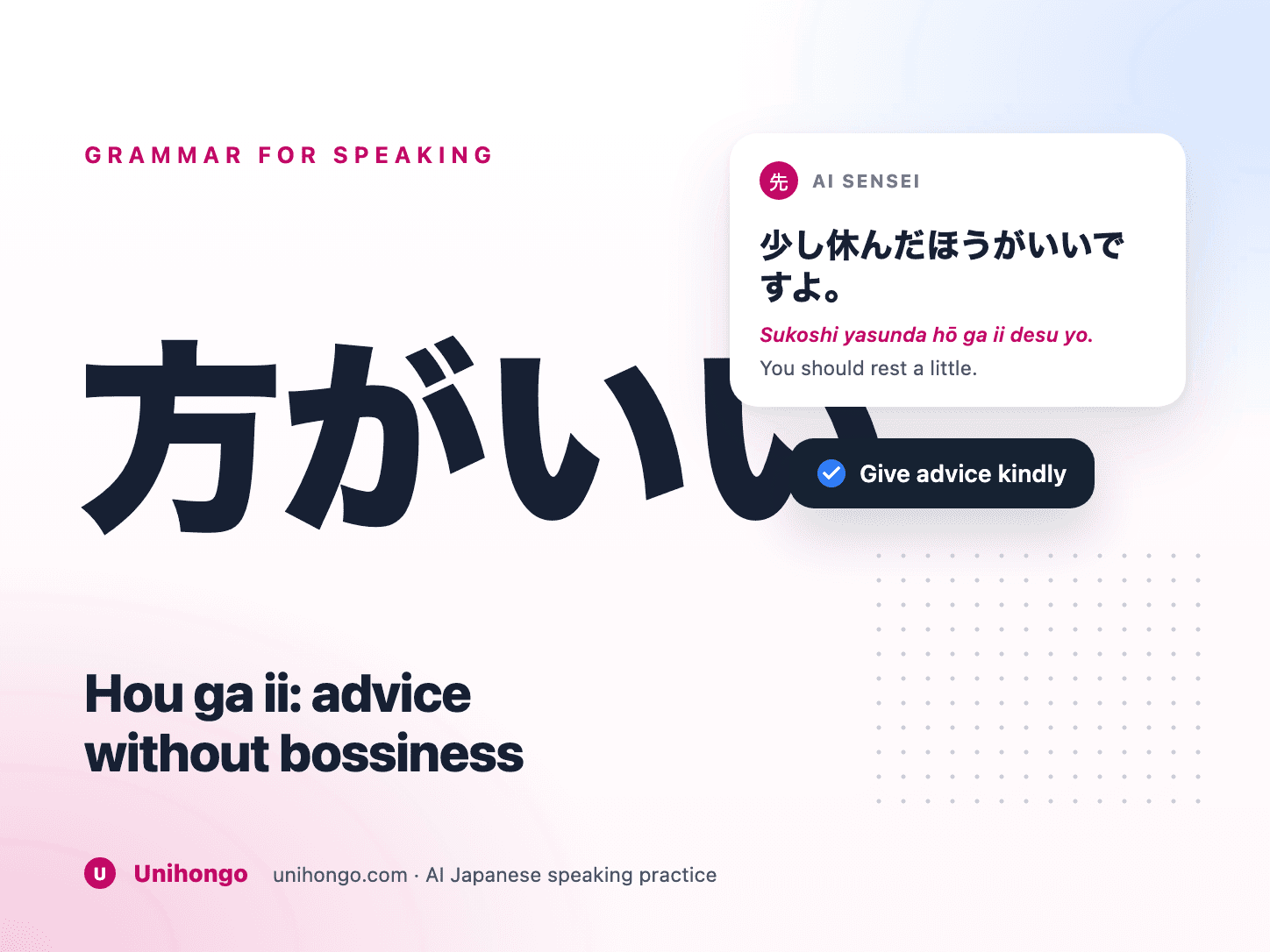
What hou ga ii means
Hou means side or direction, and ii means good, so hou ga ii is literally that side is better. It comes from comparison: of the choices available, this one is the better one. The same hou appears in comparisons like kochira no hou ga ii, this one is better.
When a verb comes before it, the phrase becomes advice. Yasunda hou ga ii, it would be better to rest, suggests that resting beats the alternative. You are not just stating a preference; you are telling the listener what you think they should do.
| Japanese | Romaji | Meaning |
|---|---|---|
| 少し休んだほうがいいですよ。 | Sukoshi yasunda hō ga ii desu yo. | You should rest a little. |
| 病院に行ったほうがいいよ。 | Byōin ni itta hō ga ii yo. | You'd better go to the doctor. (casual) |
| あまり無理しないほうがいいですよ。 | Amari muri shinai hō ga ii desu yo. | You shouldn't push yourself too hard. |
| 傘を持っていったほうがいいと思います。 | Kasa o motte itta hō ga ii to omoimasu. | I think you should take an umbrella. |
How to form it
For positive advice, use the plain past form, the ta form, plus hou ga ii. For negative advice, use the plain nai form plus hou ga ii. Add desu for polite speech.
Mixing them up is a common mistake. Ikanakatta hou ga ii is not normal for present advice; the negative always uses the nai form. For regret about the past, keep the nai form and change ii instead: ikanai hō ga yokatta, it would have been better not to go.
| Type | Form | Example | Meaning |
|---|---|---|---|
| Positive advice | Ta form + ほうがいい | 早く寝たほうがいい | You'd better go to bed early |
| Negative advice | Nai form + ほうがいい | 夜遅く食べないほうがいい | You'd better not eat late at night |
| General principle | Dictionary form + ほうがいい | 若いうちは旅行するほうがいい | It's better to travel while young |
| Regret | Ta form + ほうがよかった | 予約したほうがよかった | We should have booked |
| Polite | …ほうがいいです | 確認したほうがいいです | It would be best to check |
| Asking for advice | …ほうがいいですか | 予約したほうがいいですか | Should I make a booking? |
How strong it sounds
Hou ga ii sits in the middle of the advice scale. It is stronger than a suggestion but weaker than a rule or an order. From a doctor, pharmacist or teacher it sounds professional; from a friend it sounds caring; from a junior colleague to a manager it can sound presumptuous.
The sentence-ending particles change it a lot. Yo adds conviction and is friendly between equals. Yo ne can sound slightly pressuring, like you know you should. Without any particle, the advice can feel flat or clinical, which is why many speakers add a gentle ne for warmth.
Stronger forms exist for when you really mean it. ~nakya dame, you have to, and ~nai to ikenai, you must, go beyond advice and should be used carefully.
| Expression | Strength | Typical speaker |
|---|---|---|
| ~たらどうですか | Light suggestion | Friends, colleagues, anyone |
| ~たほうがいいかもしれません | Soft advice | Polite, cautious speakers |
| ~たほうがいいと思います | Clear but modest advice | Colleagues, acquaintances |
| ~たほうがいいですよ | Confident advice | Doctors, experts, friends |
| ~ないとだめですよ | Near obligation | Parents, teachers, doctors |
| ~てください | Request or instruction | Staff, officials, seniors |
Softening advice
Japanese conversation tends to avoid pushing opinions onto others, so advice is often wrapped in softeners. Adding kamo shiremasen, it might be, or to omoimasu, I think, makes it clear that this is your view and the listener is free to ignore it.
You can also frame advice around yourself: watashi nara, if it were me, followed by a plain statement. This shares experience rather than instructing, and it works well with people you do not know well.
| Japanese | Romaji | Meaning |
|---|---|---|
| 早めに予約したほうがいいかもしれません。 | Hayame ni yoyaku shita hō ga ii kamo shiremasen. | It might be a good idea to book early. |
| 一度、確認したほうがいいと思いますよ。 | Ichido, kakunin shita hō ga ii to omoimasu yo. | I think it might be worth checking once. |
| 私なら、電車で行きますね。 | Watashi nara, densha de ikimasu ne. | If it were me, I'd go by train. |
| もしよかったら、薬局で聞いてみたらどうですか。 | Moshi yokattara, yakkyoku de kiite mitara dō desu ka. | If you like, why not ask at a pharmacy? |
| 無理しないほうがいいんじゃない? | Muri shinai hō ga ii n ja nai? | Maybe you shouldn't push it? (casual) |
The final casual form, hou ga ii n ja nai, is very common among friends. The negative question makes the advice sound like a shared thought rather than a command.
Alternatives: tara dō desu ka, ba ii and more
Hou ga ii is not the only way to advise. ~Tara dō desu ka, how about doing, and its polite version ~tara ikaga desu ka are lighter suggestions that leave the decision to the listener. They are good for ideas rather than warnings.
~Ba ii and ~tara ii can also give advice, as in kiite mireba ii yo, you could just ask. They tend to sound like a simple solution: all you need to do is. The question forms, dō sureba ii and dō shitara ii, are covered in more depth in our separate guide to tara ii and ba ii, so here the key point is the contrast: hou ga ii compares options and recommends one, while ba ii offers an easy way out of a problem.
For warnings, ~nai hou ga ii is the polite, standard choice. ~Chau yo, you'll end up, is a casual and friendly way to point out a consequence: sonna ni tabetara onaka kowashichau yo.
| Japanese | Romaji | Meaning |
|---|---|---|
| 駅員さんに聞いてみたらどうですか。 | Ekiin-san ni kiite mitara dō desu ka. | How about asking a station attendant? |
| こちらを試してみたらいかがですか。 | Kochira o tameshite mitara ikaga desu ka. | Would you like to try this one? (very polite) |
| 分からなかったら、聞けばいいよ。 | Wakaranakattara, kikeba ii yo. | If you don't understand, just ask. |
| 今日は早く帰ったほうがいいですよ。 | Kyō wa hayaku kaetta hō ga ii desu yo. | You should go home early today. |
| そんなに飲んだら、明日つらいよ。 | Sonna ni nondara, ashita tsurai yo. | If you drink that much, tomorrow will be rough. |
Advice to seniors and customers
In many workplaces, giving direct advice to someone senior can seem presumptuous, because it implies you know better. Rather than saying buchō, kakunin shita hō ga ii desu, people usually offer information or ask a question and let the senior person decide.
In customer service, staff rarely tell customers what they had better do. They use recommendations, such as o-susume desu, this is recommended, or polite suggestions with ikaga deshō ka.
The exception is safety and urgent information, where clarity matters more than modesty. A plain statement of the risk, followed by a polite request, is normal even to a senior.
| Japanese | Romaji | Meaning |
|---|---|---|
| 念のため、確認されたほうがよろしいかと思います。 | Nen no tame, kakunin sareta hō ga yoroshii ka to omoimasu. | Just in case, it may be best to check. (very polite) |
| こちらの方法もあるんですが、いかがでしょうか。 | Kochira no hōhō mo aru n desu ga, ikaga deshō ka. | There's also this approach. What do you think? |
| こちらがおすすめです。 | Kochira ga osusume desu. | This one is our recommendation. |
| 足元が滑りやすいので、お気をつけください。 | Ashimoto ga suberiyasui node, o-ki o tsuke kudasai. | The floor is slippery, so please watch your step. |
Common learner mistakes
- Using the past negative for present advice: say tabenai hō ga ii, not tabenakatta hō ga ii.
- Giving unsolicited hou ga ii advice to a superior or someone older, which can feel like a correction.
- Stacking pressure with yo ne and a flat tone, which can sound like nagging.
- Confusing hou ga ii advice with comparison. Kochira no hō ga ii desu can mean this one is better, not advice to do something.
- Forgetting the regret form. Kasa o motte kita hō ga yokatta, I should have brought an umbrella, is a natural way to talk about your own mistakes.