
Why passing N1 can feel flat
The result arrives and very little changes. You still hesitate before a phone call, still write emails that a colleague quietly rewrites, still lose the thread when four people talk across a restaurant table. That is not a failure of your study. N1 measures how much written and spoken Japanese you can process at speed, and you now do that well. It never asked you to produce a single sentence, so the abilities it did not measure are exactly the ones still missing.
The second problem is structural. Every level before this one handed you a syllabus, a date, and a finish line. After N1 there is no next level, so the daily habit loses its scaffolding and quietly dissolves into occasional reading. The answer is not to invent another exam. It is to pick one direction, define a project with a visible end, and keep the same weekly rhythm that carried you through the levels.
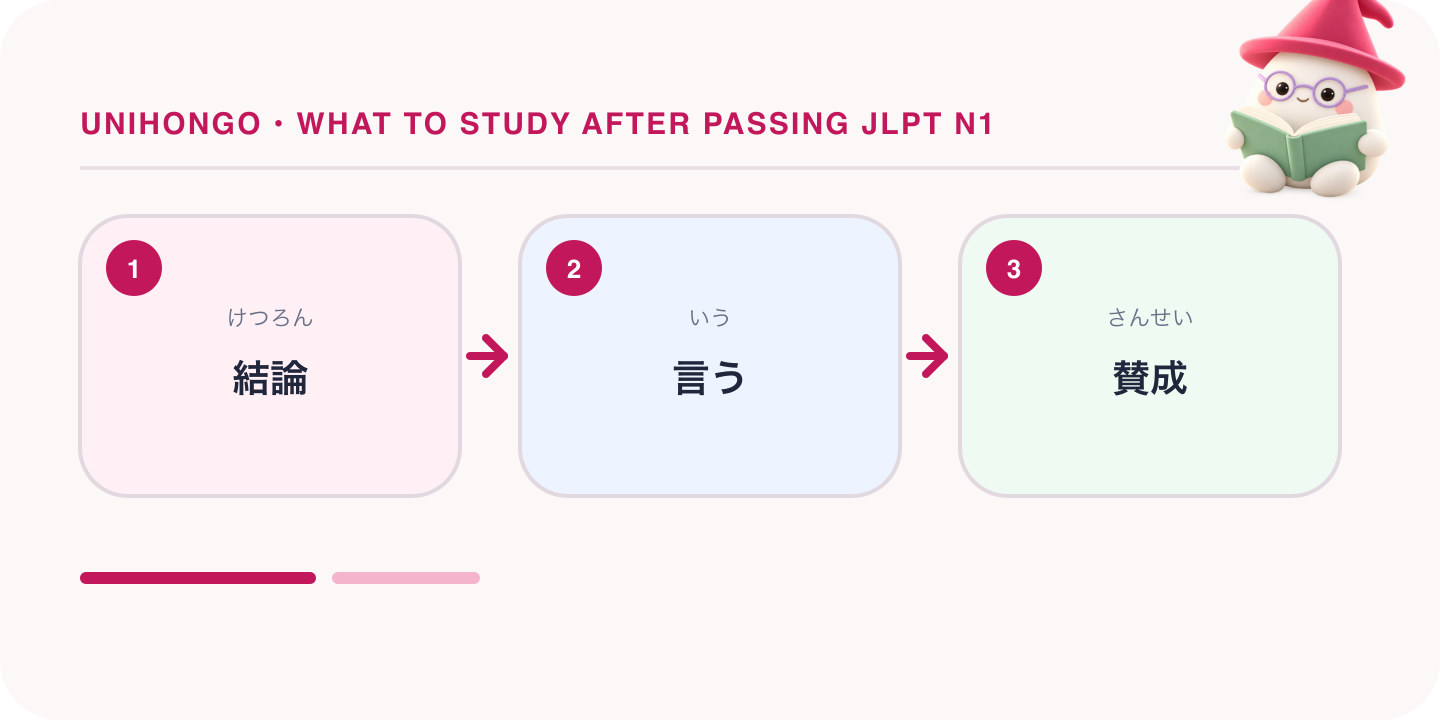
Three directions worth taking
| Direction | The gap it closes | First project |
|---|---|---|
| Production | Reading and listening far ahead of speaking and writing | Record a five-minute spoken summary of one article every week for a month |
| Depth in one field | General fluency with no vocabulary for your own work or interest | Build a glossary from three real documents in that field and use it in one conversation |
| Register control | A single flat polite style used for every person and situation | Write the same request three ways: casual, plain polite, and full keigo |
Most people need all three eventually, but running them together produces a vague plan that fails in a fortnight. Choose the one that is blocking you now. If you avoid speaking, start with production. If you can chat comfortably but freeze in a meeting about your own job, start with depth. If colleagues seem faintly amused by how you address people, start with register.
Direction one: bring production up to your reading level
After N1 your passive vocabulary is large and your active vocabulary is small, and the distance between them is what makes speaking uncomfortable. The fix is narrow and repetitive: take material you already understand, and force yourself to say something about it without a script. Summarising is ideal because the content is handed to you and all the effort goes into construction.
Aim for structured speech rather than chat. Announce your conclusion, count your reasons, give an example, then handle an objection. These moves are what separate an advanced speaker from a fluent but shapeless one, and they are learnt as fixed openings you can rely on while your mind works on the content.
| Japanese | Romaji | Meaning |
|---|---|---|
| 結論から言うと、この案には賛成できません。 | Ketsuron kara iu to, kono an ni wa sansei dekimasen. | To start with my conclusion, I cannot support this proposal. |
| 理由は主に三つあります。 | Riyū wa omo ni mittsu arimasu. | There are mainly three reasons. |
| 具体的な例を挙げると、去年の件がそうです。 | Gutaiteki na rei o ageru to, kyonen no ken ga sō desu. | To give a concrete example, last year's case was like that. |
| おっしゃることは分かりますが、少し違う見方もあると思います。 | Ossharu koto wa wakarimasu ga, sukoshi chigau mikata mo aru to omoimasu. | I understand what you are saying, but I think there is also a slightly different view. |
| 一点だけ補足させてください。 | Itten dake hosoku sasete kudasai. | Let me add just one point. |
| うまく言えないので、言い方を変えます。 | Umaku ienai node, iikata o kaemasu. | I cannot put that well, so let me rephrase it. |
| つまり、優先順位の問題だということですね。 | Tsumari, yūsen jun'i no mondai da to iu koto desu ne. | So in other words it is a question of priorities. |
Direction two: go deep in one field
General advanced vocabulary runs out quickly once a conversation touches your actual work. An engineer who can discuss politics may still be lost in a specification review, because the words that matter there never appear in exam material. Depth means choosing one field, harvesting its vocabulary from real documents rather than lists, and then talking about it until the terms come out without hesitation.
| Japanese | Romaji | Meaning |
|---|---|---|
| この分野の専門用語をまとめておきたいです。 | Kono bun'ya no senmon yōgo o matomete okitai desu. | I want to organise the technical terms in this field. |
| 業界では、この略語を日常的に使います。 | Gyōkai de wa, kono ryakugo o nichijōteki ni tsukaimasu. | In the industry, this abbreviation is used every day. |
| 現場ではどう呼ばれていますか。 | Genba de wa dō yobarete imasu ka. | What is it called on the ground? |
| 数字の根拠を教えていただけますか。 | Sūji no konkyo o oshiete itadakemasu ka. | Could you tell me the basis for these figures? |
| 専門外なので、基本から教えていただけると助かります。 | Senmongai na node, kihon kara oshiete itadakeru to tasukarimasu. | It is outside my field, so it would help if you could explain it from the basics. |
| 今の説明を、私の言葉で確認させてください。 | Ima no setsumei o, watashi no kotoba de kakunin sasete kudasai. | Let me check what you have just explained in my own words. |
- Pick three genuine documents from the field: a manual, a report, and something written for the public.
- Log every term you had to guess, with the sentence it appeared in, not a bare word plus gloss.
- Mark which terms are spoken and which are only written, because many technical words have a plainer spoken twin.
- Learn the fixed collocations around each term, since advanced Japanese fails on partners rather than on nouns.
- Explain the field to a listener who knows nothing about it, then to one who knows more than you do.
Direction three: control your register
Many N1 holders speak in one unvarying polite style, which is safe but reads as slightly stiff with friends and slightly casual with a client. Register is the ability to move between plain, polite, and honorific speech according to who is present, how well you know them, and what you are asking for. The exam tests these forms as recognition items, so you can identify them instantly and still not choose correctly in the moment.
Train it by rewriting rather than by studying tables. Take one request you actually make, then produce it three ways and say all three aloud. The differences you notice while speaking, especially in how the refusal or the ask is softened, are the ones that survive into real conversation. The existing guide on polite and casual Japanese covers the beginner contrast; what you need now is the judgement of when to shift.
- Choose the person first, then the form, rather than defaulting to the safest option every time.
- Notice how long a Japanese request becomes as politeness rises, and let your sentences grow with it.
- Watch for the moment a colleague drops into plain form with you, and follow rather than lead.
- Keep humble forms for your own actions and honorific forms for the other person's, and check that in your own recordings.
Keigo and formal writing beyond exam grammar
Business Japanese is a small set of fixed frames used constantly, not an endless field of new grammar. A dozen openings, a dozen closings, and a reliable way to refuse will carry most email and most phone calls. Say them aloud until the long ones come out in one breath, because hesitation in the middle of a keigo sentence is what makes it collapse.
| Japanese | Romaji | Meaning |
|---|---|---|
| 恐れ入りますが、少々お時間をいただけますでしょうか。 | Osoreirimasu ga, shōshō o-jikan o itadakemasu deshō ka. | I am sorry to trouble you, but might I have a moment of your time? |
| 資料をお送りいたしましたので、ご確認ください。 | Shiryō o o-okuri itashimashita node, go-kakunin kudasai. | I have sent the documents, so please take a look. |
| 部長はただいま席を外しております。 | Buchō wa tadaima seki o hazushite orimasu. | The manager is away from his desk at the moment. |
| ご都合のよろしい日をお知らせいただけますと幸いです。 | Go-tsugō no yoroshii hi o o-shirase itadakemasu to saiwai desu. | I would be grateful if you could let me know a day that suits you. |
| 私どもで確認のうえ、改めてご連絡いたします。 | Watakushi-domo de kakunin no ue, aratamete go-renraku itashimasu. | We will check on our side and contact you again. |
| 大変申し訳ございませんが、今回は見送らせていただきます。 | Taihen mōshiwake gozaimasen ga, konkai wa miokurasete itadakimasu. | I am very sorry, but we will pass on this occasion. |
| ご不明な点がございましたら、お気軽にお申しつけください。 | Go-fumei na ten ga gozaimashitara, o-kigaru ni o-mōshitsuke kudasai. | If anything is unclear, please do not hesitate to ask. |
Expect the reply to be equally formal: kashikomarimashita for an accepted request, or shōshō o-machi kudasai while someone checks. The common advanced mistake is mixing levels inside one message, opening with full keigo and closing with a plain form because the writer ran out of energy. Read every formal email aloud once before sending and the mismatch becomes obvious.
Casual speech and dialect that exams ignore
The JLPT is written in standard Japanese and leans towards the formal end, so an N1 holder can be defeated by three friends talking quickly over dinner. Contracted endings, sentence-final particles, and regional forms carry a great deal of the meaning there. You do not have to speak a dialect to benefit; being able to follow one, and recognising when someone has switched into it to sound warmer, is enough.
| Japanese | Romaji | Meaning |
|---|---|---|
| 明日でいいんじゃない? | Ashita de ii n ja nai? | Wouldn't tomorrow be fine? (casual) |
| ちょっと無理かも。 | Chotto muri kamo. | That might be a bit much for me. (casual) |
| そうなんだ、知らなかった。 | Sō nanda, shiranakatta. | Oh really, I did not know. (casual) |
| とりあえずビールで。 | Toriaezu bīru de. | A beer to start with, please. (casual) |
| 今どこ?もう着いた? | Ima doko? Mō tsuita? | Where are you? Have you arrived yet? (casual) |
| それ、めっちゃええやん。 | Sore, meccha ee yan. | That is really good. (casual, Kansai) |
| ほんまに? | Honma ni? | Really? (casual, Kansai) |
| そやなあ。 | Soya nā. | Yeah, that is true. (casual, Kansai) |
Reading whole books and long-form journalism
Exam reading trains you to extract an answer from a short passage against the clock, which is a genuine skill but a narrow one. A full book asks something different: to hold characters, arguments, and a voice across hundreds of pages, and to tolerate not understanding a paragraph without stopping. That tolerance is what turns advanced reading into ordinary reading.
Long-form journalism sits usefully between the two. An investigative feature or a weekly column gives you structured argument, current vocabulary, and a length you can finish in one sitting. Read the same columnist for a month and their style stops being an obstacle, which is the moment your speed jumps.
- Finish the first book even if you understand less than you would like, because abandoning books becomes the habit.
- Look up only words that block the sentence, and mark the rest to check after the chapter.
- Read aloud for ten minutes of every session so written vocabulary reaches your mouth.
- Keep one column and one novel running at once, so a hard day still has an easy option.
- Write three sentences about what you read, in Japanese, before closing the book.
Set a goal that is not an exam
A goal works when someone else can see whether you reached it. Ten books this year, a presentation to your team, a monthly recorded conversation you keep and compare, a translated article a colleague will actually read. These have a date and an audience, which is what a test provided, without pushing you back towards recognition practice.
| Japanese | Romaji | Meaning |
|---|---|---|
| 今年は日本語で本を10冊読みます。 | Kotoshi wa nihongo de hon o jissatsu yomimasu. | This year I will read ten books in Japanese. |
| 来月、社内の勉強会で発表します。 | Raigetsu, shanai no benkyōkai de happyō shimasu. | Next month I will present at an in-house study session. |
| 週に一度、日本語で日記を書いています。 | Shū ni ichido, nihongo de nikki o kaite imasu. | Once a week I write a diary in Japanese. |
| 半年後に、原稿なしで10分話すのが目標です。 | Hantoshi go ni, genkō nashi de juppun hanasu no ga mokuhyō desu. | My goal is to speak for ten minutes without a script in six months. |
Tell one person the goal and the date. An advanced learner rarely fails from lack of ability after N1; they fail because nothing in the week insists that the study happens. A promise to a colleague does that job better than any wordlist.
A weekly shape that survives without a syllabus
- One long conversation where you have to explain something you care about, not answer questions about yourself.
- One recorded monologue of about five minutes, listened back once with two corrections noted.
- One piece of formal writing, even a three-line email, checked for register from opening to close.
- Thirty minutes of reading in your chosen field, mining terms rather than chasing comprehension.
- One session of pure listening at natural speed with no transcript, ideally casual speech.
- A short weekly review that asks what you could not say, and turns each item into next week's target.