
The head start: you can already read the street
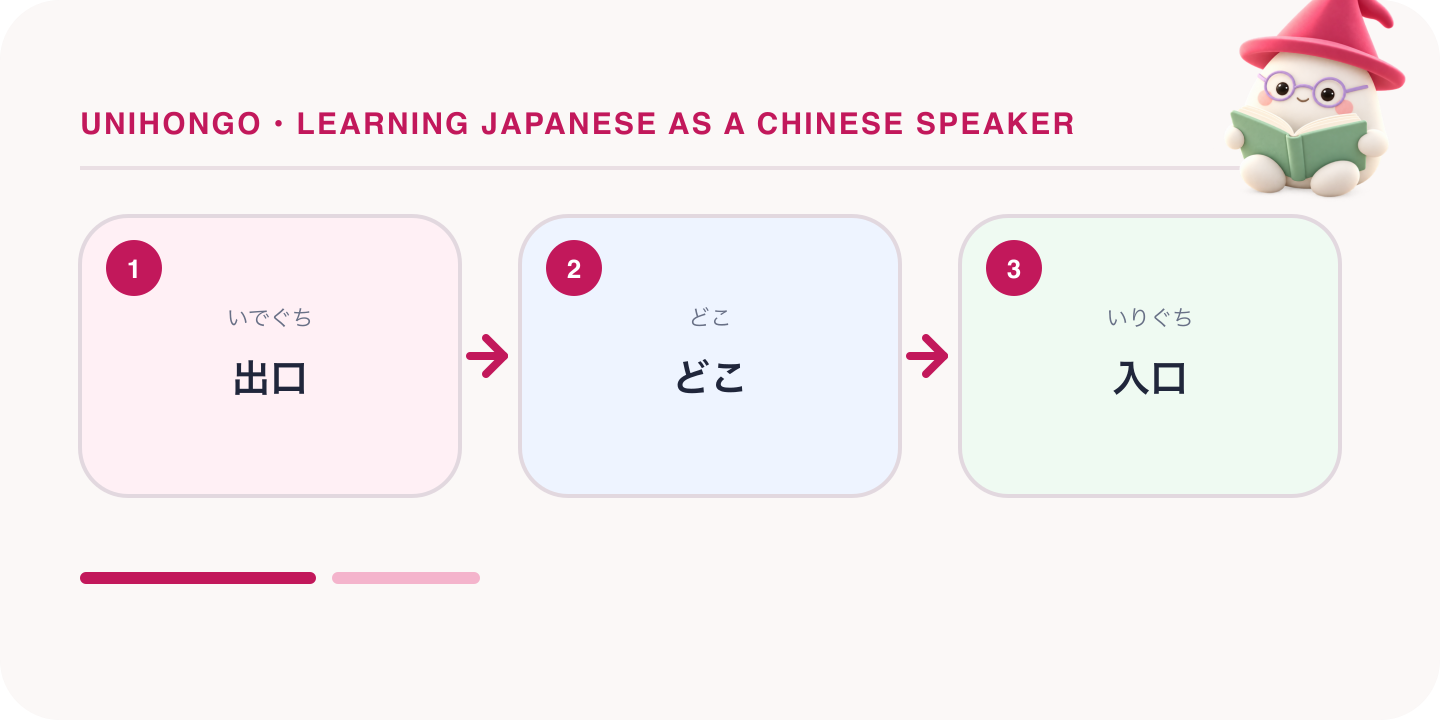
Walk through a Japanese station and you will understand 出口, 入口, 東口, 北口, 切符, 禁煙 and 営業中 before you have learned a single word of Japanese. Menus, maps, warning signs and newspaper headlines give up their meaning to you on sight. Learners from alphabetic languages spend years reaching that point. Many Chinese speakers find that they can guess the topic of a Japanese paragraph from the first day, and that guess is usually right.
Two things make the head start larger than it first appears. Most formal and technical vocabulary in Japanese is Sino-Japanese, built from two-character compounds that exist in Chinese with the same or a close meaning: 経済, 政治, 文化, 電話, 図書館. And Japanese counters work like Chinese measure words, so the habit of putting a classifier between a number and a noun is one you already have. What the head start does not give you is any idea how a word sounds, or how to put it into a sentence.
| Japanese | Romaji | Meaning |
|---|---|---|
| 出口はどこですか? | Deguchi wa doko desu ka? | Where is the exit? |
| 入口はあちらです。 | Iriguchi wa achira desu. | The entrance is over there. |
| 今日は休みです。 | Kyō wa yasumi desu. | We are closed today. |
| 東京駅で降ります。 | Tōkyō-eki de orimasu. | I get off at Tokyo Station. |
Where the shared script stops
Japan simplified its characters after the war, and the choices only sometimes match the mainland simplifications. Some Japanese forms are identical to simplified Chinese (学, 国, 会), some are identical to traditional (語, 電, 東), and some exist only in Japan (図, 広, 気, 発, 沢, 駅). Readers of traditional characters tend to find more that is familiar, but everyone meets a third set that has to be learned. One shape can also mislead: Japanese 芸 is the character for art, but in Chinese 芸 is an unrelated character, and the art character was 藝.
Japan also invented characters of its own, usually for things with no Chinese word, and they will look like nothing you know: 峠 for a mountain pass, 畑 for a dry field, 込 in 込む, 働 in 働く, to work, and 辻 for a crossroads. There are not many, but 働く is one of the most common verbs in the language, so you will meet the group early.
| Japanese | Romaji | Meaning |
|---|---|---|
| 駅で働いています。 | Eki de hataraite imasu. | I work at the station. |
| 電車が込んでいます。 | Densha ga konde imasu. | The train is crowded. |
| Meaning | Japanese | Simplified Chinese | Traditional Chinese |
|---|---|---|---|
| picture, map | 図 | 图 | 圖 |
| wide | 広 | 广 | 廣 |
| spirit, air | 気 | 气 | 氣 |
| emit, depart | 発 | 发 | 發 |
| marsh | 沢 | 泽 | 澤 |
| dragon | 竜 (also 龍) | 龙 | 龍 |
| station | 駅 | 驿 | 驛 |
| return | 帰 | 归 | 歸 |
| sell | 売 | 卖 | 賣 |
| fruit, truth | 実 | 实 | 實 |
| yen, circle | 円 | 圆 | 圓 |
| art | 芸 | 艺 | 藝 |
| read | 読 | 读 | 讀 |
| change | 変 | 变 | 變 |
| pleasure, music | 楽 | 乐 | 樂 |
| single | 単 | 单 | 單 |
False friends that will embarrass you
The dangerous words are not the ones you cannot read. They are the ones you read instantly and wrongly. 手紙 is a letter in Japanese and toilet paper in Chinese. 勉強 is study, not reluctance. 娘 is a daughter, not a mother. 大丈夫 means all right, and you will hear it dozens of times a day with no great man in sight. Many learners find these words hard to correct precisely because the reading feels finished before it has begun. The table lists the ones that come up in ordinary speech.
| Japanese | Romaji | Meaning |
|---|---|---|
| 手紙を書きます。 | Tegami o kakimasu. | I am writing a letter. |
| 毎日日本語を勉強しています。 | Mainichi nihongo o benkyō shite imasu. | I study Japanese every day. |
| 娘は五歳です。 | Musume wa go-sai desu. | My daughter is five. |
| 大丈夫ですか? | Daijōbu desu ka? | Are you all right? |
| 田中さんは留守です。 | Tanaka-san wa rusu desu. | Tanaka is not at home. |
| ご迷惑をおかけしました。 | Go-meiwaku o okake shimashita. | I am sorry for the trouble I caused. |
| Word | Japanese reading | Japanese meaning | Chinese meaning |
|---|---|---|---|
| 手紙 | tegami | letter | toilet paper |
| 勉強 | benkyō | study | reluctantly, barely managing |
| 娘 | musume | daughter | mother |
| 大丈夫 | daijōbu | all right, no problem | a real man |
| 汽車 | kisha | steam train | car |
| 走る | hashiru | to run | to walk |
| 老婆 | rōba | old woman | wife |
| 新聞 | shinbun | newspaper | news |
| 先生 | sensei | teacher, doctor | Mr, husband |
| 丈夫 | jōbu | sturdy, healthy | husband |
| 床 | yuka | floor | bed |
| 湯 | yu | hot water, bath | soup |
| 愛人 | aijin | lover, mistress | spouse (mainland usage) |
| 検討 | kentō | consideration, review | self-criticism |
| 結束 | kessoku | unity, solidarity | to end |
| 怪我 | kega | injury | blame me |
| 迷惑 | meiwaku | nuisance, trouble | confused |
| 人参 | ninjin | carrot | ginseng |
| 高校 | kōkō | high school | university, college |
| 留守 | rusu | being away from home | staying behind |
| 切手 | kitte | postage stamp | not a word; reads as cut hand |
| 経理 | keiri | accounting | manager |
| 顔色 | kaoiro | complexion | colour |
| 用心 | yōjin | caution | attentiveness, intention |
On readings: your pronunciation is a partial key
Most characters carry an on reading that came from Chinese and a kun reading that did not. The on reading, used in compounds, is where your pronunciation helps. Mandarin shān is Japanese san, xīn is shin, jīn is kin, ān is an: a final n usually survives. A final ng usually becomes a long vowel, so dōng is tō, míng is mei and zhōng is chū. And syllables that once ended in a stop consonant, the entering tone that Mandarin has lost, come out as two moras: xué is gaku, guó is koku, yī is ichi, bā is hachi.
If you speak Cantonese, Hakka, Min or another variety that kept those final stops, the last pattern is transparent: hok6 to gaku, gwok3 to koku, luk6 to roku. The tone itself never crosses. A character often has two on readings from two waves of borrowing, which is why 人 is nin in 三人 and jin in 日本人, and 生 is sei in 先生 and shō in 一生. Learn the reading inside the word rather than trying to fix one sound to each character.
| Japanese | Romaji | Meaning |
|---|---|---|
| 三人で行きます。 | San-nin de ikimasu. | The three of us are going. |
| 中国人です。 | Chūgokujin desu. | I am Chinese. |
| 先生は東京の大学にいます。 | Sensei wa Tōkyō no daigaku ni imasu. | The teacher is at a university in Tokyo. |
| Kanji | Mandarin | Cantonese | Japanese on | Pattern |
|---|---|---|---|---|
| 山 | shān | saan1 | san | Final n survives |
| 心 | xīn | sam1 | shin | Final n or m becomes n |
| 金 | jīn | gam1 | kin | Final n or m becomes n |
| 安 | ān | on1 | an | Final n survives |
| 東 | dōng | dung1 | tō | Final ng becomes a long vowel |
| 名 | míng | ming4 | mei | Final ng becomes ei |
| 中 | zhōng | zung1 | chū | Final ng becomes a long vowel |
| 学 | xué | hok6 | gaku | Old final k becomes ku |
| 国 | guó | gwok3 | koku | Old final k becomes ku |
| 六 | liù | luk6 | roku | Old final k becomes ku |
| 一 | yī | jat1 | ichi | Old final t becomes chi or tsu |
| 八 | bā | baat3 | hachi | Old final t becomes chi |
| 電 | diàn | din6 | den | Final n survives |
| 人 | rén | jan4 | jin, nin | Two on readings from two eras |
| 生 | shēng | sang1 | sei, shō | Two on readings from two eras |
Kun readings owe nothing to Chinese
The same character 山 is san in 富士山 and yama on its own. 水 is sui in 水曜日 and mizu in a glass. 人 is jin in 日本人 and hito when you count people on a street. The kun readings are native Japanese words that were attached to Chinese characters because the meanings matched, and no amount of Chinese will help you guess them. Verbs and adjectives are almost all kun: 食べる taberu, 話す hanasu, 高い takai. They also carry okurigana, the hiragana tail that conjugates, which Chinese has no equivalent for.
Many Chinese speakers find that they know a character, know what it means, and are silent when asked to say the sentence it sits in. The fix is to learn the spoken word first and attach the character second, which reverses the order your literacy suggests. When you see 山, say yama before you think shān.
| Japanese | Romaji | Meaning |
|---|---|---|
| 山に登ります。 | Yama ni noborimasu. | I climb the mountain. |
| 富士山は高いです。 | Fujisan wa takai desu. | Mount Fuji is high. |
| 水を飲みます。 | Mizu o nomimasu. | I drink water. |
| 水曜日は忙しいです。 | Suiyōbi wa isogashii desu. | Wednesday is busy. |
| 人が多いですね。 | Hito ga ōi desu ne. | There are a lot of people, aren't there? |
| この漢字は何と読みますか? | Kono kanji wa nan to yomimasu ka? | How do you read this kanji? |
The grammar you must build from nothing
Chinese puts the verb in the middle and shows roles by position: 我在车站等朋友. Japanese puts the verb at the end and shows roles with particles after each noun: 私は駅で友達を待っています. The particles are the part with no Chinese counterpart. Wa marks the topic, ga the subject, o the object, ni a target or time, de the place of an action, kara a starting point, to a companion. The particles guide on this blog explains each one; what matters here is that they replace word order, so you cannot line the words up as you would in Chinese.
Verbs conjugate, which Chinese verbs do not. Tabemasu becomes tabemashita in the past, tabemasen in the negative, tabemasen deshita for both. Your 了 and 没 are done by the verb ending, not by a separate word, and the ending also carries politeness. Counters transfer well, with one trap: Japanese 本 counts long thin objects such as bottles and pens, and books are counted with 冊.
| Japanese | Romaji | Meaning |
|---|---|---|
| 私は駅で友達を待っています。 | Watashi wa eki de tomodachi o matte imasu. | I am waiting for a friend at the station. |
| 昨日、映画を見ました。 | Kinō, eiga o mimashita. | I watched a film yesterday. |
| コーヒーは飲みません。 | Kōhī wa nomimasen. | I do not drink coffee. |
| 上海から来ました。 | Shanhai kara kimashita. | I came from Shanghai. |
| 本を三冊買いました。 | Hon o san-satsu kaimashita. | I bought three books. |
| ビールを三本ください。 | Bīru o san-bon kudasai. | Three beers, please. |
Note the last two lines. A Chinese speaker's instinct is to say san-bon for three books, because 本 is the measure word for books in Chinese. In Japanese that orders three bottles of something. The counter habit helps; the specific counters have to be relearned.
Politeness lives in the verb, not the pronoun
Chinese marks respect with a few choices: 您 instead of 你, 请, 贵姓, a formal register of vocabulary. The verb does not change. Japanese marks respect on every verb, every time. Tabemasu is polite; taberu is plain and reserved for close friends and family; meshiagarimasu raises the eater and itadakimasu lowers the speaker. There is no neutral zone where the verb carries no register, so you choose one in every sentence. The default for a learner is the desu and masu form, which is safe with strangers, teachers, colleagues and shops.
Pronouns move the other way. Chinese uses 你 and 您 constantly; Japanese avoids anata almost entirely and uses the person's name with san instead. The habit of translating 您 as anata produces sentences that sound oddly distant. Say Tanaka-san wa, or drop the subject altogether when the context already supplies it.
| Japanese | Romaji | Meaning |
|---|---|---|
| お名前は何ですか? | O-namae wa nan desu ka? | What is your name? |
| 王と申します。 | Ō to mōshimasu. | My name is Wang. |
| 田中さんは何を飲みますか? | Tanaka-san wa nani o nomimasu ka? | What will you have to drink, Tanaka? |
| 何飲む? | Nani nomu? | What are you having? (casual) |
| 少々お待ちください。 | Shōshō o-machi kudasai. | Please wait a moment. |
| ちょっと待って。 | Chotto matte. | Hang on. (casual) |
The sounds your Chinese predicts you will get wrong
Mandarin gives every syllable a tone. Japanese gives every word one pitch shape, usually a rise after the first mora and at most one drop, and the drop's position is what tells hashi, chopsticks, from hashi, bridge. Many Chinese speakers put a separate contour on each syllable, which sounds sing-song to a Japanese ear and hides the one drop that matters. Say the word as a single line with one step down, or none. Cantonese and other tonal varieties set the same habit; the fix is the same.
The consonants are the second problem. Mandarin b, d and g are unaspirated but voiceless, so your daigaku can reach a Japanese ear as taigaku, a different word. Japanese k, t and p are also less aspirated than yours, so the two series blur from both sides. The Japanese r is a quick tap of the tongue tip, closer to your l or to a very light d than to the retroflex r of 日 or 人. And three things Mandarin does not have at all: vowel length, doubled consonants, and a final n that takes a full beat and does not glide into the next vowel.
| Japanese | Romaji | Meaning |
|---|---|---|
| 橋を渡ります。 | Hashi o watarimasu. | I cross the bridge. |
| 箸をください。 | Hashi o kudasai. | Chopsticks, please. |
| 大学で働いています。 | Daigaku de hataraite imasu. | I work at a university. |
| 来週、来ます。 | Raishū, kimasu. | I will come next week. |
| 料理が好きです。 | Ryōri ga suki desu. | I like cooking. |
| おばあさんは元気です。 | Obāsan wa genki desu. | My grandmother is well. |
| 東京は大きいです。 | Tōkyō wa ōkii desu. | Tokyo is big. |
| 切手を三枚ください。 | Kitte o san-mai kudasai. | Three stamps, please. |
| 千円です。 | Sen'en desu. | That is one thousand yen. |
| 禁煙ですか? | Kin'en desu ka? | Is it non-smoking? |
| 本を読みます。 | Hon o yomimasu. | I read a book. |
| Target | What a Chinese accent tends to produce | Fix |
|---|---|---|
| 橋 hashi (bridge) | Same word as chopsticks, or a tone on each syllable | Low then high, no drop |
| 箸 hashi (chopsticks) | Same as above | High then a drop on shi |
| 大学 daigaku | taigaku, leaving school | Hum before releasing the d and the g |
| 銀行 ginkō | kinkō | Voice the g from the first sound |
| 来る kuru | A retroflex r as in 日 | Tap the tongue tip once, like a light l |
| 料理 ryōri | A curled-back r | Same tap, twice |
| おばあさん obāsan | obasan, an aunt | Hold the a for two beats |
| 東京 Tōkyō | Tokyo in two beats | Four beats: to, o, kyo, o |
| 切手 kitte | kite, come | A silent beat before te |
| 千円 sen'en | senen, or sen-nen | Full beat on n, then a fresh e |
| 禁煙 kin'en | kinen, a memorial | Same: n is its own beat |
| 本を hon o | ho-no | Do not link the n into the o |
The pronunciation guide on this blog covers the full sound system. For you the priority order is voicing first, because it changes words; then vowel length and the doubled consonants, because they change words too; then the r; and pitch last, because a flat delivery is understood even when the drop is in the wrong place.
The silent reading trap
Because you can read, you will read. Textbooks, subtitles, menus and chat messages all give you meaning through your eyes, and your speaking never gets tested. Many Chinese speakers reach the point where they can follow a newspaper article and cannot order a coffee without pointing, and the reason is not a lack of study. It is that every hour of study went in through the script. The Japanese you understand and the Japanese you can say separate early, and the separation widens unless you force sound into every session.
The practical rule is that nothing counts until it has been said. Read aloud rather than silently, cover the kanji and work from hiragana or from audio when you can, and when you learn a compound, learn it by ear first and confirm the characters second. The character will still be there when you need it; the sound will not be unless you put it there.
| Japanese | Romaji | Meaning |
|---|---|---|
| 読めますが、話せません。 | Yomemasu ga, hanasemasen. | I can read it, but I cannot say it. |
| 漢字は分かりますが、読み方が分かりません。 | Kanji wa wakarimasu ga, yomikata ga wakarimasen. | I understand the kanji, but I do not know how to read it. |
| 声に出して読んでもいいですか? | Koe ni dashite yonde mo ii desu ka? | May I read it aloud? |
- Read every text aloud, including the ones you would normally skim, and stop at any character whose reading you cannot say.
- Learn new vocabulary from audio or a spoken example first, then look at how it is written.
- Hide the transcript in conversation practice until the session is over, so your ear has to do the work.
- When you do not know a reading, ask for it in Japanese rather than guessing from Chinese.
Your first month of speaking
The plan is built to force output, because that is the side your head start neglects. Each week adds one focus and keeps the previous ones alive, and every day has a spoken component that cannot be done with the eyes.
| Japanese | Romaji | Meaning |
|---|---|---|
| もう一度、ゆっくりお願いします。 | Mō ichido, yukkuri onegai shimasu. | Once more, slowly, please. |
| 私の発音はどうですか? | Watashi no hatsuon wa dō desu ka? | How is my pronunciation? |
| 中国語では意味が違います。 | Chūgokugo de wa imi ga chigaimasu. | In Chinese the meaning is different. |
- Week one: self-introduction and daily routine in desu and masu form. Record yourself and check two things only: voiced d and g, and vowel length.
- Week two: particles. Take ten nouns and run each through wa, o, ni, de and kara aloud, in full sentences, without writing anything down.
- Week three: readings. Take twenty compounds you can already read, say each one before you look it up, and mark which on readings you guessed correctly from Chinese.
- Week four: false friends and pitch. Use the words from the table in conversation on purpose, and say every new word as one flat line with a single drop.
- Every day: one short text read aloud, and one conversation where you ask for at least one reading in Japanese.
Expect a specific shape of progress. Your reading will run ahead of everyone else's and your speaking will lag behind your reading for a long time. That is not a failure of ability; it is what a script-based head start produces when it is not balanced by sound. Balance it from the first week and the two will grow together.