
Why a plan built on play survives a busy week
The reason most adult study plans collapse is not laziness. It is activation energy. A textbook chapter asks for a quiet room, a clear head and half an hour, and by nine in the evening none of those are available. A game round asks for ninety seconds and a thumb. If the first step of the plan is that small, the plan starts on the days when nothing else would, and once you are in, the next step is easy to add.
Play has a limit you should know before you commit to it. Games train recognition and speed: seeing a word and knowing it, hearing it and picking it out. They do not train producing the word in a sentence while a person waits for you to finish. That is why this plan spends its longest block on live conversation. The games exist to make that conversation better, not to replace it.
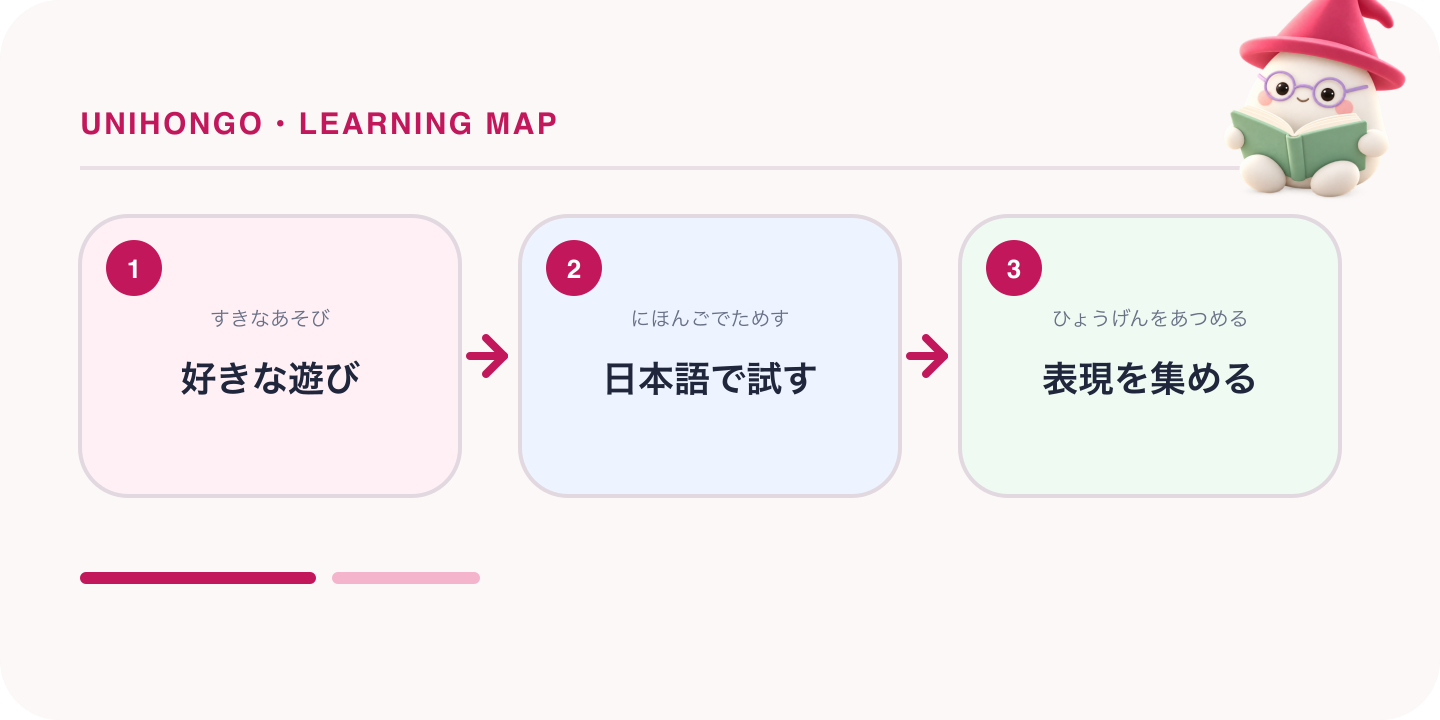
The plan by minute
| Minute | Activity | What it trains | Game or feature |
|---|---|---|---|
| 0 to 2 | Warm-up | Kana reading speed or flashcard recall | Kana Dash or Quick Flip |
| 2 to 7 | One deck, one game | Meaning recognition under time pressure | Vocabulary Dash or Sushi Sort |
| 7 to 10 | Ears or mouth | Listening recognition or pronunciation | Listen & Pick or Say It! |
| 10 to 20 | Live conversation | Producing the deck's words in real sentences | AI Sensei in the 3D classroom |
| 20 to 21 | Triage | Noticing corrections and saving misses | Session report |
The order matters more than the exact minutes. Reading first, because kana speed is the cheapest gain and it wakes you up. One vocabulary game second, so the words are fresh. A listening or speaking round third, so your ears and mouth are already in Japanese before the conversation starts. Then the conversation, then the report. If you must cut something, cut from the games, never from the ten minutes of speaking.
Minutes 0 to 2: warm up with Kana Dash or Quick Flip
Kana Dash is a 3D runner for hiragana and katakana. A kana appears, you switch lanes and pass through the correct gate, and the pace rises as you go. Two minutes of this does two things for a beginner: it keeps kana reading automatic, which every later step depends on, and it puts you in a game frame of mind rather than a homework one. Katakana is the usual weak spot, so alternate the two scripts across the week rather than always choosing the one you find comfortable.
If your kana are already solid, use the two minutes for Quick Flip instead. Quick Flip is flashcard recall: a card shows one side, you try to remember the other before you flip, and you decide whether you had it. Your saved flashcards appear there automatically, so if you were signed in yesterday, this morning's cards are the words you stumbled over in yesterday's conversation. That loop, from a mistake in speech to a card the next morning, is the engine of the whole plan.
Minutes 2 to 7: one deck, one game
Pick a single deck for the whole week and play it in one game. Vocabulary Dash is a 3D lane runner: a word or a meaning appears, and you steer into the gate that matches it. Sushi Sort is a conveyor rush: a customer places an order in Japanese and you send the right plate down the belt before the timer runs out, which makes it the natural choice for the Food deck. Five minutes is two or three rounds, enough to see every word in the deck at least once and the ones you miss several times.
The decks are Everyday, Travel, Food, your saved flashcards, and JLPT N5 to N1 packs. A week on one deck sounds slow, but the goal is not to see many words. It is to carry the same twenty or thirty words through a week of games and conversations until they stop being answers and start being vocabulary. A learner on the Everyday deck should be able to say lines like these by the end of the week, not just pick them out of a gate.
| Japanese | Romaji | Meaning |
|---|---|---|
| 朝ご飯を食べましたか? | Asagohan o tabemashita ka? | Did you eat breakfast? |
| 今日は買い物に行きます。 | Kyō wa kaimono ni ikimasu. | I am going shopping today. |
| 会社まで電車で行きます。 | Kaisha made densha de ikimasu. | I go to the office by train. |
| 週末は何をしますか? | Shūmatsu wa nani o shimasu ka? | What do you do at weekends? |
| 昨日は忙しかったです。 | Kinō wa isogashikatta desu. | Yesterday was busy. |
| 少し疲れました。 | Sukoshi tsukaremashita. | I am a little tired. |
- Start with Everyday if you have no trip or exam planned; its words come up in every conversation.
- Choose Travel or Food in the three weeks before a trip, then switch back.
- Use a JLPT pack only when you are preparing for that level; the words are narrower and more formal.
- After a month, spend one week on your saved flashcards deck so your own misses get the full treatment.
- Change deck on the same weekday every time so the choice never becomes a reason to skip.
Minutes 7 to 10: ears or mouth
Listen & Pick plays a Japanese word and asks you to choose its meaning. The answer is not shown first, so you cannot read your way to it; you have to have heard it. Three minutes here is the cheapest listening practice in the plan, and it catches a specific problem: words you recognise on a gate but not in the air, usually because of a long vowel or a doubled consonant you have been reading past for weeks.
On alternate days use Say It!, the pronunciation quest. You hear the word, say it aloud, reveal the reading, and decide whether to clear it. Be strict with yourself on that decision. The learner mistake in every self-graded exercise is to clear a word that was roughly right, and roughly right is what the AI Sensei will correct ten minutes later. Leaving a word uncleared costs nothing except seeing it again.
Minutes 10 to 20: speak the words you just played
This is the block that makes the plan work, and it is the one learners are most tempted to skip. Open a live voice conversation with your AI Sensei in Unihongo's immersive 3D classroom and tell the teacher what you played. The classroom setting is deliberate: standing in front of a teacher who is looking at you produces a small, useful pressure that a text box does not, and the teacher's personality is yours to set. Gentle when the day was hard, strict when you have been coasting, funny or relaxed when you need the session to feel like a chat.
Your only job in these ten minutes is to use the deck's words in sentences about your own life. Do not aim for interesting; aim for complete. The teacher will ask a follow-up question, and the follow-up is where the word either holds or breaks. Here is how the first few minutes usually go for a learner on the Travel deck, with the teacher's likely replies.
| Japanese | Romaji | Meaning |
|---|---|---|
| 今日はゲームで新しい言葉を五つ覚えました。 | Kyō wa gēmu de atarashii kotoba o itsutsu oboemashita. | Today I learnt five new words in a game. |
| 「駅」という言葉を使って話したいです。 | "Eki" to iu kotoba o tsukatte hanashitai desu. | I want to talk using the word "eki". |
| いいですね。駅はどこにありますか? | Ii desu ne. Eki wa doko ni arimasu ka? | Good. Where is the station? (teacher) |
| 駅は家の近くにあります。 | Eki wa ie no chikaku ni arimasu. | The station is near my house. |
| 毎朝、駅まで歩きます。 | Maiasa, eki made arukimasu. | Every morning I walk to the station. |
| 何分ぐらいかかりますか? | Nanpun gurai kakarimasu ka? | About how many minutes does it take? (teacher) |
| 十分ぐらいかかります。 | Juppun gurai kakarimasu. | It takes about ten minutes. |
| この言葉の使い方は合っていますか? | Kono kotoba no tsukaikata wa atte imasu ka? | Is the way I used this word correct? |
| はい、合っています。もう一度言ってみましょう。 | Hai, atte imasu. Mō ichido itte mimashō. | Yes, that is right. Let's say it once more. (teacher) |
| もう少しゆっくり話してください。 | Mō sukoshi yukkuri hanashite kudasai. | Please speak a little more slowly. |
| 「切符」はどういう意味ですか? | "Kippu" wa dō iu imi desu ka? | What does "kippu" mean? |
| 切符はチケットのことです。 | Kippu wa chiketto no koto desu. | Kippu means a ticket. (teacher) |
| 切符を二枚買いました。 | Kippu o nimai kaimashita. | I bought two tickets. |
| 今日はここまでにします。ありがとうございました。 | Kyō wa koko made ni shimasu. Arigatō gozaimashita. | Let's stop here for today. Thank you. |
Notice that the learner drives the conversation by naming the word they want to use. That is the difference between practice and a chat: you decide the target, the teacher supplies the pressure. When you run out of words from the deck, ask for a word you heard in the listening round, and if the teacher uses a word you did not catch, ask what it means in Japanese rather than switching to English.
Minute 20 to 21: read the report
The session report lists your corrections: the particle you dropped, the word you used in the wrong register, the sound the teacher asked you to repeat. Give it one minute, not ten. You are not studying the report; you are triaging it. Look for one grammar correction to carry into tomorrow, one pronunciation note to hand to Say It!, and every vocabulary miss, which goes into flashcards. Anything else can wait for the weekend.
- One grammar correction: repeat the corrected sentence aloud three times, then close the report.
- One pronunciation note: it becomes the first word you try in Say It! tomorrow.
- Every word the teacher supplied that you did not know: save it as a flashcard.
- Do not reread yesterday's report; the flashcards remember for you.
Turning session words into flashcards
When you are signed in, the words that came up in a conversation can be saved as flashcards, and those cards appear automatically in Quick Flip and in the saved flashcards deck of Vocabulary Dash. This is the mechanism that keeps the warm-up honest. A generic card set goes stale in a fortnight because you learn the cards rather than the words. Cards made from your own stumbles do not go stale, because tomorrow's conversation produces new ones and the old ones drop out as you clear them.
Save the word in the form you actually needed, not the dictionary form alone. If the teacher supplied yoyaku because you wanted to book a table, the card that helps is the sentence you were trying to say. When Quick Flip shows the meaning side, produce the whole line aloud before you flip. Cards like the ones below typically appear in a learner's second week, and every one of them started as a pause in a conversation.
| Japanese | Romaji | Meaning |
|---|---|---|
| 予約をお願いします。 | Yoyaku o onegai shimasu. | I would like to make a reservation. |
| 少し遅れます。 | Sukoshi okuremasu. | I will be a little late. |
| 明日は都合が悪いです。 | Ashita wa tsugō ga warui desu. | Tomorrow is not convenient for me. |
| 会議は三時からです。 | Kaigi wa san-ji kara desu. | The meeting is from three. |
| 週末に友達と出かけました。 | Shūmatsu ni tomodachi to dekakemashita. | I went out with a friend at the weekend. |
Weekend and low-energy variants
| Japanese | Romaji | Meaning |
|---|---|---|
| 今日は疲れているので、短くお願いします。 | Kyō wa tsukarete iru node, mijikaku onegai shimasu. | I am tired today, so please keep it short. |
| わかりました。今日は三つだけ質問しますね。 | Wakarimashita. Kyō wa mittsu dake shitsumon shimasu ne. | Understood. I will ask just three questions today. (teacher) |
| 週末はカフェのロールプレイをしたいです。 | Shūmatsu wa kafe no rōrupurei o shitai desu. | At the weekend I want to do the cafe roleplay. |
| Variant | Play | Speak | Total time |
|---|---|---|---|
| Standard weekday | Warm-up, one deck, then ears or mouth | Ten minutes of conversation on the deck's words, then the report | About 21 minutes |
| Low-energy day | Two minutes of Quick Flip and one round of Listen & Pick | A two-minute check-in with the teacher, or one Say It! round instead | About 7 minutes |
| Weekend | Sentence Builder on the week's words, then Sushi Sort for fun | A roleplay mission (cafe, hotel, job interview or workplace call), then the report | About 35 to 40 minutes |
| Missed day | One round of anything | Nothing required | Under 3 minutes |
The weekend version is where roleplay missions belong. A cafe or hotel mission uses the Travel and Food decks directly, and a job interview or workplace call mission is the right test for a learner on a JLPT pack, because those words are formal and need a formal scene. The low-energy version is not a lesser session. Its job is to keep the chain unbroken, and a two-minute check-in with the teacher counts. Tell the teacher what kind of day it is and the session will be shaped to fit.
How to tell after a month whether it is working
Do not judge the plan by scores. Game scores rise with familiarity whether or not the words have reached your speech. Judge it by the conversation. At the end of the first week, note how many times you switched to English or stalled for more than a few seconds in the ten-minute block. At the end of the fourth week, count again on the same deck. Fewer stalls on the same words is progress; a higher Vocabulary Dash score with the same number of stalls is not.
| Japanese | Romaji | Meaning |
|---|---|---|
| 先週の日曜日は何をしましたか? | Senshū no nichiyōbi wa nani o shimashita ka? | What did you do last Sunday? (teacher) |
| 公園を散歩して、カフェでコーヒーを飲みました。 | Kōen o sanpo shite, kafe de kōhī o nomimashita. | I took a walk in the park and had a coffee at a cafe. |
| 来週は出張があります。 | Raishū wa shutchō ga arimasu. | I have a business trip next week. |
| 日本語の勉強は毎日二十分ぐらいです。 | Nihongo no benkyō wa mainichi nijuppun gurai desu. | My Japanese study is about twenty minutes a day. |
| 最近、聞き取りが少し楽になりました。 | Saikin, kikitori ga sukoshi raku ni narimashita. | Recently, listening has got a little easier. |
- You answer the teacher's follow-up question with a word from the deck without searching for it.
- The session report's corrections have moved from vocabulary to grammar, which means the words are there and the sentences are the new frontier.
- Listen & Pick rounds on the week's deck feel slow, so you are ready for the next deck.
- You can say the lines below about your own month without a pause.
If none of these has happened, the usual cause is that the ten-minute block was cut or turned into listening to the teacher. Go back to naming the word you want to use in every exchange, and make the games shorter, not the conversation.