
The honest answer: it depends on what you buy
People who ask what Japanese costs are usually asking two different questions. One is how much money. The other is how much of that money turns into Japanese they can use. A learner who spends a lot on a group class and never speaks outside it has bought a social routine and some grammar. A learner who spends a tenth of that on a textbook and a cheap speaking partner, and uses both daily, has bought a language. The ranges below are honest, which means they are wide and hedged; local prices vary and change.
The motto for this guide is in the first line below: continuing matters more than money.
| Japanese | Romaji | Meaning |
|---|---|---|
| お金より続けること。 | Okane yori tsuzukeru koto. | What counts is continuing, not money. |
| 授業料はいくらですか。 | Jugyōryō wa ikura desu ka. | How much is the tuition? |
| 予算は月に一万円です。 | Yosan wa tsuki ni ichiman'en desu. | My budget is ten thousand yen a month. |
The four main ways to pay for Japanese
Everything on the market is a version of one of four things: a school, a private teacher, a group class or self-study material. The picture cards give you the Japanese names, which you will need the moment you ask anyone in Japan for advice.
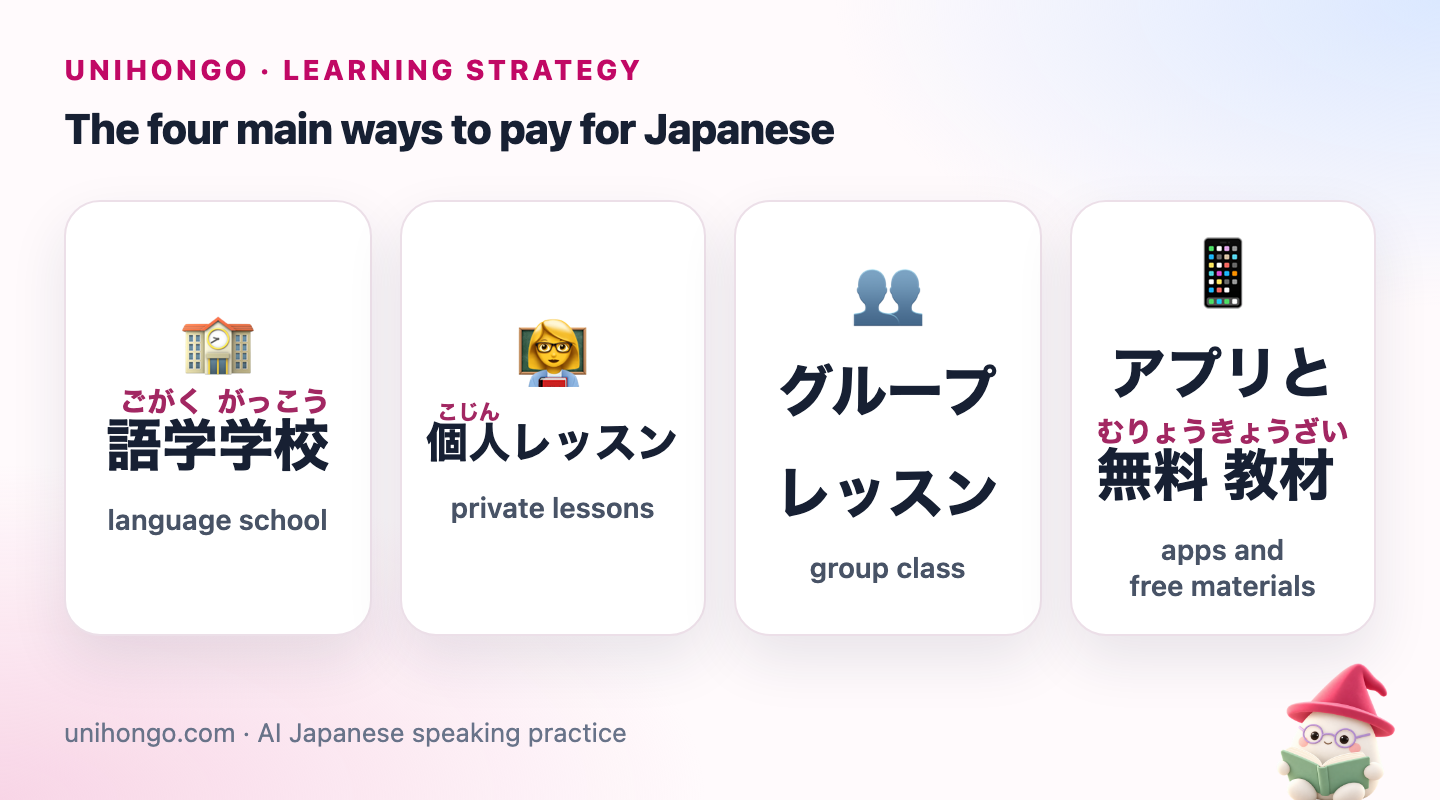
| Japanese | Romaji | Meaning |
|---|---|---|
| 語学学校 | gogaku gakkō | language school |
| 個人レッスン | kojin ressun | private lessons |
| グループレッスン | gurūpu ressun | group class |
| アプリと無料教材 | apuri to muryō kyōzai | apps and free materials |
| Option | Typical cost (hedged; varies by country) | What it buys | Fits when |
|---|---|---|---|
| Language school in Japan, full-time | Tuition commonly in the high hundreds of thousands of yen a year, plus enrolment and materials; living costs separate | Structure, a visa route, daily immersion, classmates | You can move to Japan for six months or more and want the fastest total progress |
| Private tutor, online or local | Often ten to forty dollars an hour, more for specialists | Every minute is yours; personal corrections; flexible topics | Speaking is your bottleneck and you can prepare between lessons |
| Group class, evening or weekend | Commonly a few hundred dollars per term in many cities | A teacher, a schedule, people to study with | You need external structure and enjoy a classroom |
| Textbooks and workbooks | A main textbook often costs about the same as a few restaurant meals | A tested sequence of grammar and vocabulary | Everyone; it is the cheapest reliable base |
| Apps and AI partners | Many have a free tier; paid tiers are often priced like a streaming subscription per month | Daily contact, drills, and in some cases spoken conversation | You want something every day at odd hours |
| Free resources | Free | Reading, listening, exchange partners, community classes | Everyone, as the supplement that keeps costs down |
The cheapest per hour is the group class; the cheapest per spoken minute is almost always the private tutor or an AI conversation partner, because in both you talk most of the time.
Language schools: the big-ticket option
A full-time school in Japan is the most expensive route and, for people who can do it, often the fastest, because you study four hours a day and live in the language. Fee tables usually separate nyūgakukin, the enrolment fee paid once, from jugyōryō, tuition, and kyōzaihi, materials. Ask what is included and whether the school helps with housing and the student visa; schools vary in what they offer and the cheapest tuition is not always the cheapest year.
Outside Japan, cultural institutes and university extension courses are the equivalent, at a fraction of the price and intensity.
| Japanese | Romaji | Meaning |
|---|---|---|
| 入学金 | nyūgakukin | enrolment fee |
| 授業料 | jugyōryō | tuition fee |
| 教材費 | kyōzaihi | materials fee |
| 月謝 | gessha | monthly fee |
| 授業料に教材費は含まれていますか。 | Jugyōryō ni kyōzaihi wa fukumarete imasu ka. | Does the tuition include materials? |
| 寮はありますか。 | Ryō wa arimasu ka. | Is there a dormitory? |
Tutors and group classes: paying per hour versus per term
A private tutor is priced per hour, and the hourly range is wide because it mixes community tutors who are native speakers without teaching qualifications and professional teachers with years of classroom experience. Both can be excellent for speaking; the professional usually explains grammar better, the community tutor is often cheaper and more conversational. The cost that is easy to forget is the booking: lessons happen when both of you are free, which for many working learners means once a week at most.
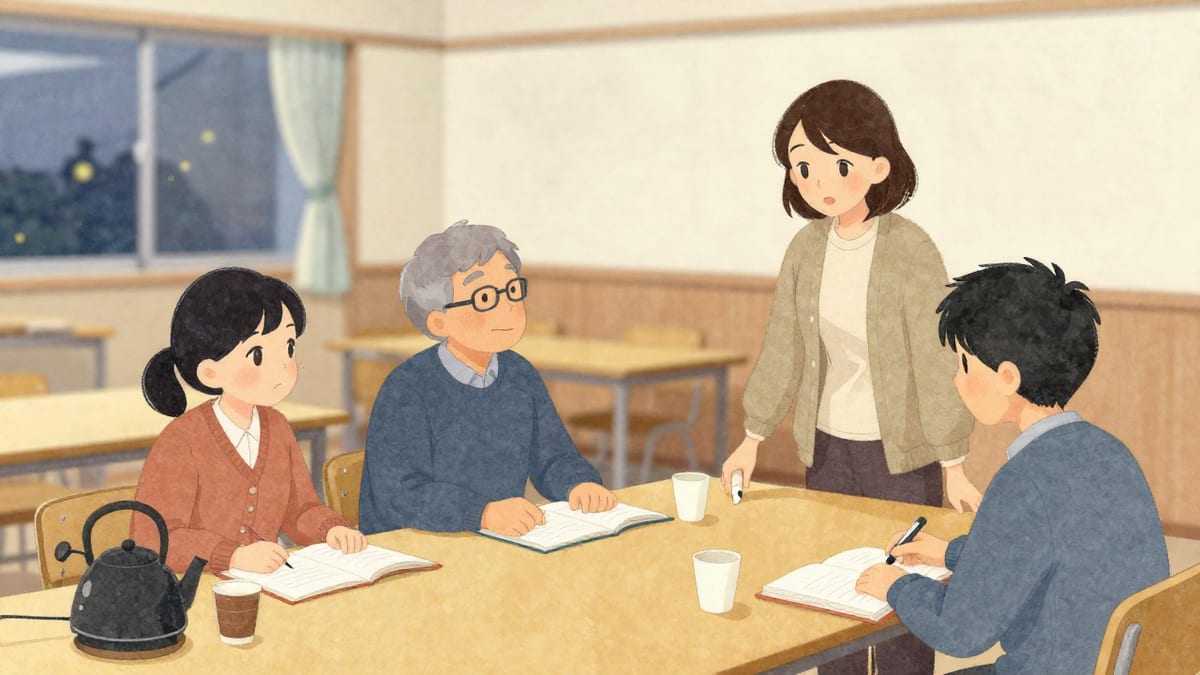
A group class is priced per term and feels cheap per hour, but divide the hour by the number of students and you have your real speaking time. It still has real value: a human teacher who notices your face, a fixed appointment you will keep, and classmates. Just do not expect a group class to be where you learn to talk.
| Japanese | Romaji | Meaning |
|---|---|---|
| 体験レッスンはありますか。 | Taiken ressun wa arimasu ka. | Is there a trial lesson? |
| 一回のレッスンは何分ですか。 | Ikkai no ressun wa nanpun desu ka. | How long is one lesson? |
| クラスは何人ですか。 | Kurasu wa nannin desu ka. | How many people are in the class? |
| 話す練習を多くしたいです。 | Hanasu renshū o ōku shitai desu. | I want to do a lot of speaking practice. |
| キャンセルはいつまでできますか。 | Kyanseru wa itsu made dekimasu ka. | Until when can I cancel? |
Budgeting for speaking: the line most learners forget
Here is a way to budget that puts speaking first. Decide how many spoken sessions you want a week, then cover them with the cheapest mix that gives you corrections. A common pattern among working adults: one human lesson every week or two for the things only a human does well, such as explaining a nuance, talking about your life and noticing your confidence, plus a daily conversation partner that costs little and needs no booking. For the daily partner, the options are a language-exchange friend, which costs your time in return, or an AI tutor.
Unihongo is one such AI partner: a Japanese-only voice conversation in a 3D classroom where you can ask the Sensei to play a clerk, a friend or an interviewer, slow down, or switch between casual and polite, and read a session report afterwards with corrections and vocabulary. It fits when what you lack is spoken practice at odd hours without booking; it does not replace a human teacher who knows your story. There is a free plan, so trying it costs nothing.
| Weekly speaking plan | What you pay | Minutes of your own speech |
|---|---|---|
| One group class | A term fee | Low: the hour is shared |
| One tutor lesson | One hourly fee a week | High during the lesson, nothing between |
| Tutor every two weeks plus daily AI partner | Half the tutor cost plus a small subscription or a free tier | High, every day, with corrections |
| Language exchange only | Your time in your own language | Half the session, usually uncorrected |
What you can get for free
- Public libraries in many countries stock the main beginner textbooks; in Japan, municipal libraries also carry graded readers.
- Free graded readers for Japanese exist online from the extensive-reading community; they are the cheapest way to read a lot at your level.
- The public broadcaster publishes daily news written in simplified Japanese with furigana, good for daily reading and listening.
- Volunteer-run Japanese classes for foreign residents exist in many Japanese municipalities, often for a very small fee per session; ask at your city or ward office or the local international association.
- Language exchange: you give an hour of your language for an hour of Japanese. It is free in money and costs discipline, because it is easy to drift into the easier language.
- Your own voice: shadowing audio, retelling what you read, and describing your day aloud cost nothing and are the practice most learners skip.
At the front desk: asking about fees
Whether you are enrolling at a school in Japan or arranging lessons with a tutor, the conversation about money follows a pattern: ask the fee, ask what it includes, ask about a trial, ask how to pay. Here is the exchange with a school's reception, polite throughout.
| Japanese | Romaji | Meaning |
|---|---|---|
| 日本語のコースについて聞きたいのですが。 | Nihongo no kōsu ni tsuite kikitai no desu ga. | You: I'd like to ask about the Japanese courses. |
| はい、どのようなコースをお探しですか。 | Hai, dono yō na kōsu o osagashi desu ka. | Receptionist: Of course, what kind of course are you looking for? |
| 週に二回、夜のクラスを探しています。 | Shū ni nikai, yoru no kurasu o sagashite imasu. | You: I'm looking for an evening class twice a week. |
| 月謝は税込みですか。 | Gessha wa zeikomi desu ka. | You: Is the monthly fee tax included? |
| 分割払いはできますか。 | Bunkatsu barai wa dekimasu ka. | You: Can I pay in instalments? |
| 少し考えてから、また連絡します。 | Sukoshi kangaete kara, mata renraku shimasu. | You: I'll think about it and get back to you. |
Kikitai no desu ga, with ga trailing off, is the polite way to open a request: it leaves the other person room to respond. Zeikomi, tax included, and zeinuki, tax excluded, matter in Japan because prices are shown both ways.