
The head start: sounds you already own
Japanese has five vowels, a, i, u, e, o, and they are the same clear, unreduced vowels you use in Indonesian and Malay. Japanese syllables are short and evenly timed, nearly all of them end in a vowel or n, and there are no tones. Many learners from tonal or stress-heavy languages spend months on this; you can spend that time elsewhere. Most Japanese consonants also exist in your language, including the ch of cari, the ny of nyanyi, and a soft r that is closer to your r than the English one.
Two adjustments make the transfer complete. The Indonesian e pepet, the schwa in the first syllable of sepuluh, does not exist in Japanese: every e is the clear e of enak, so sensei and desu never soften. And if you speak Malay with the Johor-Riau final a, where saya ends in a schwa-like sound, hold the final a of Japanese words open, so that desu ka ends in a clear ah. Your r may also be a fuller trill than the light Japanese tap; keep it to a single touch of the tongue.
| Japanese | Romaji | Meaning |
|---|---|---|
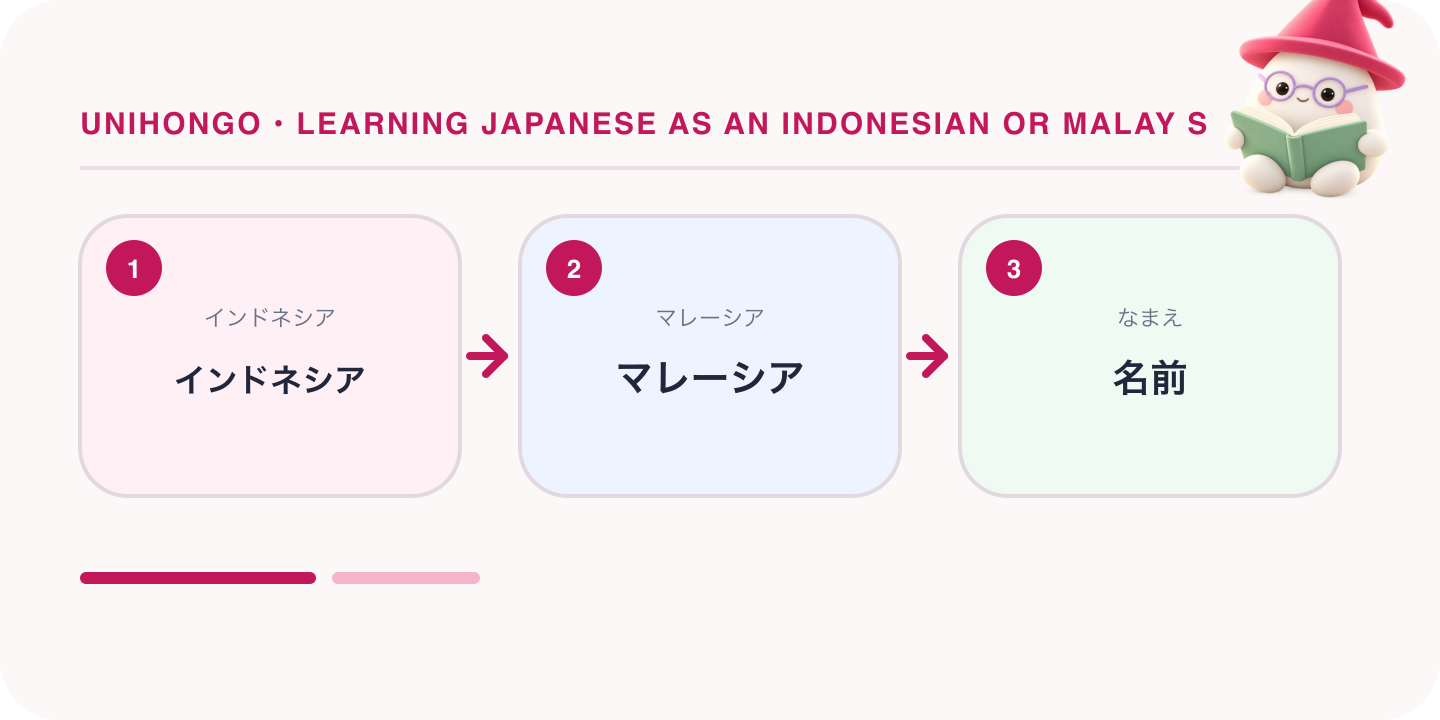
| こんにちは。私はインドネシア人です。 | Konnichiwa. Watashi wa Indoneshia-jin desu. | Hello. I am Indonesian. |
| マレーシアから来ました。 | Marēshia kara kimashita. | I am from Malaysia. |
| 名前はアディです。 | Namae wa Adi desu. | My name is Adi. |
| 日本語を勉強しています。 | Nihongo o benkyō shite imasu. | I am studying Japanese. |
| よろしくお願いします。 | Yoroshiku onegai shimasu. | Pleased to meet you. |
Trap one: long vowels held for a full beat
Indonesian and Malay do not use vowel length to tell words apart, so the habit is to give every vowel one beat. Japanese long vowels are two beats, and the second beat changes the word. Obasan is an aunt and obāsan is a grandmother. Biru is a building and bīru is a beer. Koko means here and kōkō is a high school. Many learners find this the most persistent trace of an Indonesian accent because nothing in their own language makes a short vowel feel wrong.
Train the ear before the mouth. Tap once per beat while you read: o-ba-a-sa-n has five taps, o-ba-sa-n has four. When you say Tōkyō, tap four times, to-o-kyo-o. If you finish in two taps, you said it the Indonesian way.
| Japanese | Romaji | Meaning |
|---|---|---|
| おばあさんは元気です。 | Obāsan wa genki desu. | My grandmother is well. |
| ビールを二つください。 | Bīru o futatsu kudasai. | Two beers, please. |
| 東京に住んでいます。 | Tōkyō ni sunde imasu. | I live in Tokyo. |
| この通りをまっすぐ行ってください。 | Kono tōri o massugu itte kudasai. | Please go straight along this street. |
| 高校の先生です。 | Kōkō no sensei desu. | I am a high school teacher. |
| Short | Meaning | Long | Meaning |
|---|---|---|---|
| おばさん obasan | aunt | おばあさん obāsan | grandmother |
| ビル biru | building | ビール bīru | beer |
| ここ koko | here | 高校 kōkō | high school |
| 鳥 tori | bird | 通り tōri | street |
| 主人 shujin | husband, master | 囚人 shūjin | prisoner |
| 家 ie | house | いいえ iie | no |
Trap two: the small tsu, tsu itself, and the n before a vowel
The small tsu is a silent beat where the mouth holds the next consonant. Kite means come, and kitte, with the held t, means stamp. Indonesian and Malay do not double consonants inside a word, so the natural move is to skip the pause. Count it as a beat: ki-t-te, three taps. The same applies to gakkō, which carries both traps, a held k and a long o.
The sound tsu is new. Your language has c as in cari and s as in satu, but not the ts of tsukue at the start of a syllable. Many learners replace it with chu or su, so that kutsu, shoes, drifts toward kuchu. Put the tongue in the t position and release straight into s without moving. Finally, the n before a vowel keeps its own beat: kin'en, non-smoking, is ki-n-e-n, not the two-syllable kinen that means commemoration. The apostrophe in romaji is telling you not to join them.
| Japanese | Romaji | Meaning |
|---|---|---|
| 切手を三枚ください。 | Kitte o san-mai kudasai. | Three stamps, please. |
| ちょっと待ってください。 | Chotto matte kudasai. | Please wait a moment. |
| 靴を脱いでください。 | Kutsu o nuide kudasai. | Please take off your shoes. |
| 一つください。 | Hitotsu kudasai. | One, please. |
| 千円です。 | Sen'en desu. | It is one thousand yen. |
| 禁煙席をお願いします。 | Kin'en-seki o onegai shimasu. | A non-smoking seat, please. |
| 原因は何ですか? | Gen'in wa nan desu ka? | What is the cause? |
| Target | What an Indonesian or Malay accent tends to produce | Fix |
|---|---|---|
| 切手 kitte | kite, which means come | Hold the t for one silent beat |
| 学校 gakkō | gako | Hold the k, then two beats of o |
| 靴 kutsu | kuchu or kusu | A t that slides into s, no ch |
| 机 tsukue | chukue or sukue | Same tongue position as t, released into s |
| 禁煙 kin'en | kinen, commemoration | Give the n its own beat before e |
| 千円 sen'en | senen | Se, n, e, n: four beats |
| 原因 gen'in | genin | Ge, n, i, n: four beats |
The grammar that is new: verbs change shape
In Indonesian and Malay, makan stays makan whether you ate yesterday, are eating now, or will eat tomorrow; sudah, sedang, and akan carry the time. Japanese moves that information into the verb ending. Tabemasu covers the present and future, tabemashita is the past, tabete imasu is happening now, and tabemasen is the negative. Time words such as kinō and ashita are welcome but optional, because the ending already says when.
One mapping deserves attention because it is used constantly. Belum, not yet, is mada plus the negative of the continuing form: mada tabete imasen, I have not eaten yet. Mada tabemasen means I will not eat yet, which is a different sentence. And the everyday Indonesian question sudah makan? becomes mō tabemashita ka, with the past ending doing the work of sudah.
| Japanese | Romaji | Meaning |
|---|---|---|
| 毎朝、ご飯を食べます。 | Maiasa, gohan o tabemasu. | I eat rice every morning. |
| 朝ご飯を食べました。 | Asagohan o tabemashita. | I ate breakfast. |
| 今、食べています。 | Ima, tabete imasu. | I am eating now. |
| まだ食べていません。 | Mada tabete imasen. | I have not eaten yet. |
| 辛いものは食べません。 | Karai mono wa tabemasen. | I do not eat spicy food. |
| もう食べましたか? | Mō tabemashita ka? | Have you eaten already? |
| Indonesian or Malay | Japanese | Romaji |
|---|---|---|
| saya makan | 食べます | tabemasu |
| sudah makan | 食べました | tabemashita |
| sedang makan | 食べています | tabete imasu |
| akan makan (besok) | (明日) 食べます | (ashita) tabemasu |
| tidak makan | 食べません | tabemasen |
| belum makan | まだ食べていません | mada tabete imasen |
The verb conjugation guide on this blog lays out the full set of endings; for the first month, these six patterns and the question form ka cover most of what you will need to say.
Word order and particles instead of prepositions
Saya menunggu teman di stasiun runs subject, verb, object, place. The Japanese version puts the verb last and marks each noun with a particle after it: watashi wa eki de tomodachi o machimasu. Di, ke, and dari become de, ni or e, and kara, but they move to the other side of the noun. Think of each noun and its particle as one block, and stack the blocks before the verb.
Two smaller reversals follow from the same rule. Rumah besar becomes ōkii ie, with the adjective in front. Buku saya becomes watashi no hon, with the owner first and the connecting no between. And ada, which covers both people and things for you, splits into imasu for living things and arimasu for objects. The particles guide on this blog goes deeper; these are the four you need first.
| Japanese | Romaji | Meaning |
|---|---|---|
| 私は駅で友達を待ちます。 | Watashi wa eki de tomodachi o machimasu. | I will wait for my friend at the station. |
| バリに行きたいです。 | Bari ni ikitai desu. | I want to go to Bali. |
| ジャカルタから来ました。 | Jakaruta kara kimashita. | I came from Jakarta. |
| 大きい家ですね。 | Ōkii ie desu ne. | What a big house. |
| これは私の本です。 | Kore wa watashi no hon desu. | This is my book. |
| 時間がありますか? | Jikan ga arimasu ka? | Do you have time? |
| Indonesian or Malay | Japanese | Romaji | Note |
|---|---|---|---|
| di stasiun | 駅で | eki de | place of action, after the noun |
| ke Bali | バリに | Bari ni | destination |
| dari Jakarta | ジャカルタから | Jakaruta kara | starting point |
| rumah besar | 大きい家 | ōkii ie | adjective first |
| buku saya | 私の本 | watashi no hon | owner first |
| ada anjing / ada waktu | 犬がいます / 時間があります | inu ga imasu / jikan ga arimasu | living things take imasu |
Politeness you already do with word choice
You already switch register without thinking: saya with a stranger, aku with a friend, Bapak or Ibu before a name, permisi before interrupting. Japanese does the same job with two tools. The first is the verb ending, masu and desu for anyone you would call Pak or Bu, plain form for anyone you would call by name alone. The second is the name plus san, which does the work of Pak and Bu and is used far more than any word for you.
That last point is the trap. Anda feels neutral to you, so learners reach for its Japanese partner anata. In Japanese, anata to someone you know is distant or even cold; the natural choice is their name with san, or no pronoun at all. Where you would say Bapak mau kopi?, a Japanese speaker says Tanaka-san, kōhī wa ikaga desu ka. Your instinct for who deserves which word is exactly right; only the tool changes.
| Japanese | Romaji | Meaning |
|---|---|---|
| 田中さんはいらっしゃいますか? | Tanaka-san wa irasshaimasu ka? | Is Mr Tanaka there? |
| 田中さんの出身はどちらですか? | Tanaka-san no shusshin wa dochira desu ka? | Where are you from, Mr Tanaka? |
| リナと申します。 | Rina to mōshimasu. | My name is Rina. |
| お名前は何ですか? | O-namae wa nan desu ka? | What is your name? |
| すみません、ちょっといいですか? | Sumimasen, chotto ii desu ka? | Excuse me, do you have a moment? |
| 失礼します。 | Shitsurei shimasu. | Excuse me. (entering or leaving a room) |
Permisi maps onto two Japanese lines depending on the moment: sumimasen to get attention or apologise lightly, and shitsurei shimasu when you enter or leave someone's space. The polite-versus-casual guide on this blog shows where the plain form belongs; until then, masu and desu are always safe.
Kanji is the biggest time cost
Your language is written in the Latin alphabet, so all three Japanese scripts are new. Hiragana and katakana are small and can be learned in a couple of weeks; kanji is thousands of characters with more than one reading each, and for most Indonesian and Malay learners it is the single largest block of study time, larger than grammar and pronunciation together. Speakers of Chinese start with the shapes already known; you do not, and it is better to plan for that than to be surprised by it.
The efficient order for a speaker is to learn kana first, speak from day one in kana and romaji, and add kanji inside words you already say aloud. A character you meet as part of gakkō, a word you can already use in a sentence, sticks far better than the same character memorised from a list. Katakana repays early attention because it carries loanwords, including many you will recognise.
| Japanese | Romaji | Meaning |
|---|---|---|
| この漢字の読み方を教えてください。 | Kono kanji no yomikata o oshiete kudasai. | Please tell me how to read this kanji. |
| ローマ字で書いてもいいですか? | Rōmaji de kaite mo ii desu ka? | May I write it in romaji? |
| 山という漢字です。 | Yama to iu kanji desu. | It is the kanji for mountain. |
- Learn hiragana in week one and katakana in week two, reading them aloud rather than copying them silently.
- Add kanji only for words you can already say in a sentence, starting with numbers, days, and places.
- Read short texts aloud daily so reading speed and speaking speed grow together.
- Ask about a character the way Japanese speakers do, by naming a word it appears in.
The few loanwords you share
Indonesian, Malay, and Japanese have all borrowed from English, so a small set of everyday words arrives ready made. Hotel is hoteru, taksi or teksi is takushī, bas or bis is basu, kamera is kamera. The shapes differ in a predictable way: Japanese adds a vowel after most consonants and often cuts a long word short, so televisi becomes terebi and komputer becomes konpyūtā. Traffic runs the other way too: sushi, karaoke, and tsunami are Japanese words you already use.
Treat these as a bonus rather than a method. The shared set is small, and the katakana shape has to be learned for each word because the vowel that gets added and the syllable that gets cut are not always the ones you would guess.
| Japanese | Romaji | Meaning |
|---|---|---|
| ホテルはどこですか? | Hoteru wa doko desu ka? | Where is the hotel? |
| タクシーを呼んでください。 | Takushī o yonde kudasai. | Please call a taxi. |
| コーヒーを一つお願いします。 | Kōhī o hitotsu onegai shimasu. | One coffee, please. |
| Indonesian or Malay | Japanese | Romaji |
|---|---|---|
| hotel | ホテル | hoteru |
| taksi / teksi | タクシー | takushī |
| bis / bas | バス | basu |
| kamera | カメラ | kamera |
| televisi / televisyen | テレビ | terebi |
| komputer | コンピューター | konpyūtā |
| restoran | レストラン | resutoran |
| cokelat / coklat | チョコレート | chokorēto |
| kopi | コーヒー | kōhī |
Your first month of speaking
Your pronunciation lets you be understood from the first week, so the month should build the timing habits and the verb endings before speed sets them in the Indonesian way. Each week adds one focus and keeps the earlier ones alive.
| Japanese | Romaji | Meaning |
|---|---|---|
| もう一度言ってください。 | Mō ichido itte kudasai. | Please say it again. |
| ゆっくり話してください。 | Yukkuri hanashite kudasai. | Please speak slowly. |
| 今日は暑いですね。 | Kyō wa atsui desu ne. | It is hot today, is it not? |
- Week one: self-introduction and three daily-routine sentences with masu. Record each session and check only long vowels.
- Week two: add the small tsu and tsu words. Open every session with the minimal pairs from this guide, then use three in sentences.
- Week three: verb endings. Retell yesterday, today, and tomorrow with mashita, te imasu, and masu, and practise mada te imasen for belum.
- Week four: particles and order. Describe where you did things, with the place block first and the verb last, and use name plus san instead of anata.
- Every day: read one short kana text aloud while tapping the beats, and add one kanji from a word you said that day.
Expect to be understood early and to sound Indonesian for a while, mostly through shortened vowels and skipped pauses. Both are fixable with the tapping habit, and they are worth fixing in the first month, before fluent speech makes them permanent.