
Compare N2-Style Japanese Vocabulary in Context With Mocchi

For N2-style vocabulary practice, compare what an expression means in its sentence before choosing a paraphrase. Ask Mocchi to preserve scope and register, and explain why a familiar-looking alternative changes the message or does not fit the context.

Mocchi compares a Japanese expression and a proposed paraphrase against the sentence's meaning and context
What you need to know

Compare N2-Style Japanese Vocabulary in Context With Mocchi

Vocabulary questions can be difficult even when every option looks familiar. Two expressions may share an English gloss but differ in the action they describe, the kind of noun they accompany, or the strength of a claim. Keep the full sentence visible and identify the relevant meaning. Mocchi can supply a small original set and explanations, while your own comparison makes the review more useful than memorizing one word-to-word equivalence.

Read the target expression in its whole sentence.

Preserve the relevant action and scope.

Check word partners and audience where they matter.

Compare a fresh example after learning the distinction.

Establish the intended meaning before comparing options

Read the full sentence and state what the target expression contributes. Is it describing a possibility, an action, a degree, or a social relationship? Tell Mocchi your interpretation before selecting. This helps distinguish an unknown word from a known word used in an unfamiliar context, which may need a different follow-up.

Use a small set for the first comparison. Several close options can be useful practice, but they become hard to learn from if every explanation introduces more unfamiliar vocabulary. Ask for clearer surrounding language when the intended contrast is being hidden by unrelated difficulty.

Check whether the alternative keeps the same scope

一部の人は賛成しています concerns some people agreeing. みんな賛成しています concerns everyone agreeing. An alternative that changes one into the other does not preserve the same scope, even if the topic and verb remain familiar. Ask Mocchi to make that difference explicit before moving to subtler vocabulary contrasts.
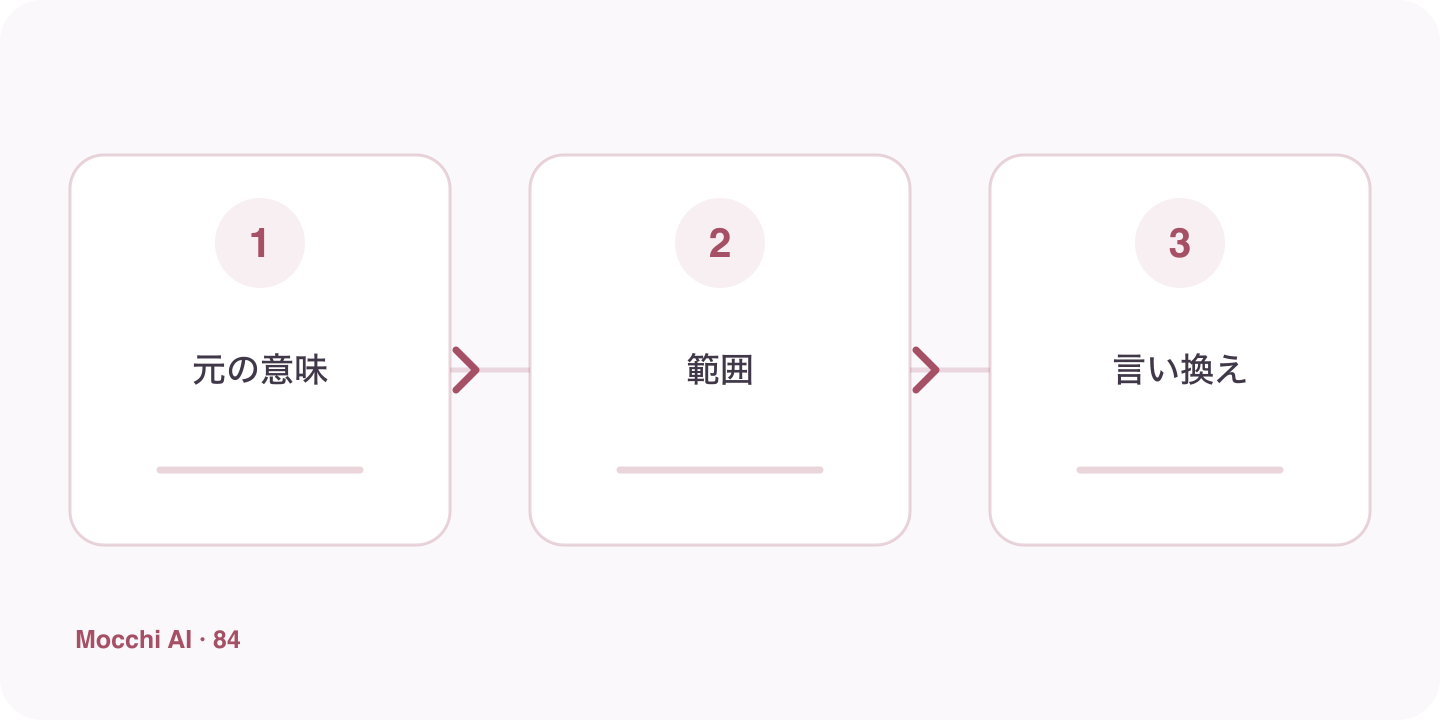
The original meaning is checked against scope, register, and a plausible alternative expression
A paraphrase must preserve the relevant meaning in context, not merely reuse a familiar gloss.
JapaneseRomajiMeaning
一部の人は賛成しています。Ichibu no hito wa sansei shite imasu.Some people agree.
みんな賛成しています。Minna sansei shite imasu.Everyone agrees.

Inspect word partners and register when relevant

A proposed synonym may express a related idea but fit different nouns, actions, or audiences. Ask for the context in which the alternative would be natural. This prevents one rejected option from becoming a false rule that the word is never useful, while still explaining why it does not solve the current task.

Explain the attraction of the wrong option

Say what made you choose it: a shared translation, a familiar character, or a phrase you recently studied. Ask Mocchi which clue should have outweighed that attraction. A clear explanation of your first reasoning makes the next exercise more targeted and helps you avoid repeating the same shortcut with another pair of words.

Build review around a changed context

Use the relevant expressions in new sentences and compare their meanings before reopening the original answer. Keep the question fair by supplying the clue needed to choose. Mocchi can help organize the contrast around your goal, while official exam samples remain the reference for test format. The useful outcome is a more accurate vocabulary decision, not a guaranteed prediction from one practice set.

Key points

A practical way to improve

Ask Mocchi for a short vocabulary or paraphrase task at your current target level. Explain the original meaning before choosing an option. Afterward, compare one tempting alternative and identify what changes: scope, action, register, or word partnership. Use the difficult pair in a new context and keep a concise note of the clue rather than saving only two broad translations.

  1. 1

    Choose one clear goal

    Focus each session on a situation or skill you can actually use.

  2. 2

    Practice actively

    Say complete answers aloud instead of only reading or recognizing Japanese.

  3. 3

    Review and repeat

    Keep useful corrections and revisit the same skill until it feels natural.

FAQ

Frequently asked questions

Are near-synonyms always interchangeable in a quiz?

No. Context, word partners, register, and scope can affect whether an alternative preserves the intended meaning. Compare complete sentences instead of relying only on shared translations.

Why do I choose an option that repeats a word from the prompt?

A repeated word can feel like evidence without preserving the whole meaning. Explain the action and relationship in the original sentence, then test whether the option actually matches them.

What should go on a review card after this task?

Keep one intended sense and the clue that distinguishes it from the tempting alternative. A short contextual prompt is usually more informative than a broad gloss that could accept both words.

Choose the meaning that fits this sentence

Use Mocchi to compare close vocabulary through context and a fresh application.